Friday assorted links
1. Who are the Masters of Their Domains?
2. Austan Goolsbee on the vulnerability of the U.S. economy to coronavirus: so many face-to-face services (NYT).
4. More on the effective Taiwanese response to the coronavirus. And on the South Korean testing response.
Transcript of my Stanford talk on *Stubborn Attachments*
You will find it here, along with the video link, previously covered on MR without the transcript. Recommended, this was an almost entirely fresh talk. Here is my beginning paragraph:
I’d like to do something a little different in this talk from what is usually done. Typically, someone comes and they present their book. My book here, Stubborn Attachments. But rather than present it or argue for it, I’d like to try to give you all of the arguments against my thesis. I want to invite you into my internal monologue of how I think about what are the problems. It’s an unusual talk. I mean, I think talks are quite inefficient. Most of them I go to, I’m bored. Why are you all here? I wonder. I feel we should experiment more with how talks are presented, and this is one of my attempts to do that.
In the Q&A I also discuss how to eat well in the Bay Area.
Further results on social security wealth and inequality
From a recent paper by John Sabelhaus and Alice Henriques Volz:
…the present value of Social Security benefits for everyone who has paid anything into the system was $73.3 trillion in 2019. Thus, the present value of Social Security benefits is estimated to be roughly double all other household-sector pension and retirement account assets combined, and approximately three-fourths the size of all conventionally measured household net worth. Social Security is also an important retirement wealth equalizer, as employer-sponsored pension and retirement accounts accrue disproportionately to high wealth families.
…the bottom 50 percent of persons aged 35 to 44 in 2016 had average Bulletin net worth of only $13,500. However, the same group had average expected SSW of nearly $40,000, the difference between a PDV of benefits around $125,000 and a PDV of taxes around $85,000. Again, this is unsurprising given that low wealth individuals have much lower lifetime incomes, and the Social Security tax and benefit formulas are inherently progressive, even though differential mortality offsets some of that redistribution….although incorporating SSW into household wealth has a substantial impact on wealth inequality levels, it does not change overall trends in top wealth shares. While the top ten percent share of SCF Bulletin wealth (within age-sorted and person-weighted) increased from 58 percent to 66 percent between 1995 and 2016, the expanded wealth share that includes both DB wealth and SSW increased from 40 percent to 47 percent.
That is via the excellent David Splinter, one of the most important economists working today, and here is his new paper Presence and Persistence of Poverty in U.S. Tax Data. And here is the previous MR post on wealth inequality and social security.
From a scientist, coronavirus pictures to ponder
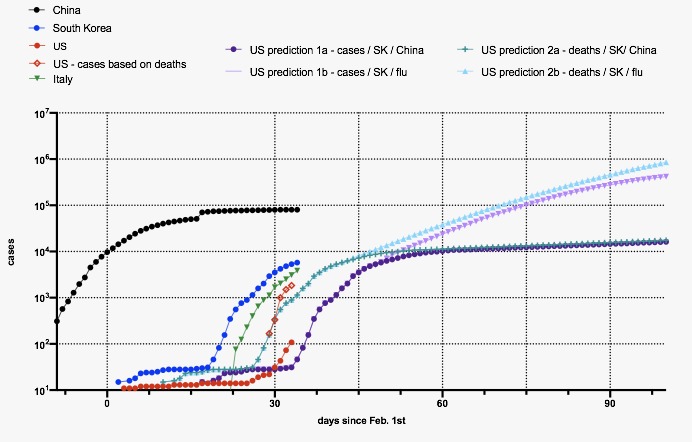
Figure legend
– Plotted in log scale!
– US cases based on deaths: estimated number of real cases using SK‘s current death rate of 0.6%
– US prediction 1a: predicted lower lower bound trajectory based on SK and China (assumes containment and large amount of testing )
– US 2a: upper bound, same assumptions as 1a
– US prediction 1b: no serious containment, trajectory similar to flu, lower bound
– 2b: Higher bound for flu-like trajectory
As I read this picture, it seems to suggest that the returns to properly done containment can be high. What do you all think?
Thursday assorted links
1. “The NWMC nongovernmental organization provides soft propaganda while they operate alongside the Russian military and imbed military tactics into foreign Russian populations through their corporate entity Wolf Holding of Security Structures.” (Huh?)
2. The heroism of Chinese doctors in Wuhan (WSJ, though I believe the paywall is off on this one). Recommended.
3. MIE: “A Coronavirus Pop-Up Shop Has Opened on Florida Avenue.”
5. Dan Klein on Smith, Hume, and Burke. And here.
6. Michael Strain on what to do (Bloomberg).
Our new world of classical music concerts
The line in the men’s room was to wash hands, not to use the other facilities. During the concert, there was remarkably little coughing compared to usual times. Is this because?:
1. The coughers were self-quarantining at home (there were more empty seats than usual).
2. Potential coughers didn’t want their seat neighbors to think of them as infecting pariahs.
3. Potential coughers abstained for fear of having to think, if they are coughing, that they might have coronavirus.
In any case, the elasticity of coughing with respect to self-reputation is higher than I had thought.
https://www.youtube.com/watch?v=y8-nWq6pqag
Yana and I were pleased to have watched from a private box (to be clear, we had a private box because the other people did not show up).
*Very Important People*
The author is Ashley Mears and the subtitle is Status and Beauty in the Global Party Circuit. I loved this book, my favorite of the year so far.
Haven’t you ever wondered why more books shouldn’t just take social phenomena and explain them, rather than preening their academic feathers with a lot of non-committal dense information? Well, this book tries to explain the Miami club where renting an ordinary table for the night costs 2k, with some spending up to 250k, along with the underlying sociological, economic, and anthropological mechanisms behind these arrangements. Here is just a start on the matter:
Any club, whether in a New York City basement or on a Saint-Tropez beach, is always shaped by a clear hierarchy. Fashion models signal the “A-list,” but girls are only half of the business model. There are a few different categories of men that every club owner wants inside, and there is a much larger category of men they aim to keep out.
Or this:
Bridge and tunnel, goons, and ghetto. These are men whose money can’t compensate for their perceived status inadequacies. The marks of their marginal class positions are written on their bodies, flagging an automatic reject at the door.
A clever man can try to use models as leverage to gain entry and discounts at clubs. A man surrounded by models will not have to spend as much on bottles. I interviewed clients who talked explicitly about girls as bargaining chips they could use at the door.
The older, uglier men may have to pay 2k to rent a table for the evening, whereas “decent-looking guys with three or four models” will be let in for free with no required minimum. And:
Men familiar with the scene make these calculations even if they have money to spend: How many beautiful girls can I get to offset how I look? How many beautiful girls will it take to offset the men with me? How much money am I willing to spend for the night in the absence of quality girls?
How is this for a brutal sentence?:
Girls determine hierarchies of clubs, the quality of people inside, and how much money is spent.
Here is another ouch moment:
…I revisit a second critical insight of Veblen’s on the role of women in communicating men’s status. In this world, girls function as a form of capital. Their beauty generates enormous symbolic and economic resources for the men in their presence, but that capital is worth far more to men than to the girls who embody it.
if you ever needed to be convinced not to eat out at places with beautiful women, this book will do the trick. Solve for the equilibrium, people…
You can pre-order here. (By the way, I’ve been thinking of writing more about “lookism,” and why opponents of various other bad “isms” have such a hard time extending the campaign to that front.)
Wednesday assorted links
1. Productivity claims made by Daniel Gross, channeled by Erik Torenberg.
2. L. Summers on the appropriate response to the coronavirus.
3. Gender and the consulting academic economist.
4. New Steve Davis and Kevin Murphy economics podcast.
5. New Zealand birds are capable of statistical inference.
Donald Trump tweets my column
But they really knew who was going to win! https://t.co/WZnOx6ZHmW
— Donald J. Trump (@realDonaldTrump) March 4, 2020
Please don’t even try reading the comments on this post.
How an economist thinks
I saw this on Twitter:
Hard Times for Adjunct Professors: 25% of part-time university faculty nationally rely on public assistance programs.
My immediate reaction was “Given the crowding in the sector, and that they presumably earn non-pecuniary returns from the enjoyment of teaching, shouldn’t we be taxing them at a higher rate?”
British colonialism in Nigeria
British colonialism in Nigeria lasted some six decades…First, the British sought to run Nigeria on the cheap. This led to a fetish for indirect rule. Much of the work of colonial governance was done in collaboration with traditional African authorities. The British expended little effort to create a centralized rule, a coherent armed force, or a professional civil service. The quality of the state that the British constructed and left behind in Nigeria was fairly poor…
The British depended on import taxes as the main source of revenue for running the colonial state. Little of these minimal revenues was spent on improving agriculture (except for the exportable cash crops), and even less on the promotion of technological or industrial development. When the British left Nigeria, the hand-hoe was still the main tool used for cultivation in the fields…
The British made do with a fairly low rate of taxation: during the interwar period tax revenue were only 2 percent to 3 percent of the GDP. As important was that nearly 60 percent of these revenues came from taxing foreign trade, a bureaucratic task that was much easier than collecting direct taxes…
Between 1900 and 1930, Nigeria’s average per capita income grew at about half a percent per annum and then essentially stagnated until the end of the war.
That is all from Atul Kohli, Imperialism and the Developing World: How Britain and the United States Shaped the Global Periphery. The book is quite good.
Overall, I have found that as I learn more about the history of British imperialism, the lower my opinion of it sinks.
The coronavirus debate is splitting into two broad camps
The “growthers” and the “base-raters” — which are you and why? Here is my latest Bloomberg column. Hard to excerpt but good.
China estimate of the day
“Only 30 percent of small and medium businesses nationwide have resumed work,” Shu Chaohui, an official at the Ministry of Industry and Information Technology, told reporters Tuesday. “It’s a pretty severe situation.”
…A nationwide survey led in February by Peking University found half the country’s small businesses will run out of cash within three months, and 14 percent might not survive past mid-March. Unlike large state conglomerates or multinational companies that could weather the storm, China’s small businesses say they simply do not have cash reserves to continue paying wages and rent.
And while manufacturing giants that mass-produce gadgets such as Apple iPhones can rely on the government to charter buses and trains to shuttle migrant workers back to their factories, nearly 40 percent of smaller businesses say they cannot get their workers back to Chinese cities because of transportation bottlenecks and quarantine restrictions, according to the Peking University study.
Here is more from Gerry Shih.
Tuesday assorted links
2. Are there negative externalities to having a lot of network-based hiring?
3. “My Guatemalan audiences took to Open Borders like fish to water.” Link here.
4. Why coronavirus testing is difficult. And here is a specific story.
Maybe they are the ones who know?
The top 1% are the only affluent group consistently more inclined than the general population to attribute variation in drive and IQ to both internal causes, particularly to innate causes (the top 1% also differ from the other affluent, at p < .01). This said, the affluent are not more dismissive than others of environmental causal explanations. Interestingly, across all income groups, “environmental” explanations for drive and IQ are more popular than the two internal explanations.
That is from a new paper (and here) by Elizabeth Suhay, Marko Klašnja, and Gonzalo Rivero.