Category: Books
The growing cost of textbooks
As many textbooks now break the $100 barrier, complaints are rising
Some college and public-interest groups charge that the publishing industry is forcing textbook prices higher by introducing unnecessary new editions and packaging books with expensive study materials that not all students want or need. The National Association of College Bookstores says wholesale prices of college textbooks have risen nearly 40 percent in the past five years.
And students are finding that many of the same books are sold overseas at much lower prices.
Note, by the way, that textbook prices have not risen as rapidly as tuition and fees (admittedly the latter is difficult to calculate in real terms, given different way of valuing financial aid). This makes it harder for universities to make a stink.
The economic problem is simple: professors assign a book without worrying much about the cost that students will pay. In fact a pricey book might be a nice way to drive down your enrollment and lower your workload.
But do we really need Congressional hearings on the matter?
How about this for a simple solution? If a professor can lower the price of classroom materials, the university adds one-tenth of the class’s gain to that professor’s salary or research account. Yes in the short run there might be inefficient skimping but in the longer run prices should come down. Some professors, of course, might resort to teaching their classes through blogs. As the subtitle of this blog notes, “Small Ideas for a Much Better World.”
Arnold Kling, a master expositor of economics, has another excellent solution.
Why reading Homer’s Iliad is good for you
Reciting the Iliad could have epic effects on your health. German physiologists have recently shown that such poetry can get your heart beating in time with your breaths. This synchronization may improve gas exchange in the lungs as well as the body’s sensitivity and responsiveness to blood pressure changes.
The poem’s use of hexameter — six rhythmic units per line — is seen as especially important to this result.
Here is one brief account, see also the October issue of Scientific American, p.29.
How the Internet saved bookstores
Most of all used bookstores; read more here.
And here are the most requested out-of-print books.
The Sledgehammer of Wow
By this point in life I’ve stuffed so much material down my gullet I feel I am hard to impress. When it comes to new books and music in particular, I can go many moons without feeling The Sledgehammer of Wow. But yesterday I felt it twice:
Blueberry Boat by The Fiery Furnaces dispays a level on ongoing invention that one expected from Brian Wilson circa 1968.
Susannah Clarke’s Jonathan Strange and Mr. Norrell: A Novel has been called a “Harry Potter for grown-ups”; it starts by asking whether magic has disappeared in England. Only rarely have I been captivated so quickly and so deeply by a novel of our time. Read the ever-insightful Henry Farrell (CrookedTimber.org) on this wonderful book. Here is another good review, also courtesy of Henry; here is a Slate.com review.
On a sadder note, Johnny Ramone has passed away. “Twenty-twenty-twenty-four hours to go, I wanna be sedated…!”
The politics of Nobel Prizes
Jorge Luis Borges was one of the greatest writers never to win a Nobel Prize (try the early short fiction if you don’t already know his work). Now I know why:
The visit to [Pinochet’s] Chile finished off Borges’s chances of ever winning the Nobel Prize. That year, and for the remaining years of his life, his candidacy was opposed by a veteran member of the Nobel Prize committee, the socialist writer Arthur Lundkvist, a long-standing friend of the Chilean Communist poet Pablo Neruda, who had received the Nobel Prize in 1971. Lundkvist would subsequently explain to Volodia Teitelboim, one of Borges’s biographers and a onetime chairman of the Chilean Communist Party, that he would never forgive Borges his public endorsement of General Pinochet’s regime.
Borges, it should be noted, did believe in democracy but thought Pinochet the best of the available options at the time. For purposes of contrast, consider the following (slightly overstated) description of Laureate Pablo Neruda:
On the eve of his [Neruda’s] death, in 1973, he could still describe Stalin as “that wise, tranquil Georgian”. His feelings were similarly soft for Mao’s China, where he loved to see everyone in those vast landscapes and streetscapes dressed in regulation blue.
The former quotation is from p.426 of Edwin Williamson’s excellent Borges: A Life.
The Dead Zone
I’ve now entered the vacation part of my trip, which of course means that I am slightly bored. On the bright side, I’ve just discovered Stephen King’s Dark Tower series. I admire his ability to think in epic terms and grab the reader at the same time; I’ve long thought that his best material will still be read one hundred years from now. My previous favorites have been Stand and The Dead Zone, among others. And the food in Acapulco is of course amazing. I’m back at the beginning of the week to come, and my apologies for being slow in email responses.
Cyclopaedia of Political Economy
Have you ever wondered what nineteenth century, classical liberal political economy looked like? No, not the classic writers but rather ordinary political economy?
A new web resource answers your question. John J. Lalor’s Cyclopaedia of Political Science, Political Economy collected classical liberal writings on the economic issues of the day, circa 1881. You can now access and read the work in its entirety. Here is information about the book and author.
For one sample, here is the brief article on the political economy of debt. Or try this entry on the balance of trade, still relevant today. The item on the division of labor remains eloquent and insightful. Gustav de Molinari writes passionately on the link between freedom, prosperity, and the arts, a favorite topic of mine. I’ve spent a good bit of time browsing through the book (both recently and much earlier), and it offers surprisingly few clunkers. On social issues it is consistently liberal and progressive.
Kudos to the ever-excellent Liberty Fund for putting the work on-line. Until their efforts, you could buy the book for a mere $675.
Addendum: The links to the previous version of this post have now been fixed.
Literary role models for bloggers
All writers have their role models. To whom should bloggers look?
One obvious choice is Samuel Pepys, who kept regular diaries for about ten years. But Adam Sisman’s excellent book, written before the advent of blogging, nonetheless directs our attention to the Scot James Boswell:
Boswell’s plain, direct prose was easy to read, and appealed to twentieth-century readers as [Samuel] Johnson’s mannered, classical style never could. Moreover, Boswell’s interest in himself, which seemed so peculiar to his contemporaries, was very much more acceptable two centuries later. Indeed, Boswell seemed to offer a unique combination: a writer who poured the contents of his mind freely into his journal, without either embarrassment or knowingness…Here was a miracle: a pre-Freudian autobiographer who revealed everything in his mind, without restraint, concealment, or distortion. Or so it seemed.
Boswell [borrowed] techniques from the novel, the theatre, and the confessional memoir. With meticulous care, with long-practised skill, and with a generous imagination, he crafted a character who lived and breathed [TC: I have long felt that Boswell, not Samuel Johnson, is the real biographical subject of Boswell’s Life of Johnson]. He also set new scholarly standards; his verification of every possible detail, which seemed so eccentric to his contemporaries, would become the norm. In doing what he did, he relied mainly on instinct, his sense of what would serve his purpose best.
Hmm…and like many bloggers, Boswell often got in trouble for writing up his private conversations with others.
Should we ban the peanut?
I have to point out that many common foods — the peanut is a good example — couldn’t pass the screening of GMOs [genetically modified organisms] in the United States.
That is from James Trefil’s illuminating generalist tract Human Nature: A Blueprint for Managing the Earth — By People, For People. Trefil argues that better science will prove the most effective way to save our planet from environmental disaster. He is an unabashed fan of ecological management and is skeptical about the idea of pristine wilderness. How about this?:
The real advance in genetic modification…[will come] from a second wave of plants already being developed. One example of this new wave is what are called neutraceuticals [nutraceuticals]. These are food plans that have been engineered to produce molecules that are specifically beneficial to humans. You can imagine, for example, a banana whose DNA has been modified so that it produces the recommended daily allowance of vitamins. Once such trees are planted, they would continue to produce the vitamins without any further intervention…
We can even imagine a banana that would provide protection from cholera or other diseases. Golden Rice already has the potential to alleviate vitamin A deficiencies; read an update here.
Psychoanalysis and Consumer Society
Freudian introspection aimed to foster the individual’s capacity to live an authentically personal life, yet it wound up helping to consolidate consumer society…Psychoanalysis remained marginal to European psychiatry until after Wrofl War II, when Americans brought it back to Europe, but it became central to American culture almost immediately. The reason was the weakness of traditional authority in the United States and the widespread belief in the power of the individual mind to overcome “external” difficulties. In that context, American psychoanalysis became intensely popular. As a result, it was caught up in a process that emphasized personal empowerment, self-regulation, and individual charisma. As we shal see, the actual practice of analysis was less important than its cultural impact. Ultimately American analysis came to mean almost the opposite of the self-reflective exploration of internal limitations that characterized its European counterpart.
From the intermittently fascinating Secrets of the Soul: A Social and Cultural History of Psychoanalysis, by Eli Zaretsky.
Gordon Tullock triumphant
My colleague Gordon Tullock, along with Thomas Schelling, is one of the most deserving scholars never to have received a Nobel Prize [Ed Prescott and Eugene Fama are also obviously deserving, though they are much younger].
A new Liberty Fund series may help rectify this injustice. In ten cheap volumes ($12.00 for the first, 450 pp.) we will receive the greatest hits of Tullock. The first book, just published, presents Tullock’s best essays, including his classic article on rent-seeking behavior; read this summary as well.
Gordon’s degree is in law, many of his formative experiences were in post-WWII China (some say he was a spy), and he took only a single economics class, from Henry Simons at Chicago. Nonetheless Gordon is an economist to the core and full of intellectual surprises.
Gordon is best-known for his co-authorship of Calculus of Consent, which set the foundation for how economists think about voting rules and “politics as exchange.” But I think as much about his lesser-known contributions. He wrote early works on the economics of scientific organization, the economics of trials, and the economics of animal societies, including insects. These works have yet to be mined for their full insights. His Politics of Bureaucracy remains a classic.
Gordon is very much a systematic thinker, although he is oddly reluctant to admit this fact. I take his central insight to be the importance of law, but also that real laws are given by economic incentives, rather than by what is on the books. Here is Gordon’s 46-page vita, with a brief written introduction.
Kudos to Charles Rowley for having edited the volumes, and here is a more general link to the Liberty Fund publishing program.
The greatest poet of the twentieth century?
I don’t think it is crazy to pick the late Pablo Neruda, whose one hundredth birthday is today. (Yeats or Wallace Stevens are serious competition, however. Not to mention Rilke, who is probably my first choice…) Read this appreciation. Here are three poems in English, but no most poetry doesn’t translate well. Here is a (much better) concordance of poems in Spanish.
But why did so many artists love Stalin?
Neruda had become an ardent communist. Over the years he wrote a lot of sincerely felt, but otherwise weak, didactic poems denouncing Western imperialism. His strident praise for the Communist Party seems at best naive, and his admiration for Stalin, whom he never disavowed, can be hard to stomach. Such figures as Octavio Paz and Czeslaw Milosz broke with him over communism. In his Memoirs, completed just a few days before his death, he called himself “an anarchoid,” and that seems closer to the truth. “I do whatever I like,” he said.
Nonetheless, Neruda’s social and political commitments were crucial to his life and work. He was elected senator for the Communist Party in Chile in 1945. He campaigned for Gabriel González Videla, who became president the next year — and whose government then outlawed the Communist Party. Neruda denounced him, and in 1948 he was accused of disloyalty and declared a dangerous agitator. After a warrant for his arrest was issued, he went into hiding in Chile, then fled to Argentina and traveled to Italy, France, the Soviet Union and Asia. (His brief stay on the island of Capri during his exile was fictionalized in the touching film “Il Postino.”)
If I could have the answers to five questions in political science/sociology, the appeal of Stalinism to intellectuals would be one of them.
Addendum: Tom Myers notes that it is also the hundredth birthday of Deng Xao-Ping, here is a full list of famous July 12 babies.
What are the most popular library books?
65 percent of Americans use the nation’s 16,000 libraries, and those libraries spend almost $2 billion on books each year, about a fifth of the total market.
So which library books are most popular? And does it mirror the bestseller lists?
Here is the list of the top fifteen, an Adobe reader is required. Number one is The South Beach Diet, followed by some of the usual political books and Eats, Shoots and Leaves. The first book I enjoyed comes at number six with Brian Greene’s The Fabric of the Cosmos, here is my earlier summary.
My question is whether people are more likely to buy books and never read them, or take books out of the library and then never read them. The naive economist might think that you get more phoney-baloney behavior when the books are free. I suspect the opposite is true. If the book costs nothing, bringing it home involves little signaling or self-signaling. It might impress your neighbor to see a weighty tome on your bookshelves, but only if you had to spend money. So the good news would be that those people actually wanted to read the Greene book.
Here is the full story.
How to read difficult books
Yes, today is the hundredth anniversary of “Bloomsday,” June 16, 1904, the day on which the adventures of Leopold Bloom (Ulysses) start. The book, long a favorite of mine, is not nearly as difficult as it is sometimes thought to be.
Here are a few tips for reading otherwise difficult works of fiction:
1. Try reading the last chapter first. Don’t obsess over the sequential.
2. Read through the first time, following each voice or character, skipping passages as you need to. Then reread the book as a whole in order. This works especially well for Faulkner.
3. Try reading the first fifty pages three times in a row before proceeding.
4. Don’t be afraid to skip over material and return to it later. This is necessary for the first fifty pages of Nostromo.
5. Read through without stopping, and then try the book again, but with some idea of where things are headed.
6. Read some of the secondary literature first. I don’t like CliffNotes, but in general don’t be afraid to go low when looking for help.
7. Read the book out loud to yourself or to others.
8. Simply give up.
I’ve found that some combination of these tricks almost always works.
By the way, here are some recent writings on Ulysses and the centenary.
Crowds are wiser than you think
I’m reading James Surowiecki’s The Wisdom of Crowds – so far, it’s very good! Steve Sailer posted the following comment on the book:
…he doesn’t really explain why pseudo-markets like the Iowa Election Market tend to be more accurate than traditional predictive tools like the Gallup Poll, although the answer is obvious: because they piggyback off traditional sources of information like Gallup. For example, participants in the IEM look at not just the Gallup Poll but a dozen others. Without these pollsters spending large amounts of money to generate information, however, the market players would be pretty clueless. Similarly, if the crowd takes the average of the 11pm weather forecasts of the weatherguys on Channels 2, 4, and 7, they may well beat the best individual forecast, but that doesn’t mean the crowd could beat the professional weathermen — unless the pros first tell them what they think the weather is going to be.
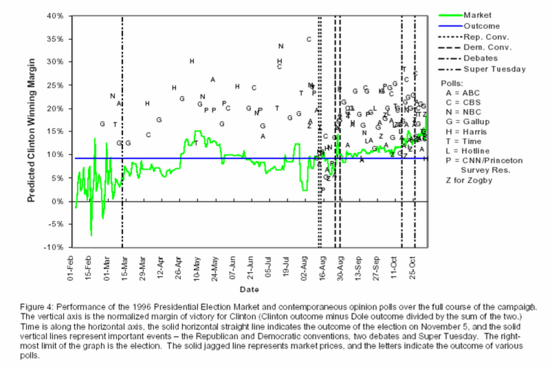
Clearly, there is some truth to this – Hayek said markets are “marvelous” he didn’t say “miraculous.” But a lot more goes on in information markets than averaging. The green line in the figure below (click to expand) shows the Iowa market prediction for the 1996 Presidential election. The blue line is what actually occured. The spots are various polls. Now notice that from February through August every single poll overpredicted Clinton’s victory and every single poll, with but one exception, was above the market prediction. This means that the market prediction could not possibly be an average of the polls.
Surowiecki gives a number of other examples where the wisdom of the crowds cannot be explained by averaging of expert opinion even though averaging is an important reason why crowds can be wise.