Category: Current Affairs
The Simple Mathematics of Chinese Innovation
The NYTimes has a good data-driven piece on How China Went From Clean Energy Copycat to Global Innovator, the upshot of which is that the old view of China as simply copying (“stealing” in some eyes) no longer describes reality. In some fields, including solar, batteries and hydrogen, China is now the leading innovator as measured by high-quality patents and scientific citations.
None of this should surprise anyone. China employs roughly 2.6 million full-time equivalent (FTE) researchers versus about 1.7 million in the United States. On a per-capita basis the U.S. is ahead—about 4,500 researchers per million people versus China’s 1,700—but population scale tips the balance. China simply has more researchers in absolute terms. If you frame it in terms of rare cognitive talent, as in my post on The Extreme Shortage of High IQ Workers—the arithmetic is even more striking: 1-in-1,000 workers (≈IQ 145) ~170,000 in the U.S. labor force and ~770,000 in China. Scale matters.
In the 20th century the world’s most populous countries were poor but that was neither the case historically nor will it be true in the 21st century. The standard of living in China remains well below that in the United States and China may never catch U.S. GDP per capita, but quantity is a quality of its own. More people means more ideas.
To be clear, the rise of China and India as scientific superpowers is not per se a threat. Whiners complain about US pharmaceutical R&D “subsidizing” the world. Well, Chinese pharmaceutical innovation is now saving American lives. Terrific. Ideas don’t stop at borders, and their spread raises living standards everywhere. It would be wonderful if an American cured cancer. It would be 99% as wonderful if a Chinese scientist did. What matters is that when more scientists attack the problem, the odds of a cure rise so we should look favorably on a world with more scientists. That is progress.
The danger is not China’s rise but America’s mindset. Treat science as zero-sum and every Chinese patent looks like a loss. But ideas are nonrival: a Chinese breakthrough doesn’t make Americans poorer, it makes the world richer. A multi-polar scientific world means faster growth, greater wealth, and accelerating technology—even if America wins a smaller share of the Nobels.
Read it and weep
A global bond sell-off deepened on Wednesday, driving the yield on the 30-year US Treasury to 5 per cent for the first time since July, as investors’ fears over rising debt piles and stubbornly high inflation dominated trading.
Longer-dated bonds bore the brunt of the selling, with the yield on the 30-year Treasury up 0.03 percentage points at 5 per cent and Japan’s 30-year bond yield hitting a record high of 3.29 per cent.
In the UK, long-term borrowing costs climbed further after reaching their highest level since 1998 on Tuesday. The 30-year gilt yield rose 0.06 percentage points to 5.75 per cent.
Here is more from the FT.
Could China Have Gone Christian?
The Taiping Rebellion is arguably the most important event in modern history that even educated Westerners know very little about. It’s also known as the Taiping Civil War and it was one of the largest conflicts in human history (1850–1864), with death toll estimates ranging from 20 to 30 million, far exceeding deaths in the US civil war (~750,000) with which it overlapped. The civil war destabilized Qing China, weakening it against foreign powers and shaped the trajectory of 19th- and 20th-century Chinese politics. In China the Taiping Civil War is considered the defining event of the 19th-century.
The most surprising aspect of the civil war is that the rebels were Christian. The rebellion has its genesis in 1837 with the dramatic visions of Hong Xiuquan. In his visions, Hong and his elder brother traveled the world slaying demons, guided onwards by an old man who berated Confucius for failing to teach proper doctrines to the Chinese people. (I draw here on Steven Platt’s excellent Autumn in the Heavenly Kingdom). It is perhaps not coincidental that Hong began experiencing his visions after failing the infamously stressful Chinese civil service exams for the third time. It wasn’t until 1843, however, after he failed the exams for the fourth time, that he had an epiphany. A Christian tract that he had never read before suddenly unlocked the meaning of his visions–the elder brother was Jesus Christ, making Hong the second son of the old man, God.
With his visions unlocked, Hong threw himself into learning and then teaching the Gospels. He quickly converted his cousin and a neighbor and they baptized themselves and began taking down icons of Confucianism at their local school. Confucianism, of course, underpinned the exam system that Hong had grown to hate (Recall, that a similar pattern is visible in India today, where mass exams generate large numbers of educated but frustrated youth).
The wild visions of a lowly scholar wouldn’t seem to have the makings of a revolutionary movement but this was the beginning of the century of humiliation when China was forced to confront the idea that far from being the center of civilization it was in fact a backward and weak power on the world stage. Moreover, China was governed by foreigners, the Manchus, who despite ruling for 200 years had never really integrated with the Chinese population. Hence, Hong’s calls to kill the demons merged with a nationalist fervor to massacre the Manchus. Hong proclaimed himself the Heavenly King and his movement quickly grew to more than a million zealous warriors who captured significant territory including establishing the Taiping Heavenly Kingdom with its capital at Nanjing.
The regime banned foot‑binding, prostitution and slavery, promoted the equality of men and women, distributed bibles, and instituted a 7-day week with strict observance of the sabbath. To be sure, this was a Sinicized, millenarian Christianity, more Old Testament than new but the Christianity was serious and real and the rebels appealed to British and Americans as their Christian brothers. One Taiping commander wrote to a British counterpart:
You and I are both sons of the Heavenly Father, God, and are both younger brothers of the Heavenly Elder Brother, Jesus. Our feelings towards each other are like those of brothers, and our friendship is as intimate as that of two brothers of the same parentage. (quoted in Platt p.40)
Now, as it happened, the Heavenly Kingdom fell to the Qing, but it was a close thing and could easily have gone the other way. Western powers—above all Britain, but also the United States—hedged their bets and at times fought both sides, yet for short-sighted reasons ultimately tilted toward the Qing, an intervention Ito Hirobumi later called “the most significant mistake the British ever made in China.” Internal purges fractured the movement, alliances went unmade, and crucial opportunities slipped away. Yet the moment was pregnant with possibility. Hong Rengan, Hong Xiuquan’s cousin and prime minister from 1859, pushed sweeping modernization: railroads, steamships, postal services, banks, and even democratic reforms. These initiatives would likely have brought what one might call Christianity with Chinese Characteristics into closer alignment with Western Christianity.
Indeed, it is entirely plausible that with only a few turns of history, China might now be the world’s most populous Christian nation. And if that seems hard to believe, consider what did happen. Sixty three years after the fall of Nanjing in 1864, China again erupted into civil war under Mao Zedong. This time the rebels triumphed, and instead of a Christian Heavenly Kingdom the world got a Communist People’s Republic. The parallels are striking: both Hong and Mao led vast zealous movements that promised equality, smashed tradition, and enthroned a single man as the embodiment of truth. Both drew on foreign creeds—Hong from Protestant Christianity, Mao from Marxism-Leninism. Both movement had excesses but of the counter-factual and the factual I have little doubt which promised more ruin. The Heavenly Kingdom pointed toward a biblical moral order aligned with the West, the People’s Republic toward a creed that delivered famine, purges, and economic stagnation. Such are the contingencies of history—an ill-timed purge in Nanjing, a foreign gunboat at Shanghai, a missed alliance with the Nian. Small events cascaded into vast consequences. For the want of a nail, the Heavenly Kingdom was lost, and with it perhaps an entirely different modern world.
Policy uncertainty matters right now
More than half of Fourth District business contacts said that “uncertainty and the potential impact on demand” was the most important factor influencing their capital expenditure plans for the rest of 2025. Contacts most often reported that their inventory levels were the same as they were one year ago, though more firms reported lower inventory levels than higher ones. More than half of firms anticipated that they would work through their current inventories in one to three months. Most survey respondents said that one-fourth or less of their current inventory had been subject to additional duties in 2025 because of changes to trade policy.
Here is more from the Cleveland Fed.
I podcast with Jacob Watson-Howland
He is a young and very smart British photographer. He sent me this:
Links to the episode:
Youtube: https://youtu.be/4nMg0Qg7KRI
Spotify: https://open.spotify.com/episode/2wDyCaXhGN5ruN1SNkcaBt?si=3c054eb0396f4787
Apple: https://podcasts.apple.com/gb/podcast/watson-howland/id1813625992?i=1000724051310
Jacob’s episode summary is at the first link.
What are the markets telling us?
That is the topic of my latest piece for The Free Press, as after all stock valuations are high. Excerpt:
First, the One Big Beautiful Bill Act, passed earlier this year, slashed corporate taxes. Before Trump’s first term, the corporate tax rate was 35 percent; in his first term Trump cut it to 21 percent, and this year he and the Republican Congress extended aspects of that first-term tax bill. Factors such as 100 percent bonus depreciation and expanded interest deductions give many companies the ability to lower their tax bill further, though not in a way that can be expressed readily by any single number.
With these lower tax burdens, companies should be worth much more. At the same time, the American taxpayer now owes more than $37 trillion in debt. So someone has to pay higher taxes over time, to satisfy those obligations. That someone probably is you, so you might want to take that into account in your overall assessment. But you should feel good about the companies, and somewhat less good about yourself and your children, given the tax hikes in the offing, sooner or later. You are paying for some of those higher stock market values.
Plus the ten or so percent decline in the value of the dollar can be seen as a loss of confidence in the United States, for a bunch of the obvious reasons. But will the country fall apart? Probably not:
That said, some of the worries are exaggerated. I’ve seen lots of posts on X lately saying that Trump is destroying the independence of the Federal Reserve system, and that this change will bring much higher rates of price inflation. Maybe. But that is not what the markets are saying. There are different measures of expected inflation, and most stand between 2 and 3 percent, with some of the more important market measures clustered near 2.5 percent. You might think that is higher than it should be, but it is hardly a sign of pending hyperinflation. It’s also not different from how things were toward the close of Joe Biden’s term.
And this:
Finally, are you worried about fascism coming to America? The collapse of democracy? Did you read about the Trump critics Jason Stanley, Timothy Snyder, and Marci Shore moving from America to Canada?
Well, head on over to the prediction markets—for instance, Kalshi. Currently the Democrats are favored at 53 percent to win the next presidential election. In other words, it costs 53 cents to buy a security that pays off a dollar if the Democrats win. In turn, that means the market thinks the Democrats have a very slight advantage in 2028. Does that sound like the collapse of democracy to you?
I return here to the same logic: If you think the market is being naive and foolish, why aren’t you placing your bets in the opposite direction? At the very least you could be wealthier under the forthcoming fascism you predict, and you might even be able to donate your winnings to antifascist causes.
Comments that fail to understand the distinction between optimal ex ante prediction and ex post outcomes should be shamed!
Resources for Teaching Tariffs
Trump has put tariffs on the economics agenda in a way that hasn’t been true for decades. As a new semester of principles of economics begins, here are some resources for teaching tariffs.
Comparative Advantage (video)
The Microeconomics of Tariffs and Protectionism (video)
Why Do Domestic Prices Rise with Tariffs? (post)
Trade Diversion (Why Tariffs on More Countries Can Be Better) (post)
Manufacturing and Trade (post), Manufacturing Went South (post) and Tariffs Hurt Manufacturing (post)
Three Simple Rules of Trade Policy (Lerner symmetry, imports are inputs, trade balances and capital flows; post)
Tariffs and Taxes (post), Tariffs are a Terrible Way to Raise Revenue (Albrecht post) and Consistency on Tariffs and Taxes (post)
Globalization: Economics, Culture and the Future (video)
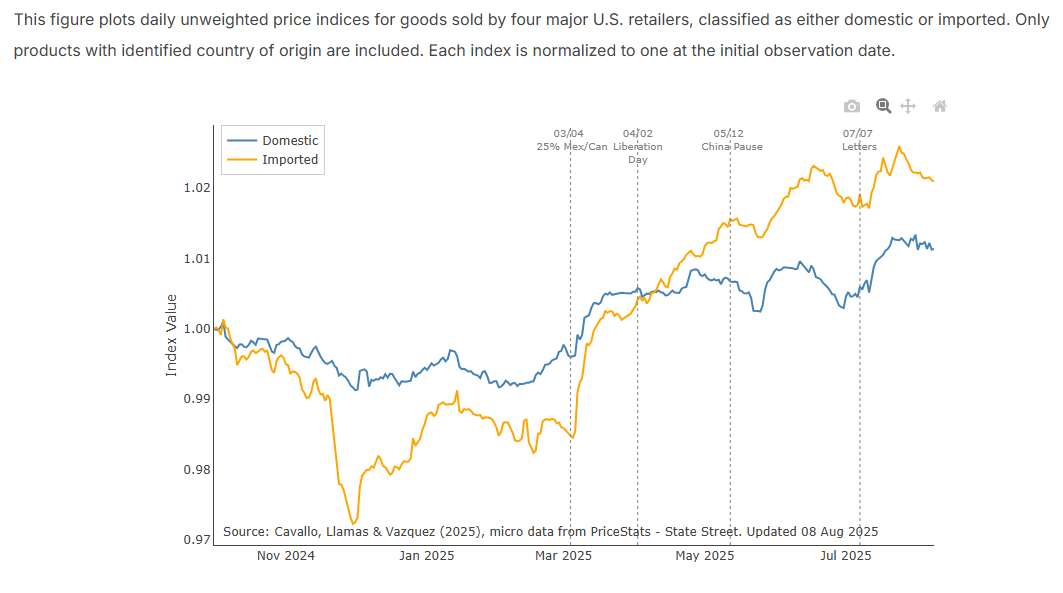
The Tariff Tracker, great source for real time tracking of prices such as below (the data can be downloaded):
Abundance lacking!
Amtrak is launching a new high-speed Acela train, but there is one wrinkle: It isn’t actually faster, yet.
Five next-generation Acela trains begin service Thursday as part of a $2.45 billion project to improve service along the key Washington-to-Boston corridor. But two of them running from Washington to Boston will actually travel more slowly than their predecessors do on the same route Thursday, according to a Wall Street Journal analysis of Amtrak’s schedule. These new trains are scheduled to take at least seven hours and five minutes to complete the trip, compared with the average time of six hours and 56 minutes on the older Acela trains.
Here is more from the WSJ. Via Anecdotal.
The history of American corporate nationalization
I wrote this passage some while ago, but never published the underlying project:
The American Constitution is hostile to nationalization at a fundamental level. The Fifth Amendment prohibits government “takings” without just compensation to the owners, and that is sometimes called the “takings clause.” Since the United States did not start off with a large number of state-owned enterprises, there is no simple and legal way for the country to get from here to there. Government nationalization of private companies would prove expensive, most of all to the government itself. More importantly, the strength of American corporate interests has taken away any possible pressures to eliminate or ignore this amendment.
The lack of interest in state-owned enterprises reflects some broader features of the United States, most of all a kind of messiness and pluralism of control. An extreme federalism has bred a large number of regulators at federal, state, and local levels, often with overlapping jurisdictions. Each level of government digs its claws into the regulatory morass, and not always for the better, but this preempts nationalization, which would centralize power and control in one level of government. That is not the American way.
A tradition of strong state-level regulation was built up during the mid- to late 19th century, when the federal government did not have the resources, the reach, or the scope to do much nationalizing. America developed some very large national commercial enterprises, such as the railroads, Bell (a phone company), and Western Union (a communications and wire service), which were quite large and far-ranging before the federal government itself had reached a mature size. At that time local government accounted for about half of all government spending in the country and the federal government had few powers of regulation. It wasn’t quite laissez-faire, but America could not rely on its federal government and this shaped the later evolution of the country. To handle these booming corporate entities, America created more state-level regulation of business than was typical for the other industrializing Western countries. That steered Americans away from nationalization as a means for distributing political benefits or disciplining corporations[1]
This policy decision to rely so much on multiple levels of federalistic regulation comes with a price. American failures in physical infrastructure have been the other side of the coin of American successes in business. A strong rule of law, combined with so many legal checks and balances and blocking points, has carved out a protected space for private American businesses. They can operate with relatively secure property rights. At the same time, those same laws and blocking points make it hard to get a lot of things built when a change in property rights is required, whether government or business or both are doing the building. The law is used to obstruct growth and change, and for NIMBYism — “Not In My Backward,” and more generally for giving any litigation-ready interest group a voice in any decision it cares about. Can you imagine a sentence like this being written about China?: “The [New York and New Jersey] Port Authority sent out letters inviting tribe representatives to join the environmental review project, inviting the Shawnee Tribe of Oklahoma and the Sand Hills Nation of Nebraska.”[2]
In America background patriotism sustains a rule by general national consensus, and so the American government doesn’t need extensive state-owned companies to build or maintain political support through the creation of so many privileged insiders. The American paradox is this: the reliance on the law reflects a relatively strong and legitimate government, but the multiplication of that law renders government ineffective in a lot of practical matters, especially when it comes to the proverbial “getting things done,” a dimension where the Chinese government has been especially strong.
You should note that although the United States has not so many state-owned enterprises, the American government still has ways of expressing its will on business, or as the case may be, favoring one set of businesses over another. In these latter cases it can be said that American business is expressing its will over government through forms of crony capitalism, a concept which is spreading in both America and China.
The United States has evolved a subtle brand of corporatism and industrial policy that is mostly decentralized and also – this is an important point — relatively stable across shifts of political power. America uses its large country privileges to maintain access to world markets and to protect the property rights of its investors, usually without much regard for whether they are Democrats or Republicans. For instance the State Department works hard to maintain open world markets for films and other cultural goods and services. Toward this end America has used trade negotiations, diplomatic leverage, foreign aid, and also explicit arm-twisting, based on its military commitments to protect allied nations in Western Europe and East Asia. America already had successful entertainment producers, it just wanted to make sure they could earn more money abroad, and that is why the American government usually insists on open access for audiovisual products when it negotiates free trade treaties. Yet in these deals there is not much if any explicit favoritism for one movie or television studio over another, or for one political alliance over another. Democrats are disproportionately overrepresented in Hollywood, but Republican administrations protect the interests of the American entertainment sector nonetheless. It’s about the money and the jobs, not about shifting political coalitions. You’ll note that the independence from particular political coalitions gives the American business environment a particular stability and predictability, to its advantage internationally and otherwise.
[1] See Millward (2013, chapter nine, and p.222 on chartering powers).
[2] That is from Howard (2014, p.10).
Contemporary TC again: Let us hope that I was at least partially correct…
Comparative Advantage
The excellent Don Boudreaux on comparative advantage, one of the deepest and most important ideas in economics.
As a new semester begins this is a good reminder that MRU has great videos for learning and teaching economics, all entirely free and open. (Of course, these videos pair delightfully with Modern Principles of Economics).
AI and the Detection of Gravity Waves
Researchers at the Laser Interferometer Gravitational-Wave Observatory, the giant two-observatory machine to detect gravitational waves, developed an AI to improve the sensitivity of the design:
Wired: Initially, the AI’s designs seemed outlandish. “The outputs that the thing was giving us were really not comprehensible by people,” Adhikari said. “They were too complicated, and they looked like alien things or AI things. Just nothing that a human being would make, because it had no sense of symmetry, beauty, anything. It was just a mess.”
The researchers figured out how to clean up the AI’s outputs to produce interpretable ideas. Even so, the researchers were befuddled by the AI’s design. “If my students had tried to give me this thing, I would have said, ‘No, no, that’s ridiculous,’” Adhikari said. But the design was clearly effective.
It took months of effort to understand what the AI was doing. It turned out that the machine had used a counterintuitive trick to achieve its goals. It added an additional three-kilometer-long ring between the main interferometer and the detector to circulate the light before it exited the interferometer’s arms. Adhikari’s team realized that the AI was probably using some esoteric theoretical principles that Russian physicists had identified decades ago to reduce quantum mechanical noise. No one had ever pursued those ideas experimentally. “It takes a lot to think this far outside of the accepted solution,” Adhikari said. “We really needed the AI.”
…If the AI’s insights had been available when LIGO was being built, “we would have had something like 10 or 15 percent better LIGO sensitivity all along,” he said. In a world of sub-proton precision, 10 to 15 percent is enormous.
As with AlphaGO and Move 37 the AI developed entirely novel approaches:
“LIGO is this huge thing that thousands of people have been thinking about deeply for 40 years,” said Aephraim Steinberg, an expert on quantum optics at the University of Toronto. “They’ve thought of everything they could have, and anything new [the AI] comes up with is a demonstration that it’s something thousands of people failed to do.”
My Conversation with David Brooks
Held live at the 92nd St. Y, here is the video, audio, and transcript. Here is the episode summary:
David Brooks returns to the show with a stark diagnosis of American culture. Having evolved from a Democratic socialist to a neoconservative to what he now calls “the rightward edge of the leftward tendency,” Brooks argues that America’s core problems aren’t economic but sociological—rooted in the destruction of our “secure base” of family, community, and moral order that once gave people existential security.
Tyler and David cover why young people are simultaneously the most rejected and most productive generation, smartphones and sex, the persuasiveness of AI vs novels, the loss of audacity, what made William F. Buckley and Milton Friedman great mentors, why academics should embrace the epistemology of the interview, the evolving status of neoconservatism, what Trump gets right, whether only war or mass movements can revive the American psyche, what will end the fertility crisis, the subject of his book, listener questions, and much more.
Excerpt:
COWEN: Now, you mentioned the Tanenhaus book. It’s striking because you appear as a character in the book. I know you haven’t gotten to that part yet, but surely you remember the reality that William F. Buckley was considering making you editor of National Review. What would your life have been like if you had received that offer? Would you have even taken it? What does that alternate universe look like?
BROOKS: The American conservative movement is going from strength to strength. Donald Trump is a failed real estate developer somewhere.
COWEN: [laughs]
BROOKS: I was never an orthodox National Review person, that kind of conservative. I was a neoconservative, which was different. Basically, you can tell what kind of conservative a person is by what year they want to go back to.
I’ve learned, especially from this Tanenhaus biography, that a lot of the old right National Review people wanted to go back to the 19th century. They were pre-New Deal. I never had a problem with the New Deal. I had some problems with some of the policies of the 1960s, and I was an urban kid. I was a New Yorker, and I was a Jew, and the magazine was Catholic. I’ve been told that one of the reasons I didn’t get the job was that reason.
COWEN: Tanenhaus says this.
BROOKS: Oh, does he?
COWEN: Yes.
BROOKS: Buckley was my mentor. We can tell that story, how that happened. I worked at National Review, and then I worked at the Wall Street Journal editorial page. I went from being an old right to being a free market, Wall Street Journal sort of person. I never had the opportunity to think for myself until I left those places and went to a place called the Weekly Standard. Suddenly, I could think for myself. It was funny how long — because I was in my 30s — before I really thought, “What do I believe?” Not how do I argue for the Wall Street Journal position on this, or the National Review position.
When I did that, I found I had two heroes. One was Edmund Burke, whose main idea is epistemological modesty. Change is really complicated, and we should be really cautious about what we think we can know about reality. The second was Alexander Hamilton, who’s a Puerto Rican hip-hop star from Washington Heights. Hamilton’s belief was using government in limited but energetic ways to create a dynamic country where poor boys and girls like him could rise and succeed.
That involves a lot more state intervention than National Review would be comfortable with. So, I became sort of a John McCain Republican. Now, another one of my other heroes is this guy named Isaiah Berlin, and toward the end of his life, Berlin said, “I’m very happy to be on the rightward edge of the leftward tendency.” That’s where I found myself today, as a conservative Democrat. I would not have fit in at National Review because I didn’t really hew to the gospel.
And:
COWEN: If you think about Buckley, where you disagree with him, and I don’t mean on particular issues — I feel I know that — but his method of thought, what is there in his method of thought where you would say, “I, David Brooks, diverge from Buckley in a fundamental way”?
BROOKS: His gift and his curse was that he couldn’t slow down his thinking. I would see him write a column in 20 minutes, and if he wrote it for an hour, it would get no better. He just moved at that speed. It takes me two days to write a column. It takes me 14, 20 hours. That’s one thing.
Second, he grew out of such a different background. His dad, as we know from this book, was an old right America Firster. My parents were Lower East Side New York intellectual progressives. I always felt at home in a diverse America, in a regular working-class America that was light years away from the world he inhabited.
COWEN: Your difference with Milton Friedman, again, not on specific issues such as the New Deal, but conceptually, how is it that you think differently from how Milton did?
BROOKS: Friedman — his great gift — and I think this is a libertarian gift — is that once you get inside their logical system, within their assumptive models, there’s no arguing with them. It all fits together. I don’t believe in assumptive models. I’m much less rational. I think human beings are much less rational than needed. I think they obviously respond to incentives in some ways, but often respond to incentives in no rational way. I’m, again, being more neoconservative than conservative, or more whatever you want to call it, a Humean.
I really do believe that David Hume’s famous sentence that reason is and ought to follow the passions — I believe that’s true, that our passions are wiser than our reasonable mind, and that our emotions, when well trained, are much more supple and much more responsible for the way we think. Again, I may be caricaturing, but the rational school of economics thought, well, you see the world, that simple process of looking, and then weigh costs and benefits about the world, and then you make a decision about the world, I don’t believe that’s the way thinking works.
Self-recommending!
Bad news, Mises vindicated!
U.S. Commerce Secretary Howard Lutnick is looking into the federal government taking equity stakes in computer chip manufacturers that receive CHIPS Act funding to build factories in the country, two sources said.
Expanding on a plan to receive an equity stake in Intel (INTC.O), in exchange for cash grants, a White House official and a person familiar with the situation said Lutnick is exploring how the U.S. can receive equity stakes in exchange for CHIPS Act funding for companies such as Micron (MU.O), Taiwan Semiconductor Manufacturing Co (2330.TW), and Samsung (005930.KS). Much of the funding has not yet been dispersed.
Here is more from Reuters. It was bad to do this with General Motors, and bad when many of you, way back when, suggested doing this with the bailed out banks. It is still bad, and getting worse.
The AI polity that is Albania?
While the rest of Europe bickers over the safety and scope of artificial intelligence, Albania is tapping it to accelerate its EU accession.
It’s even mulling an AI-run ministry.
Prime Minister Edi Rama mentioned AI last month as a tool to stamp out corruption and increase transparency, saying the technology could soon become the most efficient member of the Albanian government.
“One day, we might even have a ministry run entirely by AI,” Rama said at a July press conference while discussing digitalization. “That way, there would be no nepotism or conflicts of interest,” he argued.
Local developers could even work toward creating an AI model to elect as minister, which could lead the country to “be the first to have an entire government with AI ministers and a prime minister,” Rama added.
While no formal steps have been taken and Rama’s job is not yet officially up for grabs, the prime minister said the idea should be seriously considered…
AI is already being used in the administration to manage the thorny matter of public procurement, an area the EU has asked the government to shore up, as well as to analyze tax and customs transactions in real time, identifying irregularities.
Here is the whole Politico story, via Holger.
China Versus the US in the Competition for Global Talent
In my posts The Sputnik vs. DeepSeek Moment and The Answers, I contrasted America’s reaction to Sputnik—expanded funding for education in math, science, and foreign languages; creation of agencies like ARPA; higher federal R&D spending; recruitment of foreign talent; and reduced tariff barriers—with the more recent U.S. response to China’s rise as an economic and scientific power, which has been almost the reverse.
One can also compare America’s choices today with China’s own strategy, where the roles also seem reversed. A striking example is China’s new K visa for science and technology.
BEIJING, Aug. 14 …China will add a K visa to its ordinary visa categories, available to eligible young science and technology professionals.
Compared with the existing 12 ordinary visa types, K visas will offer more convenience to holders in terms of number of permitted entries, validity period and duration of stay, according to a press conference held by relevant authorities on Thursday.
After entering China, K visa holders can engage in exchanges in fields such as education, culture, and science and technology, as well as relevant entrepreneurial and business activities.
…applications for K visas do not require a domestic employer or entity to issue an invitation, and the application process will also be more streamlined.
“China’s development requires the participation of talent from around the world, and China’s development also provides opportunities for them,” according to the press conference.
The decision aims to…facilitate the entry for foreign young sci-tech talent into China, and promote international cooperation and exchanges among young sci-tech professionals, said officials at the press conference.
Keep in mind that this is on top of China’s newly-eased rules for visa-free entry.
In December 2023, China announced visa-free entry for citizens of France, Germany, Italy, the Netherlands, Spain and Malaysia. Almost all of Europe has been added since then. Travelers from five Latin American countries and Uzbekistan became eligible last month, followed by four in the Middle East. The total will grow to 75 on July 16 with the addition of Azerbaijan.
About two-thirds of the countries have been granted visa-free entry on a one-year trial basis.
The United States faces a shortage of high-IQ workers, yet instead of treating international talent as resource, every immigrant is cast as a threat. Today, it can take months to years just to get an interview to visit the US. At the same time, we are deporting international students, making them feel unwelcome, cutting research funding, and, as a result, losing ground in the competition for academic talent.
Attracting global talent is not China’s strength—the world’s best would rather join the United States. But if America abandons the openness that has long underpinned its exceptionalism, it will squander one of its biggest advantages and decline into a second-rate power.
