Category: Current Affairs
The changes in vibes — why did they happen?
Clearly it has happened, and it has been accelerated and publicized by the Biden failings and the attempted Trump assassination. But it was already underway. If you need a single, unambiguous sign of it, I would cite MSNBC pulling off Morning Joe for a morning, for fear they would say something nasty about Trump.
Another way to put it is that Trump was a highly vulnerable, defeated President, facing numerous legal charges and indeed an actual felony conviction. Yet he now stands as a clear favorite in the next election. In conceptual terms, how exactly did that happen?
I had been thinking it would be a good cognitive test to ask people why they think the vibes have changed, and then to grade their answers for intelligence, insight, and intellectual honesty.
For instance, I used to read people arguing “Trump is popular because of racism,” but now that view is pretty clearly refuted, even if you think (as I do) that racism has some marginal impact on his support. Or other people have attributed the development to “polarization.” Whether or not you agree with the polarization thesis, it begs the question here, as we could be polarized with Trump as a big underdog.
In any case, thought I should start this process by offering my answers. Here they are, in a series of bullet points:
1. Trump and his team understand that we now live in a world of social media. Only a modest part of the Democratic establishment has mastered the same.
2. The “Trumpian Right,” whether you agree with it or not, has been more intellectually alive and vital than the Progressive Left, at least during the last five years, maybe more. Being fully on the outs, those people were more free to be creative, noting that I am not equating creative with being correct.
3. The deindustrialization of America has mattered more than people expected at first, and has had longer legs, in terms of its impact on public opinion. I would say this one is squarely in the mainstream account of the matter.
4. Many Trumpian and MAGA messages have been more in vibe with the negative contagion effects of our recent times.
5. The Democrats made a big bet that trying to raise the status of blacks would be popular, but at best they had mixed results. Some part of this failing was due to racists, some part due to immigrants with their own concerns, and some part due simply to the unpopularity of the message.
6. The ongoing feminization of society has driven more and more men, including black and Latino men, into the Republican camp. The Democratic Party became too much the party of unmarried women.
7. The Obama administration brought, to some degree, both the reality and perception of being ruled by the intellectual class. People didn’t like that.
8. Democrats and leftists are in fact less happy as people than conservatives are, on average. Americans noticed this, if only subconsciously.
9. The relentlessly egalitarian message of Democrats is not so popular, and furthermore — since every claim must have messengers — it translates in lived practice into an “I am better than you all are” vibe. Americans noticed this, if only subconsciously.
10. The Woke gambit has proven deeply unpopular.
11. Trans support has not been a winning issue for Democrats, but it is hard for them to let it go.
12. Immigration at the border has in fact spun out of control, and that has been a key Trump issue from the beginning of his campaign. And I write this as a person who is very pro-immigration. You can imagine how the immigration skeptics feel.
13. Higher education has been a traditional Democratic stronghold, and it remains one. Yet its clout and credibility have fallen significantly in the last few years.
14. The Democrats made a big mistake going after “Big Tech.” It didn’t cost them many votes, rather money and social capital. Big Tech (most of all Facebook) was the Girardian sacrifice for the Trump victory in 2016, and all the Democrats achieved from that was a hollowing out of their own elite base.
15. Various developments in Afghanistan, Ukraine, and Israel did not help the Democratic cause. Inflation was very high, and real borrowing rates went up sharply. This is true, whether or not you think it is the fault of Biden, or Trump would have done better. Crypto came under attack. The pandemic story is complicated, and its politics would require a post of its own, but I don’t think it helped the Democrats, most of all because they ended up “owning” many of the longer-lasting school closures.
And we haven’t even gotten to “Defund the police,” the recurring rise of anti-Semitism on the left, and at least a half dozen other matters.
16. In very simple terms, you might say the Democrats have done a lot to make themselves unpopular, and not had much willingness to confront that. Their own messages make this hard to face up to, since they are supposed to be better people.
You might add to this:
17. Trump is funny (he is one of the great American comics in fact), and
18. Trump acts like a winner. Americans like this, and his response to the failed assassination attempt drove this point home.
19. Biden’s recent troubles, and the realization that he and his team had been running a con at least as big as the Trump one. It has become a trust issue, not only an age or cognition issue.
On the other side of the ledger, you might argue, as do many intelligent people, that the Democrats are better at technocracy, and also that Democrats are more respectful of traditional political processes, especially transitions after elections. I’m not here to debate those issues! I know many MAGA supporters are not convinced, most of all on the latter. I’ll simply note that, in the minds of many Americans, those factors do not necessarily outweigh #1-19.
And there you go.
Addendum: Of course there was and is plenty wrong with Trump and the Trump administration. But the purpose here is not to compare Biden and Trump, rather it is to see why the Democrats are not doing better. If your response to that question is to cite reasons why the Democrats are better than Trump…well then you are exactly part of the problem.
One view, not to be entirely dismissed
EAs building God. NRxers conquering the state. No more wokes vs chuds, but Thiel vs Karnofsky; Land smiles bitterly. Debates not about bathrooms, but «fear Apocalypse less and Antichrist more» and «we must secure the future of the light cone». I’ve been there, when it all began.
https://x.com/teortaxesTex/status/1813052509012824188. And a modest comment from David Brooks.
J.D. Vance was selected
You can comment on that here…
Poland’s PPP income is likely to exceed that of Japan by 2026.
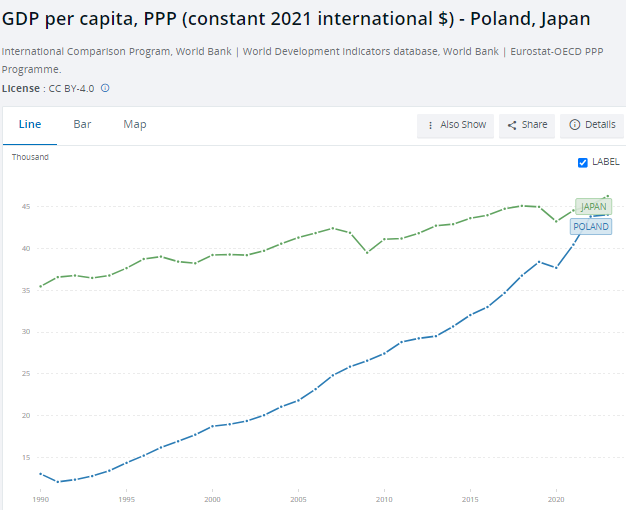
Here is the link.
The polity that is Hawaii
From an MR reader:
The most Democratic legislature in the country passed two market-friendly bills this session.
1) HB2404 CD 1 represents the largest income tax cut in the State’s history (description and analysis here).
2) SB 3202 forces the counties to allow more construction of Accessory Dwelling Units on residential properties (news article here).
As somebody who works on HI state policy, looking at the supply-side constraints is a new way of thinking here. People are starting to recognize that the same old demand-side approaches are not working. I expect more laws like this in the coming years.
Hawaii has always been a small-c conservative state, in part due to the large Asian population. The Leg once again struck down a Cannabis legalization bill this year despite a big push from Progressives.
It will be interesting to see what happens next.
My excellent Conversation with Brian Winter
Here is the video, audio, and transcript. Here is the episode summary:
It’s not just the churrasco that made him fall in love with Brazil. Brian Winter has been studying and writing about Latin America for over 20 years. He’s been tracking the struggles and triumphs of the region as it’s dealt with decades of coups, violence, and shifting economics. His work offers a nuanced perspective on Latin America’s persistent challenges and remarkable resilience.
Together Brian and Tyler discuss the politics and economics of nearly every country from the equator down. They cover the future of migration into Brazil, what it’s doing right in agriculture, the cultural shift in race politics, crime in Rio and São Paulo, the effectiveness and future consequences of Bukele’s police state in El Salvador, the economic growth of Colombia despite continued violence, the prevalence of startups and psychoanalysis in Argentina, Uruguay’s reduction in poverty levels, the beautiful ugliness of Sao Paulo, where Brian will explore next, and more.
And here is one excerpt;
COWEN: What’s the economic geography of Brazil going to look like? All the wealth near Mato Grosso and the north just very, very poor? Or the north empties out? How’s that going to work? There used to be some modest degree of balance.
WINTER: That’s true. Most of the population in Brazil and the economic center, for sure, was in the southeast. That means, really, São Paulo state, which is about a quarter of Brazil’s population but roughly a third of its GDP. Rio as well, and the state of Minas Gerais, which has a name that tells its history. That means “general mines” in Portuguese. That’s the area where a lot of the gold came out of in the 18th and 19th centuries. That’s gone now, so it’s not as much of an economic pull.
You’re right, Tyler, though, that a lot of the real boom right now, the action, is in places like Mato Grosso, which is in the region of Brazil called the Central West. That’s soy country. I’m from Texas, and Mato Grosso is virtually indistinguishable from Texas these days. It’s hot. It’s flat. The crop, like I said, is soy. There’s cattle ranching as well.
Even the music — Brazil, as others have noted, has gone from being the country of bossa nova and the samba in the 1970s to being the country of sertanejo today. Sertanejo is a Brazilian cousin of country music with accordions, but it’s sung by people — men mostly — in jeans, big belt buckles, and cowboy hats. They’re importing that — not only that economic model but that lifestyle as well.
COWEN: What is the great Brazilian music of today? MPB is dead, right? So, what should someone listen to?
Recommended, interesting throughout.
Sierra Leone update
An addiction crisis is gripping Sierra Leone, one of the world’s poorest nations, driven by a surge in use of “kush”, a toxic blend of psychoactive substances. As the West African nation struggles to boost its economy, thousands of unemployed young adults have turned to the potent alternative to marijuana to fill their days.
The kush crisis is part of a growing trend of substance abuse across Africa, particularly among the continent’s youth.
“People are addicted to escape,” said Abass Wurie, a biomedical scientist in Freetown who is studying the effects of the drug on the heart and kidney.
Here is more from Aanu Adeoye at the FT. Is this a new trend for very poor countries, as the prices of escapist, addictive drugs fall all the more?
How democratic are the French results?
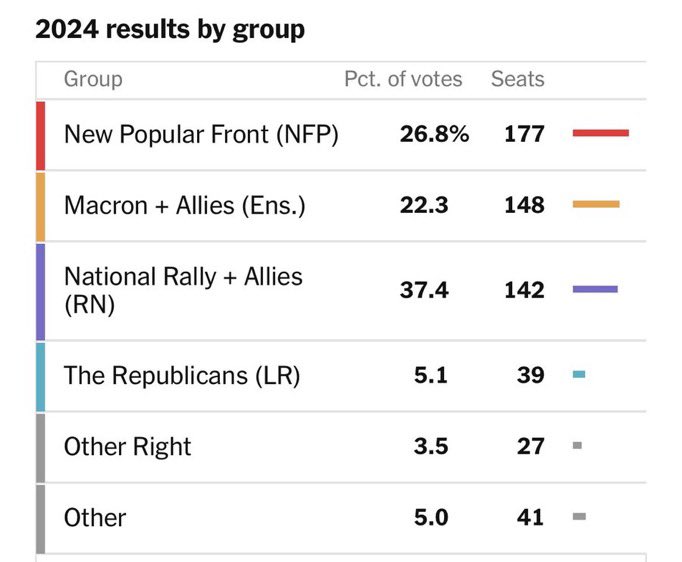
Here is the source tweet.
The French left is now winning
This is a big surprise to many people, as in the first round the right was doing much better in terms of votes and seats. We’ll learn more soon, but in the meantime I am reminded of one of the paradoxes in the theory of expressive voting. You might want to send a protest vote, but you don’t want too many other people sending the same protest vote. For instance, some people voting for Ralph Nader didn’t really want him to win. And the same may be true for the French right. So the very show of force from the right, in the first round, may have limited their subsequent numbers. More generally, you could say that an equilibrium, when there is a lot of expressive voting, is super-sensitive to expectations about the voting behavior of others. Especially when the receives of the expressive votes come close to holding real power.
Do you know the apocryphal story of the economics department that wanted to decide, unanimously, to vote 18-3 on the tenure case of a junior professor? That was not allowed, and so everyone voted in favor.
I wonder what this all means for a possible Democratic mini-primary!?
What should I ask Christopher Kirchhoff?
I will be doing a Conversation with him. In case you do not know, Christopher self-describes as:
Christopher Kirchhoff is an expert in emerging technology who founded the Pentagon’s Silicon Valley office and has led teams for the President, Chairman of the Joint Chiefs of Staff, and CEO of Google. He recently worked special projects at Anthropic. Previously, Dr. Kirchhoff helped design and scale $1 billion in philanthropic programs at Schmidt Futures. He also founded and led the Pentagon’s Silicon Valley Office, Defense Innovation Unit X, which piloted flying cars and microsatellites in military missions and created a new acquisition pathway for start-ups now responsible for $70 billion dollars of technology acquisition. During the Obama Administration, he was Director for Strategic Planning at the National Security Council and the senior civilian advisor to the Chairman of the Joint Chiefs of Staff.
I very much enjoyed his new book Unit X: How the Pentagon and Silicon Valley are Transforming the Future of War, co-authored with Raj M. Shah. Here is his home page. The book just received a very strong review from the FT.
So what should I ask Christopher?
PR for the UK?
I say no, we have enough European governments with proportional representation already. Should not someone allow for the possibility of more decisive action?
Estimates are suggesting that Labour won two-thirds of the seats with one-third of the vote, more or less. So that induces the usual cries of misrepresentation of the electorate (it also reminds us that virtually all electoral systems are not “democratic” in the naive sense of that term). But Britain has many serious problems, and I would rather see one party given a decisive mandate to handle them. And I write that as someone who is not in general rooting for the Labour Party — virtually all of my favorite British politicians are Tories, even if I do not like what that party has become as a whole.
Contrast the British with the recent French election. The distribution of votes was not altogether dissimilar, but the Britsh have “a landslide,” while the French have a possibly ungovernable situation.
I do love checks and balances, but the UK needs to defeat NIMBY and fix the NHS. Now it is Labour’s turn to try. Here is a broad outline of Labour’s 100-day plan. Not exactly what I would choose (see Wooldridge at Bloomberg), but if they get two or three big things right the regime still could be a success.
Note that the margins for the Labour victorious seats are extremely low, which means there is an ongoing constraint on the exercise of government power. I am not so worried about an “elected dictatorship.” If anything, it may not be decisive enough.
Another consideration is that PR for the UK could end up meaning the rise of an Islamic party of some kind, of course with minority status. I suspect that would worsen rather than improve democratic discourse in Britain, and perhaps hinder immigrant assimilation as well. I don’t want that to happen, and so it is another reason why the UK should not switch to a PR system.
The polity that is the UK
There is no doubt that the past 14 years has seen miserable progress on living standards. Real household disposable income per person has flatlined in the UK since the 2019 election, compared with roughly 2 per cent annual growth in most parliaments since the second world war. More interesting is the distribution of income changes over the past five years and the whole period the Conservatives have led government since 2010.
Despite a huge rise in food bank use and cuts to social security for working-age households, the surprise is that it is the poorest households that have done better than the rest of the UK.
Better is a relative measure, however. Taking detailed income data up to 2022-23 and updating this with known trends thereafter, the Resolution Foundation finds that only the bottom 20 per cent of the income distribution saw any real income gains in the latest parliament.
Here is more from Chris Giles at the FT. Samir Varma sends me this link about problems with British driving school and the resulting fees and queues. By the way, the SNP is likely to lose three-quarters of its seats in Scotland (FT). And how small a group of party voters will be necessary to mount a challenge to Reform Party leadership? Will there be a core?
Words from Ross Douthat
As a holiday meditation, consider that many of the things that fill people with understandable fear for our national future – polarization, extremism, radicalization, mutual incomprehension across cultural and moral and theological chasms – are also in their own way signs of national vitality. It’s good that so many people from so many different backgrounds still find the American future worth fighting over. It’s potentially good that freaks, weirdos and eccentrics have an increasing share in our politics alongside levelheaded moderates. It’s potentially good that far right and further left are both seeking reimaginings of the national narrative, incompatible as those imaginings may seem. We face a difficult situation in the world and a bad, late-imperial-seeming choice in November — but many of our derangements are also indicators of a heathy discontent with the comfortable decadence of developed societies. From multiple perspectives the American experiment appears at risk — but better to be at risk than to be settled, torpid, stagnant.
Maybe these are just the things you tell yourself when you’ve just had a fifth child. But I think there’s a good chance, a very good chance, that my children will inherit an America quite different from any of our past golden or silver ages, but still the best place to be born and live and flourish in this age of the world.
Here is the link.
Guyana fact of the day
Guyana bursts into the IMF’s 2024 top ten of countries by GDP per capita (PPP). Most are tax havens or oil states (as is Guyana). Singapore, Switzerland, and the USA are the only real economies out of the 16 here.
That is from @whyvert, here is the list.
An overly simple model of positive and negative contagion
When people feel bad and act badly, if only in rhetoric, they make others around them worse as well. That is a simple account of negative contagion of mood.
There is positive contagion too, but it is harder to pull off. If nine people tell you nice things, and one person serves up a somewhat credible insult, it is the insult that sticks with you.
Most social times are a relatively stable mix of positive and negative feelings, but sometimes the dynamics of negative contagion take over, and negativism leads to yet more negativism. Arguably this happened in Europe before WWI, and arguably it is happening in many countries today, including the United States. Very bad events, such as financial crises, also can trigger cycles of negative contagion.
This negative contagion is self-validating. If all the negative feelings, expressed collectively, in fact make outcomes worse, it will seem those negative feelings are justified. In this equilibrium the negative feelings about “opposing others” will be true, but still it would be better to avoid that equilibrium altogether.
A country can get out of a negative cycle either by winning a major war, or when a political entrepreneur comes along with enough oomph and reforms to shift the equilibrium, as Ronald Reagan did in America. Still, negative cycles are hard to break once you get into them. That said, over time things do start to become worse, so options for the positivity entrepreneurs do arise, at least if they can overcome coordination problems and get enough people to feel better.
Many thinkers and writers contribute to this equilibrium of negative feelings, most of all by writing about each other. Even if their substantive points are correct, their social marginal product usually is negative, though you can learn from them because they are competing to offer the most incisive critique.
If you can avoid being overwhelmed by the peer pressure of this negative dynamic, the private and social returns are high. You can just keep on going and build things. Yet few are able to resist the logic of Durkheim, no matter how ostensibly contrarian they may be. In fact the contrarians are often at greatest risk of being caught up in this, because they are so skilled in rejecting and also criticizing the claims of the opposing forces.
Happy Fourth of July!