Category: Current Affairs
Venezuela under “Brutal Capitalism”
Jeffrey Clemens points us to some bonkers editorializing in the NYTimes coverage of the likely stolen election in Venezuela. The piece starts out reasonably enough:
Venezuela’s authoritarian leader, Nicolás Maduro, was declared the winner of the country’s tumultuous presidential election early Monday, despite enormous momentum from an opposition movement that had been convinced this was the year it would oust Mr. Maduro’s socialist-inspired party.
The vote was riddled with irregularities, and citizens were angrily protesting the government’s actions at voting centers even as the results were announced.
The term “socialist-inspired party” is peculiar. The party in question is the United Socialist Party of Venezuela (Partido Socialista Unido de Venezuela) and it’s founding principles state, “The party is constituted as a socialist party, and affirms that a socialist society is the only alternative to overcome the capitalist system.” So, I would have gone with ‘Mr. Maduro’s socialist party’. No matter, that’s not the big blunder. Later the piece says:
If the election decision holds and Mr. Maduro remains in power, he will carry Chavismo, the country’s socialist-inspired movement, into its third decade in Venezuela. Founded by former President Hugo Chávez, Mr. Maduro’s mentor, the movement initially promised to lift millions out of poverty.
For a time it did. But in recent years, the socialist model has given way to brutal capitalism, economists say, with a small state-connected minority controlling much of the nation’s wealth.
Venezuela is now governed by “brutal capitalism” under Maduro’s United Socialist Party!??? The NYTimes has lost touch with reality. From the link we find that what they mean is that some price and wage controls were lifted, including allowing dollars to be used because the bolívar, was “made worthless by hyperinflation,” and remittances from the United States were legalized:
NYTimes: With the country’s economy derailed by years of mismanagement and corruption, then pushed to the brink of collapse by American sanctions, Mr. Maduro was forced to relax the economic restraints that once defined his socialist government and provided the foundation for his political legitimacy.
Lifting some controls does not make Venezuela a capitalist country. Moreover, the lifting of controls led to improvements:
…Seeing shelves stocked again has also helped ease tensions in the capital, where anger over the lack of basic necessities has, over the years, helped fuel mass protests.
…The transformation also brought some relief to the millions of Venezuelans who have family abroad and can now receive, and spend, their dollar remittances on imported food.
Of course, the improvements were not equally shared. If you want to call unequal improvements, “brutal capitalism”. Well, I don’t think that’s useful but if you do so be sure to note that “under Maduro’s administration, more than 20,000 people have been subject to extrajudicial killings and seven million Venezuelans have been forced to flee the country.” (Wikipedia.) That’s brutal socialism.
Lastly, I don’t expect, the NYTimes to keep up on the latest counter-factual estimation techniques so I won’t ding them too much, but it’s clear that the Chavismo regime never lifted millions out of poverty. At best, poverty fell during the good years at the rate one would have expected from looking at similar countries. It’s the later rise in poverty which is unprecedented, as the NYTimes previously acknowledged.
Britain fact of the day
But many of the phrases the English grew up with are fading away as younger generations plug into TikTok or other platforms where they learn to call each other “Karen” or “basic” like any other rando, instead of sticking with tried and tested indigenous slurs.
Nearly 60% of the Gen Z cohort haven’t heard the insult “lummox,” according to a study by research agency Perspectus Global. Less than half know what a “ninny” is, with only slightly more of them familiar with “prat” or “tosspot.”
What a bunch of plonkers.
There was a time when nearly everybody would sling about terms like “blighter” or “toe-rag,” and sometimes far ruder terms. That was when the British had more of a shared pop culture, often built around television comedies such as “Only Fools and Horses,” about a family of likable London con men. People would talk about them in the schoolyard or at work the next morning. Everyone knew what everyone else was talking about, even if it was a load of twaddle.
Here is more from James Hookway at the WSJ. How can those ninnies not know what a ninny is?
What should I ask Tom Tugendhat?
My previously scheduled Conversation with him was postponed, now it is on the schedule again. So what should I ask him? (Wikipedia page here, if you don’t know what a lummox is).
Germany fact of the day
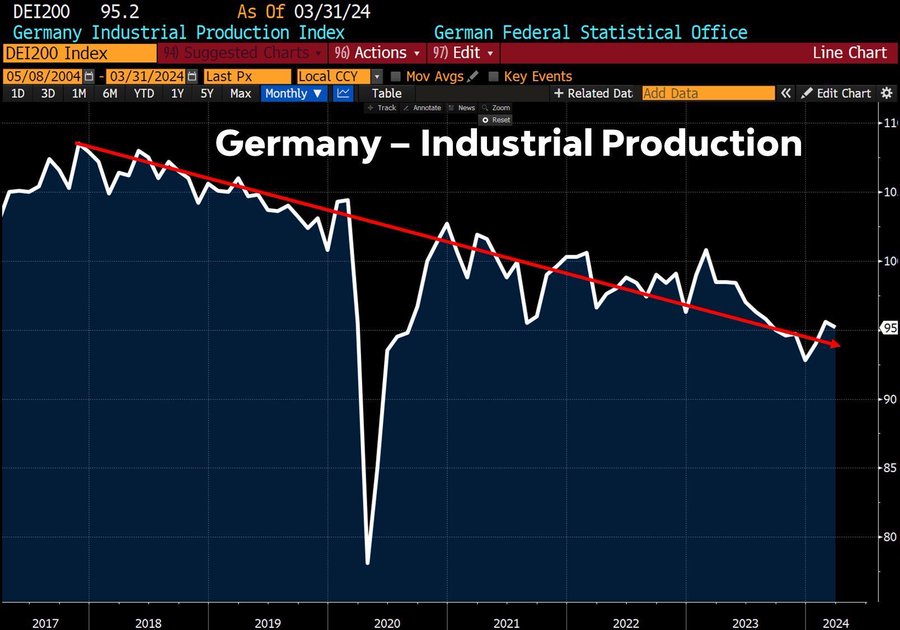
Here is the source.
Rent Control Reduces New Development: Bug or Feature?
The minimum wage will tend to increase unemployment among low-skill workers, often minorities. To many people that’s an argument against the minimum wage. But to progressives at the opening of the 20th century that was an argument for the minimum wage–progressive’s demanded minimum wages to get women and racial minorities out of the work force.
Something similar may be happening with rent control. Rent control reduces new development. Bug or feature? California Republican Tony Strickland argues that reduced development is a feature. New state laws in California prevent cities from restricting development but if rent control was legal cities could be used it to do the same thing just by making it unprofitable to build.
Politico: Strickland said Weinstein’s rent control measure [allowing cities to use rent control] would block “the state’s ability to sue our city” because Huntington Beach could slap steep affordability requirements on new, multi-unit apartment projects that are now exempt from rent control. Such requirements, he argued, could stop development that would “destroy the fabric” of the town’s quaint “Surf City” vibe…. “It gives local governments ironclad protections from the state’s housing policy and therefore overreaching enforcement.”
“On paper, it would be legal to build new homes. But it would be illegal, largely speaking, to make money doing so,” said Louis Mirante…
Hat tip: Ben Krauss at Slow Boring.
Austin Vernon on emissions reduction (from my email)
Tyler,
Your point about easier reductions abroad goes much further than you wrote about. In the US we have already significantly decreased coal usage so electricity generation is roughly a quarter of our greenhouse gas emissions. Electricity generation accounts for half of emissions in countries like China. Many countries haven’t even installed their first battery system, so there is extensive low hanging fruit. And for a range of reasons the installed cost of solar is much lower abroad than in the US so every dollar goes further. In general the US would be much better off with deregulation (ending tariffs, simplifying tax credits, etc.) over adding any more subsidies. I think it would be a net gain for the industry if all subsidies went away but there was also significant deregulation.
As you point out, it is difficult to move the needle in transportation because the investment required is so much larger than in the electricity sector for roughly the same amount of emissions left to abate. There are sub sectors like trucking and commercial vehicles that could go much faster, but again it is probably better to spend the effort making it easier to install high power chargers than direct subsidies. Companies can and do calculate the total cost of ownership for their vehicles and the next generation of commercial EVs and trucks will be in the green without subsidies for many applications. Another policy/tech pairing with high leverage in the transportation space is rapidly legalizing autonomous EVs as they become available.
Industry could also transition quickly once alternative systems are in the money. Systems must be cheap and scalable which requires developing the technology and getting solar panel prices close to the global average (right now prices are 2x-3x higher in the US).
Austin
Here is the Austin Vernon Substack.
The French Olympic opening ceremony
I’ve only seen excerpts, but many people are upset. I can vouch “this is not what I would have done,” but perhaps the over the top, deviance-drenched modes of presentation are reflecting some longer-running strands in French culture. La Cage aux Folles? Le Bal des Folles? The whole Moulin Rouge direction? How about Gustave Moreau, not to mention his lower-quality followers? Jean Paul Gaultier? (NYT, “Fashion Freak Show”) Pierre et Gilles?

Zaza Fournier? Even Rabelais.
In my view, these styles work best on the painted canvas, thus Moreau is the one creator on the list I truly like. But please note these Olympics may be less of a break from traditional French culture — or some of its strands — than you may think at first.
I’m kind of tired of this
First of all, I favor the classical liberal strands on the Right, not the New Right strands, as I have argued repeatedly in the past. So I am not trying here to argue for “my guys.” But the degree of misinformation at the current moment is just staggering, and most intellectual commentators seem to be embracing it or at least tolerating it. For one thing, the whole couch´sofa matter just isn’t true. For another, Trump did not just say, at the end of his recent speech, that democracy will end in four years. Listen to the entirety of the very end of the speech. What he said is that he will end electoral fraud if he wins, and thus, in the future, Republicans won’t need all their supporters to vote to give them huge, fraud-proof margins. (To be clear, that claim itself involves some significant misinformation.) He was not heralding the end of democracy.
Or how about the patently absurd claims from Timothy Snyder, famous historian from Yale, who cannot even get right the events from a few days ago?
If you want, track all the links down yourself. In the meantime, a lot of our elites are embarrassing themselves yet again, and that too is very bad for democracy, not to mention intelligence and intellectual honesty.
Russia facts of the day
A further bump in real wages of up to 3.5 per cent is expected this year, alongside an expected 3 per cent jump in real disposable income, according to Russia’s Center for Macroeconomic Analysis and Short-Term Forecasting. The unemployment rate, forecast to hit between 7 and 8 per cent in 2022, is at 2.6 per cent — a record post-Soviet low.
Here is much more from Courtney Weaver and Anastasia Stognei in the FT. Now model that!
Cuba Libre! Part 2
In April I posted, following an excellent piece by Martin Gurri, that 4% of Cuba’s population had recently escaped. The Miami Herald now reports, based on official Cuban data, that 4% was a large underestimate.
A stunning 10% of Cuba’s population — more than a million people — left the island between 2022 and 2023, the head of the country’s national statistics office said during a National Assembly session Friday, the largest migration wave in Cuban history.
…It was a somber moment that capped a week of National Assembly sessions in which government officials shared data revealing the extent of the economic crisis and the failure of current government policies meant to increase production, address widespread shortages, deal with crumbling infrastructure and tame inflation.
Most seriously food production has collapsed:
Alexis Rodríguez Pérez, a senior official at the Ministry of Agriculture, said the country produced 15,200 tons of beef in the first six months of this year. As a comparison, Cuba produced 172,300 tons of beef in 2022, already down 40% from 289,100 in 1989.
Pork production fared even worse. The country produced barely 3,800 tons in the first six months of this year, compared to 149,000 tons in all of 2018. Almost every other sector reported losses and failed production goals.
And yet
…Cuban Prime Minister Manuel Marrero announced several new restrictions on the island’s private sector (!!!)
Raul Castro is 93. I am betting that his death or something similar will signal a new revolution. Is the US prepared for an open Cuba?
Kamala Harris economic record
As a presidential candidate, Ms. Harris proposed replacing Mr. Trump’s 2017 tax cuts with a monthly refundable tax credit worth up to $500 for people earning less than $100,000. The policy, known as the LIFT the Middle Class Act, was unveiled in 2018 and aimed to address the rising cost of living by providing middle-class and working families with money to help pay for everyday expenses. She framed it as a way to close the wealth gap in the United States.
In 2019, Ms. Harris proposed increasing estate taxes on the wealthy to pay for a $300 billion plan to raise teacher salaries. In what was billed as the “largest federal investment in teacher pay in U.S. history,” the plan would have given the average teacher in America a $13,500 pay increase.
…Ms. Harris wanted to raise the corporate tax rate from 21 percent to 35 percent, which is higher than the 28 percent that Mr. Biden had proposed.
And:
Ms. Harris made affordable housing a priority during her tenure in the Senate and her presidential campaign, but took a different approach. She proposed the Rent Relief Act, which would have provided refundable tax credits allowing renters who earn less than $100,000 to recoup housing costs in excess of 30 percent of their incomes.
To help the poorest, Ms. Harris also called for providing emergency relief funding for the homeless and for spending $100 billion in communities where people have traditionally been unable to get home loans because of discrimination.
And:
Ms. Harris, who served as California’s attorney general from 2011 to 2017, has also focused heavily on consumer protection. In 2016, she threatened Uber with legal action if the company did not remove driverless cars from the state’s roads.
After the 2008 financial crisis, she pulled California out of a national settlement with big banks, leveraging her power to wrest more money from major mortgage lenders. She later announced that California homeowners would receive $12 billion in mortgage relief under the settlement.
Here is the full NYT piece by Alan Rappeport.
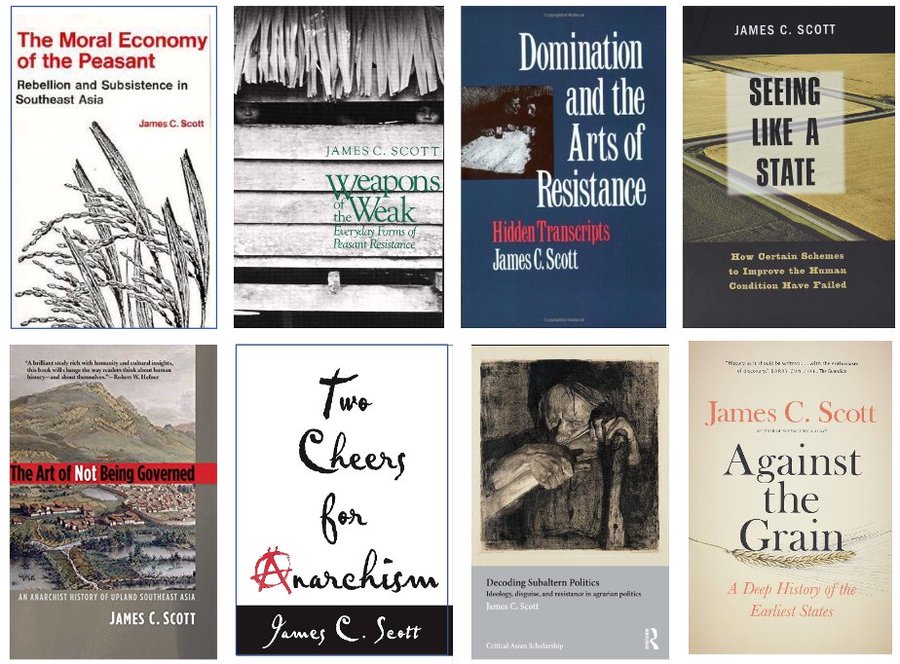
James Scott, RIP
Comments are open
If you would like to discuss recent events…
Argentina fact of the day
La actividad económica creció 2,3% interanual en mayo de 2024 y 1,3% respecto de abri

Here is the tweet, here is the pdf link.
U.S.A. retail fact of the day
At the remaining publicly listed department stores, credit cards — rather than retail sales — now generate a surprisingly large chunk of profits. Credit income accounted for about 47 per cent and 66 per cent, respectively, of Nordstrom’s and Kohl’s operating income last year, according to Bank of America Global Research. At Macy’s, the figure was about 55 per cent in 2022, said Citigroup.
Here is more from Lex at the FT.