Category: Current Affairs
Tabarrok on China: World of DAAS Podcast
I was very pleased to appear on Safegraph CEO Auren Hoffman’s World of DAAS podcast. We covered lots of material including this (lightly edited) bit on China.
Auren Hoffman (23:06.518):
Now, you’ve thought a lot about things like reshoring, building manufacturing capacity. How do you think we could be thinking about that differently?
Alex (23:24.058)
I understand that there are some concerns about China, and there is an argument and I think it’s a legitimate argument, that there are some things such as chips that we want to make sure, it’s not good to have them located in Taiwan, right? We want to make sure that we onshore those. However, I have three concerns. One is, fundamentally, I don’t think China and the United States have such a clash of interest. Of course, it’s not perfect harmony, but there’s a lot of harmony of interest between China and the United States. We do lot of trade with China, which benefits both China and the United States.
..China’s getting richer Okay, people are worried because they’re getting more military whatever but also what this means is that people in China are getting cancer. Well now there’s 1 .4 billion people who want to cure for cancer, and they’re willing to put some money into it, right? And then that’s going to increase the amount of research and development for all kinds of high-tech goods, which is amazing for us. Like, I would be thrilled if an American wins the Nobel Prize for curing cancer. I would be 99.5 % as happy if a Chinese scientist wins a Nobel Prize for curing cancer.
So we have a lot to gain from a richer China. That’s point one. Point two is that, yeah, I get the idea that we want to onshore chip manufacturing, but I think we want to friendshore, right? So we don’t want to just have protection against all countries. Like I get it, okay, a hundred percent tariff on your Chinese EVs. It’s kind of crazy, but all right. However, let’s reduce tariffs on Germany.
Let’s reduce tariffs on Europe. In fact, let’s create a free trade, even a free immigration block among the Western democracies, you know, including Japan, Australia, New Zealand. So, let’s not turn a small problem in foreign policy, which is to make sure that we have a ready military supply. Let’s not turn that into trying to create a fortress America Which is going to make us poorer and actually less safe instead, you know, let’s build up the free world. Okay, let’s create an immigration and free trade with Europe and Canada and Mexico and so forth. Let’s build up the free world. That’s point two.
Point three is that look. It’s very, very easy to take a foreign policy argument and turn it into rent seeking for the benefit of special interests and protectionism for the benefit of special interests. Right? So at one point in the United States, probably even still today, you know, we were prohibiting mohair imports. Okay. Why? Because we use mohair to make military uniforms. The whole thing is ridiculous. But it’s very easy, almost inevitable, that this kind of argument is turned into a special interest trough.
I think this is one of my best podcast appearances because we covered some new material on crime, the universities, why Tyler and I are able to cooperate on so many projects, a conspiracy theory I believe and more. Listen to the whole thing.
Europeans deserve to be as cool as Americans
That is the (very good) title they gave my recent Bloomberg column. Should Europe have more air conditioning? Basically yes. Here is one excerpt:
Some 90% of the US has air conditioning, according to one estimate, compared to only 19% for Europe. Worldwide, the US, China and Japan account for about two-thirds of all air conditioning…
And yet it will not be easy to make Europe as cool (speaking only in terms of temperature) as America. Much of the continent faces higher energy prices than does the US, and there are taxes — in France, they are 20% on AC systems.
And then there are the esthetics. Many Europeans complain that artificially cooled air is less healthy or less pleasant to breathe — a view this American has some sympathy for. (I am not much bothered by the heat and enjoyed the fresh air of Siena.) European buildings are also on average older than those in the US, and were not built to make AC units easy to install. So issues may arise from local regulations and historic-preservation laws.
Some Europeans also have an option unavailable to Americans if the temperature truly is unbearable: They can take the entire month of August off. They can swim in the Mediterranean, or take a quick flight to Finland or Ireland. The economic lesson that people adjust to their circumstances is borne out by these realities.
Personally, I would prefer a world with less air conditioning, or with temperatures not so low. And in Europe in particular, I enjoy how the relative paucity of AC forces people outdoors and into public squares. But that is only me. In sum;
So the best argument an American can make for why Europe should have more air conditioning is this: because Europeans want it. There are cultural forces keeping the shift toward more AC from proceeding as quickly as it ought to, but the transition will eventually happen. Why not accelerate the pace of installation and get to where much of Europe is likely to end up anyway?
My current hotel in Ireland…has no air conditioning.
IRA manufacturing delays
Some 40 per cent of the biggest US manufacturing investments announced in the first year of Joe Biden’s flagship industrial and climate policies have been delayed or paused, according to a Financial Times investigation.
The US president’s Inflation Reduction Act and Chips and Science Act offered more than $400bn in tax credits, loans and grants to spark development of a US cleantech and semiconductor supply chain.
However, of the projects worth more than $100mn, a total of $84bn have been delayed for between two months and several years, or paused indefinitely, the FT found.
Here is more from Amanda Chu, Alexandra White and Rhea Basarkar at the FT.
New data on marijuana legalization
That is the topic of my latest Bloomberg column, and here is one excerpt:
What do the numbers show? A new study from the Federal Reserve Bank of Kansas City offers some important keys toward an answer.
Start with the good news, or what appears to be the good news. Post-legalization, incomes in legalizing states grew by about 3%, home prices went up by 6%, and populations rose by about 2%. The researchers used appropriate statistical controls, but there is some question about causation vs. correlation. At the very least, it seems highly likely that state GDP went up: A state with legal marijuana can sell it, including to users in other states. Selling marijuana is a new business, and like any new business, it boosts the local economy.
But it is not so simple. Measures of GDP and GDP per capita are usually good metrics for human well-being — but not always. Cigarette sales, for instance, are not as beneficial for citizens as much as the initial GDP boost might indicate, because nicotine is bad for most people…
In states with legal marijuana, self-reported usage rose by 28%. Meanwhile, substance use disorders increased by 17%. Chronic homelessness went up by 35%, a possible sign that marijuana use leads to a downward financial spiral, and perhaps job loss, for many users. Arrests increased by 13%, although reported crime did not itself go up.
And in sum:
That said, these results are hardly a great advertisement for the legalization experiments. They stand in jarring contrast to what advocates promised: an end to black markets, safer marijuana and a better-protected user population. And if I may be allowed to think less like an economist for a moment, I confess I don’t feel good about a social practice that lowers effective IQ. No one smokes pot to perform better on their SATs.
I remain of two minds on the entire question.
Worth a ponder.
Schengen eroding, child legal arbitrage markets in everything
“We are increasing surveillance, in part to increase security, but also to prevent hired Swedish child soldiers who come to Copenhagen to carry out tasks in connection with gang conflicts,” he added.
Hummelgaard revealed on Thursday that there had been 25 incidents since April where Danish criminal gangs had hired what he called “child soldiers” to commit crimes in Denmark. In the last two weeks alone, Danish police have linked three shootings to Swedish teenagers…
Swedish police say that powerful criminal gangs often use children to commit murders as they will receive light sentences. Drug gangs — many of whom are led by second-generation immigrants now living outside the country — have infiltrated parts of the welfare, legal and political systems, meaning the fight against them could take decades, according to Swedish officials.
Here is more from Richard Milne at the FT. Elsewhere, “Brown bears are protected under EU law,” solve for the equilibrium (FT).
I think crypto performed well in the Monday pseudo-crash
Of course the crypto prices fell first, over the weekend. I think Bitcoin fell by about 15 percent?
You can think of crypto as a hedge against illiquidity, rather than against inflation, or against the decline of America, or whatever. There are not enough liquid assets! So sometimes solvent economies go tails up, because debtors do not have enough liquidity to meet their obligations.
Putting another liquid asset in the mix, in this case Bitcoin, eases that liquidity constraint. You can’t meet your margin call? Just sell some Bitcoin!
Economies will become more resilient to liquidity squeezes, especially from surprise events, for instance the financial volatility in Japan. And the crypto prices falling, when other asset prices fall, is a sign of this mechanism working, not of crypto failing.
Of course it is not entirely so simple. In the longer run, the liquidity of crypto will encourage people to take out more debt. Still, overall, an economy with more liquid assets should (usually) have superior risk-sharing properties.
I don’t see this aspect of crypto discussed very much.
My excellent Conversation with Paul Bloom
Here is the audio, video, and transcript. Here is part of the episode summary:
Together Paul and Tyler explore whether psychologists understand day-to-day human behavior any better than normal folk, how babies can tell if you’re a jerk, at what age children have the capacity to believe in God, why the trend in religion is toward monotheism, the morality of getting paid to strangle cats, whether disgust should be built into LLMs, the possibilities of AI therapists, the best test for a theory of mind, why people overestimate Paul’s (and Tyler’s) intelligence, why flattery is undersupplied, why we should train flattery and tax empathy, Carl Jung, Big Five personality theory, Principles of Psychology by William James, the social psychology of the Hebrew Bible, his most successful unusual work habit, what he’ll work on next, and more.
And here is one excerpt:
COWEN: I have some questions about intelligence for you. If we think of large language models, should we let them feel disgust so that they avoid left-wing bias?
BLOOM: [laughs] Why would disgust make them avoid left-wing bias?
COWEN: Maybe we’re not sure it would, but there are various claims in the literature that for people on the right, disgust is a more fundamental emotion, and that a greater capacity to feel disgust encourages people in some ways to be more socially conservative. Debatable, but I don’t think it’s a crazy view. So, if you build LLMs, and you give them, say, a lot of empathy and not much or any disgust, you’re going to get left-leaning LLMs, which you might say, “Well, that was my goal.” But obviously, not everyone will accept that conclusion either.
BLOOM: I wouldn’t want woke LLMs. I think there’s a lot in extreme —
COWEN: You’ve got them, of course.
BLOOM: I’ve got them. I think Gemini is the one, if I wanted to go — the woke LLM of choice. Because I think the doctrine called wokeness leads to a lot of moral problems and makes the world worse in certain ways, but I wouldn’t mind left-wing LLMs.
In fact, I’m not a fan of disgust. You’re right that disgust is often associated with right-wing, but in the very worst instantiation of it. Disgust is what drives hatred towards gay people. It involves hatred of interracial marriage, the exclusion of immigrants, the exclusion of other races. If there’s one emotion I would take away from people, it would be disgust, at least disgust in the moral realm. They could keep their disgust towards rotten food and that sort of thing. That’s the one thing I wouldn’t put into LLMs. I’d rather put anger, pity, gratitude. Disgust is the one thing I’d keep away.
COWEN: So, you wouldn’t just cut back on it at the margin. You would just take disgust out of people if you could?
And:
COWEN: I think at the margin, I’ve moved against empathy more being a podcast host, that I’ll ask a question —
BLOOM: Wait. Why being a podcast host?
COWEN: Well, I’ll ask a question, and a lot of guests think it’s high status simply to signal empathy rather than giving a substantive answer. The signaling-empathy answers I find quite uninteresting, and I think a lot of my listeners do, too. Yet people will just keep on doing this, and I get frustrated. Then I think, “Well, Tyler, you should turn a bit more against empathy for this reason.” And I think that’s correct.
Paul cannot be blamed for doing that, however. So substantive, interesting, and entertaining throughout.
Life in Belarus update (from my email, from anonymous)
Just an interesting update:
Chinese cars are rapidly replacing European & American cars in the city. An improvement in terms of comfort. Luxury cars still only European.
Housing prices in Minsk are reaching highs not seen since 2016. Government bodies that deal with the sales of properties are booked out 2 weeks. (Not common)
Subjectively, restaurants have improved immensely in the past few years with the influx of Chinese students and businessmen. Minsk has its first proper Korean restaurant, and Chinese food has become as good as in China. Minskers have a new found taste of spicy food (so says friends in the food industry)
Everyone I know that lost their jobs from sanctions has found something new working for a locally (or CIS) focused company.
Any products that disappeared after sanctions was either replaced by local (or russian) products, or reappeared with a Chinese label.
From my perspective, regarding Chinese, the immigration center I go to every year has become very very crowded with Chinese. It went from maybe 10 people waiting, to over 100 – every day.
Oppositional people have left long ago, people who remain accept or support the Government. . .
There has to be some profound lessons to draw from this, but I’m not sure.
It’s hard to measure & quantify resilience? Sanctions are ineffective with such a global economy? China is in control of this century? Maybe it’s a good thing to produce things locally? GDP is taken too seriously in the public mind?
Have the vibes shifted back?
Noah writes:
I would love an update to this
post, explaining why the vibes have seemingly shifted back!
I don’t think the vibes have shifted back at all, and here is my earlier post. To cite one key point, MZ referred to Trump being “bad ass,” and it still has not created anything close to a scandal. This new world is here to stay, and this kind of toleration is likely to be extended further.
Part of the ongoing shift in vibes is that now the Democrats are trying to win with a “brat” and “vibes only” strategy, and no real policy positions. That is a sign that they too recognize the vibes have shifted. So far Harris has been resisting most of the pressure from the Left. And Walz’s Congressional voting record was to the right of 70% of the Democrats. His recent big speech often felt like Frank Capra. I also predict that his more extreme actions as Governor will not be emphasized, to say the least.
Noah has a very good post on the new vibes of the Democrats, and I agree with his major points. Note that Cori Bush just became the second Squad member to be ousted in a Democratic primary.
It was never about who would win the election, as most economic theories predict this should be close to 50-50. Rather, ideology has changed, voters are (mostly) fed up with Left positions, and of course they are fed up with a bunch of right-wing positions too (note that Vance is not popular and Trump is disavowing the 2025 agenda).
Once you realize that none of this is about “which party wins,” it is obvious that the vibe shift is continuing, not being reversed.
An economist as interim leader of Bangladesh
The president of Bangladesh on Tuesday appointed Muhammad Yunus, a pioneer in microfinance and a Nobel laureate, to oversee an interim government, accommodating demands by protesters and offering a reprieve for a country scarred by violence.
The plans for a new government were announced a day after Bangladesh’s authoritarian leader, Sheikh Hasina, resigned and fled the country amid a popular uprising.
Here is more from the NYT.
A thread on Japan
https://x.com/peruvian_bull/status/1820199767336702052?s=61
The cheery point, if you wish to go that route, is that both the Japanese stock market and yen simply are back to December 2023 levels.
England and Wales fact of the day
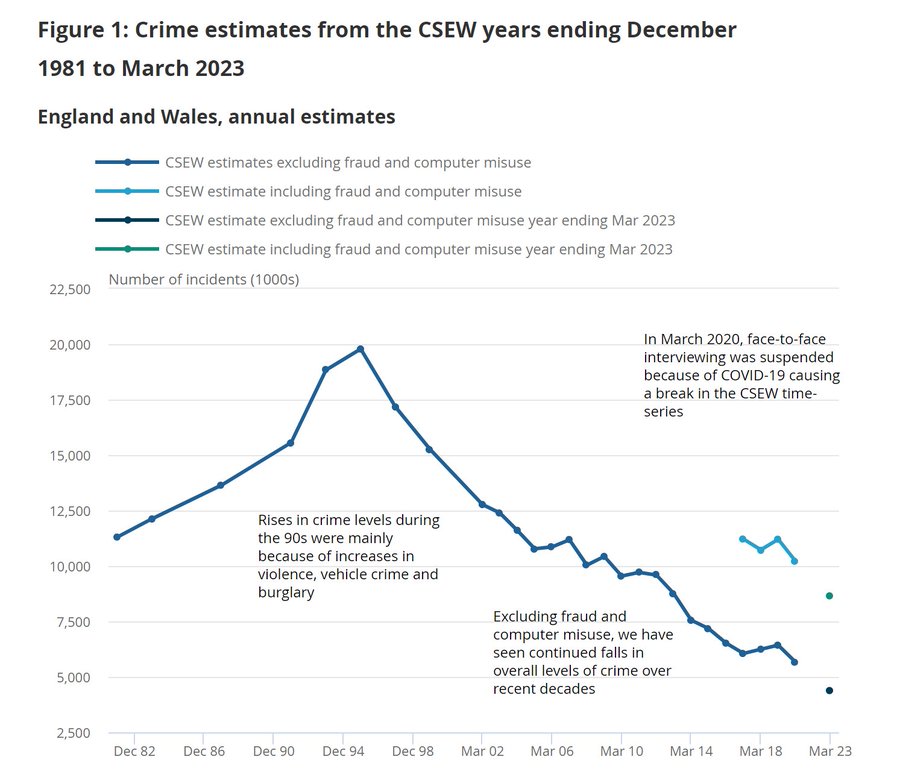
Here is the source.
Arena magazine
Introducing: Arena Magazine. It’s a print & digital magazine about tech, capitalism, and the USA – that’s actually on the side of tech, capitalism, and the USA! Subscribe: arenamag.com/join
Here is a link and a thread.
Operation Warp Speed for Cows
 The UK Health Security Agency has raised their pandemic threat level for H5N1 bird flu from a 3 to a 4 on a 6 point scale.
My takeaway is that we have completely failed to stem the outbreak in cattle, there has been animal to human transmission which we are surely undercounting, but so far the virus has not mutated in a way to make it very adaptable to humans.
The failure to stem the outbreak in cattle is concerning because it suggests we would not be able to stem a human outbreak. We can easily test, quarantine and cull cattle!
It is absolutely outrageous that dairy farmers are refusing to cooperate on testing:
To date dairy farmers have, in large measure, refused to cooperate with efforts to chart how deeply the virus has infiltrated U.S. herds, seeing the possible stigma of admitting they have H5N1-infected cows as a greater risk than the virus itself.
We should be testing at much higher rates and quarantining and culling. The dairy farmers should be and are being compensated but frankly the farmers should have no say in the matter of testing. Externalities! Preventing a pandemic is much cheaper both in resources and in restrictions on liberty than dealing with one.
And how about an Operation Warp Speed for a vaccine for cows? Vaccinate. Vacca! It’s right there in the name! If only we could come up with a clever acronym for an Operation Warp Speed for COWS.
Developing a vaccine for cows would also speed up a human vaccine if one were needed.
Here are some key points from the UK HSA:
There is ongoing transmission of influenza A(H5N1) in the US, primarily through dairy cattle but with multispecies involvement including poultry, wild birds, other mammals (cats, rodents, wild mammals) and humans (1, 2). There is high uncertainty regarding the trajectory of the outbreak and there is no apparent reduction in transmission in response to the biosecurity measures that have been introduced to date. There is ongoing debate about whether the current outbreak should be described as sustained transmission given that transmission is likely to be facilitated by animal farming activities (3). However, given that this is a permanent context, the majority of the group considered this outbreak as sustained transmission with the associated risks.
…There is evidence of zoonotic transmission (human cases acquired from animals). There is likely to be under-ascertainment of mild zoonotic cases.
..Overall, there is no evidence of change in HA which is suggestive of human adaptation through these acquired mutations. Although genomic surveillance data are likely to lag behind infections, the lack of evidence of viral adaptation to α2,6SA receptors after thousands of dairy cattle infected may suggest that transmission within cows does not strongly predispose to human receptor adaptation. Evidence of which sialic acid receptors are present in cows, which is needed to support this hypothesis, is still preliminary and requires confirmation.
Underreported news of the day
The attack affected online services of all major Russian banks, national payment systems, social networks and messengers, government resources, and dozens of other services…Carpet-Bombing Hack: #Ukraine’s Intelligence (#HUR) has completed one of the largest cyberattacks on Russia’s financial sector and government resources, Kyiv Post HUR sources reported.
Here is the link.