Category: Current Affairs
Regulation is the Friend of the Incumbent!
A fantastic talk from VC Bill Gurley. A great primer on public choice and regulation.
IFOs
While strolling in the garden one day…a priest said to him, ‘Father Joseph, oh, how beautiful God has made heaven!’ Then Joseph, as if he had been called to heaven, gave a loud shriek, leapt off the ground, flew through the air, and knelt down atop an olive tree, and—as witnesses declared in his beatification inquest—that branch on which he rested waved as if a bird were perched upon it, and he remained up there about half an hour” (Paolo Agelli, Vita del Beato Giuseppe di Copertino, 1753).
What kind of nonsense is this? Who is this liar quoted above? Human beings can’t fly or kneel on slender tree limbs like little birds. So, how is it that in the sixteenth and seventeenth centuries—the very era that gave birth to aggressive skepticism and empirical science—countless people swore that they had witnessed such events? And how is it that some of these sworn testimonies are legal records, archived alongside lawsuits and murder trials, from all sorts of people, not just illiterate peasants but also elites at the apex of the social, intellectual, and political hierarchy?
…Levitation is one of the best of all entry points into the history of the impossible, principally because it is an event for which we have an overabundance of testimonies, not just in Western Christianity but throughout all of world history.
Carlos Eire argues in CommonWeal that these events should be taken seriously. Eire is cagey about what he means by take seriously but I agree that we can say something about the form such visions take and when and why they rise and fall in frequency. Eire notes, for example, that reporting of such events changed significantly with the Protestant Reformation.
…Protestants of all stripes also rejected the proposition that God had continued to perform miracles beyond the first century, a doctrine that came to be known as “the cessation of miracles” or “the cessation of the charismata.” The miracles mentioned in the Bible had really occurred, they argued, but such marvels became unnecessary after the birth of the early Church and would never happen again. Consequently, all of those miraculous supernatural phenomena associated with holiness throughout the Middle Ages, including levitation, could not be the work of God. But by designating these phenomena “false”—that is, not attributable to God—Protestants did not declare them impossible. As most Protestant Reformers and their later disciples saw it, ecstatic seizures, levitations, luminous irradiance, and all such phenomena did in fact occur, but they were all diabolical in origin.
…Given the religious, social, political, and intellectual turmoil caused by the advent of Protestantism and its great paradigm shift, it is not at all surprising that miracles became a marker of difference between Catholics and Protestants, as well as a flash point of discord and a polemical weapon.
That’s right but the author would have done better to refer to the work of my GMU colleagues. GMU (oddly?) is a leading center of experts on witch trials. See most notably Leeson and Russ and Johnson and Koyama.
People don’t report seeing flying people the way they used to. Is that because people have become more rational or because the socially acceptable form of vision has changed?
They Got the Lead Out of Turmeric!
Last year in Get the Lead Out of Turmeric! I reported that adulteration of turmeric was a major source of lead exposure among residents of rural Bangladesh. Well there is good news: the lead is gone!  Wudan Yan at UnDark reports the remarkable story of academic research quickly being translated into political action that improves lives.
The story begins (more or less) with PhD student Jenna Forsyth:
Jenna Forsyth knew nothing about the practice of adding lead chromate to turmeric in 2014, when she started her Ph.D. in environment and resources at Stanford University. Excited to continue her masters research on water and sanitation, she sought out working with Stephen Luby, a world expert on the subject. When she arrived, Luby instead pointed Forsyth to a conundrum he was encountering in his work in Bangladesh: In a rural part of the country, pregnant women and children had high levels of lead in their blood. There were none of the usual suspects of lead exposure. There were no nearby battery recycling plants and families didn’t paint their homes. How could this be?
After eliminating dozens of explanations, Forsyth eventually hit on turmeric contamination. But Forsyth and the team didn’t just analyze turmeric in the lab, they hit the ground in Bangladesh:
They visited mills, and sometimes found sacks of the pigment on-site. They sampled dust from the polishing machine and from the floors of the mill. If there was about one part of lead to chromium, it was a dead giveaway that the adulterant was being used. From interviews, they also understood the motive: Brighter roots led to more profit, and adulterating with a consistently bright paint agent could disguise poorer-quality roots. The findings from this study were published in 2019.
Then they took their results to the Bangladesh Food Safety Authority:
The team held a meeting with the Bangladesh Food Safety Authority. The agency’s chairman at the time, Syeda Sarwar Jahan, was immediately concerned. She decided to spearhead a massive public information campaign.
…Local and international news outlets disseminated the findings from Forsyth’s new studies to create public awareness. The researchers met with businesses to make them aware of the risks of lead in turmeric. BFSA posted notices in the nation’s largest wholesale spice market, Shyambazar. The flyers warned people of the dangers of lead and that anyone caught selling turmeric adulterated with lead would be subject to legal action.
Authorities also raided Shyambazar using a machine called an X-ray fluorescence analyzer which can quickly detect lead in spices. Nearly 2,000 pounds of turmeric was seized in the raid and two wholesalers were fined 800,000 taka, more than $9,000 USD.
…In late 2019, as part of the intervention against lead chromate use in turmeric, the Bangladesh Food Safety Authority printed and distributed an estimated 50,000 copies of green flyers, that they shared with traders and plastered around the market. Be skeptical of fingers that appear too bright and yellow, it advised, and if the yellow dusting from turmeric doesn’t come off easily, it’s likely you’ve been played.
Getting rid of the lead isn’t just a cosmetic change. Lead can be so bad, especially for children, that removing it from spices improves lives at very low cost. Kate Porterfield writing at the EA Forum reports:
Despite being a preliminary assessment, this cost-effectiveness analysis (CEA) of this intervention in Bangladesh presents an exceptionally encouraging outlook, with a cost per DALY-equivalent averted estimated at just under US$1. It is crucial not to overlook the profound significance of this outcome: US$1 represents a small investment for the equivalent of an additional year of life in optimal health.
Early results from Pure Earth’s Rapid Market Assessment project find that between 6 and 12 countries may have similar problems with contaminated spices. Large parts of northern India (also highly populated) are similarly affected. Other lead salts are also highly colored, in reds and oranges, and found in other products. Programs to halt intentional contamination of spices and other foodstuffs are enormously impactful, and ought to be a first response in the fight against lead poisoning globally.
Finally, other significant sources of lead exposure (including leaded pottery and aluminum cookware, paint, medicines etc) require a similar regulatory response, and are likely to show cost benefit ratios that are also very strong.
Bangladesh has done it. It is time for Northern India to also eliminate lead from spices.
Big congratulations to Forsyth and the other Stanford researchers who documented the problem and who cared enough to follow up with a plan to work with charities and governments in Bangladesh to solve the problem. Big congratulations also to Givewell who supported the project.
U.S.A. fact of the day
After the Supreme Court struck down Roe v. Wade last year, it looked like the number of abortions would soon plummet across the country. But new estimates suggest that has not happened. The number of legal abortions has held steady, if not increased, nationwide since 2020, our colleagues Amy Schoenfeld Walker and Allison McCann reported today.
How is that possible? New data from the Guttmacher Institute, a nonprofit specializing in reproductive health, implies that more people are traveling across state lines or using telemedicine to get abortions, including through the use of abortion pills. The increase in use of those options has offset the decrease in abortions resulting from new state bans, Amy and Allison found.
Here is more from The New York Times.
China fact of the day
China is set to become the world’s biggest car exporter this year, overtaking Japan. The watershed moment will mark the end of decades of dominance by European, American, Japanese and South Korean groups.
Here is more from the FT. Note that as recently as three years ago, China for car exports was not in the top fifteen.
Russia-Africa facts of the day
Since invading Ukraine, Russia has sought to increase the region’s share of its total global trade above the current 3.7%, with specific attention to increasing African primary commodity exports to Russia. However, African exports to Russia still make up a tiny 0.4% of the region’s total exports. In addition, Russian foreign direct investments in Africa amount to about 1% of the total flow. These numbers are not what one would expect from an alleged geopolitical heavyweight that is supposedly about to remake the region’s alliance terrain.
While Moscow is a leading arms supplier to a number of African states — a fact that is often cited a multiplier of its influence in the region — the actual numbers are inarguably underwhelming. Earlier this year SIPRI, a Swedish tracker of conflicts and trade in arms, noted that Russia had increased its share of weapons supply to Africa to 26% of the regional market share. The report was greeted with the usual willfully ignorant shock and alarm. Yet the figure quickly loses its punch once one realizes that it represents less than $115m in flows to a region of 54 sovereign states. Arms sales in Africa simply aren’t what they used to be (see below).
Here is more from Ken Opalo.
Misandry
John Tierney lets loose in a well-researched piece:
Scholars, journalists, politicians, and activists will lavish attention on a small, badly flawed study if it purports to find bias against women, but they’ll ignore—or work to suppress—the wealth of solid research showing the opposite. Three decades ago, psychologists identified the “women-are-wonderful effect,” based on research showing that both sexes tended to rate women more positively than men. This effect has been confirmed repeatedly—women get higher ratings than men for intelligence as well as competence—and it’s obvious in popular culture.
“Toxic masculinity” and “testosterone poisoning” are widely blamed for many problems, but you don’t hear much about “toxic femininity” or “estrogen poisoning.” Who criticizes “femsplaining” or pretends to “believe all men”? If the patriarchy really did rule our society, the stock father character in television sitcoms would not be a “doofus dad” like Homer Simpson, and commercials wouldn’t keep showing wives outsmarting their husbands. (When’s the last time you saw a TV husband get something right?) Smug misandry has been box-office gold for Barbie, which delights in writing off men as hapless romantic partners, leering jerks, violent buffoons, and dimwitted tyrants who ought to let women run the world.
Numerous studies have shown that both sexes care more about harms to women than to men. Men get punished more severely than women for the same crime, and crimes against women are punished more severely than crimes against men. Institutions openly discriminate against men in hiring and promotion policies—and a majority of men as well as women favor affirmative-action programs for women.
The education establishment has obsessed for decades about the shortage of women in some science and tech disciplines, but few worry about males badly trailing by just about every other academic measure from kindergarten through graduate school. By the time boys finish high school (if they do), they’re so far behind that many colleges lower admissions standards for males—a rare instance of pro-male discrimination, though it’s not motivated by a desire to help men. Admissions directors do it because many women are loath to attend a college if the gender ratio is too skewed.
Gender disparities generally matter only if they work against women. In computing its Global Gender Gap, the much-quoted annual report, the World Economic Forum has explicitly ignored male disadvantages: if men fare worse on a particular dimension, a country still gets a perfect score for equality on that measure. Prodded by the federal Title IX law banning sexual discrimination in schools, educators have concentrated on eliminating disparities in athletics but not in other extracurricular programs, which mostly skew female. The fact that there are now three female college students for every two males is of no concern to the White House Gender Policy Council. Its “National Strategy on Gender Equity and Equality” doesn’t even mention boys’ struggles in school, instead focusing exclusively on new ways to help female students get further ahead.
Read the whole thing.
A Diamond Pricing Puzzle
In our textbook, Modern Principles of Economics, Tyler and I predicted that lab grown diamonds would break the DeBeers cartel. Well, it’s finally happening.
Bloomberg: One of the world’s most popular types of rough diamonds has plunged into a pricing free fall, as an increasing number of Americans choose engagement rings made from lab-grown stones instead.
…the scale and speed of the pricing collapse of one of the diamond industry’s most important products has left the market reeling.
…De Beers has cut prices in the category by more than 40% in the past year…The impact on De Beers was clear…first half profits plunged more than 60% to just $347 million, with its average selling price falling from $213 per carat to $163 per carat.
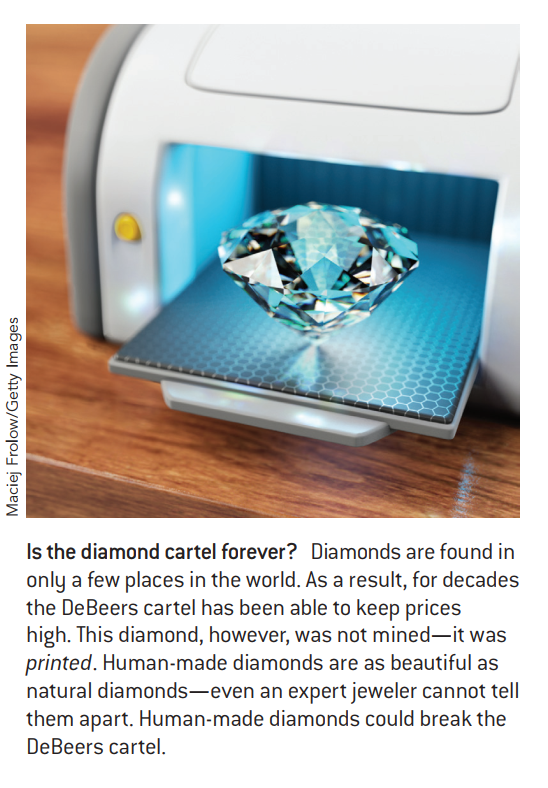
The puzzle, however, is why has it taken so long? The diamond market does have some peculiar features. Buyers of engagement rings don’t necessarily benefit from lower-prices per se as a diamond ring is a signal. If the cost of the signal goes down, people need to spend more to send the same message. An inexpensive engagement ring is thus something of a contradiction in terms, so price shopping is less intense. Nevertheless, the early buyers of lab-grown diamond rings should still benefit because the rings can’t be distinguished by the naked eye. Neither the bride, nor her friends, have to know the $10,000 ring only cost $5,000, right? Right?
Well maybe not right. DeBeers also produces lab-grown diamonds and they have a very strange pricing strategy:
De Beers started selling its own lab-grown diamonds in 2018 at a steep discount to the going price, in an attempt to differentiate between the two categories. The company expects lab-grown prices to continue to tumble, in what it sees as a tsunami of more supply coming on to the market, Rowley said. That should create an even bigger delta in prices between natural diamonds and lab grown, helping differentiate the two products, he said.
What? Ordinarily, the bigger the price between a competitor and its substitute the greater pressure on the competitor to lower prices! Yet DeBeers is gambling that the bigger the difference in price between natural and lab grown diamonds the bigger the demand for natural diamonds! Strange. The only way I see this working is if the fiancée knows the price of the ring, which maybe they do! In that case, the buyer still has to spend 10k and doesn’t care whether it’s 10k on synthetic diamonds or 10k on natural grown diamonds. But 10k on synthetic diamonds will get you more carats so we need an equilibrium in which a smaller diamond signals more expensive. But that runs against hundreds of years of expectations! And remember natural and lab grown diamonds are indistinguishable by the naked eye. It’s one thing for the fiancée to know the price of the diamond but surely her friends judge by what they can see, namely the size of the ring. Which signal is the most important to send?
All of this goes to show how peculiar the signaling model can be. Keep diamonds in mind when thinking about the the market for higher-education. Harvard is never going to lower prices and might they even raise prices as state schools lower their price?
Labor Day
Thanks capitalism!
The good news
Or: solar deployment is ~0.5% of global GDP and growing 43% Y/Y. https://t.co/1EqOj9C9vf
— Patrick Collison (@patrickc) September 4, 2023
Does China need more consumption?
I am repeatedly puzzled by this claim, which you will find in Michael Pettis, Paul Krugman, and others (WSJ), even Stephen Roach. It might make sense for short-run matters, when prices are (maybe) sticky. But as of late we are talking about how to restructure China for medium- and long-term growth.
Investment good prices are not sticky forever! If rates of return are too low, those prices will fall, thereby restoring higher rates of return. Somehow I never see that point mentioned.
Note that China is not in a liquidity trap, so weird liquidity trap results are not going to apply here. If you are worried about some kind of downward spiral of everything, monetary policy can fill the gap.
Paul Krugman for one writes (NYT):
The result is that China has a huge quantity of savings all dressed up with no good place to go.
China needs investment in lots of things, starting with say health care? There is a major doctor shortage and the quality of Chinese health care is abysmal. It is true that China also needs more consumption of health care, rather than production of health care with no one consuming it. But that is not what people mean when they say China needs more consumption.
It is plausible to argue that China has inefficiency wedges that favor some kinds of investment over consumption, such as massive subsidies for infrastructure construction. But it is odd to conclude that China needs outright “more consumption,” which indeed will limit China’s prospects for the future. What China needs is “both more consumption and more investment in the discouraged sectors.” That would both boost growth and the welfare of Chinese citizens.
The policy differences here are quite concrete. Don’t expect to get far by printing up lots of money, giving it to Chinese consumers, and telling them to spend it. You might, however, help growth rates if you could free up or otherwise assist China’s numerous dysfunctional sectors, again with health care being one very obvious example.
The WSJ wrote:
…top leader Xi Jinping has deep-rooted philosophical objections to Western-style consumption-driven growth…
C’mon people! Can I call it “Western-style production-driven growth”? (Where do you think most real income for consumption comes from?) The rebellion against Say’s Law has gone way too far.
Congratulations to Tharman!
SINGAPORE PRESIDENTIAL ELECTION: Tharman Shanmugaratnam is the next President after a landslide victory with 70.4% of the vote; Ng Kok Song finishes second (15.72%), followed by Tan Kin Lian (13.88%) https://t.co/8XuMy0xFIG #PE2023 pic.twitter.com/RJp0ca14SQ
— CNA (@ChannelNewsAsia) September 1, 2023
South Appalachia > North Appalachia
The ARC classifies 27.2 percent of North Appalachian counties as distressed but only 9.6 percent of South Appalachian counties that way. Over 70 percent of counties in South Appalachia have grown in population since the 2020 Census. North Appalachia lost 17,131 people in total, while South Appalachia gained 127,585. The difference in net in-migration is even more stark. While the North posted positive net domestic in-migration of 22,563, the South tallied almost 300,000—13 times as high. The story is similar for jobs, with the North losing 227,049 positions since the pre-pandemic year of 2019, while the South actually exceeded its pre-Covid levels by 66,377. In other words, much of South Appalachia is seeing a population inflow and is growing in both population and employment.
Here is much more from Aaron M. Renn, of interest and with good maps, and for the pointer I thank Terry O’Connor.
Driverless Cars May Already Be Safer Than Human Drivers
Tim Lee runs the numbers:
Waymo and Cruise have driven a combined total of 8 million driverless miles, including more than 4 million in San Francisco since the start of 2023.
And because California law requires self-driving companies to report every significant crash, we know a lot about how they’ve performed.
For this story, I read through every crash report Waymo and Cruise filed in California this year, as well as reports each company filed about the performance of their driverless vehicles (with no safety drivers) prior to 2023. In total, the two companies reported 102 crashes involving driverless vehicles. That may sound like a lot, but they happened over roughly 6 million miles of driving. That works out to one crash for every 60,000 miles, which is about five years of driving for a typical human motorist.
These were overwhelmingly low-speed collisions that did not pose a serious safety risk. A large majority appeared to be the fault of the other driver. This was particularly true for Waymo, whose biggest driving errors included side-swiping an abandoned shopping cart and clipping a parked car’s bumper while pulling over to the curb.
Cruise’s record is not impressive as Waymo’s, but there’s still reason to think its technology is on par with—and perhaps better than—a human driver.
Human beings drive close to 100 million miles between fatal crashes, so it’s going to take hundreds of millions of driverless miles for 100 percent certainty on this question. But the evidence for better-than-human performance is starting to pile up, especially for Waymo. And so it’s important for policymakers to allow this experiment to continue. Because at scale, safer-than-human driving technology would save a lot of lives.
Driverless cars never break the speed limit, the driver is never drunk, nor distracted by their cell phone or the fight they had with their spouse. Another advantage that people might not think of is that these cars are far better for cyclists as Parker Conrad notes:
It’s so, so obvious to anyone riding a bike in SF that autonomous vehicles are WAY safer for bicyclists than human drivers. They see me every time; human drivers constantly turn right into the bike lane without thinking.
Why? Because driverless cars literally have eyes in the back of their heads.
Driverless cars are in general less good at edge cases but the advantages add up.
I would qualify this only slightly by noting that some locations are more difficult than others and while San Francisco is quite difficult terrain, Phoenix, Arizona was chosen because of flat terrain and sunny weather. Still, the bottom line is absolutely correct. Driverless cars are safer and more capable than many people think and we should always measure their defects relative to realistic alternatives and not to some idealized notion of perfection.
Latin America fact of the day
The year 2022 was a vintage one for political turmoil in Latin America. Colombia elected a leftwing former guerrilla as president, Chile considered (and rejected) a radical new constitution, Peru’s elected president was impeached and imprisoned pending trial after after a failed attempt to seize extraordinary powers and Brazil’s far-right leader Jair Bolsonaro narrowly lost a bid for re-election.
It was also a record year for foreign direct investment. Investors committed $225bn to Latin America and the Caribbean in 2022, according to ECLAC, the UN’s economic agency for the region. That was 55 per cent more than the previous year and comfortably surpassed the previous peak a decade earlier. Part of the increase was a post-pandemic rebound but the number of future projects announced also rose, though more modestly.
And this:
Brazil was so popular with investors that it became the world’s number five destination for foreign investment last year, behind the US, China, Hong Kong and Singapore, according to Unctad. Brazil is also the top developing economy for international renewable energy investment, according to Unctad, with $115bn in projects.
Here is more from Michael Stott at the FT. Latin America is such a mess it is hard to be flat out optimistic. Yet I feel the highlights, such as southern Brazil and parts of Mexico, are going to surprise people on the upside. Mexico has survived terrible governance, and Colombia is likely to as well. Chile has turned back from the abyss. Argentina may be willing to try something different, even if it doesn’t seem on track to succeed. So these are heady days down south, noting that most of the major problems still have not gone away.