Category: Data Source
The Great (Male) Stagnation
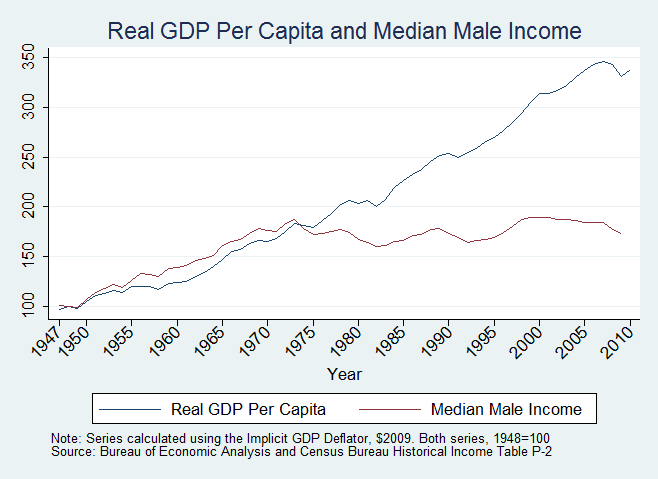
You have probably seen something like the following graph which shows real GDP per capita and median male income since 1947. Typically, the graph is shown with family or household income but to avoid family-size effects I use male income. It’s evident that real gdp per capita and median male income became disconnected in the early 1970s. Why? Explanations include rising inequality (mean male income does track real gdp per capita somewhat more closely), Tyler speculates that the nature of technological advances has changed, other people have speculated about rising corporate profits. Definitive answers are hard to come by.
Here is another set of data that most people have not incorporated into their analysis:
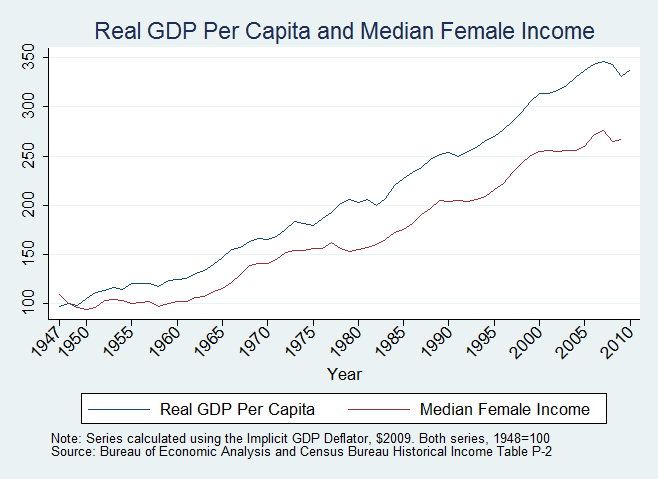
Median female income tracks real GDP per capita much more closely than does median male income. It’s unclear which, if any, of the above explanations are consistent with this finding. Increasing inequality, for example, predicts an increasing divergence in real GDP per capita and female median income but we don’t see this in the graph (there is a slight increase in the absolute difference but the ratios don’t increase). Similarly, we would expect changes in technology and corporate profits to affect both male and female median income equally but in fact the trends are very different.
One can, of course, do the Ptolemaic move and add an epicycle for differences in male and female inequality and so forth. Not necessarily wrong but not that satisfying either.
The big difference between female and males as far as jobs, of course, has been labor force participation rates, increasing strongly for the former and decreasing somewhat for the latter. Most of the female change, however, was over by the mid to late 1980s, and the (structural) male change has been gradual. Other differences are that female education levels have increased dramatically and male levels have been relatively flat. Females are also more predominant in services and males in manufacturing: plumbers, car mechanics, carpenters, construction workers, electricians, and firefighters, for example are still 95%+ male. Putting these together points to a skills and sectoral story, probably amplified by follow-on changes in labor force participation rates.
Thinking about the story this way also reminds us that the median male or female is not a person but a place in a distribution. The median male in 1970 can get rich by 1990 even though median male income is flat.
Again, no definitive answers, but the raw patterns are striking.
Note: An extra high tip of the hat to Scott Winship who whipped up all of the data during a discussion.
Sentence of the Day
…whatever some Prius fans may believe, it turns out that Priuses do have a corporeal form, and a Prius in congested traffic will cause more emissions indirectly by slowing other cars down than it will emit directly.
From Tim Harford’s excellent Adapt.
The North Korean global happiness index
Here at MR we are always keen to report dissenting viewpoints:
China is the happiest place on earth(!!) according to a new global happiness index released by North Korea’s Chosun Central Television. China earned 100 out of 100 points, followed closely by North Korea (98 points), then Cuba, Iran, and Venezuela. Coming in at 203rd place is America (or rather “the American Empire”, 美帝国), with only 3 happiness points. South Korea got a measly 18 points for 152nd place.
I cannot find the full rankings (which countries came between South Korea and the United States?) but here is a partial screen shot of the results, in Chinese. For the pointer I thank Eapen Thampy.
Zero Marginal Product (ZMP) workers
Via Annie Lowrey, from Neil Irwin:
People unemployed over 6 months rose by a whopping 361k, 44% of all unemployed.
Long Term Trends in Homicide Rates
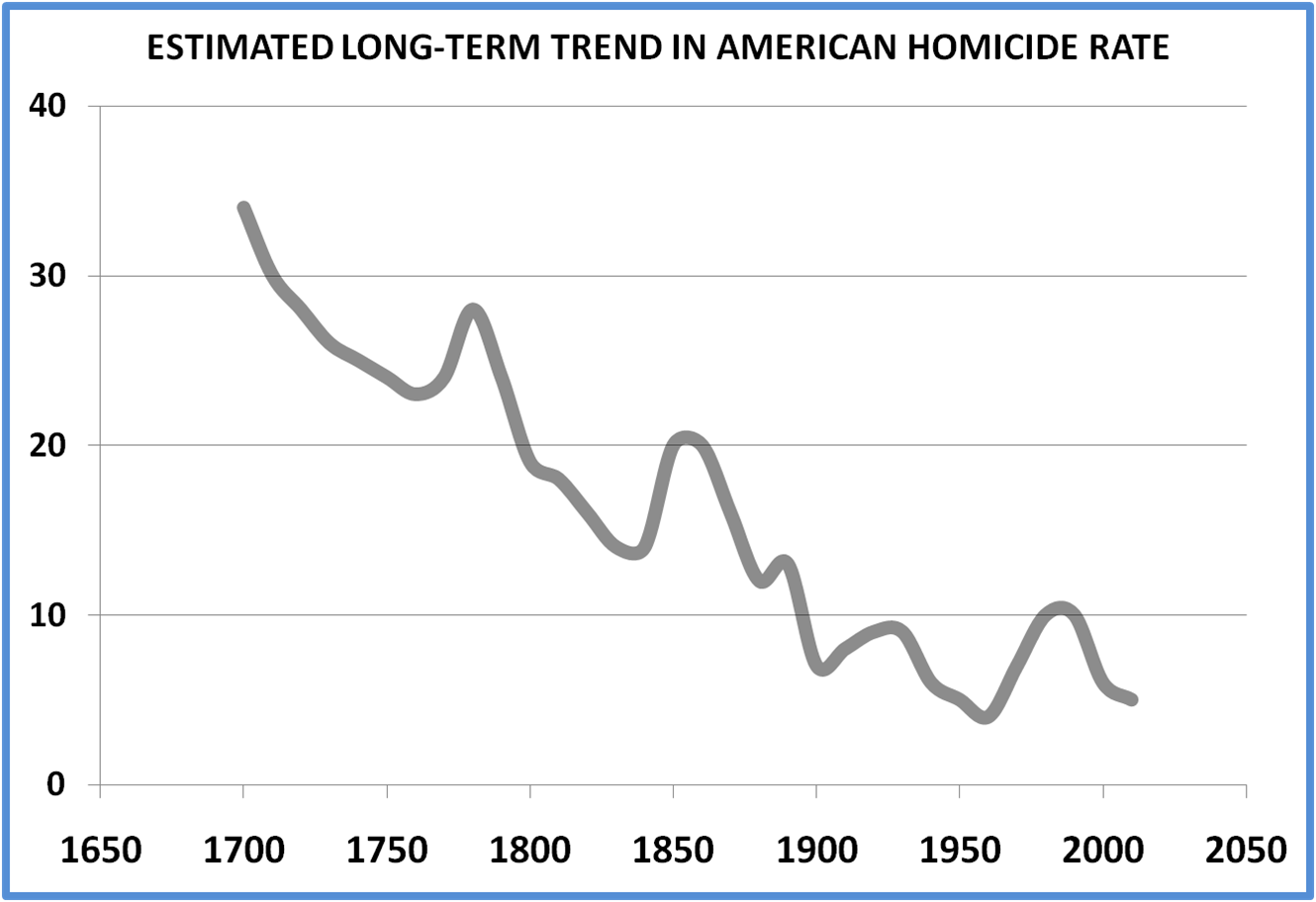
Here is a graph of American homicide rates, the earlier results should be taken with a grain of salt of course, but the trend is clear. N.B. These rates are per 100,000.
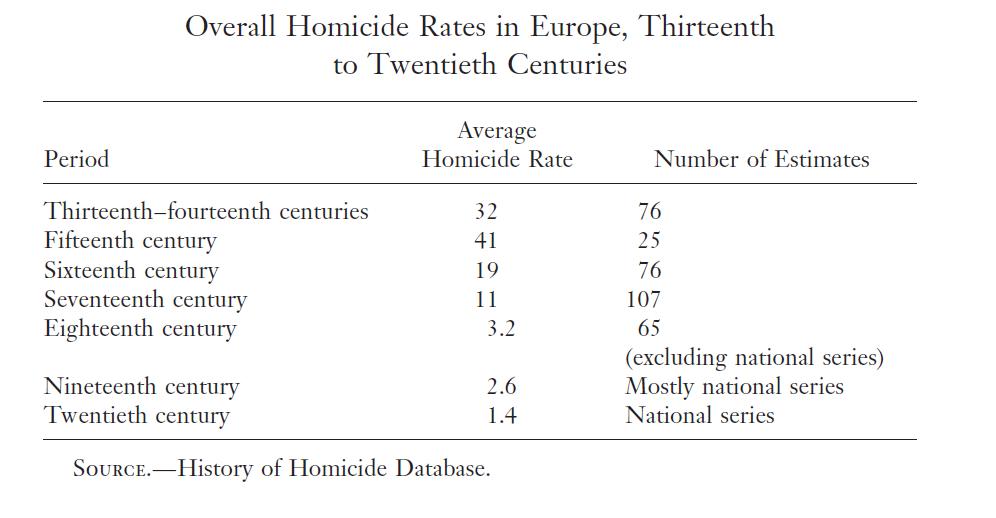
The American data is consistent with European data. Here is Table 2 from Manuel Eisner’s Long-Term Historical Trends in Violent Crime. Do note that some correction should be made for the fact that violence is less lethal when people are healthier and medical care is more effective.
The bottom line is that there has been a big and welcome decrease in homicide rates in Europe and America over the past several centuries. To put these numbers in perspective, however, note that the homicide rate in New Orleans today is 52 per 100,000 and in Detroit it’s 40 per 100,000 so even with a lower average there is lots of variation. Brazil today is around 22 per 100,000 not too far from America in the 19th century. The homicide rate in El Salvador is 71 per 100,000, in Jamaica (!) 60 per 100,000 and in Honduras 67 per 100,000 — all higher than fifteenth century Europe. Thus, the past was a more violent place but not so violent as to be unknown to the present.
Hat tip: Tim Harford.
Your Better Life Index
The OECDs Your Better Life Index lets you weight 11 dimensions of a better life such as housing, income, community, health, and life-satisfaction and then produces a flowery graph showing how countries score according to your metric. Looks like I screwed up. According to my metric, I should be living in Canada. What’s up with that, eh?
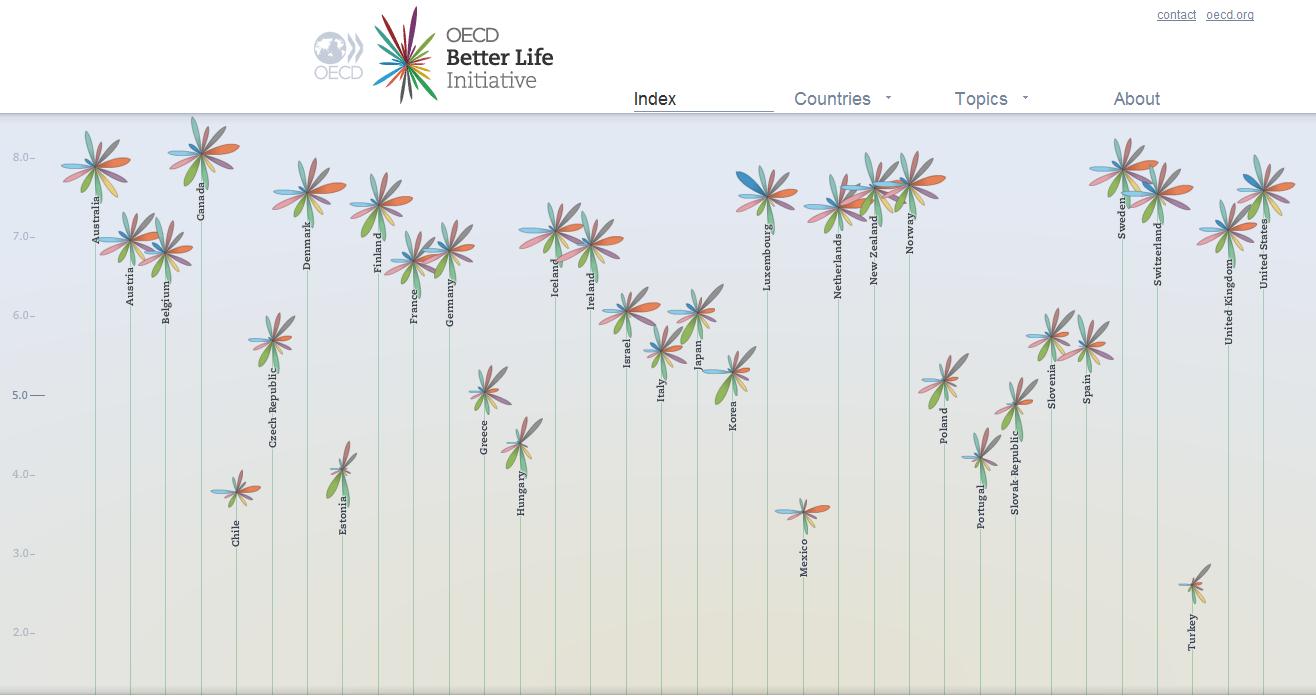
If you don’t like the OECDs better life ranking, here is Oprah’s best life series.
Hat tip: Real Time Economics.
Crime is falling, still
The number of violent crimes in the United States dropped significantly last year, to what appeared to be the lowest rate in nearly 40 years, a development that was considered puzzling partly because it ran counter to the prevailing expectation that crime would increase during a recession.
In all regions, the country appears to be safer. The odds of being murdered or robbed are now less than half of what they were in the early 1990s, when violent crime peaked in the United States. Small towns, especially, are seeing far fewer murders: In cities with populations under 10,000, the number plunged by more than 25 percent last year.
This development reminds me of a fallacy committed by (some) intellectuals. Occasionally you will read it insinuated that if inequality continues, or continues to rise, “the public will take matters into its own hands,” or something like that. Apart from being potentially factually false, such an outcome is neither endorsed nor condemned by the intellectual. The writer is hinting that the losers from such a rebellion would deserve what is coming to them, without having to say so. Least of all is the writer willing to throw his or her efforts behind dissuading or criticizing such a public response (is it so hard to write “don’t bring out the guillotine”?). The ostensibly “positive” description of what the public will do is used as a veiled threat, to be enacted if the warnings of the supposedly smarter intellectual are not heeded, yet without the intellectual having to make the threat himself.
A similar issue comes up in some discussions of free trade. It is sometimes hinted that if more is not done to help victims of free trade, the public will turn against free trade and force through extreme populist anti-trade measures. Again, the writer is playing on mood affiliation rather than analyzing such an outcome dispassionately and then evaluating the behavior of the public and trying to prevent it by framing the issue in a different manner.
The reality is that the public does not respond to most events, or most changes in the income distribution, as the intelligentsia likes to think it should, or will.
Maybe I will call this “the public as billy club” fallacy. I have a low opinion of sentences in which this fallacy is committed.
Which non-miniature country has the largest percentage of foreign-born residents?
The answer surprised me, it is under the fold (guess first!)…Ivory Coast, one source of documentation here. The article, on the Ivory Coast, is interesting in its own right. Many of the migrants are from Burkina Faso, or from other countries of West Africa, such as Mali and I believe also Liberia.

*A Convergence of Civilizations*
That’s the new book by Youssef Courbage and Emmanuel Todd and the subtitle is The Transformation of Muslim Societies Around the World. I read it as offering three major messages: a) there is no unique pattern for Muslim demographic evolution, b) there is more civilizational convergence than divergence, and c) the demographic data we observe explain a good deal about various Muslim countries. Here are some specific points:
1. In 1998-1999 about 55 percent of married women in Burkina Faso lived in polygamous relationships. In the Muslim parts of Nigeria, rates of polygamy can run forty to fifty percent, as opposed to about thirty percent in the Christian parts of Nigeria.
2. Demographically, Iran is very much a Western country with a 2.08 fertility rate, and the authors strongly hint that Iran has a reasonable chance of modernizing as Turkey has; the authors also worry that Turkey has not made a complete demographic transition and thus is vulnerable to backsliding. In general the authors seem to believe that the modernizing properties of Shiism are underrated.
3. Less than five percent of Uzbek or Tajik women are unmarried at age thirty. In Morocco it is 41 percent unmarried at age thirty, in Tunisia it is 54 percent, 50 percent in Lebanon, and a staggering 58 percent unmarried at age thirty in Algeria.
4. Palestinian birth rates are not as high as they are often made out to be: “If one takes Israel and the occupied territories together, one can grasp the absurdity of the demographic confrontations: The high fertility rate of Israeli Arabs is an internal threat to the Jewish state, whereas the high fertility rate of the Jewish settlers threatens Palestinian predominance in the West Bank.” (p.67)
5. In Shiite Azerbaijan, there are almost twice as many abortions per woman as live births, 3.2 to 1.7.
6. Among the Muslims of Europe, the Kosovars are arguably the least religious but also the most demographically conservative.
7. The Muslim Malays seem to have combined high birth rates with relatively high status for women.
Speculative throughout, as they say, but always interesting. Here is one short but accurate review. For the original pointer to the book I thank Chris F. Masse. Chris also points us to the DSK prediction market.
The offshore bias in U.S. manufacturing
In the newest Journal of Economic Perspectives, Susan Houseman, Christopher Kurz, Paul Lengermann and Benjamin Mandel report:
In this paper, we show that the substitution of imported for domestically produced goods and services—often known as offshoring—can lead to overestimates of U.S. productivity growth and value added. We explore how the measurement of productivity and value added in manufacturing has been affected by the dramatic rise in imports of manufactured goods, which more than doubled from 1997 to 2007. We argue that, analogous to the widely discussed problem of outlet substitution bias in the literature on the Consumer Price Index, the price declines associated with the shift to low-cost foreign suppliers are generally not captured in existing price indexes. Just as the CPI fails to capture fully the lower prices for consumers due to the entry and expansion of big-box retailers like Wal-Mart, import price indexes and the intermediate input price indexes based on them do not capture the price drops associated with a shift to new low-cost suppliers in China and other developing countries. As a result, the real growth of imported inputs has been understated. And if input growth is understated, it follows that the growth in multifactor productivity and real value added in the manufacturing sector have been overstated. We estimate that average annual multifactor productivity growth in manufacturing was overstated by 0.1 to 0.2 percentage points and real value added growth by 0.2 to 0.5 percentage points from 1997 to 2007. Moreover, this bias may have accounted for a fifth to a half of the growth in real value added in manufacturing output excluding the computer and electronics industry.
In other words, Michael Mandel was right. An ungated version is here. In terms of income distribution, think of these rents as going to those individuals and institutions which are good at managing international supply chains. That’s a relatively small number of people. A lot of the offshoring is enabled by an innovation — the internet — which really does boost productivity but not in a way which much helps the median U.S. wage.
Hemp for Victory
During World War II hemp made a brief comeback as an American crop due to shortages of rope-making stock from other countries. Hemp for Victory is a 1942 US Department of Agriculture film that encourages farmers to grow hemp. It opens with a discussion of the ancient history of hemp (canvas derives from cannabis) and then moves into how it is being farmed in Kentucky and other US states to help in the war effort.
The film has an interesting history. For decades the USDA and the Library of Congress denied that such a thing had ever been made but in 1976 Rastafarians delivered a copy to a reporter in Florida.
http://www.youtube.com/watch?v=W0xHCkOnn-A
Do demographic changes matter for financial market returns?
Be careful when predictable factors appear to shape financial market returns, but nonetheless this result, written up by Robert Arnott and Denis Chaves,is intriguing:
It seems natural that the shifting composition of a nation’s population ought to influence GDP growth and perhaps also capital markets returns. Entrepreneurialism, innovation, and invention tend to be associated with young adults. Accordingly, GDP growth should perhaps be best when there is a preponderance of young adults in a population. Investing for retirement is associated with middle-age, with a shift in preferences toward bonds with late-middle-age. So, stock and bond returns might be best in populations with growing rosters of these age groups, respectively. Our data – spanning over 60 years and 22 countries in our main tests and roughly 175 countries in out-of-sample robustness checks – support all of our priors.
We confirm what others have already demonstrated, but we extract markedly more statistical significance by adapting a polynomial curve-fitting technique pioneered by Fair and Dominguez (1991), to this new purpose. In our work, we find that a growing roster of young adults (age 15-49) is very good for GDP growth, a growing roster of older workers is a little bad for GDP growth, and a growing roster of young children or senior citizens is very bad for GDP growth.
This is in accord with some of Brink Lindsey’s recent observations. For the pointer I thank Sami, a loyal MR reader.
Illiteracy and Testing
Here is Matt Yglesias who is always sensible and worth reading on education policy:
Something that I think drives at least some of my disagreements with other liberals about education policy is that I think a lot of middle class liberals implicitly underestimate the extent of really bad learning outcomes. Take this report (PDF) from the Detroit Regional Workforce Fund which notes “that 47% of adults (more than 200,000 individuals) in the City of Detroit are functionally illiterate, referring to the inability of an individual to use reading, speaking, writing, and computational skills in everyday life situations” and also that “within the tricounty region, there are a number of municipalities with illiteracy rates rivaling Detroit: Southfield at 24%, Warren at 17%, Inkster at 34%, Pontiac at 34%.”
Under those circumstances, I find it difficult to be seized with worry that schools are going to be ruined by teachers “teaching to the test” too much. It is true that school districts that have started taking testing more seriously now need to step up and also take the possibility of outright cheating more seriously. But the fact that huge numbers of kids are passing through school systems and not learning basic literacy drives home the fact that districts also need to take checking to see if the kids are learning anything more seriously. That means tests, and since it’s good to be able to compare different schools to one another that means standardized tests. It’s a limited tool, it shouldn’t be the sole criterion on which the effectiveness of anything is measured, but it’s also an important one.
Mexico fact of the day
When the news was announced that Mexicans work longer days than anyone else in the world, many people here were too busy to notice.
“Really?” Marcelo Barrales said, “the longest?”
Mexicans work an average of ten hours a day, paid and unpaid labor, even though the country is far from the world’s poorest. Belgians work the least number of hours a day, at seven. It can be argued that these long hours stem in part from the inefficiency of labor in Mexico, but still this should put to rest the cliched notion that in Mexico the work ethic is weak.
Natural Gas

The graph is from Peter Tertzakian who notes:
To put this in perspective, 1,000 Tcf of natural gas contains the equivalent energy to 166 billion barrels of oil – a staggering amount considering that the discovery of 10 billion barrels of conventional oil these days is a rare occurrence, worthy of many headlines…
Estimates of recoverable shale gas have doubled in just the past year and shale gas is only part of the supply with the total being 2,552 trillion cubic feet (Tcf) of potential natural gas resources in the U.S. alone. Per unit of electricity, burning natural gas results in significantly fewer carbon dioxide emissions than coal. It is possible, however, that fracking may leak more methane to the atmosphere so the net climate benefit is unclear, at least given current methods of development.
Hat tip: Paul Kedrosky.