Category: Economics
Canada fact of the day
The University of Toronto’s commercialization office states that it is “in a class with the likes of MIT and Stanford.” But Stanford has generated $1.3-billion (U.S.) in royalties for itself and the Massachusetts Institute of Technology issued 288 U.S. patents last year alone; U of T generates annual licensed IP income of less than $3-million (Canadian) and averages eight U.S. patents a year. Statistics Canada reports that in 2009, just $10-million was netted by all Canadian universities for their licences and IP. Even when accounting for universities that have open IP policies, this is a trivial amount by global standards.
That is from Jim Balsillie, and is interesting more generally, most of all on Canada and innovation. For the pointer I thank Scott Barlow. My previous post on this topic is here.
Why Manhattan children earn less when they grow up
I am late to covering this excellent piece by David Leonhardt, but it is worth your attention. The core result is this:
Low-income children who grow up in Manhattan make less money as adults than similar low-income children who grow up elsewhere…It’s just that affluent Manhattan children don’t grow up to be quite as affluent as affluent children elsewhere.
To make the case of the affluent child concrete, if the Manhattan parents earn 400k a year, the child at age 26 averages 50k a year, compared to an average of 55k for comparable non-Manhattan kids at that same age. David considers a few hypotheses:
1. That effect is possibly diminishing as Manhattan improves, but the changes doesn’t yet show up in the data.
2. Perhaps Manhattan parents, or Manhattan itself, teach that money is not so important. For one thing, you get interested in culture there. Or maybe you want to become famous more than you want to become wealthy.
3. People who grew up in Manhattan are less likely to be married at a particular age.
4. Manhattan schools are less than perfect.
I would add a few hypotheses (not claims) of my own:
5. Manhattan is a selection of the most ambitious, highest-achieving individuals from elsewhere, and thus if you grow up there ambition and achievement seem to be especially forbidding prospects. Better not to try too hard. Recall David Hume on the “posts of honour” appearing to be filled?
6. Manhattan is a bad place, and bad things happen in bad places.
7. Manhattan families are more likely to spoil their children, create problems of moral hazard by promising or implying future support, and have less of an internal aspirational culture.
8. If you grow up there, Manhattan appears to be the center of the known universe and you are less likely to leave it in pursuit of higher earnings. Fewer people from New Jersey feel this same way, and so they end up in the region with the highest potential earnings for them; that is sometimes but not always New York City. (This mechanism also means Manhattan children are more likely to remain near their parents, see #7.)
9. A lot of Manhattan wealth is linked to finance and entertainment, and other superstar markets, which are maybe “less heritable” in terms of income than that small Midwestern furniture factory.
What else?
There is still a great stagnation
Sam Fleming reports from the FT:
The economist Andrew Smithers singles out a longer-term decline in investment as a share of GDP as a critical drag, as well as a slowdown in education improvements in recent decades. A report by the Aspen Institute and MAPI Foundation on Wednesday warned of a “significant lag in capital investment” in the US and argued this was a major contributor to low productivity growth. Whereas real GDP was in 2014 some 8.7 per cent above its level at the end of 2007, gross private domestic investment was up just 3.9 per cent in the same period, it said.
Productivity in the US rose just 0.6 per cent from a year earlier, according to the figures on Wednesday. San Francisco researchers John Fernald and Bing Wang warned in a note in February that their “best guess” is the relatively slow pace will continue. The implications from such sluggish productivity data are numerous.
The full story is here, interesting throughout. And here is a related post from Michael Mandel. Of course you should not infer much from quarterly productivity numbers, but that last quarter did not help, as employment went up a good deal and output did not.
For the pointer I thank Jim Olds.
What would a Tory victory mean?
The exit polls are predicting a solid Conservative victory, as is most of my Twitter feed and most importantly the bookies. If indeed this comes to pass, it has (at least) two pretty simple implications:
1. A people “wise enough” to opt for government-owned hospitals and single-payer health care have decided they want government smaller, not bigger. You will note “UK public spending was 36.6% of gdp in 2000, and had edged up over 50% by 2009 and 2010 and now [2013] is still in the range of 49% or so.” The Tories are indeed the party for smaller government.
2. The verdict is sufficiently positive on the “austerity experiment” (not what I prefer to call it, but that is a different story). I know this is literally unfathomable to the authors of the 7,243 blog posts I have read criticizing or perhaps even savagely attacking UK austerity, but here’s the nub of the matter: If indeed the UK should have a smaller government relative to gdp, in the medium term it will make up all of the relevant lost ground, and then some. A lot of UK voters understand that, a lot of American and British intellectuals do not, even though the latter are the ones who have studied the Solow model. I do not a priori dismiss the “labor market scarring story,” but if there is any country where it does not seem to apply it is the UK, which has had quite a rapid labor market bounce back.
Anyway, electoral events may yet surprise us, but at the very least the Tories are still in the running. Scott Sumner comments as well. By the way, if SNP really did take 58 out of 59 Scottish seats, it does seem to me that Great Britain will split up, much to my chagrin. So I am not overall cheered by the exit poll.
*Digital Gold*
The author is Nathaniel Popper and the subtitle is Bitcoin and the Inside Story of the Misfits and Millionaires Trying to Reinvent Money.
This excellent work is the book on Bitcoin you’ve been waiting for, most importantly it doesn’t require that you are the kind of person who wants to read a book on Bitcoin. I devoured my copy right away, it is full of information, explanation, and good humor, definitely recommended and entertaining throughout.
Here is Popper’s piece on Bitcoin and Argentina, here is Popper on Twitter.
Which students repay their student loans?
Fans of Game of Thrones know that “a Lannister always pays his debts.” So too do nearly all alumni from Notre Dame, Vassar, Harvey Mudd, and Brigham Young, at least when it comes to federal student loans.
There is more here, from Brookings, via Matthew C. Klein. Ahem…and for whatever reason, students from St. Johns do well too…
Pritchett’s Postulates and Urbanization
After promoting women’s groups in West Bengal as a route to development a West Bengali woman asked Lant Pritchett:
You all are from countries that are much richer and doing much better than our country so your country’s women’s self-help groups must also be much better, tell us how women’s self-help groups work in your country.
Pritchett’s inability to answer the question led him to what I call Pritchett’s postulates of development, four criteria to decide whether factor X is an important determinant of development.
- More developed countries must have more X than less developed countries.
- The developed countries must have more X than when they were less developed.
- Recent development successes must have more X than development failures.
- Countries that are developing rapidly must have more rapid growth of X than those that are developing slowly.
Since more developed countries don’t have noticeably more women’s self-help groups, this idea fails Pritchett’s postulates. Indeed, so do many fashionable development ideas being tested by RCTs which is one reason why Pritchett’s postulates are controversial in the development community.
Paul Romer, however, (whose important blog post led me to Pritchett’s postulates) has a different approach. Instead of dismissing ideas that fail the Pritchett postulates let’s look for ideas that pass them.
Romer provides evidence that urbanization passes all of Pritchett’s postulates. I think he is correct and that suggests that policies to increase the rate of urbanization could have a very big payoff for development.
We are used to thinking about urbanization as a consequence of development but it is surely also a cause. Consider, for example, the micro evidence. It’s not that rich people move to cities, it’s poor people who move to cities to become rich. We also know that cities are engines of innovation.
We can have too much urbanization or too much in one place as when we get a bloated capital city. Nevertheless, it seems that we could speed the rate of urbanization by reducing the cost of urban development – both the obvious costs like improving land allocation in say India but also improving sanitation and air quality in order to lower the health costs of urbanization. Similarly, well planned, efficient, even beautiful cities increase the benefits of urbanization. Urbanization policy in general becomes growth policy.
How else can we increase the rate of urbanization in developing countries?
The predecessors of Bitcoin and what we can learn from them
There is a new paper on this topic, by Thomas Kim:
To examine whether the recent price patterns and transaction costs of Bitcoin represent a general characteristic of decentralized virtual currencies, we analyze virtual currencies in online games that have been voluntarily managed by individuals since 1990s. We find that matured game currencies have price stability similar to that of small size equities or gold, and their transaction costs are sometimes lower than real currencies. Assuming that virtual currencies with a longer history can provide an estimate for Bitcoin’s prospects, we project that Bitcoin will be less influenced by speculative trades and become a low cost alternative to real currencies.
I remain more skeptical, as I do not see where the significant, non-speculative demand for Bitcoin comes from, outside a game setting. Imagine a future where the Chinese have removed capital controls and the private clearing houses preempt and take on a version of real time clearing, based on a (partially) publicly available ledger. Can that be more than five years away? Maybe less?
For the pointer I thank the excellent Kevin Lewis.
The ongoing rise of temping
The ever larger “staffing industry” may be having a similar effect. It is important across a much wider swathe of the economy than is often realised; having started out in the 1960s supplying office temps, today temping companies like Kelly Services, Adecco and Randstad mainly supply light manufacturing and industrial workers. In 2013 Kelly Services was America’s second-largest private-sector employer, after Walmart, with 750,000 staff. America’s 2.9m temps account for 2% of its jobs.
Temping is flourishing across the G7. In Japan, once the land of the shûshin koyô, or job for life, transient employment is ever more common; in 2014 Recruit, the country’s largest temp agency, listed for $19 billion on the Tokyo stock exchange. In Britain everything from the Olympics on down comes with temporary security guards supplied by G4S and temporary caterers provided by Compass, the country’s largest and third-largest private employers, respectively.
The industry provides flexibility for both workers and firms, and its ability to match workers on its databases to jobs may be very helpful: the 2010 Nobel prize was awarded for work showing how better job search and matching could lower unemployment. But labour aggregators that compete for business on the basis of helping lower clients’ staff costs have an incentive to keep pay low. In 2014 a report by Rebecca Smith and Claire McKenna of the National Employment Law Project, an American lobby group, claims that staffing agencies cut temps’ bargaining power.
The feature story is of interest more generally, much of it on when real wages will start to rise again by significant amounts.
How disruptive will the Tesla battery be?
Ramez Naam has an opinion, backed up by some reasonable estimates:
For most of the US, this battery isn’t quite cheap enough. But it’s in the right ballpark. And that means a lot. Net Metering plans in the US are filling up. California’s may be full by the end of 2016 or 2017, modulo additional legal changes. That would severely impact the economics of solar. But another factor of 2 price reduction in storage would make it cheap enough that, as Net Metering plans fill up or are reduced around the country, the battery would allow solar owners to save power for the evening or night-time hours in a cost effective way.
That is also a policy tool in debates with utilities. If they see Net Metering reductions as a tool to slow rooftop solar, they’ll be forced to confront the fact that solar owners with cheap batteries are less dependent on Net Metering.
That same factor of 2 price reduction would also make batteries effective for day-night electricity cost arbitrage, wherein customers fill up the battery with cheap grid power at night, and use stored battery power instead of the grid during the day. In California, where there’s a 19 cent gap between middle of the night power and peak-of-day power, those economics look very attractive.
And the cost of batteries is plunging fast. Tesla will get that 2x price reduction within 3-5 years, if not faster.
Read the whole thing, and note the discussion of India too.
Jon Stewart Wrong on Education in Baltimore
“If we are spending a trillion dollars to rebuild Afghanistan’s schools, we can’t, you know, put a little taste Baltimore’s way. It’s crazy.”
–Jon Stewart, “The Daily Show,” April 28, 2015
The Fact Checker column at the Washington Post rightly awards Jon Stewart four Pinocchios for this howler. It’s not close to being true and even as hyperbole it lends support to the common misperception that foreign aid is a large percentage of the Federal budget.
Let’s forget the off-the-cuff comparison to Afghanistan, however, and focus on a more relevant comparison. Is it true, as Stewart suggests, that Baltimore schools are underfunded relative to other American schools? The National Center for Education Statistics reports the following data on Baltimore City Public Schools and Fairfax County Public Schools, the latter considered among the best school districts in the entire country:
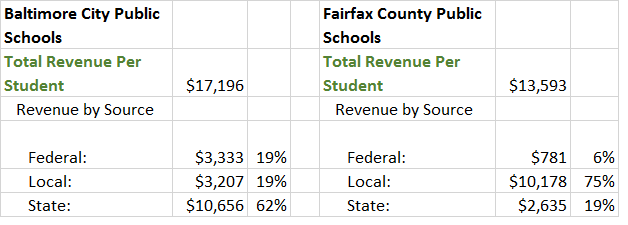
Baltimore schools spend 27% more than Fairfax County schools per student and a majority of the money comes not from the city but from the state and federal government. Thus, when it comes to education spending, Baltimore has not been ignored but is a recipient of significant federal and state aid.
Tony Atkinson and François Bourguignon on inequality
His new book Inequality: What Can Be Done?, is out mid-May but already available in some bookstores. Here is an interview with Atkinson. I thought this book did not take sufficient care with some very basic distinctions, such as the difference between a problem of poverty and a problem of inequality. Nor does it put enough emphasis on wealth creation, or explain why Korean-Americans have done pretty well over the last thirty years, among other possible examples.
The book is dedicated to the NHS workers of Britain. That’s fine, many of them are very good, but Atkinson doesn’t mention a few key points, namely that a) the British system ranks relatively poorly by European standards, b) the British system probably has too much governmental ownership and provision, and c) bureaucracies usually underpay their best workers and thus do not generate enough initial income inequality.
François Bourguignon has a very good and readable new book on the international dimension of inequality, The Globalization of Inequality.
Martin Wolf has an FT review of both books.
For the pointer to the Atkinson interview I thank Enrico Schaar.
Square Dancing Bees and Quadratic Voting
It’s well known that bees dance to convey where useful resources are located but how do bees convey the quality of the resource and what makes this information credible? Rory Sutherland and Glen Weyl argue that the bees have hit upon a key idea, quadratic dancing or as I like to put it, square dancing.
Seeley’s research shows that the time they spend on dances grows not linearly but quadratically in proportion to the attractiveness of the site they encountered. Twice as good a site leads to four times as much wiggling, three times as good a site leads to nine times as lengthy a dance, and so forth.
Quadratic dancing has some useful properties which can be duplicated in humans with quadratic voting.
Under Quadratic Voting (QV), by contrast, individuals have a vote budget that they can spread around different issues that matter to them in proportion to the value those issues hold for them. And just as with Seeley’s bees, it becomes increasingly costly proportionately to acquire the next unit of influence on one issue. This approach highlights not only frequency of preferences but also intensity of preferences, by forcing individuals to decide how they will divide their influence across issues, while penalising the single-issue fanatic’s fussiness of putting all one’s weight on a single issue. It encourages individuals to distribute their points in precise proportion to how much each issue matters to them.
They offer a useful application
Consider a firm that wants to learn whether customers care about particular product attributes: colour, quality, price, and so on. Rather than simply ask people what they care about — which leads to notoriously inaccurate results, often where people affect strong views just to maximise their individual influence — a business, or a public service, could supply customers with budgets of credits which they then used to vote, in quadratic fashion, for the attributes they want. This forces the group of respondents, like the swarm of bees, to allocate more resources to the options they care most about.
Weyl’s paper with Eric Posner is a good introduction to quadratic voting and here are previous MR posts on quadratic voting.
Fast Tracking the FDA
Bart Madden and James Pinkerton suggest a new “free to choose” track for pharmaceuticals. Pharmaceuticals which showed initial effectiveness would be available for early sale but all treatment information under the early-sale program would have to be reported to an open-access database.
After a drug successfully passes safety trials and shows initial effectiveness in clinical trials—that is, the early steps—a drug developer could request that their drug be available for sale on a “free to choose” track (the developer could elect also to continue on the FDA clinical trial track). As a result, patients such as Matt Bellina would be able to access innovative new drugs up to seven years earlier than waiting for a final FDA decision. For patients given only a few years—or months—to live, seven years sooner could spell life, not death.
Under our proposal, a patient’s doctor would be required to submit treatment results and medical information such as a patient’s genetic data to the open-access database. Doctors and patients would get real-time updates about the benefits and side effects of any “free to choose” drug and be able to make informed decisions about an early use of these new drugs versus approved drugs.
We might bear in mind that clinical trials involve patients who are mostly similar. On the other hand, because the “free to choose” option would be available to everyone, new insights would be obtained about how a drug performs for a far broader range of patients. These insights would better inform the biopharmaceutical industry, leading, in turn, to better allocation of research funds and faster innovation.
Bart’s excellent book Free to Choose Medicine has more on the proposal, which I think would speed drugs to patients and increase pharmaceutical research and development. Do note that I hold the Bartley J. Madden chair in economics at Mercatus at GMU and I have my biases.
How will Canada be a part of the knowledge economy?
Me:
Some economic sectors are distributed everywhere, like every city has its dentist[s], and other sectors are quite clustered. Banking is pretty clustered — New York, London, Hong Kong. Tech has been evolving in a pretty clustered way; I don’t mean simple software support, which is more like dentistry, but big, grand projects — the next Google, the next Facebook, Uber. We see those come out of quite a small number of places, so Skype coming from Estonia is quite the exception. Even then, it was improved by people in the clusters.
I think any location, not just Canada, has to ask itself, ‘are we going to be one of those clusters or not’? And the correct answer may be ‘no’. It may also be the sector evolves so it’s less clustered and more like dentistry, and then everywhere including Canada would partake. But maybe the future is Canada will have a knowledge sector doing small-scale things like software design for local projects but not anything like its own Silicon Valley. I guess at this point that seems likely — that Canada will not be a huge innovative part of the knowledge economy.
That is from my interview with the excellent Eva Salinas, mostly about other topics, such as what a great egalitarian age we live in and also where the World Bank and IMF stand, among other issues. A few of the comments make more sense if you know that the interviewer is Chilean and we were discussing Chile before the formal interview started.