Category: Economics
Korean private high schools outperform Korean public high schools
There is a semi-new paper (pdf) by Youjin Hahn, Liang Choon Wang, and Hee-Seung Yang, the abstract is this:
We show that private high school students outperform public high school students in Seoul, South Korea, where secondary school students are randomly assigned into schools within school districts. Both private and public schools in Seoul must admit students randomly assigned to them, charge the same fees, and use the same curricula under the so-called equalization policy’, but private schools enjoy greater autonomy in hiring and other staffing decisions and their principals and teachers face stronger incentives to deliver good students’ performance. Our findings suggest that providing schools greater autonomy in their personnel and resource allocation decisions while keeping school principals accountable can be effective in improving students’ outcomes.
That is from G Heller Sahlgren, who has numerous tweets of interest on Korean schooling.
Down on the farm?
Farming businesses in the United States are still dominated by whites, but Mr. Flores (whose last name means “flowers” in English) is one of a growing number of Latinos who own or operate farms in the country. While the overall number of farms in the United States decreased by 4 percent from 2007 to 2012, during the same period the number of farms run by Hispanics increased by 21 percent to 67,000 from 55,570, according to data released in May from the government’s 2012 census of agriculture. The numbers signaled a small but consistent pattern of growth in agribusiness among Latinos, many of whom have gone from working in the fields to sitting in the head offices.
Many, like Mr. Flores, emigrated from Mexico in the 1970s and ’80s and worked their way up from picking produce to managing the business. They have classic American bootstrap stories of grit, determination and a little bit of luck. Some own the land they till while others rent. Many employ Mexicans whose language and job duties they understand intimately.
That is from Tanzina Vega, there is more here.
North Carolina discounts for praying customers
A North Carolina diner that offers discounts to praying customers has ignited an internet firestorm across the US.
For the past four years, Mary’s Gourmet Restaurant in Winston-Salem, North Carolina, had been surprising customers with a 15% discount if they prayed or meditated before meals.
“It could be anything – just taking a moment to push away the world,” says Mary Haglund, the owner. “I never asked anyone who they were praying to – that would be silly. I just recognised it as an act of gratitude.”
However, it wasn’t until customer Jordan Smith shared her receipt with a Christian radio station on 30 July that the diner and its discount went viral.
“There was no signage anywhere that promoted the prayer discount. We just ordered our food and prayed over it once it arrived,” says Smith. “It wasn’t until the end when they brought the bill over and it said 15% discount for praying in public.”
The story is here, and for the pointer I thank Felix Morency-Lavoie. By the way, the discount may violate the 1965 Civil Rights Act.
Dying on payday
And this is from the relatively egalitarian Sweden:
In this paper, we study the short-run effect of salary receipt on mortality among Swedish public sector employees. By exploiting variation in pay-days across work-places, we completely control for mortality patterns related to, for example, public holidays and other special days or events coinciding with paydays and for general within-month and within-week mortality patterns. We find a dramatic increase in mortality on the day salaries arrive. The increase is especially pronounced for younger workers and for deaths due to activity-related causes such as heart conditions and strokes. Additionally, the effect is entirely driven by an increase in mortality among low income individuals, who are more likely to experience liquidity constraints. All things considered, our results suggest that an increase in general economic activity upon salary receipt is an important cause of the excess mortality.
The authors are Elvira Andersson, Petter Lundborg, and Johan Vikström, the pdf is here, hat tip goes to Ben Southwood.
Facts about food
Stanford’s Dan Jurafsky has written a book doing just that. In The Language of Food: A Linguist Reads the Menu, Jurafsky describes how he and some colleagues analyzed a database of 6,500 restaurant menus describing 650,000 dishes from across the U.S. Among their findings: fancy restaurants, not surprisingly, use fancier—and longer—words than cheaper restaurants do (think accompaniments and decaffeinated coffee, not sides and decaf). Jurafsky writes that “every increase of one letter in the average length of words describing a dish is associated with an increase of 69 cents in the price of that dish.” Compared with inexpensive restaurants, the expensive ones are “three times less likely to talk about the diner’s choice” (your way, etc.) and “seven times more likely to talk about the chef’s choice.”
Lower-priced restaurants, meanwhile, rely on “linguistic fillers”: subjective words like delicious, flaky, and fluffy. These are the empty calories of menus, less indicative of flavor than of low prices. Cheaper establishments also use terms like ripe and fresh, which Jurafsky calls “status anxiety” words. Thomas Keller’s Per Se, after all, would never use fresh—that much is taken for granted—but Subway would. Per Se does, however, engage in the trendy habit of adding provenance to descriptions of ingredients (Island Creek oysters, Frog Hollow’s peaches). According to Jurafsky, very expensive restaurants “mention the origins of the food more than 15 times as often as inexpensive restaurants.”
There is more here, you can pre-order the book here. My previous posts about this work are here.
How much does a Toronto fire hydrant earn in parking tickets?
…as it turns out, some hydrants seem to be more tempting — and more costly — than others.
In Toronto, one hydrant stands above the rest. People are fined so often for parking in front of it that on Google’s Street View, a white Toyota can be seen with a yellow slip under its wiper blade as a parking-enforcement officer walks away.
Since 2008, cars that parked too close to the hydrant at 393 University Ave. have been ticketed 2,962 times. Those fines add up to $289,620 —more than any other hydrant in the city.
More generally:
A Canadian Press analysis of Toronto’s parking-ticket data found the city has collected more than $24 million since 2008 by fining people who parked too close to hydrants.
Fabrizi says all parking fines, including those from parking next to hydrants, add up to $80 million a year.
That may seem like a big number, but Fabrizi says it only represents about one per cent of the money needed to run all of the city’s programs.
“The amount of revenue that parking generates is so minuscule compared to the overall revenue that it really doesn’t serve a great purpose as a revenue generator.”
About half the revenue from parking tickets pays for parking enforcement and operations, he added.
The full article, which also lists the ten most lucrative Toronto hydrants, is here. For the pointer I thank Michelle Dawson.
Europe’s problem isn’t just the deflation
Leonid Bershidsky writes:
For more than four years, consumer prices in Switzerland have risen at an annual pace well below 1 percent. In 2012 and 2013, the country even experienced deflation. Yet its economy has grown at a steady pace, and is expected to expand by 2 percent this year. The unemployment rate is a low 3.2 percent.
He makes some good points, but I think he is too complacent about the costs of deflation for less flexible economies.
Are big cities bad places to live?
Kevin Bryan directs my attention to this David Albouy paper (pdf), which attempts to estimate the quality of life across various metropolitan areas. Here is the key part of the abstract:
…adjusted quality-of-life measures successfully predict how housing costs rise with wage levels, are positively correlated with popular “livability” rankings and stated preferences, and do not decrease with city size. Mild seasons, sunshine, hills, and coastal proximity account for most inter-metropolitan quality-of-life differences.
If you go to Table A1, toward the very back of the paper, Honolulu is #1, followed by some fancy places in northern California, Santa Barbara, and Santa Fe. Last on the list are Decatur, Il, Beaumont-Port Arthur Texas, and last and also least is Kokomo, Indiana.
The states with the highest qualify of life are out west and in New England. I suspect these rankings are not taking heterogeneity seriously enough, as market prices capture marginal values but marginal values only for some movers. “Livability” is actually closer to an “average value” sort of concept. In other words, even with above average income I don’t want to have to pay Santa Barbara home prices.
In any case, the topic has come up lately and I thought I would pass these results along.
What should the European Central Bank actually do?
As parts of the eurozone seem to be creeping into deflation, a number of you have written and asked me what I think the ECB should be doing. Here are my views on three options:
1. Quantitative easing. People mean different things by this, but I am not sure that a complicated answer would be much better than a simpler one. I view it as better than nothing, but there is a risk it amounts to little more than a short- vs. long-term asset swap, which is hardly a solution.
2. Nominal gdp targeting. In general I like this idea, but which ngdp gets targeted? Eurozone ngdp, presumably. But when you have multiple countries, individual countries can end up with insufficient nominal gdp even if the eurozone meets a well-specified target overall. (Given independent bank regulators, debt structures, fiscal authorities and the like, I view this as more serious than say the 50 U.S. states, which have a higher level of integration, most of all at the policy level.) How much of a guarantee is there that Portugal would reap expansionary benefits, given the private credit contraction in that country? The potential clustering of ngdp growth in some parts of the eurozone is another way of stating why the currency union wasn’t a good idea in the first place. This is still much better than doing nothing, but as a monetary policy rule ngdp seems better designed for the single-country case.
There is another issue with ngdp targeting for the ECB, and that is markets simply might not believe it. If that were the case, what then should the ECB actually do to see through the promise? That brings us to #3:
3. A new and different inflation target. My current wish would be a new ECB mandate specifying a minimum core inflation rate of three percent for each of the largest countries in the eurozone, say France, Germany, Italy, and Spain. If any of these four countries seemed to be coming in under three percent inflation, the ECB would have to do more. And if need be, you could extend this rule through to more countries, with Malta and Cyprus probably at the end of that list.
Sumnerians should note this also might be the best way to actually meet an operational ngdp target for a fair number of eurozone countries. Note that I accept many of Scott’s critiques of inflation rate targeting, at least on a theoretical level. The (only?) advantage of this policy is that citizens would know what it means. They would know they hate it, in the same way that say Americans hate higher gas prices. They would know this is a higher inflation policy and the ECB would know it could not spin it any other way. A fair amount of inflation and thus monetary stimulus would in fact result.
Of course that is also why this is unlikely to happen. We’ll probably get some form of ineffective QE as a cop-out but better-than-nothing attempt.
“Needing a policy that you hate” — maybe there should be a phrase in Nahuatl for that?
Addendum: Scott Sumner comments.
The economics of complex tax incentives
I’ve long wondered about this question, now there is a paper about it, from Johannes Abeler and Simon Jäger, forthcoming, “Complex Tax Incentives,” American Economic Journal: Economic Policy. The abstract is here:
How does tax complexity affect people’s reaction to tax changes? To answer this question, we conduct an experiment in which subjects work for a piece rate and face taxes. One treatment features a simple, the other a complex tax system. The payoff-maximizing output level and the incentives around this optimum are, however, identical across treatments. We introduce the same sequence of additional taxes in both treatments. Subjects in the complex treatment underreact to new taxes; some ignore new taxes entirely. The underreaction is stronger for subjects with lower cognitive ability. Contrary to predictions from models of rational inattention, subjects are equally likely to ignore large or small incentive changes.
I would think the real world danger is that intermediaries will teach people how to game complex tax systems over time. Still, the actual tax incentive faced by individuals may not be so transparent even to informed and strategic advisors, nor are the advisors always able to communicate actionable advice to the individuals facing the taxes.
Here is Simon’s paper on the returns to German higher education.
FDA Device Regulation
In the interests of length I had to sacrifice a few points in my WSJ review of Innovation Breakdown by Joseph Gulfo (excerpted on MR yesterday). In the review, I argued that the FDA could speed the approval of medical devices and reduce uncertainty by not reviewing directly but becoming a certifier of certifiers as is done in Europe.
In fact, a US model is already in place. OSHA, the Occupational Safety and Health, requires that a range of electrical products and materials meet certain safety standards but it outsources certification to Underwriters Laboratories and other Nationally Recognized Testing Laboratories. We could and should do the same for medical devices and for drugs. Indeed, if a device or drug is permitted in a developed, advanced economy such as in Europe, Australia and Japan then I see no reason why it ought not to be provisionally approved in the United States (and vice-versa).
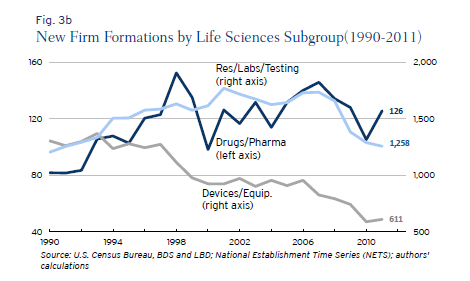
My paper with DiMasi and Milne showed that some FDA drug divisions appear to be much more productive than other divisions suggesting possibilities for substantial improvements if best practices were uniformly adopted. There also appear to be substantial differences between the regulation of drugs and devices especially in recent years. Ian Hathaway and Robert Litan have a new paper on Entrepreneurship and Job Creation in the U.S. Life Sciences Sector that shows that new firm creation in the medical device sector has fallen drastically since 1990 and far more than in the drug sector. Although there are likely many causes, the drop in the number of new firms is consistent with Gulfo’s experience of regulatory uncertainty and may suggest increases in regulatory cost for devices relative to drugs. Here is Hathaway and Litan:
The medical devices and equipment sector, on the other hand, saw new firm formations decline steadily and persistently between 1990 and 2011—falling by 695 firms or 53 percent during that period. Its share of new life sciences firms fell to 31 percent in 2011 from 50 percent in 1990. Unlike its life sciences sector counterparts, the decline in new firm formations in this segment appears to stretch beyond the cyclical effects of the Great Recession.
Do the advantages of undergraduate prestige persist?
Joni Hersch of Vanderbilt has a new paper on this topic. Given the multiple dimensions of unobserved quality, I wonder if there is any method which can convince me on such questions. Still, I am glad to see someone putting the effort in. Here is what the author came up with:
Income disparities arise not only from differences in the level of education but also from differences in status associated with an individual’s degree-granting college or university. While higher ability among those who graduate from elite undergraduate institutions may account for much of the earnings premium associated with elite education, ability should be largely equalized among those who graduate from similarly selective graduate programs. Few graduates of nonselective institutions earn post-baccalaureate degrees from elite institutions, and even when they do, undergraduate institutional prestige continues to influence earnings overall and among those with law, medical, graduate business and doctoral degrees.
For the pointer I thank the excellent Kevin Lewis. Kevin also refers us to this unorthodox paper on the Finns, namely why are they so smart yet win so few Nobel Prizes.
Fair trade markets in everything?
“Fair Trade” Cocaine Is A Thing Now
For instance:
Even more intriguing is the use of marketing strategies that mimic corporate social responsibility initiatives. These may take the form of financial sponsorship of organizations likely to be viewed favorably by online drug consumers. For example, one Australian drug vendor recently advertised their enterprise as a: “Proud financial supporter of WikiLeaks and Bluelight.”
At the more extreme end of socially progressive marketing strategies used by online dealers are those that involve the promotion of drugs on the basis of supposedly “ethical”, “fair trade”, “organic” or “conflict-free” sources of supply:
“We are a team of libertarian cocaine dealers. We never buy coke from cartels! We never buy coke from police! We help farmers from Peru, Bolivia and some chemistry students in Brazil, Paraguay and Argentina. We do fair trade!”
Naturally, it is impossible to verify these claims.
For the pointer I thank Annie Lowrey.
Innovation Breakdown
From my review today in the WSJ of Innovation Breakdown by Joseph Gulfo:
Yo is a smartphone app. MelaFind is a medical device. Yo sends one meaningless message: “Yo!” MelaFind tells you: “biopsy this and don’t biopsy that.” MelaFind saves lives. Yo does not. Guess which firm found it easier to put their product in consumers hands? Oy.
In “Innovation Breakdown: How the FDA and Wall Street Cripple Medical Advances,” Joseph Gulfo tells the tumultuous history of MELA Sciences, the company that invented MelaFind. When Dr. Gulfo joined the firm as president and CEO in 2004, the company’s brilliant team of scientists had spent many years and tens of millions of dollars to develop MelaFind, a “camera with a brain”—optical technology that would scan potential melanomas in multiple spectra and then, using sophisticated algorithms and large datasets, diagnose which were most likely to be cancerous.
MELA Sciences conducts an extensive clinical trial according to a protocol agreed on by the FDA and all looks good. After the clinical trial is completed, however, the FDA backs away from the protocol and comes out against MelaFind.
…The title of Dr. Gulfo’s book is “Innovation Breakdown” but “Innovator’s Breakdown” might have been more apt. The letter sent the author into survival mode. He battled the FDA, calmed investors, and defended against the lawsuit all while trying to keep the company afloat. Under stress, Dr. Gulfo’s health began to decline: He lost 29 pounds, his hair began to fall out, and the pain in his gut became so intense he needed an endoscopy. When his wife begged him to quit, he refused. They turned into roommates. “We were nothing more than cordial. I basically shut my wife out of my life,” he writes.
…The climax to this medical thriller comes when, in “the greatest 15 minutes of [his] life,” Dr. Gulfo delivers an impassioned speech, à la “Twelve Angry Men,” to the FDA’s advisory committee. The committee voted for approval, 8 to 7, and, perhaps with the congressional hearing in mind, the FDA approved MelaFind in September 2011.
It was a major triumph for the company, but Dr. Gulfo was beat. He retired from the company in June 2013—just in time to save his marriage.
Yet remarkably, given his experience, Mr. Gulfo writes that he still believes in a strong FDA. He argues in the book that better “leadership” and a few tweaks to existing rules can fix the problem. He’s wrong.
Compare MelaFind’s experience in the U.S. with its reception in Europe: MelaFind was submitted for marketing approval in Europe in May 2011. It was approved just five months later. One key reason for Europe’s efficient approval process is that European governments don’t review medical devices directly. Instead they certify independent “notified bodies” that specialize and compete to review new products. The European system works more quickly than the U.S. system, and there is no evidence that it results in reduced patient safety. Rather than tweak the current system, why doesn’t the U.S. just adopt the European model and call it a day? Our health and our economy would be better off for it.
Google’s Sergey Brin recently said that he didn’t want to be a health entrepreneur because “It’s just a painful business to be in . . . the regulatory burden in the U.S. is so high that I think it would dissuade a lot of entrepreneurs.” Mr. Brin won’t find anything in Dr. Gulfo’s book to persuade him otherwise. Until we get our regulatory system in order, expect a lot more Yo’s and not enough life-saving innovations.
Why is there so much unemployment in Gaza?
Assaf Zimring writes to me:
Since we tend to associate high unemployment with any economic calamity, people don’t seem to think a lot about why we see very high unemployment in Gaza. But I am puzzled by it. How come an economy with such tremendous shortages fails to employ 40% of its workers in an attempt to meet these shortages?
Has the (by now, fairly loose) blockade pushed the MPL to zero for 40% of workers? Is it uncertainty that stops investment? Did large aid payments (in some years – 50% of GDP) cause some kind of a Dutch disease of an epic scale (though I am not sure that would lead to unemployment)? I wonder if you have any thoughts about that.
At the first link you will find some interesting papers by Assaf on the Gaza blockade and other Gaza shocks. One option of course is simply that hardly anyone is really employed, although there is massive underemployment in grey and black market economies, including for the digging of tunnels and subsistence agriculture.