Category: Economics
The separate door
In an age of widening inequality, in a city with ever-more expensive rent, the “poor door” has become an outsized symbol.
Technically, it doesn’t exist yet. But earlier this month, New York City approved plans for a high-rise apartment in Manhattan that will include it: a separate entrance for the property’s subsidized tenants. The luxury condo will otherwise have more than 150 market-rate apartments. But its 55 affordable units, offered by the developer Extell through the city’s inclusionary housing program, will be separated with different amenities, different views of the city and, yes, a different front door.
A housing complex in DC soon may be trying the same.
Sentences about poverty
The number of distressed neighborhoods in the suburbs grew by nearly 140 percent, compared to 50 percent in urban areas.
That is since 2000, from Danielle Kurtzleben.
Ghana isn’t doing as well as many people think
Ghana will turn to the International Monetary Fund for help after the west African country’s currency plunged roughly 40 per cent this year against the dollar, making the cedi the worst performing currency in the world in 2014.
Nearly three years after the start of oil production, which was meant to further strengthen the country’s fiscal position, the public purse is looking empty. Ghana is battling a double-digit fiscal deficit after a 75 per cent increase in public salaries over two years. Inflation is rising rapidly as the cedi plunges.
Ghana ran a fiscal deficit equal to 10.1 per cent of gross domestic product in 2013. The government has promised to lower the deficit to 8.5 per cent this year, but observers believe it would struggled to reduce it below 10 per cent.
The full FT story is here, here are ungated sources, here is one account from Ghana.
U.S. IT investment as a share of gdp
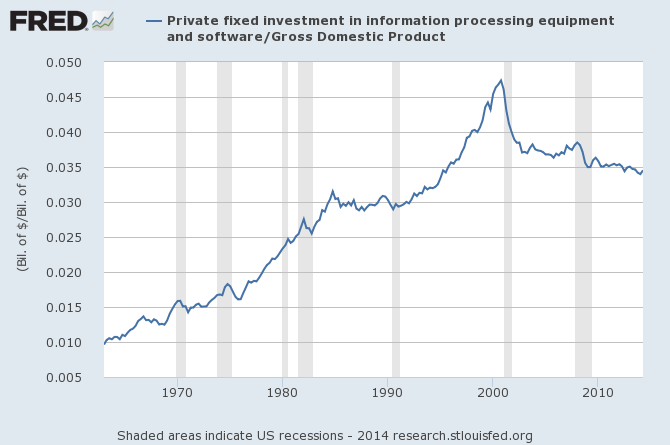
The pointer is from Matt Yglesias.
Addendum: Claudia Sahm refers us to this chart of declining IT prices. It also can be argued that IT spending moved into other, more general business categories.
Russia fact of the day
Shares in Gazprom, a company that made $32bn in net income last year, trade at only 2.6 times forward earnings.
That is from FTAlphaville.
American firms are aging too
The share of firms aged 16 years or more was 23 percent in 1992, but leaped to 34 percent by 2011—an increase of 50 percent in two decades. The share of private-sector workers employed in these mature firms increased from 60 percent to 72 percent during the same period. Perhaps most startling, we find that employment and firm shares declined for every other firm age group during this period.
We explore three potential contributing factors driving the increasing share of economic activity occurring in older firms, and find that a secular decline in entrepreneurship is playing a major role. We also believe that increasing early-stage firm failure rates might be a growing factor.
From Ian Hathaway and Robert E. Litan, there is more here.
Why is euro-area inflation so low?
Sober Look has the numbers, for instance:
The area’s CPI is now below 0.5% on a year-over-year basis. Yesterday we saw German CPI hit new lows (see chart) and Italy’s inflation rate is now hovering just above zero.
What is the most economical model here? The ECB invested in building up a lot of credibility in some areas, such as price level stability, but that means less credibility when it comes to pushing higher inflation. So to get two percent inflation, perhaps the ECB has to genuinely and truly seek four percent inflation, because a big chunk of the market won’t believe they really want four percent. Four will get them to two.
The ECB in fact may be wishing for two percent price inflation and getting…less than that. Which in turn conditions market participants to doubt the commitment of the ECB to the rates of price inflation which it claims to be seeking. The ECB and the citizenry can get stuck in a self-fulfilling prophecies equilibrium, yet without requiring a standard liquidity trap.
I don’t by the way think of this as a time consistency problem. The ECB doesn’t want to be in a position where it is genuinely shooting for four percent inflation, even if that means it will end up imposing only two percent on the Germans. They are still caught with their proverbial pants down and their internal culture of inflation love would be seen as unacceptable and illegal too. Yes, the ECB is selfish, and law-abiding as well, as its charter mandates price stability as the goal.
And you know what? When “selfish” and “law-abiding” point in the same direction, that is very often what you will get.
Economists sign petition asking Congress to contain fallout from Argentina debt ruling
The notice is here, signers include Bob Solow and Dani Rodrik. I agree with their arguments, and you will find my slightly different but still consistent earlier critique here. Here is one bit from the press release:
“It’s a widely shared opinion among economists that the court’s attempt to force Argentina into a default that nobody – not the debtor nor more than 90 percent of creditors – wants, is wrong and damaging,” said Mark Weisbrot, economist and Co-Director of the Center for Economic and Policy Research, who helped circulate the letter.
Matt Levine has a good post on the situation here.
Private Schools vs. Caste Discrimination
Nearly 30% of children in India (ages 6-14) attend private schools and in some states and many urban regions a majority of the students attend private schools. Compared to the government schools, private schools perform modestly better on measures of learning (Muraldiharan and Sundararaman 2013, Tabarrok 2011) and much better on cost-efficiency. Moreover, even though the private schools are low cost and mostly serve very poor students they also have better facilities such as electricity, toilets, blackboards, desks, drinking water etc. than the government schools (e.g. here and here).
In an op-ed Vipin Veetil and Akshaya Vijayalakshmi argue that the private schools may also reduce caste discrimination:
It’s no secret that government schools in India are of poor quality. Yet few know that they are also breeding grounds for caste-based discrimination, with lower-caste students in government schools often asked to sit separately in the classroom, insulted in front of their peers and even forced to clean toilets. This despite the fact that caste discrimination is illegal in India.
…Government-school teachers aren’t necessarily more prejudiced than their private-school counterparts. But private-school teachers find it more costly to discriminate. In a survey of over 5,000 children, academic researchers James Tooley and Pauline Dixon found that students in private schools felt more respected by their teachers than children in government schools.
Caste discrimination in the government schools is also one of the reasons why the private schools focus on teaching English. Among the Dalits, English is understood as the language of liberation not just because it offers greater job prospects but even more because Hindi, Sanskrit and the regional languages are burdened by and interwoven with a history of Dalit oppression. As one Dalit put it, “No one knows how to curse me as well as in Tamil.”
Why not put a firm on your board?
State corporate law requires that “natural persons” provide director services. This Article puts this obligation to scrutiny, and concludes that there are significant gains that could be realized by permitting firms (be they partnerships, corporations, or other business entities) to provide board services. We call these firms “board service providers” (BSPs). We argue that hiring a BSP to provide board services instead of a loose group of sole proprietorships will increase board accountability, both from markets and from courts. The potential economies of scale and scope in the board services industry (including vertical integration of consultants and other board member support functions), as well as the benefits of risk pooling and talent allocation, mean that large professional director services firms may arise, and thereby create a market for corporate governance distinct from the market for corporate control. More transparency about board performance, including better pricing of governance by the market, as well as increased reputational assets at stake in board decisions, means improved corporate governance, all else being equal. But our goal in this Article is not necessarily to increase shareholder control over firms; we show how a firm providing board services could be used to increase managerial power as well. This shows the neutrality of our proposed reform, which can therefore be thought of as a reconceptualization of what a board is rather than a claim about the optimal locus of corporate power.
That is from a Stanford Law Review piece by Stephen M. Bainbridge and M. Todd Henderson. For the pointer I thank Kevin Lewis.
Interview on inequality, with Eduardo Porter
Eduardo Porter interviewed me in addition to his column, here is one excerpt:
What about other consequences of inequality? There is evidence that it hurts mobility, sapping young men’s incentives to succeed. Some have suggested it corrupts our political system and could fuel social unrest.
We know very little about what income inequality tends to cause in politics. We do see that income inequality is up considerably and crime is down considerably. We do know that older societies, as we are becoming, tend to be more peaceful and stable. We also see that a rising middle class often leads to political instability, such as in Thailand or Turkey or Brazil or for that matter the United States in the 1960s. Many young American men may be experiencing a crisis of confidence these days, but the problem lies in the absolute quality of their opportunities, not the gap between them and Bill Gates.
And this:
If we are looking for a remedy, a greater interest in strict religions would help many of the poor a lot — how about Mormonism for a start? Just look at the data. Many other religions prohibit or severely limit alcohol, drugs and gambling. That said, this has to happen privately rather than as a matter of state policy.
Here is the whole thing.
“In a data-chic world, a chief economist is the new marketing must-have.”
The rest of the WaPo story, by Lydia DePillis, is here. Here is one excerpt:
The market for consumer-facing economists is certainly getting crowded. Big Internet companies have had chief economists for years now; Google’s Hal Varian is an oft-quoted exponent of his employer’s capabilities and worldview. Microsoft recently hired Yahoo’s former chief economist to push a more “data-driven culture” at the tech dinosaur.
But they’re not just looking for super-wonks. More importantly for Richardson, rival real estate sites Zillow, Trulia, and CoreLogic have offered their chief economists as media-friendly talking heads, always available to explain national trends: Stan Humphries, Jed Kolko, and Mark Fleming have essentially become their companies’ most visible employees, speaking at conferences and testifying on Capitol Hill. That’s why Apartmentlist.com’s recent listing for a chief economist includes the following in its job description: “Act as the face of the company with key journalists for both print and tv interviews with leading publications,” “work closely with our PR and branding teams,” and have “excellent stage presence.”
File under “Those New Service Sector Jobs.”
Ukraine fact of the day
The Ukrainian economy shrank 4.7 per cent annually in the second quarter, far deeper than expected and casting a cloud over the assumptions that underpin the International Monetary Fund’s $17bn bailout.
That follows a 1.1 per cent year-on-year contraction in the first quarter. Given the ongoing unrest in eastern Ukraine, where much of the industrial base can be found, economic growth is unlikely to pick up later this year.
There is more here.
Eduardo Porter on me on inequality
He has a very good column on this topic today, here is one excerpt:
“The returns to growth are going to people in other countries, most notably China, and generally to people with high I.Q., no matter where they live,” said Tyler Cowen, a professor of economics at George Mason University and a contributor to the Economic View column in The New York Times. “I don’t really know how you could undermine this dynamic, short of wrecking the world. Trying to deny that logic is going to fail or worse, backfire.”
Mr. Cowen, who describes himself as a libertarian with a lowercase “l,” is the author of “Average Is Over: Powering America Beyond the Age of the Great Stagnation,” (Dutton, 2013), which posits that technology and globalization have essentially split the labor market in two: high and low earners. Far fewer stable jobs are left over in the middle to support what through much of the 20th century we called the middle class.
In his view, the defining challenge of our era is that workers in the bottom half of the distribution can no longer trust that their living standard will double every generation. “The right moral question is ‘are poor people rising to a higher standard of living?’ Inequality itself is the wrong thing to look at,” he told me. The real problem is slow growth.
“The best way to address rising inequality is to focus on increasing educational attainment,” Professor Mankiw said. Mr. Cowen adds other potentially useful policies, like expanding the earned-income tax credit or using urban policy to, say, make it easier for people who are not rich to live in San Francisco.
The full story is here, interesting throughout.
Al Qaeda kidnapping markets in everything
While European governments deny paying ransoms, an investigation by The New York Times found that Al Qaeda and its direct affiliates have earned at least $125 million in revenue from kidnappings since 2008, of which $66 million was paid just in the past year.
In various news releases and statements, the United States Treasury Department has cited ransom amounts that, taken together, put the total at around $165 million over the same period.
These payments were made almost exclusively by European governments, who funnel the money through a network of proxies, sometimes masking it as development aid, according to interviews conducted for this article with former hostages, negotiators, diplomats and government officials in 10 countries in Europe, Africa and the Middle East. The inner workings of the kidnapping business were also revealed in thousands of pages of internal Qaeda documents found by this reporter while on assignment for The Associated Press in northern Mali last year.
In its early years Al Qaeda received most of its money from deep-pocketed donors, but counterterrorism officials now believe the group finances the bulk of its recruitment, training and arms purchases from ransoms paid to free Europeans.
The full story is here. by Rukmini Callimachi. Oh, and don’t forget this:
Negotiators take a reported 10 percent of the ransom, creating an incentive on both sides of the Mediterranean to increase the overall payout, according to former hostages and senior counterterrorism officials.
It turns out that Al Qaeda hardly ever executes prisoners any more.
For the pointer I thank Michael Rosenwald.