Category: Economics
Armen Alchian
Armen Alchian has died. Alchian was both clever and wise, an unusual combination. His 1950 paper Uncertainty, Evolution and Economic Theory applied basic insights from evolutionary theory to suggest new approaches to economic ideas. Alchian, particularly with Demsetz, began the analysis of property rights not only what property rights do but how they evolve with changing circumstances (the link goes to Alchian’s entry on this topic in the CEE). Alchian’s textbook with Allen, University Economics which became Exchange and Production, is a classic; never a bestseller among students but avidly read by masters. The Alchian-Allen theorem, sometimes called the third law of demand, continues to bedevil theorists despite its simplicity. I am a fan of his paper Costs and Outputs which generalized some ideas about production and time and inspired Fisher Black. I never met Alchian but have always profited from reading his papers and I was truly grateful and also thrilled when he blurbed my book Entrepreneurial Economics. Fred McChesney has a good appreciation including Alchian’s pioneering event study which was suppressed for national security reasons; Bob Higgs remembers Alchian’s legendary class at UCLA and here is Larry White interviewing William Allen about A Life Among the Econ his memoir of UCLA economics during its glory years.
You can find all of these works and more in Alchian’s Collected Works.
Aviation, Liability Law, and Moral Hazard
 By 1994 the threat of lawsuits had driven the general aviation industry into the ground. Cessna and Beech ceased production in the 1990s and the other major player, Piper, went bankrupt. The problem was caused by liability law and the long-tail. Cessna, Beech, and Piper had been producing planes since 1927, 1932, and 1927, respectively, and airplanes last a long time. Thousands of aircraft built in the 1930s and 1940s are actively flown today and the average age of the general aviation fleet (small non-commercial aircraft) is more than 24 years. Liability law also grew stronger in the 1980s and 1990s so aircraft manufacturers found themselves being sued for aircraft that they had produced decades earlier. Essentially, the manufacturers found that they could be sued for any aircraft that they had ever produced.
In 1994, however, Congress passed GARA, the General Aviation Revitalization Act. GARA said that small airplane manufacturers could not be held liable for accidents involving aircraft more than 18 years old. When it was passed a huge stock of potential liability claims were lifted from the manufacturers and the industry was indeed revitalized. GARA also provided an interesting test of moral hazard theory. Usually, when liability is moved from producers to consumers, both the producers and the consumers adjust; the product changes and so does behavior, so it is difficult to parse out the effect of moral hazard alone. In the case of GARA, however, liability was lifted from the manufacturers on planes that they had produced decades earlier and no longer controlled so we can isolate the influence of the liability change on the consumers of aircraft.
My latest paper (with Eric Helland) just appeared in the JLE. We use the exemption at age 18 to estimate the impact of tort liability on accidents as well as on a wide variety of behaviors and safety investments by pilots and owners. Our estimates show that the end of manufacturers’ liability for aircraft was associated with a significant (on the order of 13.6 percent) reduction in the probability of an accident. The evidence suggests that modest decreases in the amount and nature of flying were largely responsible. After GARA, for example, aircraft owners and pilots retired older aircraft, took fewer night flights, and invested more in a variety of safety procedures and precautions, such as wearing seat belts and filing flight plans. Minor and major accidents not involving mechanical failure—those more likely to be under the control of the pilot—declined notably.
GARA thus appears to be a win-win because it revitalized the industry and increased safety. The latter came, in a sense, at the expense of the pilots and owners who now bore a greater liability burden but they were the least cost avoiders of accidents. Moreover, the pilots and owners of small aircraft were big supporters of GARA thus suggesting strongly that prior to GARA liability law for aircraft had been inefficient and destructive.
In case you are wondering about Chinese growth…
I still do not believe that the Chinese “recovery” is for real:
Chinese credit issuance surged to a record high in January on the back of a boom in shadow banking, stoking concerns that the economy could overheat.
Total new financing in January reached Rmb2.5tn ($400bn) – up more than 50 per cent from December and more than double the figure a year ago – eclipsing even the start of 2009 when China unleashed stimulus spending to battle the global financial crisis.
…The big increase in credit issuance stems from last year when China slouched to 7.8 per cent growth, its weakest in more than a decade. To revive the economy, the government stepped up the pace of infrastructure investment and gave a green light to banks to provide more funding, including through off-balance-sheet channels.
This succeeded in fuelling a recovery in the final quarter of 2012 and the momentum of that upturn has continued through into the start of this year.
But I would gladly be proven wrong. The FT article is here, and I will admit, at the very least, to needing to revise my views on how often the fires can be restoked. I had been expecting 3 to 5 percent “real growth” for China in 2012. By the way, also from the FT, you will find a more optimistic take on Chinese matters here.
Now there are two new estimates, each revising downward actual Chinese gdp. Here is one report:
Wiemer argues that “household services and manufacturing upkeep” component of the official CPI index is a better measure of services inflation.
And, given that adjustment, from Stephen Green:
…our [gdp] guesstimates for 2011 and 2012 are 7.2% and 5.5%, respectively, compared with the official prints of 9.3% and 7.3%.
From Toshiya Tsugami, here are further worrying signs. About half of measured growth is coming from fixed investment, and yet bank data suggest these investments are a) not close to self-financing, and b) the figures are “grossly inflated” in the first place. By the way, these fixed investments rose 20% from 2011 to 2012, not exactly the rebalancing which everyone is looking for.
I would again stress that we do not yet know what is going on, but it is a mistake to assume that China is in the clear. If you put together the Green and Tsugami modifications into one revision, what kind of growth would we be measuring?
Krugman on the minimum wage
I am always happy to link to interesting new arguments which have not been considered on this blog before:
…the usual notion that minimum wages and the Earned Income Tax Credit are competing ways to help low-wage workers is wrong. On the contrary, raising the minimum wage is a way to make the EITC work better, ensuring that its benefits go to workers rather than getting shared with employers. This actually is Econ 101, but done right: given a second-best world in which you use imperfect tools to help deserving workers, two tools together can produce a better outcome than either one on its own.
He is drawing from this Rortybomb post. For other, different arguments, here is Angus and here is David Henderson.
Are Government Spending Multipliers Greater During Periods of Slack?
The embarrassing result here is that no, it seems they are not:
A key question that has arisen during recent debates is whether government spending multipliers are larger during times when resources are idle. This paper seeks to shed light on this question by analyzing new quarterly historical data covering multiple large wars and depressions in the U.S. and Canada. Using an extension of Ramey’s (2011) military news series and Jordà’s (2005) method for estimating impulse responses, we find no evidence that multipliers are greater during periods of high unemployment in the U.S. In every case, the estimated multipliers are below unity. We do find some evidence of higher multipliers during periods of slack in Canada, with some multipliers above unity.
That is from a new paper by Michael T. Owyang, Valerie A. Ramey, and Sarah Zubairy.
I see a few views (among others) of the multiplier:
1. The crude form of Say’s Law is true and fiscal policy simply remixes funds with no real impact.
2. Say’s Law is not really true as stated, but why should we be so impressed with a one-time uptick in monetary velocity, also called fiscal policy, unless the supply-side effects are also really good?
3. Fiscal policy effectively targets and mobilizes unemployed resources.
4. Fiscal policy postpones adjustment issues (this can be from AD too, it doesn’t have to be a “structural” problem), and may usefully smooth consumption, but it doesn’t do a good job targeting and mobilizing unemployed resources.
5. The size of the multiplier is determined by the expected monetary policy accommodation, and not by the quantity of unemployed resources.
I would say this paper provides evidence against #1 and #3.
“Is wealth a value?”
Interview with James Heckman
More than just the usual, this is a real interview, recommended. Excerpt:
James Heckman: Well, the reason why I’m skeptical is that the most salient work on Head Start is this new evaluation which came out last October. It actually came out later than I responded to Deming. I am skeptical for the following reason. It’s really heterogeneous, and I’m sure there are some very high quality programs and some very weak ones. The latest study showed very weak effects. That was a short-term followup. Head Start has never had a long-term followup.
I was surprised by the extent to which he defends Head Start, and to the extent he sees part of that program as Perry follow-ups.
Valentine’s Day Advice
If it doesn’t hurt, you aren’t signalling.
The path of government spending
Matt Yglesias posts this chart, which I am happy to endorse, alternative scaling here, and related material from Veronique de Rugy here.

The real problem comes about ten years out, due to aging. It’s still the case that, when it comes to fiscal issues, turning on a dime can be very difficult. In the meantime, it may appear, at times, that not much is happening, but these will be a very critical ten years.
A Trapped Factors Model of Innovation
That is the new paper (pdf) by Nicholas Bloom, Paul Romer, Stephen Terry and John Van Reenen. Here is the abstract:
When will reducing trade barriers against a low wage country cause innovation to increase in high wage regions like the US or EU? We develop a model where factors of production have costs of adjustment and so are partially “trapped” in producing old goods. Trade liberalization with a low wage country reduces the profitability of old goods and so the opportunity cost of innovating falls. Interestingly, the “China shock” is more likely to induce innovation than liberalization with high wage countries. These implications are consistent with a range of recent empirical evidence on the impact of China and offers a new mechanism for positive welfare effects of trade liberalization over and above the standard benefits of specialization and market expansion. Calibrations of our model to the recent experience of the US with China suggests that there will be faster long-run growth through innovation in the US and that, in the short run, this is magnified by the trapped factor effect.
Bruce Caldwell emails me
The Center for the History of Political Economy at Duke University will be hosting another Summer Institute on the History of Economics this summer, June 2-21. The three week program is sponsored by the National Endowment for the Humanities and is designed primarily for faculty members in economics, other social sciences, and the humanities, though three of the twenty-five slots are reserved for graduate students. Participants will be competitively selected and successful applicants will receive a $2700 stipend for attending, out of which they will pay for their own room and board. Our line-up of discussion leaders is pretty impressive, and includes scholars from economics, political science, and history. The deadline for applying is March 4. More information on the Summer Institute is available at our website, http://hope.econ.duke.edu
This is a superb program and I recommend it heartily.
Road Fare>Congestion Pricing?
Congestion pricing sounds like something to avoid since neither term is something you want. Eric Jaffe held a contest for replacement terms. Decongestion pricing is one possibility since it at least hints at the idea that the pricing gets rid of congestion.
Tom Vanderbilt (author of Traffic) liked the phrase premium access — something to suggest “you pay for ‘peak perks.’ ..transport scholar David Levinson, suggests road fees for general road pricing (and peak road fees for road pricing aimed at heavy congestion), and urban planner Laurence Lui, recommends road fares. What’s nice about road fare is that it parallels mass transit, has an intuitive purpose, and offers flexibility. You can alter it to suit a specific situation — peak road fare, midtown road fare, etc. — without obscuring the basic meaning.
Road fare is quite good as it also suggests fair[ness] and can be used in an academic or commercial context. For a more commercial term I liked another suggestion, Pay2Go which has the great virtue of explaining what you get for your money.
Do note that death insurance didn’t sell well until it was given the less accurate but more affable name, life insurance.
Hat tip: Brandon Fuller.
Krugman’s response on cash hoarding
Krugman, in a response, accuses me of not understanding Keynes’s critique of Say’s Law:
Cowen can’t see why corporate hoarding is a problem. Like Riedl and Cochrane, he concedes that there might be some problem if corporations literally piled up stacks of green paper; but he argues that it’s completely different if they put the money in a bank, which will lend it out, or use it to buy securities, which can be used to finance someone else’s spending.
Let’s look at what I actually wrote:
Maybe you are less impressed if say Apple buys T-Bills, but still the funds are recirculated quickly to other investors. This may not end in a dazzling burst of growth, but there is no unique problem associated with the first round of where the funds come from. If there is a problem, it is because no one sees especially attractive investment opportunities in great quantity. (To the extent there is a real desire to invest, the Coase theorem will get the money there.) That’s a problem at varying levels of corporate profits and some call it The Great Stagnation.
The same response holds if Apple puts the money into banks which earn IOR at the Fed and the money “simply sits there.” The corporations are not withholding this money from the loanable funds market but rather, to the extent there is a problem, the loanable funds market does not know how to invest it at a sufficiently high ROR.
My arguments is that it can be a problem, and that recycling is not automatic, but in that case other factors must be in play and we should reinterpret the matter in terms of those other factors. Krugman may or may not agree but he doesn’t get to that point. Rather his critique is that I think recycling into AD is automatic. That is a “read fail,” and quite simply he would prefer to counter the argument (Keynes vs. Say) which fits into his prior template rather than deal with what was written.
Dorman thinks there are few good investment opportunities because consumer spending is weak. In a somewhat condescending fashion, he suggests that somehow I cannot, when thinking about macroeconomics, keep investment and retail spending in my mind at the same time. He doesn’t mention that my original post considered retail spending explicitly — and with a picture — and argued that although there was a big hit to spending, the pattern of the hit and subsequent recovery for retail doesn’t appear to match the pattern of our investment problems. Again, he may disagree on the point, but he can’t even bring himself to mention that I cover it, instead preferring to claim I ignore it.
Torture in a Just World
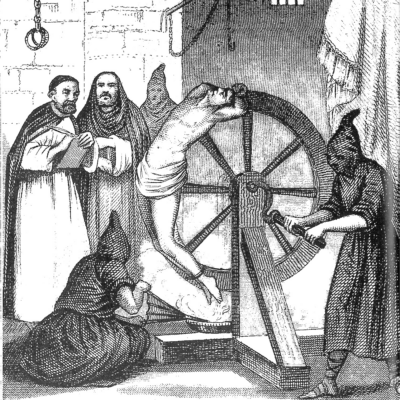 If the world is just, only the guilty are tortured. So believers in a just world are more likely to think that the people who are tortured are guilty. Perhaps especially so if they experience the torture closely and so feel a greater need to overcome cognitive dissonance. On the other hand, those farther away from the experience of torture may feel less need to justify it and they may be more likely to identify the tortured as victims. The theory of moral typecasting suggests that victims are also more likely to be seen as innocents (a la Jesus).
The theory is tested in a lab setting by Gray and Wegner. Experimental subjects are told that “Carol”, really a confederate, may have lied about a dice roll and that stress often encourages people to admit guilt. Subjects then listen to a torture session as Carol’s hand is plunged into a bucket of ice water for 80s. Subjects are then asked how likely is it that the torture victim was lying (1 to 5 with 5 being extremely likely). There are two intervention variables: 1) some of the subjects meet the torture victim before she is tortured, this is the close condition and some do not (distance condition) and 2) in some torture sessions the victim evinces pain (pain) and in others not (no pain). The key figure is shown below:
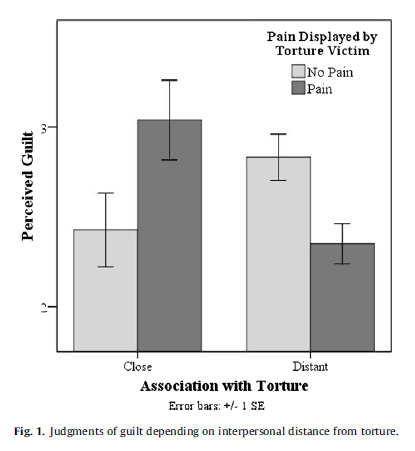 The most striking result is that in the close condition, the evincing of pain was associated with an increased judgment of guilt, consistent with torture causing cognitive dissonance which is relieved by a judgment of guilt (restoring the just world). But in the distance condition, the evincing of pain was associated with a decreased judgement of guilt, consistent with pain increasing the identification of the tortured as a victim and therefore innocent (a la moral typecasting).
Closeness in the experiment was reasonably literal but may also be interpreted in terms of identification with the torturer. If the church is doing the torturing then the especially religious may be more likely to think the tortured are guilty. If the state is doing the torturing then the especially patriotic (close to their country) may be more likely to think that the tortured/killed/jailed/abused are guilty. That part is fairly obvious but note the second less obvious implication–the worse the victim is treated the more the religious/patriotic will believe the victim is guilty.
The theory has interesting lessons for entrepreneurs of social change. Suppose you want to change a policy such as prisoner abuse (e.g. Abu Ghraib) or no-knock police raids or the war on drugs or even tax policy. Convincing people that the abuse is grave may increase their belief that the victim is guilty. Instead, you want to do one of two things. Among the patriotic you may want to sell the problem as a minor problem that We Can Fix – making them feel good about both the we and the fixing. Or, you may want to create distance – The problem is bad and THEY are the cause. People in the North, for example, became more concerned about slavery once the US became us and them.
I think research in moral reasoning is important because understanding why good people do evil things is more important than understanding why evil people do evil things.
The future of ads on mobile devices?
The Chad2Win app was developed by a Barcelona-based company and while it was only launched last month it has already attracted close to 100,000 users. All these early adapters are being given a cent for each ad they look at and three times amount if the click on it.
Mind you it is not easy to reach the maximum monthly payment of €25 and to get there a user would have to click on more than 800 ads or nearly 30 different banners every single day.
Experts who have looked at the business model have suggested that most normal users are unlikely click enough ads to make themselves more than €10 a month.
Volkswagen, Panasonic and Spanish lender Caixabank have all agreed to advertise on the app which is only available in Spain. It does not appear to have wowed users and has a three star rating among android users while those who have signed up using their iPhones have decided it is only worth two-and-a-half stars out of a possible five.
Here is more. Overall I see the collapse in value for ads on mobile devices as a major problem facing mainstream media at the moment. No one wants to view an ad on a mobile device. Economic carnage will result.