Category: Economics
Why is Italy doing so much worse these days?
Here is the graph from yesterday. So why has Italy done so much worse? During 1950-1990 or so it was a stellar growth performer, though some of this was catch-up growth from wartime destruction. It does not satisfy me to cite Italy’s corrupt and dysfunctional political culture, since that has been the case for a long time, maybe forever.
A good introduction to the bright side of Italy’s economy is Michael Porter’s 1998 The Competitive Advantage of Nations; Porter portrays Italy as having some vital clusters of family-owned businesses, largely in the North. Do you want your kitchen redone with some nice marble tile? Italy can supply just the right stuff. This neat graph shows just how much Italy has specialized in small business.
Perhaps therein lies the problem. With the advent of modern communications and information technologies, arguably the return to “small family firms” has fallen. The return to “largish projects consummated over large distances” has gone up. For Europe, the big winners here are the Nordic countries, which have worked very effectively with information technology and which do not rely so much on family ties to get efficient, non-corrupt management. The losers are Italy and Greece and Portugal too; read this superb paper on how Portugal is cursed by being stuck with all these small firms, inefficiently small for legal and regulatory reasons. These countries seem to be locked out from some of the major sources of contemporary economic growth.
Here is a very important and insufficiently appreciated sentence from the Portugal paper: “…the largest part of the productivity gap between developed and developing countries can be attributed to the inefficient allocation of resources across firms in the latter countries.” And alas Italy stands with one foot in the underdeveloped world; I am reminded of Yana’s excellent sentence, voiced upon visiting Sicily for the first time: “This reminds me of Mexico (pause) — except it’s not as nice!” (Fear not people, she loved Sicily, as do I.)
And those are the countries with the biggest problems in the eurozone. Ireland is closer to the Nordic model, as they do lots of software and hardware with MNCs, and you can see them recovering from this mess more quickly. AD matters, but real shocks and competitiveness matter too. Negative real shocks don’t have to involve “forgetting how make ice cubes.” Ex ante, countries specialize in production methods and networks, and the subsequent evolution of technology does not always bear out their choices as wise.
Viewed in these terms, it is hard to see policy changes bringing a quick Italian recovery. Italy remains good at what it long has been good at, and you can think of their superb restaurants as further and highly visible examples of small, family-run firms. Sadly for them, those efficiencies are not worth quite as much these days.
Addendum: Here is one extensive look at Italy’s growth slowdown in the 1990s.
Italy’s growth disaster
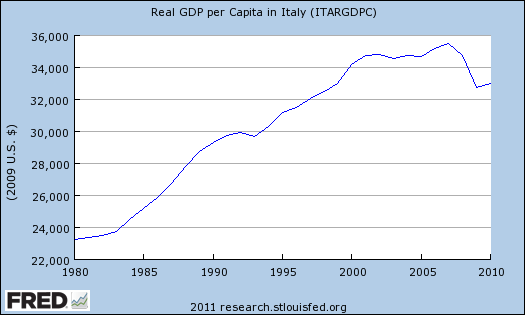
Hat tip goes to Matt Yglesias. At the risk of sounding like a broken record player, we are not sufficiently thinking through what it means for an advanced society to have basically zero net economic growth for a ten to twenty year period. It’s very possible, and this is (more or less) the same Italy that was praised in the 1980s for its dynamism and which overtook the UK in terms of per capita income, at least for a while.
How to exit the eurozone, or Lord Wolfson, how about fifty quid for a blog post?
There is no easy way out of the eurozone, as Tim Harford explains with eloquence and good humor. But here is my best guess at Wolfson’s query:
1. Issue a surprise announcement that all euro deposits in Ruritania will be converted into pesos (or whatever) at a new and lower yet defensible rate. If I try to withdraw my ten euros from my bank, I receive an IOU for ten pesos which is worth say six euros. Over time the government will replace these IOUs with a new paper currency.
2. Let physical currency euros leave the country, and stress they will be honored, in any case they are not easy to confiscate or convert. And a country may need them as a partial money during the transition. Not trying to confiscate them will mean that a lot of the euro currency stays. There will be a dual currency regime for some time to come, but the medium of account will become pesos not euros.
3. If you borrowed money denominated in euros, from a Swiss or German bank, that is between you and them. Obviously a lot of borrowers will be in partial or total default, given the whack to their bank accounts. Let the northern nations bail out their banks, they won’t send tanks to extract the funds from good ‘ol Ruritania. Who knows, the rest of the eurozone might be prompted to set up a sensible bank resolution mechanism — working through the ECB of course — though don’t count on it.
4. The assets of Ruritania banks, namely loans to Ruritania citizens, will be redenominated to pesos. Labor and rental contracts will be redenominated too.
5. Nationalize parts of the banking system if need be, so much the better if you can pass on this one. If the bank is essentially empty, that is a deflationary shock. Have the government take over the bank and fill it with new printed money to restore deposits and counter the deflationary shock. If the country cannot trust its nationalizers, they should just print up more pesos and nail them to the bank balance sheets, risking the resulting corruption and drain of funds.
Are we on track so far? The consumption of imports will fall I believe.
6. What about default? If your country is running a primary surplus (Italy yes, Greece no), partially default on your debt but make strict promises to resume payments ASAP. Capture some wealth from the foreign banks and start the game all over again. Without a significant primary surplus, the (temporary?) cessation of foreign borrowing would mean that the country has to cut government spending further. Make a political judgment here but consider not defaulting; default may be unavoidable for Greece in particular but you can’t blame my plan for how deep in the hole they are.
Let’s sum up which problems have been addressed and which not. The domestic banking system is saved, at least provided the new conversion rate is credible enough that no one expects a repeat of the depreciation. It’s key to make that first announcement a real surprise, good luck! A negative wealth shock will come anyway and my plan has accelerated the arrival of that shock; the best one can do is to combine it with monetary expansion and the positive export shock from devaluation. To fix the external banks, the wealthier countries will need to exercise and perhaps improve their LOLR powers, but that is the case under any plan, not just this one.
Admittedly this plan makes the wealth loss in Ruritania quite transparent, which may be politically unpopular, but that transparency eases the economics of the transition.
Voila! Rinse and repeat as necessary. A lot of this would be eased by high inflation from the eurozone itself but a) that would involve collateral costs on the healthier economies, and b) in any case it doesn’t look like it will happen. I’m sticking with what a small country can do on its own.
No need to write in the comments section that this is “illegal.” Breaking the three percent deficit rule, as France and Germany did, was illegal too. Ruritania will not be hauled before a court of law and I also predict Ruritania will not be ejected from EU per se. Maybe their agricultural subsidies will be cut, let them eat floating exchange rates I say.
Self-recommending eBook
Race Against The Machine: How the Digital Revolution is Accelerating Innovation, Driving Productivity, and Irreversibly Transforming Employment and the Economy, by Erik Brynjolfsson and Andrew McAfeee.
There is a partial summary of the book here, I ordered my copy last night. Here are the authors on the book.
Markets in everything the culture that is Japan
Meanwhile, in Japan, a new fashion has women paying to have their straight teeth purposefully disarranged.
A result of tooth-crowding commonly derided in the United States as “snaggleteeth” or “fangs,” the look is called “yaeba” in Japanese or “double tooth.” Japanese men are said to find this attractive: blogs are devoted to yaeba, celebrities display it proudly, and now some women are paying dentists to create it artificially by affixing plastic fronts to their real teeth.
“It’s not like here, where perfect, straight, picket-fence teeth are considered beautiful,” said Michelle Phan, a Vietnamese-American based in Los Angeles, who wrote about the phenomenon on her popular beauty blog. “In Japan, in fact, crooked teeth are actually endearing, and it shows that a girl is not perfect. And, in a way, men find that more approachable than someone who is too overly perfect.”
Here is more, thanks to Jack Kessler for the pointer.
Update on eurozone negotiations
The Irish Times is a good source for an alternative perspective on eurozone developments. They understand enough economics to get some key ideas right, yet they don’t simply adopt a “major country” perspective. (I find German coverage especially difficult to parse.) They are more explicit and less guarded than the FT, not always a virtue but worth trying on for size. Anyway, their latest report from the front line is scary. It starts with:
European Union leaders piled pressure on Italy today to hasten economic reforms to avoid a Greece-style meltdown as they began a summit to rescue the euro zone from the debt crisis.
I’m probably all for the reforms under discussion, but in this context they take far too long and along the way there is not enough political commitment. That this is the lead item is a sign that a) there are no really good intermediate measures under discussion, and b) the Italians need to be forced to do the right thing. Neither is good news. I’ve already discussed how and why Italy, with its numerous and decentralized distortions, does not have easy access to a “big bang” solution. And this:
Diplomats said they wanted to maximise pressure on Rome to implement structural labour market and pension reforms to boost Italy’s economic growth potential and reassure investors worried about its huge debt ratio, second only to Greece’s.
After the TGS experience of Japan, it needs to be recognized that perhaps a major country simply won’t grow much for twenty years or more. Yikes, and wake up! When interpreting this sentence, beware of rhetorical political posturing vis-a-vis Germany, but this too was hardly encouraging:
“Between now and Wednesday a solution must be found, a structural solution, an ambitious solution, a definitive solution,” Mr Sarkozy said. “There’s no other choice.”
A proposal for bank recapitalization, plus a further tweak on the ever-worsening Greece deal, and a lot of promises for Italian reforms, doesn’t even represent kicking the can down the road. It’s more like smashing your foot on the can.
Addendum: I agree fully with this assessment.
Some additional reasons why Iceland has done well
I agree with much of Paul Krugman’s recent posts on Iceland, here and here. But there are neglected factors behind the Icelandic recovery, namely real shocks.
Note that Iceland is a small, open economy and fish accounts for 40 percent of Icelandic exports. It does not hurt that Norwegian cod prices have risen 20 percent over the last year; I cannot find a separate figure for Icelandic cod prices but that is a likely major factor behind the Icelandic resurgence. Here is a separate, brief report on the boom in the Icelandic fishing sector. Especially when it concerns small countries, always look first for the real shocks.
As an aside, there seems to be a system of fairly flexible wages for the major export:
The lay system of remuneration is used extensively in fisheries. Under this system, fishermen are paid a share of the catch value, perhaps after subtracting some costs, rather than a fixed wage. There may, however, also be a fixed wage element, so that fishermen get a share of the catch value in addition to the fixed wage, or a fixed wage as a minimum in case the fishing trip turns out to be unrewarding.
That is a Norwegian source about fisheries worldwide and not Iceland-specific, and here is another general source on compensation for fishermen with a similar message; can anyone speak to Iceland in particular?
Krugman writes: “And nominal wages are downwardly rigid. That’s simply a fact, true always and everywhere.” But that is an overstatement, especially when an output-linked and value-linked bonus system is in effect.
Iceland has had both currency flexibility and, it seems, a higher than average degree of wage flexibility in the major export sector, automatically built in at that. (If further and more targeted sources contradict this portrait I will gladly report the update.) That real wage flexibility may or may not be a major factor in the Icelandic comeback (only 4,000 fishermen in the whole sector, and the fisheries already do their accounts in euros), but it does show the standard theory of optimum currency areas should not be applied here without considerable caution.
Finally, note that a flexible exchange rate does not bring all of the wage-reducing benefits of yesteryear. Workers are employed increasingly in domestic services (health care, education) and many export sectors are less labor-intensive than before, at least in the West. With the progress of mechanization and globalization, the ability to cut your real wages rapidly for your exports is arguably diminishing in value. The relevant rigidities are becoming increasingly domestic, it would seem.
Marginal Revolution, articulated
The minivan driver who knocked Wang down, and then ran over her deliberately, has since surrendered to the police, but offered a curious explanation for his action. He said he had been talking on his mobile phone when he hit the girl, but decided to run her over because it would have cost him less to pay off a dead girl’s parents than to pay for her hospital expenses.
“If she had died, I would have been required to pay only about 20,000 yuan (about Rs 1.5 lakh) in compensation, but if she were injured, it would cost me hundreds of thousands of yuan in hospital expenses,” he said.
Here is more and for the pointer I thank Karthik S.
The Mexican Mafia
The Mexican Mafia is a fairly small prison gang (perhaps 150-300 made members) and it has significant operational control only within  prisons in Southern California yet the Mexican Mafia is extremely powerful. In fact, the MM taxes hundreds of often larger Southern California street gangs at rates of 10-30% of revenues. How can a prison gang tax street gangs? In Governance and Prison Gangs (also here), a new paper in the APSR, David Skarbek explains the structure, conduct and performance of the Mexican Mafia.
The key to the MM’s power is that most drug dealers will sooner or later, usually sooner, end up in prison. Thus, the MM can credibly threaten drug dealers outside of prison with punishment once they are inside prison. Moreover, prison is the only place where members of many different gangs congregate. Thus, by maintaining control of the prison bottleneck, the MM can tax hundreds of gangs.
One of the most interesting aspects of Skarbek’s analysis is that he shows–consistent with Mancur Olson’s stationary bandit theory–that as the MM grew in power it started to provide public goods, i.e. it became a kind of government. Thus, the MM protects taxpayers both in prison and on the street, it produces property rights by enforcing gang claims to territory and it adjudicates disputes, all to the extent that such actions increase tax revenue of course. The MM is so powerful that it often doesn’t even have to use its own enforcers; instead, the MM can issue what amounts to a letter of marque and reprisal, a signal that a non-taxpaying gang is no longer under its protection, and privateers will do the rest.
The MM even internalizes externalities:
In addition, the Mexican Mafia regulates drive-by shootings…because any particular street gang only suffers a portion of the increased attention of law enforcement from drive-by shootings, each street gang has an incentive to do too-many (Buchanan 1973). In 1992, Mexican Mafia members sent notes throughout the prison system and Sureño neighborhoods that any gang member participating in an unauthorized drive-by shooting would be killed. Shortly after the Mexican Mafia announced this rule, drive by shootings declined.
The Mexican Mafia has much to teach us about crime and governance.
What can Italy do with its wealth?
Italian private debt is quite low and yesterday I mentioned that Italian homeowners don’t have much in the way of mortgages. David Henderson then asked a good question:
“Were more Italians to take out mortgages on their houses to buy government bonds, for example, Italy could eliminate its interest-payment problem.” How is that good news? The government would still have to pay interest on this debt.
The Italian government has high debt and productivity is not going up any time soon. We can expect a mixture of lower government spending and higher taxes, otherwise the country defaults, maybe the country defaults anyway. Ideally “they” would like to send equity in Italian homes to bondholders in lieu of making the interest payments. Italy doesn’t do a good job collecting taxes and the economy already has lots of distortions, so pulling wealth out of homes would in principle be a way to go. A CDO tranche instead of an interest coupon, so to speak. One can imagine the Italians borrowing more against their homes and sending the money to their government as a tax, or accepting lower transfer payments from the government, and that would implicitly serve as a way of paying off the bonds with fractions of homes. Of course that probably won’t happen.
Italy is house rich, somewhat cash poor, and has a miserable recent history of growth. If you look at the wealth side of the balance sheet, you can easily work up a heady optimism for Italy. If you study public choice theory, it is harder to do so. How many people in that country are either paid to do the wrong thing, or paid to do not so much at all? TGS reigns.
Italy’s privileges and distortions are so often so local, and so concentrated in inefficient professional services, that it is hard to imagine clearing them up quickly in the form of a big bang, in the way that say New Zealand or Chile or Thatcher’s England did. And even those successes took some time to pay off and underperformed for years.
Note that if Italy could credibly be expected to grow a mere 2 pct. a year — maybe less — the entire eurozone crisis probably would be messy but manageable. It’s not.
File under: non siamo cosi’ ricchi come pensavamo di esserlo!
Buy a House, Get a Visitor Visa?
I have been promoting a “buy a house, get a visa” program for several years, so I was initially pleased to see a new bill on this theme from Sens. Charles Schumer (D., N.Y.) and Mike Lee (R., Utah).
…the proposed measure would offer visas to any foreigner making a cash investment of at least $500,000 on residential real-estate—a single-family house, condo or townhouse. Applicants can spend the entire amount on one house or spend as little as $250,000 on a residence and invest the rest in other residential real estate, which can be rented out.
On closer inspection, however, the bill is very weak. Most importantly, the visa would simply allow the buyer to live in his or her house but would not allow them to work in the United States. Pathetic.
I also liked Matt Yglesias‘s spin on this:
The larger issue, however, is that the Schumer/Lee proposal would deny the new immigrants the right to work in the United States. As with other restrictions on high-skill immigration, this is essentially a form of class warfare against less educated Americans. We should be clamoring to increase the supply of foreign-born doctors, lawyers, engineers, and other highly educated occupations as a way of increasing the real wages of America’s factory workers, janitors, waitresses, carpenters, and retail clerks.
Addendum: Canadians are not impressed with the offer.
Should we “get tough” with the banks? (department of secondary consequences)
The EU seems to have that in mind but here is the problem with that idea:
Distressed European Union banks that tap national governments or the region’s €440bn rescue fund for capital will be subject to state-aid penalties, involving compulsory restructuring or – in the worst case – orderly wind-downs…
The proviso – consistent with EU state-aid rules applied throughout the crisis – is likely to discourage banks from seeking public assistance and spur them to shrink their balance sheets instead, raising the danger of a credit crunch, bankers say.
Terrence Hendershott writes to me
Below are thoughts from an author of a paper Tyler cited on algorithmic trading (and HFT). There is a project by the UK government on related topics. Some related working papers on HFT are here, here, here, here, and here.
1. Technology has made financial markets work better; improvements in liquidity are large, important, and should result in lower costs of capital for firms; these do not mean that every application of technology is good.
2. There is evidence that investors prefer continuous to periodic trading, but batch auctions as frequent as every few seconds have not been studied.
3. Until technology allows buyers and sellers to better find each other simultaneously, markets need a group of intermediaries; the lowest-cost intermediaries are those closest to the market.
4. Historically, intermediaries were floor traders, now are HFT; floor traders profit from those further from the trading mechanism as do HFT now.
5. What is the best industrial organization for the intermediation sector? i) free entry (HFT) or ii) regulated oligopoly (NYSE specialists, Nasdaq market makers, etc.)?
6. Floor trading had the advantage that within-market relative latency was not so important and the amount of market data produced was small; costs were floor traders’ large advantages and possible collusion.
7. There is yet to be robust empirical evidence linking HFT to declines in market quality or efficiency; Haldane has interesting ideas, but as comments point out, it is difficult to blame HFT more than the economic and euro crises for recent fat tails in asset returns; systemic uncertainty increases fat tails and cross-asset correlations.
Overall, technology applied to intermediation appears to bring benefits with the standard rent seeking costs of intermediaries making money, possible instability (although 1987 showed human markets have their own failings), and technology costs.
Can markets find solutions?
i) If HFT becomes competitive (zero rents), will HFT then resell their technology as brokers? Could this lead to efficiency without negative externalities?
ii) Do dark pools and batch auctions limit part of the “arms race” of technology investment? Significant volumes are already traded in these ways, e.g., the opening and closing auctions. There are many ways investors can avoid HFT. If they do not, is it revealed preference?
If regulations are needed they should target behavior, not certain trading firms, otherwise HFT features will simply be incorporated into other strategies, e.g., a HFT strategy is merged with a mid-frequency strategy.
A reenactment of how the Lucas-Sargent paper was written.
Starring Ellen McGrattan (playing Robert Lucas) and Patrick Kehoe (playing Thomas Sargent).
http://www.youtube.com/watch?v=_7zvFkM0NSQ
I thank XG for the pointer.
Piero Garegnani passes away at age 81
He combined neo-Ricardian and Marxist ideas with Keynesian aggregate demand and he thought marginalist neoclassical economics was incoherent, for reasons related to the Cambridge capital debates. Robert Vienneau offers one summary of his work. Matías Vernengo writes:
As early as 1961, while spending an academic year at MIT, he suggested during a presentation by Paul Samuelson that his results depended on the assumption that all sectors use the same capital-labor ratio. The final results of his critique were presented in Garegnani’s paper “Heterogeneous Capital, the Production Function and the Theory of Distribution.” His paper shows conclusively that the marginalist theory of value and distribution based on an aggregate production function is untenable. This of course builds on Sraffa’s work in the Production of Commodities (PC). By 1966, in the famous Quarterly Journal of Economics (QJE) Symposium, Samuelson had admitted that the neoclassical parable was not defensible.
Here are some of his articles on scholar.google.com. He always struck me as a very intelligent writer and capable of a good bracing critique, even though I don’t think his proposed alternatives have gone anywhere. Every profession needs smart and articulate dissenters and I am glad that we have had Garegnani.
For the pointer I thank Juan Carlos Esguerra.