Category: History
*From the Earth to the Moon*
I read this 1865 Jules Verne book lately and very much enjoyed it. It’s a poke at scientific rationalists and project-happy obsessives, and humorous throughout. It mocks those who wish to bet on ideas, compares the American and French versions of excess grandiosity, and asks in subtle ways what are the limits of progress. It reminded me of John Gray far more than I had been expecting. And it’s about an America with no NIMBY, where everyone wants the projects right in their backyard. The space program in fact sets off a rivalry between Texas and Florida to house the first moon shot…and it is to be done with a very large gun.
Definitely recommended, here is the book’s Wikipedia page.
“One Belt, One Road”, or the New Silk Road for China?
That is the new China initiative to rebuild the Old Silk Road along modern principles. The plan is a bit of a grab bag, but seems to include the following:
a. A deepwater naval base in Pakistan, plus a $42 billion aid/investment package for Pakistan. Here is some background on what already has been done.
b. A Chinese route to the sea through Myanmar and Bangladesh.
c. Northern shipping routes to Europe, through the Arctic, as the ice melts.
d. A rail line from Zhengzhou through Russia to Hamburg (already running, a 17-day trip).
e. Power stations and manufacturing plants for the Central Asian republics, in return for gas supply. This infrastructure transfer is also supposed to limit excess capacity in China by sending infrastructure abroad.
f. A railway and highway to connect China to the Arabian Sea.
Arnold Kling, telephone! Are these sustainable patterns of trade and specialization? Or are they slated to be proverbial white elephants? Does anyone know? Bueller?
A few points are striking here.
1. Much of this seems to be defensive geopolitics. Most of China’s oil supply, and much of China’s trade, runs through the Straits of Malacca. This plan, assuming it can be well-executed, affords China a good deal of protection. Yet that insurance does not add growth on top of the status quo, which currently is an open, well-functioning (mostly), trade channel at the Straits. At best it would hold a future catastrophe at bay for China.
2. The gravity equation in international trade economics suggests that countries trade much more when they are “near each other.” But what does proximity in this context mean exactly (pdf, an interesting trade paper by the way, on the “death of distance” theme and where it fails)? The most successful gravity models cite “distance between national capitals” rather than “distance between closest borders.” For evaluating this plan, that difference matters a great deal! I say distance between capitals is likely the more relevant variable, all the more for an economy dominated by state-owned enterprises.
3. The idea of easing excess capacity by sending infrastructure to other countries seems unlikely to succeed. Other than gas, how much do these countries currently have to offer China? And how much infrastructure can be transferred how quickly?
4. China’s economic growth has been dominated by the coasts, and the Great Canal, for approximately one thousand years; today Xi’an is a backwater for instance, although in the Tang dynasty it was possibly the most advanced city in the world. Can this now-deeply entrenched pattern — water transport beats land transport — be reversed by a lot of government spending?
5. To date China’s main external ally is North Korea, even though China is the world’s second largest economy. How well will relations with all these other nations evolve, and what does that mean for the value of those investments? Sri Lanka already has decided to redo its deals with China, and it doesn’t seem China can bully them out of that, though read this update.
During my China visit, I heard repeatedly that this New Silk Road plan will limit the pending decline of China’s growth rate. Each time I expressed skepticism about that prospect, my words were met with great dismay and, I felt, disbelief. Yet I do not see how these pieces are supposed to fit together as a growth-boosting enterprise. They do seem well-designed to extend China’s political influence in the western direction, and to transfer more contracts to state-owned firms. But to raise living standards for most of the Chinese people? I don’t see it, or even see it coming close.
Traveling back into the past to trade for present gain
Does that blog post header meet the standards of Buzzfeed? Not long ago I was asked this question in connection with a talk, but I didn’t have time to answer it:
Suppose you had a time machine you that you solely wanted to use for financial gain. You can bring one item from the present back to any point in the past to exchange for another item that people of that time would consider of equal value, then bring that new item back to the present. To what time period would you go, and what items would you choose to maximize your time-travel arbitrage?
The obvious answer encounters some difficulties upon reflection. Let’s say I brought gold back in time and walked into the studio of Velazquez, or some other famous painter, and tried to buy a picture for later resale in the present. At least some painters would recognize and accept the gold, and gold is highly valuable and easy enough to carry around. Some painters might want the gold weighed and assayed, but even there the deal would go fine.
The problem is establishing clear title to the painting, once you got back home. It wouldn’t turn up on any register as stolen, but still you would spend a lot of time talking to the FBI and Interpol. The IRS would want to know whether this was a long-term or short-term capital gain, and you couldn’t just cite Einstein back to them. They also would think you must have had a lot of unreported back income.
So here are a few options:
1. Find an artwork which can be marketed through the right private dealer, who will not ask too many questions. Of course that means it will sell for much less, without reliable provenance, even if it appears to be fully real and indeed is fully real. Furthermore depositing the check still will raise a lot of questions and invite a lot of scrutiny.
2. Find an artwork you might have some plausible path for owning, yet without paper record. Would that mean visiting de Kooning and, upon your return to the present, claiming that Papa gave it to you right before he passed on? That is still inviting lots of scrutiny and perhaps a polygraph as well. Plus other people, still alive, knew Papa and know he didn’t have contact with de Kooning, and wasn’t holding “Excavation” up in the attic.
3. Search out a class of artworks for which provenance is a more or less meaningless concept. But even then, you still need some story for how you came upon the work and how you could afford it.
OK, given all of this, what should you do? I do not, of course, recommend hiring someone to forge the provenance papers.
Rachel Lauden is wise about food
The still-underrated Todd Kliman interviews her:
I’ve been given special powers, and I appoint you czar (funny, isn’t it, how we have so many appointed czars in this unaristocratic country) of food in the US. What is your first order of business? What sorts of laws do you push for? What public statements do you make? What is your 5-year plan? Your 10?
Me? A czar? My first order of business would be to go to the bathroom and throw up in sheer terror. I’m not a fan of appointed czars or of five-year plans. I am a fan of incremental changes. Look what’s happened in the 15 years since I wrote the article. Walmart’s become a major player, so has Monsanto, celebrity chefs, sustainability, and locavore have become household words, fats and sweeteners have been vilified and un-vilified, and now Taco Bell is removing artificial flavoring and coloring, corporations are scrambling to make their products appealing to those who want healthful and organic foods, and McDonald’s is in trouble. No one could have predicted or managed these changes. And many have happened through the power of the word. So I’d turn down the offer. The pen is mightier than the czar!
Icelandic-Basque relations on the upswing
A memorial dedicated to the 32 Basque whalers who were killed in the West Fjords in 1615 in what’s known as Iceland’s only mass murder was unveiled in Hólmavík, the West Fjords, on April 22, the last day of winter. At the occasion, West Fjords district commissioner Jónas Guðmundsson revoked the order that Basques could be killed on sight in the region.
“Of course it’s more for fun; there are laws in this country which prohibit the killing of Basques,” Jónas told mbl.is. When asked whether he’s noticed an increase of Basque tourists since the order was revoked, he responded, “at least it’s safe for them to come here now.”
President of Gipuzkoa Martin Garitano spoke at the ceremony, as did Icelandic Minister of Education and Culture Illugi Gunnarsson, strandabyggd.is reports. The speeches were followed by musical performances and a moment of prayer.
The program included Xabier Irujo, descendant of one of the murdered Basque whale hunters, and Magnús Rafnsson, descendant of one of the murderers, taking part in a symbolic reconciliation, as it says on etxepare.eus.
There is more here, via Peter Kobulnicky.
*The Baltic: A History*
The author is Michael North, and this new and excellent book, when it comes to the earlier centuries, emphasizes the role of Swedes and Germans in shaping a region of prosperity and trade. The most interesting section (starts p.239) is about the 1920s, when the Baltic nations underwent a radical deindustrialization, due to their severing from the Russian empire. That is when they deviated from the Nordic economies, which for the most part continued their industrialization.
I also recommend Sverre Bagge, Cross & Scepter: The Rise of the Scandinavian Kingdoms from the Vikings to the Reformation. If nothing else, this book will make you wonder if the recent success of the Nordic nations are in fact so deeply historically rooted after all. As North (p.205) points out: “Industrialization arrived in all of these countries relatively late.” Tom Buk-Swienty’s 1864: The Forgotten War That Shaped Modern Europe is a good book on how and why Denmark lost so much territory to Prussia/Germany.
From the comments, on dissimilation
http://mentalfloss.com/article/58515/why-colonel-spelled-way
“Colonel” is pronounced just like “kernel.” How did this happen? From borrowing the same word from two different places. In the 1500s, English borrowed a bunch of military vocabulary from French, words like cavalerie, infanterie, citadelle, canon, and also, coronel. The French had borrowed them from the Italians, then the reigning experts in the art of war, but in doing so, had changed colonello to coronel.
Why did they do that? A common process called dissimilation—when two instances of the same sound occur close to each other in a word, people tend to change one of the instances to something else. Here, the first “l” was changed to “r.” The opposite process happened with the Latin word peregrinus (pilgrim), when the first “r” was changed to an “l” (now it’s peregrino in Spanish and Pellegrino in Italian. English inherited the “l” version in pilgrim.)
After the dissimilated French coronel made its way into English, late 16th century scholars started producing English translations of Italian military treatises. Under the influence of the originals, people started spelling it “colonel.” By the middle of the 17th century, the spelling had standardized to the “l” version, but the “r” pronunciation was still popular (it later lost a syllable, turning kor-o-nel to ker-nel). Both pronunciations were in play for a while, and adding to the confusion was the mistaken idea that “coronel” was etymologically related to “crown”—a colonel was sometimes translated as “crowner” in English. In fact, the root is colonna, Italian for column.
Meanwhile, French switched back to “colonel,” in both spelling and pronunciation. English throws its shoulders back, puts its hands on its hips and asks, how boring is that?
The persistence of Italian musical and entertainment traditions
There is a new paper by Karol Jan Borowiecki, published in Oxford Economic Papers:
I investigate the consequences of long-run persistence of a society’s preferences for cultural goods. Historical cultural activity is approximated with the frequency of births of music composers during the Renaissance and is linked with contemporary measures of cultural activity in Italian provinces. Areas with a 1% higher number of composer births nowadays show an up to 0.29% higher supply of classical concerts and 0.16% more opera performances. Classical concerts and opera performances have also rather bigger audiences and obtain greater revenues in provinces that have been culturally active in the past. Today, those provinces also exhibit a somewhat lower supply of other forms of entertainment (e.g., sport events), thereby implying a tantalizing divergence in societies’ cultural preferences that is attributable to events rooted in the past. It is also shown that the geography of composer births is remarkably persistent over a period of seven centuries.
For the pointer I thank Ben Southwood.
*Ukraine: What Went Wrong With It and How to Fix It*
That is the new Anders Aslund book, and it is instructive throughout. Here are a few things I learned:
1. 80 percent of Ukrainian youth receive higher education of some kind.
2. Ukraine has the world’s highest rate of pension expenditures as a share of gdp, at about 18 percent, circa 2010. Most of that is old age pensions, and that is for a population with a relatively short lifespan, 68.5 years, 122th in the world according to UNDP.
3. At the time of publication, Ukraine’s public expenditures stood at 53 percent of gdp.
4. “Ukraine is running out of money…” OK, that one I already knew.
5. “No economy has fared as poorly in peacetime as Ukraine did from 1989 to 1999. For a decade, Ukrainian GDP plummeted by a total of 61 percent, according to official statistics.” Some of this, however, was offset by the growth of black markets.
6. Crimea is no longer included in Ukraine’s formal measure of gdp, although Donbas is still included.
Why China is hard to figure out
It’s not just the differences of language, history, and culture. It’s not just the (sometimes) questionable economic data, or the paucity of good Chinese academic research until very recent times.
Today’s China is sui generis. The country has grown so quickly that every decade or so there is a very new China. And so we cannot easily look to the past as a guide. In economic terms, China seven years ago is equally removed from China today as the United States about thirty-five years ago is removed from the United States today, putting recent cyclical factors aside.
You could say that China’s recent past is relatively thin in terms of information. For a more extreme example, how well would we understand an economy which went from zero to fully grown in the span of a week? When do the diagnostics get to be run and how well would we understand its resiliency? Arguably we also would not understand the resiliency of an economy which never grew and never changed in our sample…which raises the question of which rate of economic growth makes recent history “thickest” in terms of information and instructiveness?
Economics aside, China’s political system also has changed much more than ours, and it is less predictable than ours.
So for any question about contemporary China, it is n = 1, if that.
We’ve had a version of ISDS with Vietnam since 2001
Has it been so bad? For us? For them? How many of us had even noticed?
Here are some information (pdf), and here (pdf), I thank Matthew Vogel for reminding me of this.
Here is my previous post on ISDS and TPP. Here is a good CRS brief on previous trade agreements with Vietnam.
Model this, the Terra Cotta Warriors of Xian
Supposedly they were built to guard the tomb of an emperor:
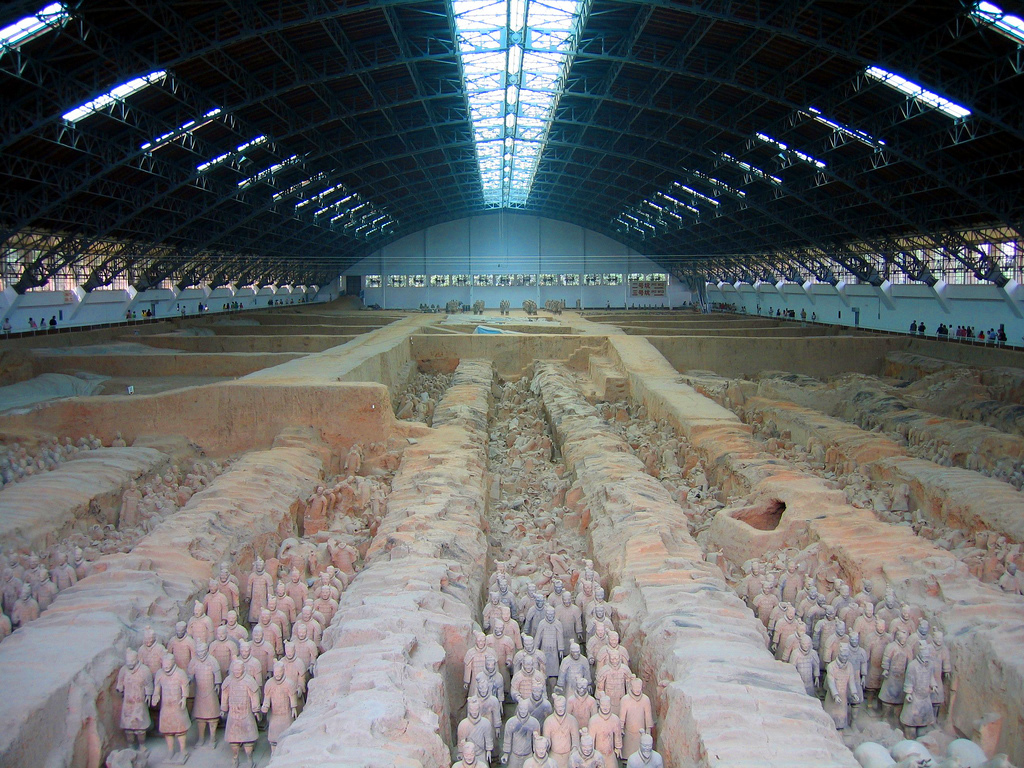
So what’s up?
1. The emperor had a state-dependent utility function (e.g., money is worth less when you are dead), and this was the ancient equivalent of cryonics. If there was a chance you might be called back to life, spend a lot of resources protecting your corpse and its burial site.
2. The emperor was signaling (sorry Noah!) his ability to assemble such an impressive row of life-size figures, and of course the original had many more than what has been restored to date.
3. This was a form of fiscal policy, to stimulate the economy in slow times, by employing craftsmen.
4. The guild of said craftsmen was an influential interest group.
5. It was intended as a gift to a distant future; what else could they have done that would be of more value to us today?
6. Because the emperor could.
What else?
Minority Report for Kiwi youths?
In 2012 economists at the University of Auckland published research establishing clear correlations between family circumstances and incidents of child abuse or neglect. “No one realized we were sitting on such rich data in terms of its predictive power,” says Rhema Vaithianathan, who led the research. “We can find children who are at considerably elevated risk, and we can find them at birth.”
And:
Using data from welfare, education, employment, and housing agencies and the courts, the government identified the most expensive welfare beneficiaries—kids who have at least one close adult relative who’s previously been reported to child safety authorities, been to prison, and spent substantial time on welfare. “There are million-dollar kids in those families,” English says. “By the time they are 10, their likelihood of incarceration is 70 percent. You’ve got to do something about that.”
Moving closer to home:
Jennie Feria, who oversees risk assessment for L.A.’s Department of Children and Family Services, says one idea is to rate families, giving them a number that could be used to identify who’s most at risk in the way lenders rely on credit scores to determine creditworthiness. “The way we may use it, it’s going to be like it’s a FICO score,” Feria says. The information, she says, could be used both to prioritize cases and to figure out who needs extra services. “It’s at the very early stages, because we don’t know how we’re going to use it yet exactly.”
It will be interesting to see how that one develops. The article is by Josh Eidelson.
Why are there so few breweries in the South?
Stephan F. Gohmann has a paper on this topic, here goes:
Most southern states have fewer breweries per population than the rest of the country. This paper examines why. The main outcome is that in the South, the number of breweries is negatively associated with higher campaign contributions from big breweries, the number of beer distributors per capita, and the Southern Baptist adherence rate. In the non-South, these associations are insignificant or positive. The limited number of breweries in the South follows the idea of bootleggers and Baptists where those who gain economically from limited competition—large breweries and distributors—side with groups morally opposed to alcohol to keep breweries out.
The pointer is from the excellent Kevin Lewis.
*Guantánamo Diary*
That is the recent book by Mohamedou Ould Slahi, who has been held at Guantánamo for many years. This is a classic of prison literature, and I will teach it next year in my Law and Literature class. Almost every page is interesting:
It is just amazing that the FBI trusts the Jordanians more than the other American intelligence agencies.
And:
I don’t know any other language that writes Colonel and pronounces it Kernel.
His written English is quite good. Definitely recommended, and the heavily redacted nature of the text enhances the reading experience rather than detracting from it. Here is a good review from The Guardian.