Category: Law
Lead and violence: all the evidence
Kevin Drum offers a response to a recent meta-study on the link between lead and violence, blogged by me here.
I’ll take this moment to explain why the lead-violence connection never has sat that well with me.
Let’s say we are trying to explain why 2022 America is richer than the Stone Age. We could cite “incentives, policy, and culture,” noting that any accumulated stock of wealth also came from these (and possibly other) factors. You might disagree about which policies, or which cultural features of modernity, and so on, but the answer to the question pretty clearly lies in that direction.
Now let us say we are trying to explain why America today is richer than Albania today. You would do just fine to start with “incentives, policy, and culture.” You could add in some additional factors, such as superior natural resources, but you would be on the same track as with the Stone Age comparison. You would not have to summon up an entirely new theory.
Why is Nashville richer than Chattanooga? Again, start with “incentives, policy, and culture,” noting you might need again supplementary factors.
Broadly the same theory is applying to all of these different comparisons. Across time, across space, across countries, and across cities. There is something about this broad unity that is methodologically satisfying, and it helps confirm our view that we are on the right track in our inquiries.
Now consider the lead-crime connection. Insofar as you elevate the connection as very strong, you are tossing out the chance of achieving that kind of unity.
Why was violent crime so often more frequent in earlier periods of human history? It wasn’t lead, at least not for most periods, perhaps not for any of the much earlier periods.
Why was there more peace in Ethiopia five years ago than in the last few years? Again, whatever the reasons it wasn’t a change in lead exposure.
Why is the murder rate in Haiti today much higher than during the Duvaliers? Again, no one thinks the answer has much to do with changes in lead exposure. Mainly it is because political order has collapsed, and the country is ruled by gangs rather than by an autocratic tyranny.
How about the violence rate in the very peaceful parts of Africa compared to the very violent parts? Again, lead is rarely if ever going to be the answer to that one.
So we know in the true, overall model big changes in violence can happen without lead exposure being the driving force. Very big changes. In fact those big changes in violence rates, without lead being a major factor, happen all the time.
And many of those big changes are mysterious in their causes. It really isn’t so simple to explain why different parts of Africa have different murder rates, often by very significant amounts. You can hack away at the problem (e.g, Kenya and Tanzania have very different histories), but there is no simple “go to” theory. Furthermore, since both violence and peace often feed upon themselves, in a “broken windows” increasing returns sort of way, the initial causes behind big differences in violence outcomes might sometimes be fairly slight and hard to find.
That to my mind makes “the true model” somewhat biased against lead being a major factor in changes in violence rates. In the broader scheme of things, lead exposure seems to be a supplementary factor rather than a major factor. It doesn’t rule out lead as a major factor, either logically or statistically, if you wish to explain why U.S. violence fell from the 1960s to today. But the true model has a lot of non-lead, major shifts in violence, often unexplained or hard to explain.
Addendum: I am also surprised by Kevin’s comment that there isn’t likely to be much publication bias in lead-violence studies. I take publication bias to be a default assumption, namely the desire to show a positive result to get published. That hardly seems unlikely to me at all. And in this particular case there is even a particular political reason to wish to pin a lot of the blame on lead exposure. Correctly or not, people on the Left are much more likely to elevate lead exposure as a cause of social problems.
And to repeat myself, just to be perfectly clear, it strikes me as unlikely that the effect of lead exposure on violence in zero is the last seventy years of the United States.
The EU’s carbon tariffs
That is the topic of my latest Bloomberg column. Here is one excerpt, starting with the basic idea:
Importers would have to register to receive authorization to import goods, and they would pay a tax per ton of carbon dioxide produced. These fees are intended to match those already applied within the EU, which are currently about 90 euros per ton. The policy is also intended to place EU industry on a more competitive footing and encourage foreign countries to adopt greener energy policies.
But will it work?:
But would it? Economic changes take place at the margin, and currently the EU is engaged in substitution toward coal, a very dirty energy source.
In light of that reality, consider the proposed tariffs as having (at least) two effects. First, they will push some production out of foreign nations and into the EU. Second, they will induce some foreign nations to move to greener energy sources over time, to avoid the tax.
In the short run, the first effect dominates: The tariffs will lead to more coal use and a dirtier energy supply.
Be suspicious of green energy policies which at first make the problem worse. However promising the longer-run promises may sound, there is always the risk that bureaucratic inertia will intervene and the short-run policy effects will dominate.
The rationale for the beneficial long-run effects of the tariffs is that foreign nations, including some relatively poor nations such as India, will move toward greener energy at a more rapid pace. That might happen. But look at the EU itself over the past year. Its energy prices went up, due to the Russian attack on Ukraine, but the EU did not move toward greener energy, such as more nuclear or wind power. It moved toward dirtier energy, in part because domestic interest groups opposed the more beneficial adjustments.
So, despite about as strong an incentive as possible — a war — the EU made the harmful rather than the beneficial adjustment. Now it is expecting that much poorer nations, often with worse governance structures, to do better. Not only is this naïve, but it is also protectionist.
And this:
Even the positive long-run effects are up for grabs. On one hand, the tariff hike provides an incentive to move toward greener energy. On the other, it makes the exporting nations poorer than they otherwise would be. Poorer nations tend to be less interested in improving their environments, as clean environments are largely a luxury good. And extreme poverty worsens other global problems, including issues stemming from migration. Should EU policy make it more difficult for Africa to industrialize?
One also has to wonder whether the promise of lower tariffs in return for greener energy is credible. Once protectionist measures are in place, they are hard to reverse. The EU would be reaping tariff revenue, and domestic EU industries would be receiving trade protection. Any reclassification of the imports as fundamentally “greener” would require an investigation across borders and clearance through multiple levels of bureaucracy. Such changes will not be easy to accomplish, especially in an era increasingly enamored of trade restrictions.
Worth a ponder. EU coal consumption has been up over the last two years. And what is relevant here is energy supply at the margin.
Combination Rapid Tests
Once again, the US is behind on at-home rapid antigen tests–this time on combination tests that let you test for COVID, Influenza, and RSV all at once. These tests are widely available in Europe but have not been approved by the FDA. Rapid flu tests especially are potentially very useful in assigning appropriate treatment and reducing the overuse of antibiotics.

Does reducing lead exposure limit crime?
These results seem a bit underwhelming, and furthermore there seems to be publication bias, this is all from a recent meta-study on lead and crime. Here goes:
Does lead pollution increase crime? We perform the first meta-analysis of the effect of lead on crime by pooling 529 estimates from 24 studies. We find evidence of publication bias across a range of tests. This publication bias means that the effect of lead is overstated in the literature. We perform over 1 million meta-regression specifications, controlling for this bias, and conditioning on observable between-study heterogeneity. When we restrict our analysis to only high-quality studies that address endogeneity the estimated mean effect size is close to zero. When we use the full sample, the mean effect size is a partial correlation coefficient of 0.11, over ten times larger than the high-quality sample. We calculate a plausible elasticity range of 0.22-0.02 for the full sample and 0.03-0.00 for the high-quality sample. Back-ofenvelope calculations suggest that the fall in lead over recent decades is responsible for between 36%-0% of the fall in homicide in the US. Our results suggest lead does not explain the majority of the large fall in crime observed in some countries, and additional explanations are needed.
Here is one image from the paper:

The authors on the paper are Anthony Higney, Nick Hanley, and Mirko Moroa. I have long been agnostic about the lead-crime hypothesis, simply because I never had the time to look into it, rather than for any particular substantive reason. (I suppose I did have some worries that the time series and cross-national estimates seemed strongly at variance.) I can report that my belief in it is weakening…
Does more construction raise rents?
Matt Yglesias has a long post on that question, recommended albeit gated. Matt’s take is hard to summarize, so I will provide a somewhat different view, though one that is still pro-YIMBY though with a different slant.
Without loss of generality, we can assume that sometimes “more building” raises rents and other times lowers them, or rents stay the same.
Let’s say there are no big “ideas externalities” from a new NYC apartment building, and as we put more of those buildings in, the rents fall somewhat. Furthermore, say we keep on building until those rents in NYC equal those in Nashville. There is gain on the inframarginal units of construction, but at the final margin the new building in NYC has about the same social value as the new building in Nashville. The inframarginal gains are the relevant ones.
Now who gets those inframarginal gains? If land is the truly scarce factor, as NIMBY critics suggest, landlords get a lot of them! Nothing against that, I love landlords. Still, that is a slightly different story from what you hear from the YIMBYs. Landlords don’t get all of those gains, because the land scarcity constraint is precisely what is being relaxed. But the available evidence seems to indicate you need to build a lot before rents fall much. So landlords probably receive a healthy share of those new gains. Rents may fall, but not by that much. And so the gains for new urban entrants (who did not wish to migrate at the old rent levels) are correspondingly meh.
Again, let me repeat I love YIMBY and I love landlords. You should too.
Alternatively, say you keep on building and the new residents bring lots of information externalities to the urban area — ever been to Seoul? They have built like crazy and it is still quite expensive, all the more so in fact. By building more, they made the land more valuable. Good for them. (NB: The biggest beneficiaries may be the rest of Korea, and K-Pop consumers around the world, not Seoul residents.)
Now who do you think reaps most of those gains? Under standard NIMBY assumptions, I would think it is mainly the landlords. Which is not to deny the residents receive some gains from increased product diversity in Seoul (good Thai food there now, etc.), and other non-primary effects.
It’s not all the landlords. But still, the knowledge externalities make land in Seoul, in economic terms, more scarce. The landlords will do really well.
When I read or hear YIMBYs, I often feel they have a public choice model of politics, slanted toward recognizing the influence of the landlords and homeowners, but not a comparable model of factor price incidence to boot. They somehow want the lower rents and the positive information externalities both at the same time. That to me seems unlikely. And so it is harder to redistribute income away from landlords than you might think.
I again would stress that all the YIMBY changes are Pareto improvements here. But the extreme remedies suggested by the Georgists, which to be clear I do not favor, are quite explicable to me.
The best dialogue or podcast I’ve heard this year
Martin Shkreli on how the criminal justice system will treat SBF….interviewer Laura Shin…
I Still Hate Flexible Spending Accounts
According to a new report in Money workers lost billions in so-called flexible savings accounts:
…44% of workers with FSAs in 2019 forfeited money. On average, the amount lost totals $339 per person.
…With reliable data on how often workers forfeit, how much they forfeit and how many FSAs workers hold, we can now reasonably estimate that workers forfeited approximately $3 billion in 2019 and $4.2 billion in 2020.
As I said in my post from 2017 (no indent), I hate “flexible” spending accounts, i.e. those accounts where you put say $1000 in tax-free but you then must submit a bunch of health or education receipts to claim the money–and the “benefits manager” tells you half of the receipts you submitted are no good so you have to trawl through your files to find more–or lose the money. The whole process is demeaning. My hatred of this process, however, pales in comparison to that of Scott Sumner who gives a correct analogy:
Imagine a government that took 10% of each person’s income, and put in in a wooden box. The box was placed at the end of a 10-mile gravel road. Each citizen was given a knife, and told they could crawl on their hands and knees down the road, and then use the knife to cut a hole in the box, and retrieve their money.
Scott’s point is twofold. First, there is a lot of waste in crawling down the road. Second, taken in isolation, it looks like the plan at least offers people an option and so, in isolation, flex accounts and their ilk appear to benefit taxpayers. In the big picture, however, the total amount taken in taxes is somewhat fixed by politics and economics so if we got rid of the spending accounts, taxes would probably fall in other ways that are difficult to predict but nonetheless real.
Some want to crawl down the gravel road, fearing that if they abolish the program the government will not reduce their tax rates, instead the money in the box will be diverted to welfare for the poor, or higher salaries for teachers. I can’t deny that this might occur, but if we don’t even TRY to build a good country, how can we possibly succeed? Isn’t it better to try and fail, rather than not even try?
I agree with Scott. If I am going to be forced to pay taxes I’d like to hand over my cash standing like a man and not be given the option of crawling to recoup some bills the tax collector magnanimously throws on the floor.
The FDA’s Lab-Test Power Grab
The FDA is trying to gain authority over laboratory developed tests (LDTs). It’s a bad idea. Writing in the WSJ, Brian Harrison, who served as chief of staff at the U.S. Department of Health and Human Services, 2019-2021 and Bob Charrow, who served as HHS general counsel, 2018-2021, write:
We both were involved in preparing the federal Covid-19 public-health emergency declaration. When it was signed on Jan. 31, 2020, the intent was to cut red tape and maximize regulatory flexibility to allow a nimble response to an emerging pandemic.
Unknown to us, the next day the FDA went in the opposite direction: It issued a new requirement that labs stop testing for Covid-19 and first apply for FDA authorization. At that time, LDTs were the only Covid tests the U.S. had, and many were available and ready to be used in labs around the country. But since the process for emergency-use authorization was extremely burdensome and slow—and because, as we and others in department leadership learned, it couldn’t process applications quickly—many labs stopped trying to win authorization, and some pleaded for regulatory relief so they could test.
Through this new requirement the FDA effectively outlawed all Covid-19 testing for the first month of the pandemic when detection was most critical. One test got through—the one developed by the Centers for Disease Control and Prevention—but it proved to be one of the highest-profile testing failures in history because the entire nation was relying on the test to work as designed, and it didn’t.
When we became aware of the FDA’s action, one of us (Mr. Harrison) demanded an immediate review of the agency’s legal authority to regulate these tests, and the other (Mr. Charrow) conducted the review. Based on the assessment, a determination was made by department leadership that the FDA shouldn’t be regulating LDTs.
Congress has never expressly given the FDA authority to regulate the tests. Further, in 1992 the secretary of health and human services issued a regulation stating that these tests fell under the jurisdiction of the Centers for Medicare and Medicaid Services, not the FDA. Bureaucrats at the FDA have tried to ignore this rule even though the Supreme Court in Berkovitz v. U.S. (1988) specifically admonished the agency for ignoring federal regulations.
Loyal readers will recall that I covered this issue earlier in Clement and Tribe Predicted the FDA Catastrophe. Clement, the former US Solicitor General under George W. Bush and Tribe, a leading liberal constitutional lawyer, rejected the FDA claims of regulatory authority over laboratory developed tests on historical, statutory, and legal grounds but they also argued that letting the FDA regulate laboratory tests was a dangerous idea. In a remarkably prescient passage, Clement and Tribe (2015, p. 18) warned:
The FDA approval process is protracted and not designed for the rapid clearance of tests. Many clinical laboratories track world trends regarding infectious diseases ranging from SARS to H1N1 and Avian Influenza. In these fast-moving, life-or-death situations, awaiting the development of manufactured test kits and the completion of FDA’s clearance procedures could entail potentially catastrophic delays, with disastrous consequences for patient care.
Clement and Tribe nailed it. Catastrophic delays, with disastrous consequences for patient care is exactly what happened. Thus, Harrison and Charrow are correct, giving the FDA power over laboratory derived tests has had and will have significant costs.
The Birx Plan for Early Vaccination of the Nursing Homes
In Covid in the nursing homes: the US experience, Markus Bjoerkheim and I show that the Great Barrington “focused protection” plan was unlikely to have worked. I covered this last week. But there was one strategy which could have saved tens of thousands of lives–early vaccination. If the vaccine trials had been completed just 5 weeks earlier, for example, we could have saved 14 thousand lives in the nursing homes alone. But put aside the possibility of completing the trials earlier. There was another realistic possibility under our noses. We had could have offered nursing home residents the vaccine on a compassionate use basis, i.e. even before all the clinical trials were completed. An early vaccination option was neither unprecedented nor a question of 20-20 hindsight, early vaccination was discussed at the time:
Deborah Birx, the coordinator of the White House Coronavirus Task Force, forcefully advocated that nursing home residents should be given the option of being vaccinated earlier under a compassionate use authorization (Borrell, 2022). Many other treatments, such as convalescent plasma, were authorized under compassionate use procedures and there was more than enough vaccine available to vaccinate all nursing home residents. As a first approximation we find the Birx plan would have prevented in the order of 200,000 nursing home cases and 40,000 nursing home deaths. To put that in perspective, it amounts to reducing overall nursing home Covid deaths by over 26 per cent (using all CMS reported resident nursing home deaths as of 5 December 2021, and estimates of underreported deaths from Shen et al. (2021)).
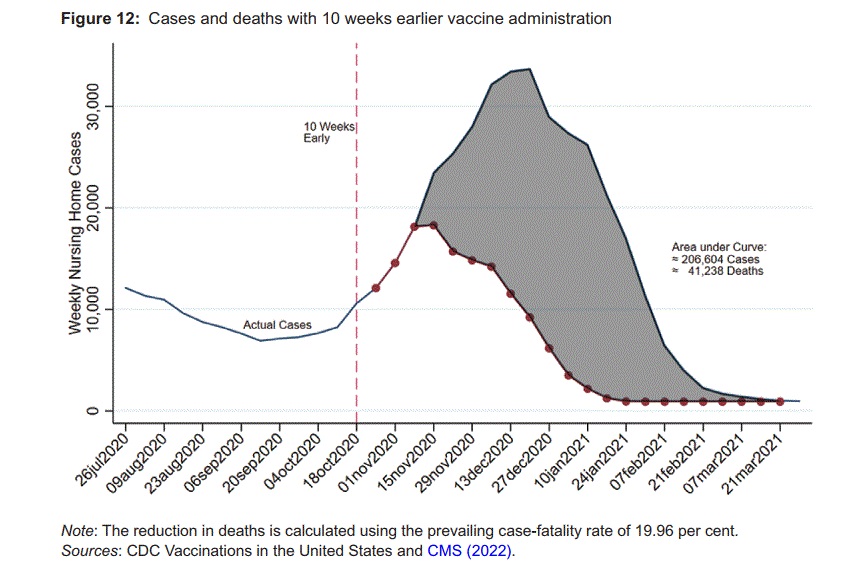
The lesson is not primarily about the past. It’s about the central importance of vaccines in any plan to protect the vulnerable and about how we should be bolder and braver the next time.
Addendum: See also Tyler’s tremendous post (further below) on focused protection.
Should the United States ban TikTok?
A bipartisan coalition is currently considering such an action and a bill has been introduced to the Senate (FT summary here). I don’t see why we should do this. I am all for keeping TikTok off the smart phones of people in the military and in national intelligence and perhaps a few other roles as well. But beyond that point?
What is the actual evidence that it is serving up slanted, pro-Chinese content, or otherwise swaying public opinion in a negative manner?
On top of that, perhaps many Americans should be more exposed to pro-Chinese views! As part of a broader menu of choice, of course. If only TikTok would teach them the theory of comparative advantage.
If TikTok did turn out to be an insidious and highly effective agent of foreign propaganda, we can always ban it later on. That won’t be hard to do, politically speaking.
You are losing your privacy to the Chinese? The Chinese, for better or worse, already can buy lots of data on you from private data brokers, just as other parties can. Few people seem super worried about that. Nor do we ban trips to China, which often result in a “stripping” of all the available information accessible through that person’s devices (people who matter and who know better often just bring burner phones and laptops, etc.).
What exactly would be the legal basis for such a ban? “I don’t like your company so we are getting rid of it?” We can do better than that.
The Great Barrington Plan: Would Focused Protection Have Worked?
A key part of The Great Barrington Declaration was the idea of focused protection, “allow those who are at minimal risk of death to live their lives normally to build up immunity to the virus through natural infection, while better protecting those who are at highest risk.” This was a reasonable idea and consistent with past practices as recommended by epidemiologists. In a new paper, COVID in the Nursing Homes: The US Experience, my co-author Markus Bjoerkheim and I ask whether focused protection could have worked.
Nursing homes were the epicenter of the pandemic. Even though only about 1.3 million people live in nursing homes at a point in time, the death toll in nursing homes accounted for almost 30 per cent of total Covid-19 deaths in the US during 2020. Thus we asked whether focusing protection on the nursing homes was possible. One way of evaluating focused protection is to see whether any type of nursing homes were better than others. In other words, what can we learn from best practices?
The Centers for Medicaire and Medicaid Services (CMS) has a Five-Star Rating system for nursing homes. The rating system is based on comprehensive data from annual health inspections, staff payrolls, and clinical quality measures from quarterly Minimum Data Set assessments. The rating system has been validated against other measures of quality, such as mortality and hospital readmissions. The ratings are pre-pandemic ratings. Thus, the question to ask is whether higher-quality homes had better Covid-19 outcomes? The answer? No.
The following figure shows predicted deaths by 5-star rating. There is no systematic relationship between nursing homes rating and COVID deaths. (In the figure, we control for factors outside of a nursing homes control, such as case prevalence in the local community. But even if you don’t control for other factors there is little to no relationship. See the paper for more.) Case prevalence in the community not nursing home quality determined death rates.
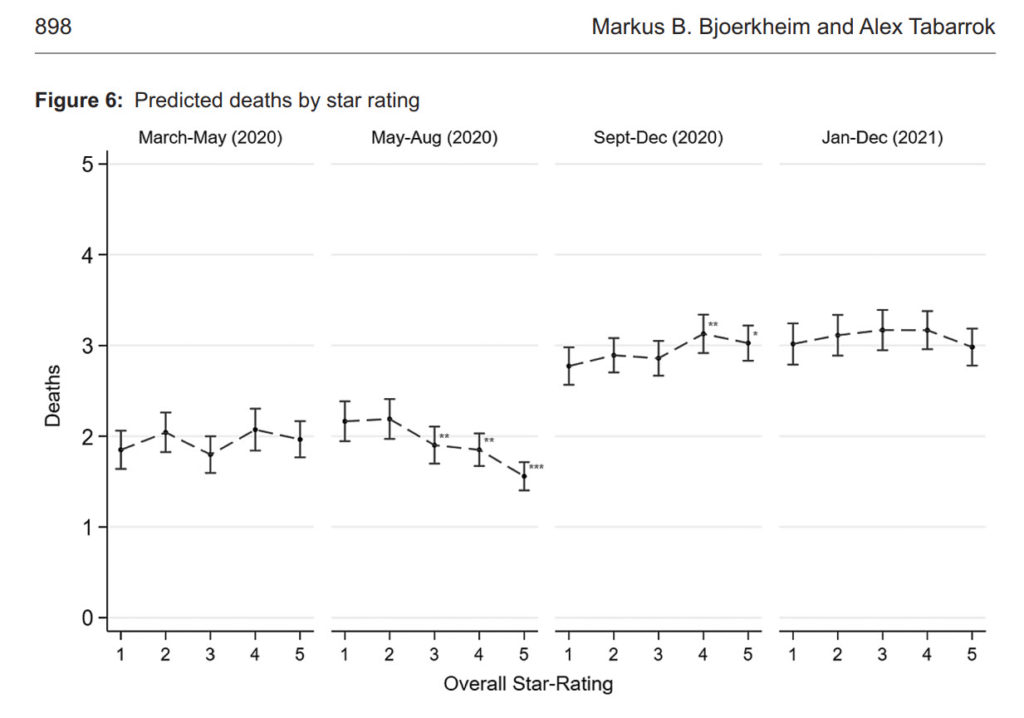
More generally, we do some exploratory data analysis to see whether there were any “islands of protection” in the sea of COVID and the answer is basically no. Some facilities did more rapid tests and that was good but surprisingly (to us) the numbers of rapid tests needed to scale nationally and make a substantial difference in nursing home deaths was far out of sample and below realistic levels.
Finally, keep in mind that the United States did focused protection. Visits to nursing homes were stopped and residents and staff were tested to a high degree. What the US did was focused protection and lockdowns and masking and we still we had a tremendous death toll in the nursing homes. Focused protection without community controls would have led to more deaths, both in the nursing homes and in the larger community. Whether that would have been a reasonable tradeoff is another question but there is no evidence that we could have lifted community controls and also better protected the nursing homes. Indeed, as I pointed out at the time, lifting community controls would have made it much more difficult to protect the nursing homes.
*Crack-Up Capitalism*
That is the new book by Quinn Slobodian. Slobodian is very smart, and knows a lot, but…I don’t know. I fear he is continuing to move in the Nancy McLean direction with this work.
This is a tale of how libertarian and libertarian-adjacent movements have embraced various anti-democratic and non-democratic positions. So you can read about seasteading, Hans-Hermann Hoppe, Hong Kong as a charter city, and “decentralization” plans for Ciskei, South Africa.
You won’t hear about the highly successful SEZ reforms for the Dominican Republic, or how the European Union was partly rooted in Hayek’s postwar piece on interstate federalism. In that essay, Hayek was explicit about how much would be done by treaty, rather than direct vote, and that is (mostly) how the European Union has turned out. With reasonable success, I might add. Do only the nuttier episodes of “less democracy” count?
Question one: Is the word “plutocratic” ever illuminating?
Question two: Is this a useful descriptive sentence for Milton Friedman? “He [Patri] had a famous grandfather, perhaps the century’s most notorious economist, both lionized and reviled for his role in offering intellectual scaffolding for ever more radical forms of capitalism and his sideline in advising dictators: Milton Friedman. The two shared a basic lack of commitment to democracy.”
Here is a YouTube clip of Friedman on democracy. Or I asked davinci-003 and received:
Yes, Milton Friedman did believe in democracy. He was an advocate of democracy and free markets, believing that economic freedom would advance both economic and political freedom. He argued that government should be limited in size and scope and that the free market should be allowed to operate with minimal interference.
Or how about engaging with the academic literature on Friedman’s visit to Chile? And more here. Was Friedman, who was elected president of the American Economic Association and won an early Nobel Prize, really “notorious”?
There is valuable content in this book, but it needs to cut way back on the mood affiliation.
Why Scott Alexander does not hate crypto
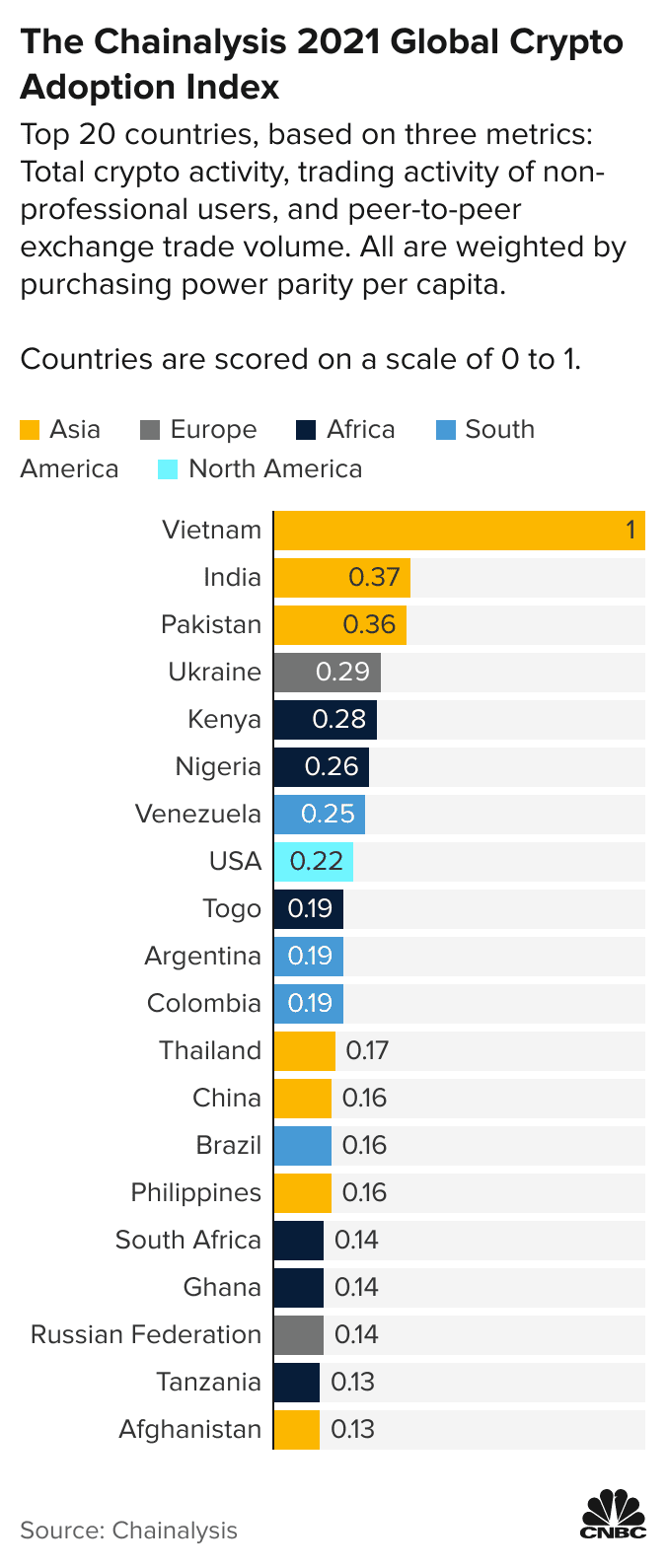
Vietnam uses crypto because it’s terrible at banks. 69% of Vietnamese have no bank access, the second highest in the world. I’m not sure why; articles play up rural poverty, but many nations have more rural poor than Vietnam. There’s a history of the government forcing banks to make terrible loans, and then those banks collapsing; maybe this destroyed public trust? In any case, between banklessness and remittances (eg from Vietnamese-Americans), Vietnam leads the world in crypto use.
Ukraine has always been among the top crypto countries: in 2021, NYT called it “the crypto capital of the world”. Again, this owes a lot to its terrible banking system. NYT describes its banks as “so sclerotic that sending or receiving even small amounts of money from another country requires an exasperating obstacle course of paperwork”, and this guy says that if you deposit more than $100,000 in a Ukrainian bank, “the chance that you get it back is very slim”. When Russia invaded, the Ukrainian government doubled down on crypto as a way for friendly Westerners to send donations to support the war effort – $70 million as of March. It proved so helpful that during the first month of the war, in between dodging Russian artillery shells President Zelenskyy found time to pass a law legalizing crypto and strengthening its regulatory framework.
Venezuela’s economy has been in slow motion collapse for the past decade. The inflation is currently in the triple digits (remember, people thought the Democrats would lose the midterms because of a US inflation rate of 8%). If your country has a triple-digit inflation rate, you might prefer to use an alternative currency, which Venezuela’s authoritarian government tries to prevent people from doing. Cryptocurrency provides a hard-to-ban alternative which has caught on among Venezuelan hustlers and small businessmen.
And consider this picture:
Here is the full post.
The Story of VaccinateCA
The excellent Patrick McKenzie tells the story of VaccineCA, the ragtag group of volunteers that quickly became Google’s and then the US Government’s best source on where to find vaccines during the pandemic.
Wait. The US Government was giving out the vaccines. How could they not know where the vaccines were? It’s complicated. Operation Warp Speed delivered the vaccines to the pharmacy programs and to the states but after that they dissappeared into a morass of incompatible systems.
[L]et’s oversimplify: Vials were allocated by the federal government to states, which allocated them to counties, which allocated them to healthcare providers and community groups. The allocators of vials within each supply chain had sharply limited ability to see true systemic supply levels. The recipients of the vials in many cases had limited organizational ability to communicate to potential patients that they actually had them available.
Patients then asked the federal government, states, counties, healthcare providers and community groups, ‘Do you have the vaccine?’ And in most cases the only answer available to the person who picked up the phone was ‘I don’t have it. I don’t know if we have it. Plausibly someone has it. Maybe you should call someone else.’ Technologists will see the analogy to a distributed denial of service incident, and as if the overwhelming demand was not enough of a problem, the rerouting of calls between institutions amplified the burden on the healthcare system. Vaccine seekers were routinely making dozens of calls.
This caused a standing wave of inquiries to hit all levels of US healthcare infrastructure in the early months of the vaccination effort. Very few of those inquiries went well for any party. It is widely believed, and was widely believed at the time, that this was primarily because supply was lacking, but it was often the case that supply was frequently not being used as quickly as it was produced because demand could not find it.
It turned out that the best way to get visibility into this mess was not to trace the vaccines but to call the endpoints on the phone and then create a database that people could access which is what VaccinateCA did but in addition to finding the doses they had to deal with the issue of who was allowed access.
A key consideration for us, from the first day of the effort, was recording not just which pharmacist had vials but who they thought they could provide care to. This was dependent on prevailing regulations in their state and county, interpretations of those regulations by the pharmacy chain, and (frequently!) ad hoc decision-making by individual medical providers. Individual providers routinely made decisions that the relevant policy makers did not agree comported with their understanding of the rules.
VaccinateCA saw the policy sausage made in real time in California while keeping an eye on it nationwide. It continues to give me nightmares.
California, not to mince words, prioritized the appearance of equity over saving lives, over and over and over again, as part of an explicitly documented strategy, at all levels of the government. You can read the sanitized version of the rationale, by putative medical ethics experts, in numerous official documents. The less sanitized version came out frequently in meetings.
This was the official strategy.
The unofficial strategy, the result the system actually obtained, was that early access to the vaccine was preferentially awarded based on proximity to power and to the professional-managerial class.
… The essential workers list heavily informed the vaccination prioritization schedule. Lobbyists used it as procedural leverage to prioritize their clients for vaccines. The veterinary lobby was unusually candid, in writing, about how it achieved maximum priority (1A) for veterinarians due to them being ‘healthcare workers’.
Teachers’ unions worked tirelessly and landed teachers a 1B. They were ahead of 1C, which included (among others) non-elderly people for whom preexisting severe disability meant that ‘a covid-19 infection is likely to result in severe life-threatening illness or death’. The public rationale was that teachers were at elevated risk of exposure through their occupation. Schools were, of course, mostly closed at the time, and teachers were Zooming along with the rest of the professional-managerial class, but teachers’ unions have power and so 1B it was. Young, healthy teachers quarantining at home were offered the vaccine before people who doctors thought would probably die if they caught Covid.
Now repeat this exercise up and down the social structure and economy of the United States.
…Healthcare providers were fired for administering doses that were destined to expire uselessly. The public health sector devoted substantial attention to the problem of vaccinating too many people during a pandemic. Administration of the formal spoils system became farcically complicated and frequently outcompeted administration of the vaccine as a goal.
The process of registering for the vaccine inherited the complexity of the negotiation over the prioritization, and so vulnerable people were asked to parse rules that routinely befuddled healthy professional software engineers and healthcare administrators – the state of New York subjected senior citizens to a ‘51 step online questionnaire that include[d] uploading multiple attachments’!
That isn’t hyperbole! New York meant to do that! On purpose!
Lives were sacrificed by the thousands and tens of thousands for political reasons. Many more were lost because institutions failed to execute with the competence and vigor the United States is abundantly capable of.
…The State of California instituted a policy of redlining in the provision of medical care in a pandemic to thunderous applause from its activist class and medical ethics experts….Residency restrictions were pervasively enforced at the county level and frequently finer-grained than that. A pop-up clinic, for example, might have been restricted to residents of a single zip code or small group of zip codes.
All people are equal in the eyes of the law in California, but some people are . . . let’s politely say ‘administratively disfavored’.
The theory was, and you could write down this part of it, disfavored potential patients might use social advantages like better access to information and transportation to present themselves for treatment at locations that had doses allocated for favored potential patients. This part of the theory was extremely well-founded. Many people were willing to drive the length and breadth of California for their dose and did so.
What many wanted to do, and this is the part that they couldn’t write down, is deny healthcare to disfavored patients. Since healthcare providers are public accommodations in the state of California, they are legally forbidden from discriminating on the basis of characteristics that some people wanted to discriminate on. So that was laundered through residency restrictions.
Many more items of interest. I didn’t know this incredibly fact about the Biden adminsitratins Vaccines.gov for example:
Pharmacies through the FRPP had roughly half of the doses; states and counties had roughly the other half (sometimes administered at pharmacies, because clearly this isn’t complicated enough yet). You would hope that state and county doses were findable on Vaccines.gov. It was going to be the centerpiece of the Biden administration’s effort to fix the vaccine finding problem and take credit for doing so.
…Since the optics would be terrible if America appeared to serve some states much better than others on the official website that everyone would assume must show all the doses, no state doses, not even from states that would opt in, would be shown on it, at least not at the moment of maximum publicity. Got that?
A good point about America.
We also benefited from another major strength of America: You cannot get arrested, jailed, or shot for publishing true facts, even if those facts happen to embarrass people in positions of power. Many funders wanted us to expand the model to a particular nation. In early talks with contacts there in civil society, it was explained repeatedly and at length that a local team that embarrassed the government’s vaccination rollout would be arrested and beaten by people carrying guns. This made it ethically challenging to take charitable donations and try to recruit that team.
Many more points of interest about the process of running a medical startup during a pandemic. Read the whole thing.
From the comments, on CDC reform
These are the word of commentator Sure:
Here is the original post.