Category: Philosophy
*The Great Persuasion*
That is the new book by Angus Burgin and the subtitle is Reinventing Free Markets since the Depression. As I had suspected, it is interesting. Here is the core thesis:
To Hayek and the other founders of the Mont Pelerin Society, Friedman’s ascent within its orbit reflected the collapse of its attempt to integrate a restrained defense of free markets into a traditionalist worldview. In the broader social environment Friedman’s rise portended, and precipitated, the triumphant return of laissez-faire.
One thing which strikes me reading this book, as it does when I reread Friedman’s 1962 Capitalism and Freedom, is how much market-oriented writers of that era were not focused on the problems of old people, even though today those problems take up a huge chunk of the budget of the federal government.
I found this excerpt interesting:
In stark contrast to the early post-war years, Friedman would conclude near the end of his career that “there are too many damn think tanks now,” adding that they simply “don’t have the talent for it.”
The words English has taken from India
Another author who has drawn inspiration from the dictionary is Tom Stoppard. In his play Indian Ink, two characters compete to use as many Hobson-Jobson words as possible:
- Flora: “While having tiffin on the veranda of my bungalow I spilled kedgeree on my dungarees and had to go to the gymkhana in my pyjamas looking like a coolie.”
- Nirad: “I was buying chutney in the bazaar when a thug who had escaped from the chokey ran amok and killed a box-wallah for his loot, creating a hullabaloo and landing himself in the mulligatawny.”
Here is more, hat tip goes to The Browser. They also refer us to this long interview with philosopher Thomas Scanlon, and Ed Glaeser on what American can learn from Australia.
The De Benoist conservative (?) critique of Hayek
Here is the concluding bit:
Hayek’s efforts differ from classical liberalism because of his attempt to re-ground the doctrine at the highest possible level without recourse to the fiction of the social contract and by attempting to avoid the critiques usually made of rationalism, utilitarianism, the postulate of a general equilibrium or of pure and perfect competition founded on the transparency of information. In order to do this, Hayek is forced to raise the stakes and to turn the market into a global concept necessary because of its totalizing character. The result is a new utopia, predicated on as many paralogisms and contradictions. Actually, as Caille put it, were it not for “the welfare state’s failure to achieve social peace, the market order would have been swept away a long time ago.” A society based on Hayek’s principles would explode in a short time. Furthermore, its institution can only be the product of a pure “constructivism” and would undoubtedly require a dictatorial state. As Albert O. Hirschman writes, “this allegedly idyllic privatized citizenship, which only pays attention to its economic interests and indirectly serves the public interest without ever playing a direct role — all of this can only be achieved within nightmarish political conditions.”[56] That today “national thought” is being reinvigorated by this type of theory says a lot about the collapse of this thought.
The full essay is here, and for the pointer I thank Bill.
Just yesterday on my doorstep I received the book The Great Persuasion: Reinventing Free Markets since the Depression, by Angus Burgin, which offers a lengthy contrast between Hayek and Friedman, among other matters. It looks interesting: “Postwar conservative thought was more dynamic and cosmopolitan than has previously been understood.”
A bit more on workplace freedom
You’ll find two responses from John Holbo and Henry Farrell to my initial post. I recall also reading good posts from Modeled Behavior, Matt Yglesias, and here, and Miles Kimball, among others, on the topic.
In a sense, I don’t think Holbo and Farrell realize how “fundamental” my initial response was. I don’t actually find “libertarianism and the workplace,” literally construed, to be a useful debate. How about debating “the workplace”? (I’ve declared my own allegiance to positive liberty some time ago, and I think this was even discussed on CT at the time.) Or some specific proposed change to workplace law? In general the CT blog, while overall excellent, suffers from the disease of spending way too much time on libertarianism as a target for not-so-empirical, mid-range conceptual blog posts which focus on doctrines and hypothetical philosophic comparisons rather than concrete results. I view my own response as simply saying this: give me some (non-anecdotal) evidence, and give me some conceptual framework or model which implies something more definite than that we should maximize wealth, productivity, and move towards full employment, all good but uncontroversial ideas. Give me something more than the time-honored arguments in favor of the civil rights movement. Without those, in my view the initial complaint has not even been registered. Reading the responses, I stick with my original sense, namely that a meaningful complaint has yet to be registered at all.
“Libertarianism and the workplace”?
Numerous readers have asked me for a response to this lengthy post from Crooked Timber. Travel commitments limit me from offering anything close to a full treatment, but here are a few points:
1. Is the complaint that workers aren’t getting enough of the pie? Let’s consider giving them cash instead of workplace regulations.
2. It would be nice to see an estimate of how much the workers cared about the issues raised in this post, say in terms of willingness to pay. I would start with that number.
3. Is the complaint that workers are getting an inefficient mix of money and workplace freedoms? Maybe so, but I’ve yet to see the argument. And what if it turned out they were getting too many workplace freedoms and not enough money, say because of intra-family externalities and the intra-family tax rate on the money?
4. Is the complaint is that workers should be getting the mix of money that the authors desire to see in place, rather than what the workers themselves wish to have, taking opportunity costs into account? If so, I’m probably not on board but in any case let’s see the authors fess up to that upfront and then defend it. Let’s see how many of the workers they can convince.
5. How about a brief mention of the fact that labor-managed firms are mostly not a big success? Or that some rights can involve a notion of property? I’d like to see an empirical paper on what kinds of workplace freedoms are allowed by labor-managed firms, more or less?
6. How about a brief mention of the fact that workplace regulations, in practice, very often are used to protect insiders and restrict employment for outsiders?
I find many (most?) of the cited restrictions on labor freedom, if that is the right phrase, defensible. Consider this:
They can be fired for donating a kidney to their boss (fired by the same boss, that is), refusing to have their person and effects searched, calling the boss a “cheapskate” in a personal letter, and more.
The latter two seem obvious to me, and on the first perhaps it is better to give your kidney to a complete stranger. Become friends later on, as Virginia Postrel did with Sally Satel, to avoid putting the other person in a conflict of interest situation. (I do agree that a moral boss should have quit, but not that the firing should be legally prohibited per se.) Presenting these and other mentions as self-evidently objectionable I don’t find so compelling. I also see a big difference between “I can find a case settled like this” and “this is always the law” and on that we are left a bit at sea.
I am not comfortable with the mood affiliation of the piece. How about a simple mention of the massive magnitude of employee theft in the United States, perhaps in the context of a boss wishing to search an employee?
When I was seventeen, I had a job in the produce department of a grocery store. They made me wear a tie. They did not let me curse. Even if there was no work at the moment, I could not appear to be obviously slacking for fear of setting a bad example. They had the right to search me, including for illegal drugs. I suspect that “contract indeterminacies” gave them other rights too.
The company kept each and every one of its promises to me and they paid me on time every two weeks. The company also taught me a lot. I honor that company to this day. I also did my best to keep each and every promise to them.
What I did observe was massive employee shirking, rampant drug use including what appeared to be on the job, regular rule-breaking, and a significant level of employee theft, sometimes in cahoots with customers.
I understand full well that’s only one anecdote and only one side of the picture, and yes the company did fire vulnerable workers and quite possibly not always with just cause. Still I get uncomfortable when this other side of the story is ignored. When I hear the phrase “workplace coercion,” the first thing I think of is employee theft, estimated by the U.S. Chamber of Commerce at over $50 billion a year.
Addendum: If I ponder my workplace at GMU, I see many more employees who take advantage of the boss, perhaps by shirking, or by not teaching well, than I see instances of the bosses taking advantage of the employees. Make that two anecdotes.
My 28-minute talk on black swans
What would we do if it turned out there were more black swans than we had thought? What should we do?
You can view the talk here, given at the Legatum Institute in London not too long ago.
A visual illusion
If it is this easy to be mistaken about simple things it must be much easier to be mistaken about difficult things. From Geekolinks.

The Google-Trolley Problem
As you probably recall, the trolley problem concerns a moral dilemma. You observe an out-of-control trolley hurtling towards five people who w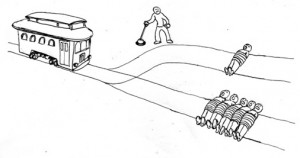 ill surely die if hit by the trolley. You can throw a switch and divert the trolley down a side track saving the five but with certainty killing an innocent bystander. There is no opportunity to warn or otherwise avoid the disaster. Do you throw the switch?
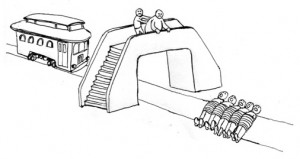 A second version is where you stand on a bridge with a fat man. The only way to stop the trolling killing five is to push the fat man in front of the trolley. Do you do so? Some people say no to both and many say yes to switching but no to pushing, referring to errors of omission and commission. You can read about the moral psychology here.
I want to ask a different question. Suppose that you are a programmer at Google and you are tasked with writing code for the Google-trolley. What code do you write? Should the trolley divert itself to the side track? Should the trolley run itself into a fat man to save five? If the Google-trolley does run itself into the fat man to save five should Sergey Brin be charged? Do your intuitions about the trolley problem change when we switch from the near view to the far (programming) view?
I think these questions are very important: Notice that the trolley problem is a thought experiment but the Google-trolley problem is a decision that now must be made.

What is the correct Bayesian inference from this British message?
I found a little card in my bathroom, perched above the toilet and near the shower:
This bath has a non slip surface in part. If you would like a rubber bath mat in addition please contact housekeeping.
And so what does that mean? Here are some options:
1. The part without the non slip surface is really, really slippery. Watch out!
2. We are boasting about having a non slip surface “in part,” yet without appearing to be boasting too explicitly.
3. We are not sure which is your best course of action (there is human heterogeneity), but we want to get you thinking about the non slip surface and also the slip surface. We are sure you will put the information to good use and also we are showing our respect for your decision-making and autonomy.
4. We have attempted to word this message as emotionally neutrally as possible. We are therefore signaling that we are a quality hotel, without intending to offer any particular advice about the non slip surface or for that matter the slip surface. We also did not fall into the trap of hyphenating “non slip” (though we did elsewhere in the bathroom hyphenate “co-operation”), nor did we place a comma after “addition” as you barbarians might have done.
I am not intelligent enough to discern which of these might be true.
*Economic Fables*, the new Ariel Rubinstein book
It is summarized here:
I had the good fortune to grow up in a wonderful area of Jerusalem, surrounded by a diverse range of people: Rabbi Meizel, the communist Sala Marcel, my widowed Aunt Hannah, and the intellectual Yaacovson. As far as I’m concerned, the opinion of such people is just as authoritative for making social and economic decisions as the opinion of an expert using a model.
Part memoir, part crash-course in economic theory, this deeply engaging book by one of the world’s foremost economists looks at economic ideas through a personal lens. Together with an introduction to some of the central concepts in modern economic thought, Ariel Rubinstein offers some powerful and entertaining reflections on his childhood, family and career. In doing so, he challenges many of the central tenets of game theory, and sheds light on the role economics can play in society at large.
Economic Fables is as thought-provoking for seasoned economists as it is enlightening for newcomers to the field.
The book can be read freely here. Rubinstein’s home page is here.
Should B. emigrate from England?
A request from a loyal blog reader. I attended a talk in Oxford by Martin Wolf from the FT a few months ago, in which he gave a very pessimistic assessment of prospects for the British and European economies. A member of the audience asked what his advice for a young graduate entering the job market would be, and his response was ’emigrate’.
So two requests, really:
(1) Do you agree?
(2) If so, where should I go?To put things in context, I am a 21-year-old male, a final year student at Oxford University reading for a BA in Politics, Philosophy, and Economics (concentrating on the latter two subjects). I have work experience in the financial sector, moderate language ability (high school level French and German, but a fast learner), and I am willing to consider a wide range of locations. I am an EU citizen, so obviously have freedom of movement within the EU. I am open to staying somewhere for a relatively long period, but at the moment I am more inclined to think of it as a below-ten-year stay. Assume, perhaps, the prospect of permanent residence is not excluded. Feel free to edit the request as appropriate for the blog.
I say:
1. The key data point is the polarization of labor market returns, including in the United Kingdom and much of Western Europe. Given that your background and reading habits signal smarts and hard work, you probably will do fine staying at home.
2. Switching languages will set you back by years, even if you are a quick study. Stick to the Anglo world, or to an English-speaking job at least.
3. It is not already obvious to B. that he should move to the United States. That’s fine, so perhaps he quite likes England already and indeed who wouldn’t? That lack of obsession with America also means he does not have a diehard commitment to maximizing pecuniary returns and that is yet further evidence he should stay in England.
4. If you want to travel and live abroad, try to start with an English multinational and then signal a willingness to move far afield. Or consider the foreign service. Or work for a year or two and then do a Jodi Ettenberg for as long as you can. All of those options sound better to me than moving to Stuttgart and trying to master the intricacies of “dass ich nicht habe lachen mussen,” (or is it “dass ich habe nicht lachen mussen”?, or do they mean different things?) while petitioning the Knigge Society for a knowledge of manners.
5. “A man who is tired of London is tired of life.”
Spoons and the social discount rate
Its hard to imagine spoons will exist in their current form in 30 years. What does this tell us about the social discount rate?
That is from the ModeledBehavior hive mind.
Let’s assume an intertemporal equilibrium. The rate of return on buying consumer durables ought to equal (risk-adjusted) the rate of return on capital. Spoon improvement means a lower rate of return on holding spoons, which means a lower return on durables, which in turn means a lower rate of return on capital investment. For a given set of interest rates, that implies a higher rate of social discount.
That said, I find it easy to imagine spoons will exist in their current form in 30 years. What if I were wrong? I would be overestimating the MU of money in future periods and thus saving too much. I ought to buy more non-spoon items, renting my current spoons, knowing that spoon improvements will glide me into a cushy retirement.
*Eric Hoffer: The Longshoreman Philosopher*
I very much enjoyed the new biography of Eric Hoffer, here is one excerpt:
Reminding us of Immanuel Kant, Hoffer went on solitary walks, did not marry, had a stomach that often gave him trouble, and (after he moved to San Francisco) rarely traveled. (Kant, it seems, never did.) Remarkably, we know more about Kant’s early life than we do about Hoffer’s. A professor of geography, Kant early on was more interested in science than in philosophy; Hoffer was the same. After moving to skid row in Los Angeles, he said, he taught himself chemistry and botany.
…Hoffer’s hundreds of three-by-five-inch index cards carried quotations from Aristotle, Bagehot, Clemenceau, Disraeli, Gandhi, Hobbes, Kant, Montaigne, Nietzsche, Pascal, Spinoza, and a hundred others, compiled over many years. Was there any precedent for this in the life of the nation? An apparently unschooled laborer who became a longshoreman and made an attempt to compile the wisdom of the ages on his own? he was filling them out by the 1940s and he continued adding to them until near the end of his life. the later dates are conspicuous because his handwriting becomes ever more shaky.
The author is Tom Bethell, you can buy the book here.
*Peter Singer and Christian Ethics*
The author is Charles C. Camosy and the subtitle is Beyond Polarization, you can buy it here.
Most philosophies draw heavily from religion, as Ross Douthat suggested recently. Peter Singer is no exception, as Camosy ably demonstrates. There should be more books like this.
My new question for visitors to the lunch table is: “What is it you really believe in?”
Request for requests
I will try to do my best in responding to your requests for topic coverage, please leave those requests in the comments section…