Category: Political Science
Nice
Accordingly, raising residential building requirements in high-amenity areas should cause those areas to move gradually to the left.
That is from Jason Sorens at Dartmouth, via the excellent Kevin Lewis.
In which ways is today’s world like the Reformation?
I can think of a few reasons:
1. Many of the structures in places are perceived as failing, even though in absolute terms they are not obviously doing worse than previous times.
2. There is a rise in nationalist sentiment and a semi-cosmopolitan ethic is starting to lose influence.
3. The chance of violent conflict is rising.
4. Dialogue is becoming more polarized and bigoted, and at some margins stupider.
5. Tales of gruesome torture are being spread by new publishing and communications media.
6. The world may nonetheless end up much better off, but the ride to get there will be rocky iindeed.
I have been reading Carlos M.N. Eire, Reformations: The Early Modern World, 1450-1650. Yes I know it is 893 pp., but it is actually one of the most readable books I have had in my hands all year.
Why do Danish-Americans do better than Danes?
That is one question I consider in my latest Bloomberg column, here is one excerpt:
Nima Sanandaji, a Swedish policy analyst and president of European Centre for Entrepreneurship and Policy Reform, has recently published a book called “Debunking Utopia: Exposing the Myth of Nordic Socialism.” And while the title may be overstated, his best facts and figures are persuasive.
For instance, Danish-Americans have a measured living standard about 55 percent higher than the Danes in Denmark. Swedish-Americans have a living standard 53 percent higher than the Swedes, and Finnish-Americans have a living standard 59 percent higher than those back in Finland. Only for Norway is the gap a small one, because of the extreme oil wealth of Norway, but even there the living standard of American Norwegians measures as 3 percent higher than in Norway. And that comparison is based on numbers from 2013, when the price of oil was higher, so probably that gap has widened.
Of the Nordic groups, Danish-Americans have the highest per capita income, clocking in at $70,925. That compares to an U.S. per capita income of $52,592, again the numbers being from 2013. Sanandaji also notes that Nordic-Americans have lower poverty rates and about half the unemployment rate of their relatives across the Atlantic.
It is difficult, after seeing those figures, to conclude that the U.S. ought to be copying the policies of the Nordic nations wholesale.
There is more to the piece, and I will note that I see a Land of Twitter where many Danes have read only that part of the piece. I close with this:
How’s this for a simple rule: Open borders for the residents of any democratic country with more generous transfer payments than Uncle Sam’s.
Do read the whole thing. You can buy the Sanandaji book here.
Regulation and Distrust–The Ominous Update
Here’s a post I wrote in 2009 (no indent) that I will update today:
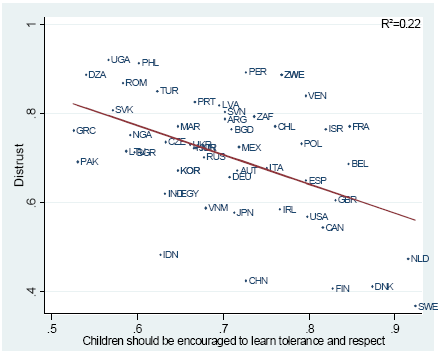
In an interesting paper, Aghion, Algan, Cahuc and Shleifer show that regulation is greater in societies where people do not trust one another. The graph below, for example, shows that societies with a greater level of distrust have stronger minimum wage laws. Note that the result is not that distrust in markets is associated with stronger minimum wages but that distrust in general is associated with greater regulation of all kinds. Distrust in government, for example, is positively correlated with regulation of business. Or to put it the other way, trust in government (as well as other institutions) is associated with less regulation.
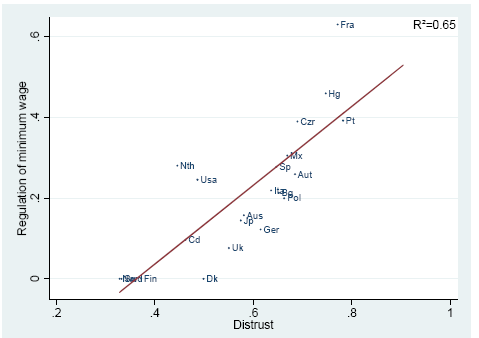 Aghion et al. argue that the causality flows both ways on the regulation-distrust nexus. Distrust makes people turn to government but in a society with a lot of distrust government is often corrupt and this makes people distrust even more. Crucially, when people distrust others they invest not in the highest return projects but in human and physical capital that is complementary to distrust–for example, they invest in human capital that helps them bond with their group/tribe/family rather than in human capital that helps them to bond with “outsiders” and they invest in physical capital that is more difficult to expropriate rather than in easier to expropriate capital, even though in both cases the latter investments may be the all-else-equal higher return investments. Such distrust traps are quite similar to Bryan Caplan’s idea traps.
Thus, societies with a lot of distrust generate regulation and corruption and citizens who don’t have the skills or preferences to break out of the distrust equilibrium. Consider, for example, that in societies with a lot of distrust parents are less likely to consider it important to teach their children about tolerance and respect for others.
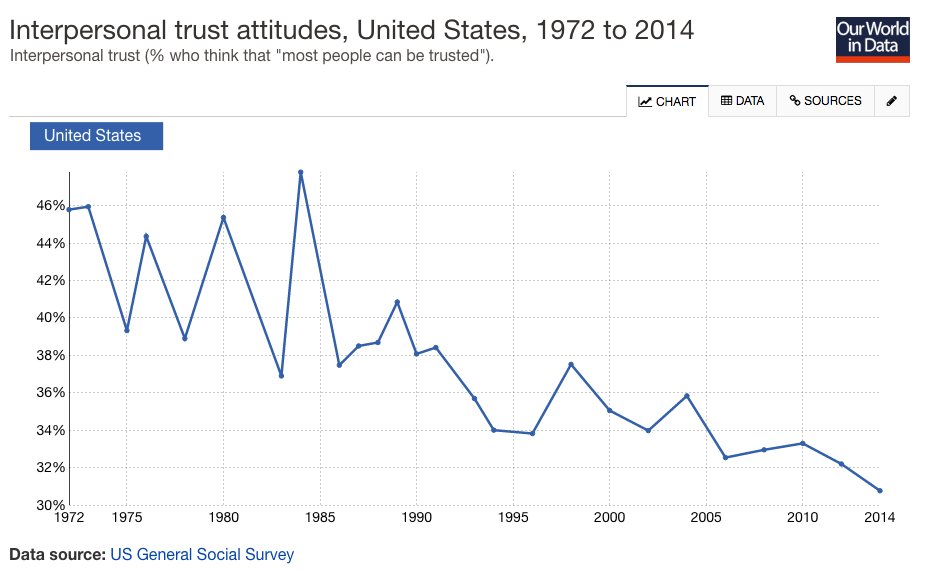
The update should be obvious. More and more this appears to be describing the United States. More distrust in government, more regulation, lower growth and more people who are so distrustful of one another that they can’t cooperate to break out of the bad equilibrium. Here drawn from Our World in Data is interpersonal trust in the United States.
Japan fact of the day
Japan’s central bank is set to become the top shareholder of 55 companies in the Nikkei
Here is more.
Faroe islands fact of the day
A lot of the women go away to study and don’t come back:
There are already 2,000 more men than women on the Faroes – which has a total population of just under 50,000 – and some of those men have taken matters into their own hands by importing wives and companions from the Philippines and Thailand.
Filipinos and Thais make up two of the largest groups of foreigners on the Faroe Islands . There are now 200 Thais and Filipinos – mostly women – spread out over the islands.
In the tiny hamlet of Klaksvík located in the northern part of the islands, there are already 15 women from Asia.
Bjarni Ziska Dahl, who married his Filipino wife in 2010, said that the foreign women could well be the answer to the issues facing the Faros.
“We must recognise that there is a problem, and welcome these strangers with dignity,” Dahl told DR Nyheder. “We need these people.”
Both Dahl and his wife Che said that they have a lot in common: island life, a dedication to family and a longing for simplicity. Dahl said that Asian woman are often willing to take jobs that Faroese women will not do.
Here is the full report, one Faorese woman does not like having to say hello to everyone she meets in the street there. And this is not just a news story, the married and younger Asian women were one of the first things I noticed getting on the plane to Faroe. (They looked not unhappy by the way. The other thing I noticed right away was how many disparate groups on the flight seemed to know each other. And that you have to be careful not to assume that people who look somewhat alike are brothers, or sisters, or parents and children.)
You might consider this a metaphor for some broader social trends around the world, albeit in this case unusually concentrated along the dimensions of geography and nation/territory. Some women just don’t want to hang out with the guys — even the best guys — who are selling to a market of 50,000 people. Other women are happy to move into that situation. Solve for the equilibrium.
The culture and polity that is Singapore, Germany, and Belarus
Singapore leads the way, offering three-quarters of a million U.S. dollars to gold-medal winners, followed by Indonesia ($383,000), Azerbaijan ($255,000), Kazakhstan ($230,000) and Italy ($185,000).
I would say Italy should not be on that list, as they have some fiscal troubles, plus plenty of other sources of national pride. And there is this:
…other countries offer alternative bait — like military exemptions (South Korea), a lifetime supply of beer (Germany) and unlimited sausages (Belarus).
Here is the article, via James Crabtree.
The roots of Trump support
It seems to be living near failure, not necessarily experiencing it yourself:
Yet a major new analysis from Gallup, based on 87,000 interviews the polling company conducted over the past year, suggests this narrative is not complete. According to this new analysis, those who view Trump favorably have not been disproportionately affected by foreign trade or immigration, compared to people with unfavorable views of the Republican presidential nominee. The results suggest that his supporters, on average, do not have lower incomes than other Americans, nor are they more likely to be unemployed.
Yet while Trump’s supporters might be comparatively well off themselves, they come from places where their neighbors endure other forms of hardship. In their communities, white residents are dying younger, and it is harder for young people who grow up poor to get ahead.
The Gallup analysis is the most comprehensive statistical profile of Trump’s supporters so far. Jonathan Rothwell, the economist at Gallup who conducted the analysis, sorted the respondents by their Zip code and then compared those findings with a host of other data from a variety of sources.
That is from Max Ehrenfreund and Jeff Guo at the always-excellent Wonkblog. And there is this:
White households tend be more affluent than other households, and Trump’s supporters are overwhelmingly white. The same is true of Republicans in general. Yet when Rothwell focused only on white Republicans, he also found that demographically similar respondents who were more affluent viewed Trump more favorably.
These results suggest that personal finances cannot account alone for Trump’s appeal. His popularity with less educated men is probably due to some other trait that these supporters share.
Rothwell’s results also very much downplay the roles of trade and China, compared to some other estimates. Here is a link to Rothwell summarizing some of these results, I am not sure if there is a link to the full study proper.
Collective Property in Palo Alto
Kate Downing, a member of the Palo Alto Planning and Transportation Commission, has resigned in protest at its no-growth policies. She writes:
After many years of trying to make it work in Palo Alto, my husband and I cannot see a way to stay in Palo Alto and raise a family here. We rent our current home with another couple for $6200 a month; if we wanted to buy the same home and share it with children and not roommates, it would cost $2.7M and our monthly payment would be $12,177 a month in mortgage, taxes, and insurance. That’s $146,127 per year — an entire professional’s income before taxes. This is unaffordable even for an attorney and a software engineer.
…I have repeatedly made recommendations to the Council to expand the housing supply…Small steps like allowing 2 floors of housing instead of 1 in mixed use developments, enforcing minimum density requirements so that developers build apartments instead of penthouses, legalizing duplexes, easing restrictions on granny units, leveraging the residential parking permit program to experiment with housing for people who don’t want or need two cars, and allowing single-use areas like the Stanford shopping center to add housing on top of shops (or offices), would go a long way in adding desperately needed housing units while maintaining the character of our neighborhoods and preserving historic structures throughout.
The vituperative responses to her letter in the local paper (quite a few now deleted for language) included many like the following:
What with everything going on I have come to realize there is a vast difference between Baby-Boomers, X-Generation, and Millennials. Not sure where Kate falls into that, suspect she is a Millennial, but her overall lack of experience regarding city planning shouts out. “Disruption” is code for the Millennials, not so for Baby-Boomers. We are not going to turn ourselves on our heads because the younger group demands change.
And another:
I’m so glad we have one less inexperienced, new resident on the Planning and Transportation Commission that is demanding that long-time residents sacrifice their hard-earned quality of life for young, new residents that want the benefits without the sacrifice and hard work.
These kinds of claims are perfectly sensible. The people who bought their homes a long time ago lucked into a windfall and they resentfully lash out at anyone trying to cut in on that windfall. But notice how un-American these claims are. The current residents want to protect their gains by telling other people how they can use their property. When a new restaurant starts to take patrons from an old restaurant we generally don’t think that the old restaurant–the long-term resident–has the right to prevent the new restaurant from opening. The same is true, by and large, for new technologies and ways of doing business. Yet when it comes to residential land we give the old residents a veto on the new.
We have collectivized property in the United States (unlike in say laissez-faire Tokyo). Property is not fully collectivized, of course, but a person’s land is not their own–it’s subject to the dictates of the collective. Collectivization has been tried in many other times and places and the results are by now predictable. Collectivization in Palo Alto has produced inefficiency, high costs and a politicization of choice that makes for ill-will and endless conflict.
Brazil is still the country of the future
That is my latest Bloomberg column, and here is just one bit from it:
Third, Brazil’s political history has been an odd mix of dictatorship and extreme decentralization. Until the late 1980s, a series of autocratic leaders took power but failed to govern outlying regions successfully. Governance remained based on a colonial model with an authoritarian leader at the center and autonomous power blocs throughout the regions — a system that, for all of its periodic dynamism, proved ill-suited for modern times.
That colonial legacy is being dismantled, in fits and starts. Brazil now has a real democracy and some degree of political accountability, though it falls short of a well-functioning federalism, as illustrated by the fiscal troubles of Rio de Janeiro and many other parts of the country. Income inequality has been falling (contrary to the trend in most countries), extreme poverty has virtually been eliminated and Brazil has moved up the rankings in terms of education.
I love to visit Brazil. I have been chased by aggressive pre-teens wielding sharpened sticks and even shot at, yet I remain an unreconstructed optimist. It’s actually a major achievement to remain “the country of the future” for so long. Can you say the same about Argentina or Venezuela? If there’s one thing we know from Olympic competition, it’s that if you remain in the game through successive rounds, your chances of winning only go up.
Do read the whole thing, there is much more detail at the link.
The big idea that won’t fix Europe’s banks
That is the topic of my latest Bloomberg column, and that idea is banking union:
Imagine a pan-European version of the FDIC…By making depositors indifferent to the risks banks take on, the guarantee would eventually spread to other parts of the economy. A financially troubled government, for example, could easily pressure banks to buy its securities — effectively relying on the insurance to support its fiscally questionable behavior. If the government ultimately defaulted, other countries’ taxpayers would be responsible for making the depositors whole — not quite the same as a fiscal union, but pretty close.
Experience suggests this is entirely possible. Around the time of the 2011 sovereign-debt crisis, European banks were very heavily loaded with government securities, in part because fiscally weak domestic governments had encouraged it. Some commentators compared this arrangement to two drunks leaning against each other, with no lamppost in sight. The incentives for such a dangerous dependence would be stronger yet if bank deposits were guaranteed at the euro area level.
Governments could also take advantage of deposit insurance more directly, through state-owned banks. Suppose Portugal expanded the operations of the government-owned Caixa Geral de Depósitos, the largest bank in the country, to attract deposits and invest the money in infrastructure and other state projects. By insuring the deposits, the EU authority would in essence be guaranteeing a bond issue of the Portuguese government, even though the funds would be channeled through a bank. This wouldn’t be a fiscal guarantee of the entire Portuguese government budget, but it could prop up spending at the margin.
Do read the whole thing.
Rigged elections for me but not for thee
Donald Trump created quite the stir a few days ago when he suggested that the forthcoming Presidential election was going to be “rigged.” I’m not sure what exactly he meant by that, or even if it’s worth debating, but I did see my Tweeter feed respond with real furor. This will undercut faith in democracy I read, and thus the media needs to call him out on it. Yet over the last few years or indeed decades I also have seen the following:
1. Numerous arguments insist that money buys elections and campaign finance reform is imperative. That’s not exactly my view, with Trump himself now being Exhibit A on the other side of the issue, but please try to be consistent. A lot of you believe that elections are (were?) rigged! (Hey, psst…when can we go back to them being rigged again? Asking for a friend!)
2. Numerous arguments that Republican-backed voter registration requirements are keeping significant numbers of voters, most of all minority voters, away from the polls. That wouldn’t quite count as “rigging,” because the outcome still is not preordained, but it would be a form of slanting.
3. Not long ago, the conventional wisdom was that the race would be Clinton (Hillary) vs. Bush (Jeb). Fortunately, that is not rigging, rather we call it “spontaneous order.” Besides, it didn’t happen. We ended up with Clinton vs…Tormentor of Bush.
4. Do we not all teach the Gibbard-Sattherthwaite theorem to our Principles classes on week three? In case you forget, the theorem shows that under some fairly general assumptions elections processes are manipulable in a rigorous sense which is defined in social choice theory. You can think of this as a corollary of the Arrow Impossibility Theorem, actually.
People, I am so glad we don’t teach our students that elections are rigged, it is so much more important to teach that they are “manipulable” in the precise sense defined by social choice theory. Sadly, Mr. Trump failed that part of the course, because the silly boy wrote down the word “rigged” instead and botched the whole answer, heal so messed up the distinction between inter- and intra-profile versions of the theorem.
5. A related branch of social choice theory, stemming from Dick McKelvey’s work in 1979, suggests that when the policy space has more than one dimension, the agenda setter in Congress has a great deal of power and typically can shape the final outcome. True, that is Congress rather than a general democratic election. By the way, how many dimensions does the policy space have these days? If you’re not sure, that means the answer is “more than one.” Good thing that only “Congress keystone of the Washington establishment” is rigged!
6. Major political scientists from schools such as Princeton tell us that elites determine policy and ordinary voters have very little say in what happens. Don’t know if he used “the r word” or not! (By the way, I agree with the critique of Dylan Matthews.)
7. The American electoral system is designed to give the two major parties a huge initial advantage. I’m not suggesting that the public is actually itching to elect Jill Stein, but it would shape final outcomes a good deal, for better or worse, if the electoral playing field were more even in this regard.
Personally, I think median voters more or less get what they want on a large number of issues, especially broad-based ones in the public eye. You won’t find the word “rigged” popping up too much in the MR search function, besides I started blogging (and breathing) after Kennedy vs. Nixon. But my goodness, I can in fact understand why Donald Trump thinks the system is rigged. For years, you have been telling him that it is.
p.s. I don’t in fact teach the Gibbard-Sattherthwaite theorem in Principles and you won’t find it in the world’s very best Principles textbook. That we rigged.
Addendum: How many Democrats have alleged that the 2000 Presidential election was rigged? Or that today most Americans want some form of tougher gun control, but that the system is rigged against that outcome happening?
*The Socialism of Fools*
There are two new and interesting books with that same title. The first is by William I. Brustein and Louisa Roberts, and it has the subtitle Leftist Origins of Modern Anti-Semitism. Think of it as a short overview of what the subtitle promises, with chapters on the Enlightenment, France, Germany, and Great Britain. The second, by Michele Battini, has the subtitle Capitalism and Modern Anti-Semitism, and is longer and perhaps more exotic. Here is one summary sentence: “My hypothesis is that this anti-Semitic anticapitalist literature arose in the context of the intransigent Catholic reaction against the revolution in political rights, the free market, and secularization. Both are of interest. Both main titles of course come from the classic quotation by August Bebel: “Antisemitism is the socialism of fools.”
Nuclear sentences to ponder
…there were at least two instances in which top officials tried to slow, or undermine, the president’s nuclear authority.
The first came in October 1969, when the president ordered Melvin R. Laird, his secretary of defense, to put American nuclear forces on high alert to scare Moscow into thinking the United States might use nuclear arms against the North Vietnamese.
Scott D. Sagan, a nuclear expert at Stanford University and the author of “The Limits of Safety,” a study of nuclear accidents, said Mr. Laird tried to ignore the order by giving excuses about exercises and readiness, hoping that the president who sometimes embraced the “madman theory” — let the world think that you are willing to use a weapon — would forget about his order.
But Nixon persisted. Dr. Sagan reports that during the operation, code-named Giant Lance, one of the B-52 bombers carrying thermonuclear arms came dangerously close to having an accident.
Then, in 1974, in the last days of the Watergate scandal, Mr. Nixon was drinking heavily and his aides saw what they feared was a growing emotional instability. His new secretary of defense, James R. Schlesinger, himself a hawkish Cold Warrior, instructed the military to divert any emergency orders — especially one involving nuclear weapons — to him or the secretary of state, Henry A. Kissinger.
It was a completely extralegal order, perhaps mutinous. But no one questioned it.
That is from William Broad and David Sanger at the NYT.
Addendum: Here is a 2008 Alex post on the same.
Do Democratic equity fund managers beat their Republican counterparts?
That is the topic of my latest Bloomberg column. Here is one bit:
The paper, by Marian Moszoro and Michael Bykhovsky, uses Federal Election Commission data to identify equity fund managers by their political contributions. If the managers at a fund gave to only one of the two major political parties, that fund is then classified as having an intellectual or ideological connection to that party.
…The authors find that for the years 2004 to 2014, with the exception of one period, equity fund managers of the two political affiliations did about the same. That should give pause to anyone who thinks that either political party has a monopoly on a better or more accurate view of the economy.
This is in noted contrast to Krugman’s frequent claim that the Republican fund managers are somehow unmoored from macroeconomic realities. But:
…for one critical period of time, December 2008 to September 2009, the Democratic fund managers did much better. They earned 25.25 percent on average, compared with the Republicans’ 17.17 percent — a difference that, by the authors’ back-of-the envelope calculations, amounted to about $13.7 billion.
My (unconfirmed) view is that much of this was lack of faith in President Obama, though a big market rally was to start in March 2009. Perhaps the Republican fund managers were not in the market enough. Another possibility of course was that some of the Republican managers expected high inflation, due to the Fed injecting trillions of liquid reserves into the banking system. Finally, the Democratic equity fund managers may have had better political connections and thus been better informed. The timing of the returns discrepancy, however, I think squares best with the “confidence in Obama” interpretation. And here is the Hansonian part of the column:
Another interesting finding: Most of the fund managers donated exclusively to either the Democratic or Republican Party — 44.9 percent and 46.6 percent, respectively. “Mixed” funds accounted for only 8.3 percent of the overall sample (of more than 80,000 fund-month observations). Since the choice of party doesn’t appear to provide much of a market edge, the loyalties might reflect longer-standing personal, regional, and institutional connections. Perhaps political unity within a company serves social and networking functions, even if it doesn’t provide any special economic insight.
Do read the whole thing. And if you are wondering:
Hedge-Fund Money: $48.5 Million for Hillary Clinton, $19,000 for Donald Trump
For the original pointer to the Moszoro and Bykhovsky piece I am grateful to Samir Varma.