Category: Political Science
My worries about Singapore
Singapore is a well-run place by world standards, and has perhaps the world’s highest quality bureaucracy, yet right now the country faces a somewhat menacing constellation of silent risks, none of their own making:
1. It is possible that the role of the United States in the Pacific Ocean is rewritten rather suddenly. This could come about through either a Trump presidency, or a successful Chinese attempt to grab more in the South China Sea. Can you imagine a Singapore that had to court Japan and India rather than relying on the United States for protection? In this same world Japan is probably more militarized than in the status quo, and possibly even a nuclear power.
2. Singapore sovereign wealth funds and related institutions have been pulling in high returns since the 1970s. Yet the opportunities in both China and Singapore’s own real estate just aren’t there any more. They would be very lucky to pull in four percent a year looking forward. While fiscal risk is minimal, this will crimp expansion plans, especially if Singapore ends up needing to spend more on national defense.
3. It seems increasing pressure is being brought to bear on the Chinese currency yet again. China would like to lower rates to stimulate its economy, and the Fed is likely to raise rates at least once more this year. There is surely a chance that the renminbi simply snaps due to capital outflow. During the Asian currency crisis, the Singaporean dollar fell about twenty percent as a side effect of the turmoil elsewhere. Yet now China is much bigger than South Korea + Thailand + Indonesia were in 1997. Furthermore Singapore is much more of a financial and clearinghouse center. How insulated is Singapore from this China risk? Does anybody know? To what extent might a flow of capital into Singapore mitigate some of this risk?
4. Climate change could well lead to rising water levels for island nation Singapore. Investing in sea walls and other forms of protection could take what percent of gdp? The Dutch are already putting 0.5% of gdp a year into a fund for future water defense.
From this list, #2 and #4 are more likely problems, whereas #1 and #3 are more speculative, but by no means in the realm of science fiction. There is the possibility of a perfect storm from all four.
And yet think of how things must have looked in 1965. The Vietnam War was going badly, and most of the trends in Southeast Asia were negative. Chinese Communism was at its nadir with the Cultural Revolution. Indonesia had just massacred 500,000 citizens, many of them Chinese. Singapore itself had just been kicked out of Malaysia, an outcome which its key founders mostly opposed. There was not yet evidence that what later became “the Singapore model” was going to work, and even Japan was not yet an evident success. It was commonly believed that Singapore, Malaysia, or both might collapse into a kind of ethnic civil war. British military expenditures were about 20% of Singapore’s gdp, and it was widely understood that source of income would be going away. Somehow they managed, most of all with the aid of human capital and being in the right place at the right time.
Here is the Singapore Complaints Choir, one of my favorite music videos.
In any case, I am happy to be here once again. For dining, I recommend Sinar Pagi Nasi Padang, at Geylang Serai hawker centre, get the beef rendang. National Kitchen, in the new National Gallery is also very good for a more traditional kind of dining.
How well does the post-recession world scale?
The bumps we’ve seen over the past 12-18 months stem from a reality that the post-recession world we’ve built doesn’t scale beyond its current size. Consider the following:
-Chipotle wanted to be this era’s McDonald’s. Turns out scaling organic, freshly-prepared food isn’t as cheap or easy as they thought.
-Fintech lenders promised to disrupt big banks. Turns out the lending business requires a lot of capital, and that in jittery markets that capital doesn’t like funding a growing lending business. Maybe the big bank model isn’t so bad.
-The San Francisco Bay Area is the economic center of the early 21st century. But it’s finding that scaling housing and infrastructure for workers is a lot harder than scaling servers and storage. So jobs and people have to move to cheaper metros.
-On demand startups were the solution to mass unemployment and megacity renters who demand services immediately. But they’re finding that as the labor market tightens those workers are getting harder to find, and maybe the unit economics never worked to begin with.
-Tesla wants to disrupt the auto industry. But it’s never produced more than 50,000 cars in a year, and suddenly has to meet demand for as many as 500,000 cars a year. That won’t be cheap or easy, and it’s unclear how much shareholders and lenders will be willing to finance that growth. It’s not as cheap to scale atoms as it is to scale bits.
-Uber and Facebook are the 800-pound gorillas in their respective industries. But as they grow, they’re running into problems of scale. For Uber, it’s finding drivers and fighting regulation. For Facebook, it’s eating too much of the revenue pie for content, and maybe as it grows it’s going to come under greater and greater scrutiny given its media clout. Both will argue they’re not utilities, but the vision and scale they aspire to would make them exactly that.
-Conservatism is finding that the demographic groups that believe in conservatism no longer scale to form a viable national party. Trump will soon find the same to be true for his white working class coalition. The Republican Party needs a new ideology or constituency that can scale to compete with Democrats.
It’s time to let Steve Jobs and Ronald Reagan rest in peace, and find new leaders who can build the world of the 2020′s.
Mexico body ratio fact of the day
In many forms of combat between armed groups, about four people are injured for each person killed, according to an assessment of wars since the late 1970s by the International Committee of the Red Cross. Sometimes, the number of wounded is even higher.
But the body count in Mexico is reversed. The Mexican Army kills eight enemies for every one it wounds.
For the nation’s elite marine forces, the discrepancy is even more pronounced: The data they provide says they kill roughly 30 combatants for each one they injure.
The government stopped reporting such figures in 2014 — model this!
Where is freedom in the world contracting? Advancing?
Contracting:
America, China, Hong Kong, Russia, Ukraine, Austria, Hungary, Poland, Slovakia, Turkey, Syria, Libya, Iraq, Yemen, Kosovo, Afghanistan, Philippines, Venezuela, Nigeria, South Africa, Malaysia, and Brazil, though the latter may be in flux. Tunisia and Iran are problematic, but arguably hard to call. Saudi may be headed toward collapse, but I don’t think you can say they are less free just yet. Ethiopia is losing more political freedom, though still making very real economic progress.
Advancing:
Mexico and Colombia, if only by consolidating previous gains, and still there is a chance of a turnaround in Argentina at some point. Latvia? Where else? You could make a (modest) case for India and some of the smaller African countries.
Neutral:
Japan, South Korea, Canada, and much of Western Europe though many of these cases appear fragile to me.
Overall this is not a thrilling ledger. I haven’t listed most of the smaller countries, but in the longer run they often follow the lead of their larger neighbors.
File under Not Good.
The wisdom of Nicholas Kristof
…when scholars cluster on the left end of the spectrum, they marginalize themselves. We desperately need academics like sociologists and anthropologists influencing American public policy on issues like poverty, yet when they are in an outer-left orbit, their wisdom often goes untapped.
In contrast, economists remain influential. I wonder if that isn’t partly because there is a critical mass of Republican economists who battle the Democratic economists and thus tether the discipline to the American mainstream.
Neerav Kingsland on the new Robin Hanson book
Here is an excerpt from a longer post, which also includes a summary:
Here are some of the most interesting ideas in the book:
1. Mind speeds: I had not previously spent much time thinking about how our brain’s hardware affects the speed at which we think. As it happens, our minds are spectacularly slow compared to what’s feasible with other materials! Better hardware, as well inequalities of hardware across individuals, will likely drive many parts of em society.
2. Death in the time of copies: An individual’s relationship to death is much different when you can make and store copies of yourself. Given how much of our current lives and societies are wrapped in who dies / how they die / when we die – a world where death is less central has major implications for identity, values, and relationships.
3. Security concerns are paramount: Theft (making copies of you without your permission) thus becomes almost more of an issue than death. As such, laws and cultural taboos will shift with security becoming more central to em value systems.
4. Less democratic: In a short period of a time, a well run non-democratic regime can outperform your average democracy. However, in the modern human world, these regimes often implode on themselves before they can dominate the rest of the world. But in the em world, things will move so fast (economic doubling rates are incredibly fast, every month or two!), that the rewards to short bursts of effective non-democratic regimes may be very high.
5. Religion: I tend not to think of robots as religious, but Robin makes the case that the utility of religion (nicer hard-working people) and the values of the em world (more farmer like) should lead to increased religiosity.
6. Increased utility: The sheer number of ems, coupled with their high mind speeds – as well as the likelihood that there lives will be ok in terms of meaning and happiness – suggests that the transition to an em world will be a positive utility move.
You can order the book here. Here is my earlier review.
Sentences to ponder
Plug those numbers into the formula, and the prediction is that the Democratic share of the two-party presidential vote in 2016 will be 44.99%.
That is from Timothy Taylor, here is an earlier piece by Jeff Sommer.
What the hell is going on?
Donald Trump may get the nuclear suitcase, a cranky “park bench” socialist took Hillary Clinton to the wire, many countries are becoming less free, and the neo-Nazi party came very close to assuming power in Austria. I could list more such events.
Haven’t you, like I, wondered what is up? What the hell is going on?
I don’t know, but let me tell you my (highly uncertain) default hypothesis. I don’t see decisive evidence for it, but it is a kind of “first blast” attempt to fit the basic facts while remaining within the realm of reason.
The contemporary world is not very well built for a large chunk of males. The nature of current service jobs, coddled class time and homework-intensive schooling, a feminized culture allergic to most forms of violence, post-feminist gender relations, and egalitarian semi-cosmopolitanism just don’t sit well with many…what shall I call them? Brutes?
Quite simply, there are many people who don’t like it when the world becomes nicer. They do less well with nice. And they respond by in turn behaving less nicely, if only in their voting behavior and perhaps their internet harassment as well.
Female median wages have been rising pretty consistently, but the male median wage, at least as measured, was higher back in 1969 than it is today (admittedly the deflator probably is off, but even that such a measure is possible speaks volumes). A lot of men did better psychologically and maybe also economically in a world where America had a greater number of tough manufacturing jobs. They thrived under brutish conditions, including a military draft to crack some of their heads into line.
To borrow a phrasing from Peter Thiel, perhaps men did better in the age of “technological progress without globalization” rather than “globalization without technological progress,” as has been the case as of late.
Here’s a line from Martin Wolf:
Princeton professors Anne Case and Angus Deaton note, in addition, a sharp relative deterioration in mortality and morbidity among middle-aged white American men, due to suicide, and drug and alcohol abuse.
(Addendum: note this correction.)
For American men ages 18-34, more of them live with their parents than with romantic partners.
Trump’s support is overwhelming male, his modes are extremely male, no one talks about the “Bernie sisters,” and male voters also supported the Austrian neo-Nazi party by a clear majority. Aren’t (some) men the basic problem here? And if you think, as I do, that the incidence of rape is fairly high, perhaps this shouldn’t surprise you.
The sad news is that making the world nicer yet won’t necessarily solve this problem. It might even make it worse.
Again, we don’t know this is true. But it does help explain that men seem to be leading this “populist” charge, and that these bizarre reactions are occurring across a number of countries, not just one or two. It also avoids the weaknesses of purely economic explanations, because right now the labor market in America just isn’t that terrible. Nor did the bad economic times of the late 1970s occasion a similar counter-reaction.
One response would be to double down on feminizing the men, as arguably some of the Nordic countries have done. But America may be too big and diverse for that really to stick. Another option would be to bring back some of the older, more masculine world in a relatively harmless manner, the proverbial sop to Cerberus. But how to do that? That world went away for some good reasons.
If this is indeed the problem, our culture is remarkably ill-suited to talking about it. It is hard for us to admit that “all good things” can be bad for anyone, including brutes. It is hard to talk about what we might have to do to accommodate brutes, and that more niceness isn’t always a cure. And it is hard to admit that history might not be so progressive after all.
What percentage of men are brutes anyway? Let’s hope we don’t find out.
*Prison Break: Why Conservatives Turned Against Mass Incarceration*
That is the new book by David Dagan and Steven Teles, here is the publisher’s description:
- Argues, counter to the conventional wisdom, that the conservative embrace of criminal justice reform is not primarily about money
- Provides the most comprehensive account both of the rise of the conservative reform movement and of the criminal justice reforms that have swept the states in the last 10 years
- Features interviews with of the major players in the conservative criminal justice reform movement
- Provides a theory for how to create breakthroughs in other policy areas amid political polarization
I am looking forward to my copy, here is the Amazon link.
Military Egalitarianism: a short speculative fiction
In the Empire of Amerigo there is heated debate about the priorities of the polity.
The Egalitarians push for much higher military spending, on the grounds that many poor people around the world require Empire protection from aggressors or at the very least from severe external pressure. The Egalitarians have a subcult, called The Samanthas, who favor direct military intervention in very destructive civil wars. They are willing to cut domestic spending on social services to achieve this end, even though their founder did not draw this exact same conclusion.
The opposing party The Three-Percenters favors much higher social spending to the nation’s less fortunate citizens, who are for the most part within the global top three percent. The Three-Percenters are an openly elitist party, and they emphasize how place of birth determines an individual’s moral worth, Amerigo coming first of course with no prize for second place.
The Egalitarians have been pushing hard for affirmative action. It turns out that no one on the country’s Supreme Council has a military background, and they believe this should be rectified by an explicit system of quota. Furthermore only a few members of the legislature ever have killed another human being in service of their country. So the military point of view, as would be required to implement true egalitarian social justice, is badly underrepresented in the upper tiers of government and society.
After the great wage equalization of 2104, it became the common view that willingness to die and more importantly the willingness to kill for one’s country — or not — was the most fundamental remaining difference among citizens of Amerigo. The self-proclaimed Proud Killer Faction earns some of the lowest wages in the country, yet they continue to push for greater recognition at the federal level, realizing it is not enough to control several state governments.
So far the Three-Percenters have the more popular view, because after all humans are naturally elitist and clubbish, and so their coalition rule has remained unchallenged for several terms of government. Yet virtually all philosophers and academics back The Egalitarians, with some radicals even endorsing the Proud Killer Faction.
Addendum: There is another, now-vanquished faction of The Egalitarians, called The Medicoors. They argue the strange and indeed untenable view that those on the verge of death have almost infinitely less than anyone else, even the very poor, and so a true egalitarianism means everything should be redistributed their way to prolong their lives, even if only for a short period of time. They ruled the government for almost a century. At first they were mocked for the doctrine of being “Forward Lookers,” and then finally they were defeated by the success of their own efforts. Medical technology raised life expectancy to three hundred years of age, thereby inducing voters to think of themselves as nearly eternal, at least for the time being. Some seers have predicted that eventually the Medicoors will make a major political comeback…
Google Correlate
Which search terms correlate with support for which politicians? Why not at least ask this question?
John Kasich. Places that like Kasich are richer in some fairly policy-wonkish search terms: “net cost,” “renewable portfolio standard,” the economist Joseph Stiglitz, Financial Times writer Martin Wolf, and Vox writer Dylan Matthews. These terms have a ring of plausibility. They might be good fodder for small talk…if you are talking with a Kasich supporter!
But then there are terms that I don’t entirely understand: Route 73 and Haven Pizza. Maybe someone can explain those to me. It is also true that with billions of search terms to choose from, occasionally a correlation will arise by chance. These might be false positives.
Ted Cruz. Many Cruz-related search terms are related to domestic life of a certain kind: family photos, felt Christmas stockings, scentsy plug ins, balloon animals, Baby Trend car seats, and DIY cribs. Easy enchiladas are particularly Cruz-y. Mmmm, enchiladas. And udder covers…I wasn’t expecting that one. Maybe the Cruz campaign could start distributing Cruz-themed udder covers!
Donald Trump. Note that the correlations are weaker. That could be because Trump support is broad-based in the Republican Party. Or it could be that the connection between the voter and the Google-searcher is indirect (i.e. they are different individuals who live near one another).
That is from Sam Wang, via the keen-eyed Jordan Schneider. And what about the Democrats?
Near Clinton supporters it’s cheap bedroom furniture, Nicki Minaj fans, and pink hoverboard shoppers. And “career in” – Google auto-complete as a job counselor!
And the strongest correlate with Bernie Sanders support?: “candied nuts,” next in line is “best oatmeal,” ladies and gentlemen that is proof this is not just data mining and false correlations. The list is dominated by recipe terms, and “corn syrup substitute” is number four! Oh where oh where is Martin Wolf?
*A Life Beyond Boundaries*,by Benedict Anderson
That is the title of his posthumous memoir, highly recommended. It is one of the best books on the charm of studying Southeast Asia, and also a very good look at how American academia rose from mediocre to excellent in the postwar era. It is short and can be consumed in a single gulp.
Here is Andrew Batson on the book. Here is Anderson on Wikipedia; he was best known as a theorist of nationalism but he also did important work on Indonesia and Thailand.
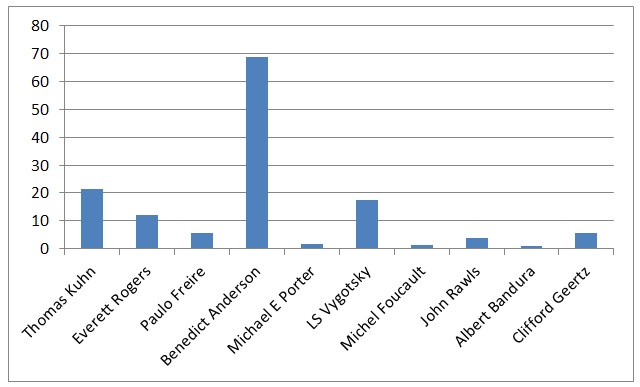
Ratio of most-cited publication to second-most-cited publication for authors among the top-10 most cited books in the social sciences:
The Developmental Roots of Conformity Bias
Michael Tomasello reviews theories of learning–some suggest that liberalism may be unnatural:
…a consistent finding in comparative studies is that human children are much more concerned than are other great apes to copy the exact actions of others, including arbitrary gestures, conventions and rituals (Tennie et al. 2009). Indeed, this tendency is so strong…when children do not see a clear goal to an actor’s action, they imitate even more precisely than if they do see a goal…
Moreover, children quickly learn to enforce arbitrary conventions and rituals:
…young children are so concerned with conformity that they will even enforce it on others, even when they themselves are not affected and the action involved is merely an arbitrary convention. For example, if children learn that on this table we play the game this way and on that table we play it another way, if a puppet then plays the game the wrong way on the wrong table, they intervene and stop him (Rakoczy, Hamann, Warneken, & Tomasello, 2010; Rakoczy, Warneken, & Tomasello, 2008)….Interestingly, when actors violate conventional norms, 3-year-olds admonish them more often if they are in-group rather than out-group members, presumably because in-group members should know better and be more committed to how “we” do it (Schmidt, Rakoczy, & Tomasello, 2011).
The enforcement of conformity is so important for young children that 5-year-olds have more positive feelings toward a norm enforcer (even though he is acting aggressively) than they do toward someone who simply lets a norm violation go (even though he is behaving in a neutral manner; Vaish, Herrmann, Markmann, & Tomasello, 2016).
In the environment of evolutionary adaptedness (EEA) an individual could not survive outside the group of their birth and so conformity was a matter of life and death. Conform or be cast out. Conformity to arbitrary convention was not in fact arbitrary but signalled affiliation. Conformity banded groups together.
Today, however, conformity is often counter-productive. Trying to enforce the arbitrary conventions of one’s in-group impedes social cooperation on the scale that makes modernity possible. Conformity also slows the development of new ideas and new ways of doing things–the essence of growth and progress. Even though conformity is now counter-productive the desire to conform and to enforce conformity is buried deep–the atavism of social justice.
Individualism and liberalism are foundational ideas for modernity but these adult ideas battle the desire to conform in our childish hearts.
Hat tip: Rolf Degen on twitter.
*Polarized: Making Sense of a Divided America*
James E. Campbell has written an excellent book on this contested and…polarizing…topic. Here is just one of many good bits:
As they [some commentators] see it, party polarization has been asymmetrical. The Republican Party allegedly has been captured by right-wing zealots while the Democratic Party has remained a reasonable center-left party. The claim of asymmetrical party polarization is half-true and completely understandable. First, there should be no mystery to asymmetry. If the parties are very competitive, as they are, and the public is skewed to the conservative end of the ideological scale, the parties should be similarly skewed. In a center-right nation, the right-wing party should be further to the right than the left-wing party is to the left. If the two parties were equally ideological, the Democrats would be in a permanent minority. That said, the increased polarization of the parties cannot be entirely attributed to the Republican Party becoming more conservative. Before the Republicans began moving to the right, Democrats had moved further to the left. Party polarization followed the staggered nature of the realignment. In the 1970s, congressional Democrats moved significantly to the left, while there was little change in congressional Republicans. The Republican shift to the right came later and was augmented by the growth of conservatism in the public. The polarization of the parties was a two-step dance — maybe three big steps: One big step to the left and two smaller steps to the right.
There is also this:
A five- or ten-percentage-point shift in ideological preferences may seem like “small potatoes,” but a nation that is 40% moderate and 60% ideological (liberal or conservative) operates quite different politically from one that is a 50-50 split.
By the way, it is sometimes noted, or noticed, that left-leaning thinkers have become crazier lately. I think overall that is true. It may be a sign that America is switching from a center-right to a center-left nation, given Campbell’s analysis above.
Recommended, due out in June from Princeton University Press. And here is Timothy Taylor on polarization.
China fact of the day
In 2015, total nominal credit expansion was nearly 4 times greater than total nominal GDP expansion.
That is from Christopher Balding, more of interest at the link.