Category: Television
What should I ask Brian Koppelman?
I will be doing a Conversation with him, here is Wikipedia:
Brian William Koppelman (born April 27, 1966) is an American showrunner. Koppelman is the co-writer of Ocean’s Thirteen and Rounders, the producer for films including The Illusionist and The Lucky Ones, the director for films including Solitary Man and the documentary This Is What They Want for ESPN as part of their 30 for 30 series, and the co-creator, showrunner, and executive producer of Showtime‘s Billions and Super Pumped: The Battle for Uber…
So what should I ask him?
On-line, Chinese production of *The Three-Body Problem*
With subtitles, find it here.
How to assign property rights in actor AI likenesses
This is an issue in the Actors and Writers Guild strikes, with a key issue being whether studios should be making “take it or leave it” offers which give them rights to the AI likenesses in perpetuity, even for extras. Here is part of my take in my latest Bloomberg column:
I suggest that the eventual strike settlement forbid studios from buying the rights to AI likenesses for more than a single film or project. Or, as a compromise, the contract could be for some limited number of projects, but not in perpetuity. Actors thus would remain in long-run control of their AI likenesses, yet if they wanted to keep selling those likenesses – project by project – they could do so.
Note that this proposal is along some dimensions quite inegalitarian. That is, future stars would end up much richer and the large numbers of actors who fail would end up slightly poorer. They would not be paid small upfront sums for rights that would quickly become worthless.
We can feel better about that trade-off if we consider the interests of the fans. Many people (myself included) enjoy the image and thought of Han Solo (one of Ford’s most famous roles), whether or not they are paying money in a given year to see the Star Wars movies. Would those fans prefer that Ford or some movie studio be in control of the Han Solo image?
The answer may depend on the wisdom and aesthetic taste of the actor in question, but overall I would opt for actor control of the AI likenesses. At least some actors will care about the quality of the projects their likenesses are attached to, rather than just seeking to maximize profit from deploying the likenesses. So, if the question is whether an AI likeness of Han Solo can greet visitors at the entrance to a Disney ride, Disney might say yes but Ford might say no, or at least he would have that choice.
Having celebrity images remain scarce rather than overexposed is a good aesthetic decision, even if it keeps some market power in the hands of Ford, his eventual heirs and future movie stars more generally. With these additional restraints on AI likenesses, we will likely end up with a more exciting, less tired and less overexposed kind of celebrity culture, and I hope that leads to broader social benefits, if only by cultivating better taste among fans and viewers.
Such a proposal is not so unusual when viewed in a broader context. Standard labor contracts don’t allow you to sell your labor to your boss in perpetuity, as you always retain the right to quit. Few people consider that limitation on contracting objectionable, as it protects human liberty against some hasty or ill-conceived decisions, such as selling yourself into slavery. If your AI likeness ends up being such a good substitute for your physical being, as it seems our current technological track may bring, why should we not consider similar restrictions on the contracts for the AI likeness?
Worth a ponder, these are not easy issues.
At the Helm, Kirk or Spock? The Pros and Cons of Charismatic Leadership
That is a new paper (AEA gate) by the very smart Benjamin Hermalin, here is the abstract:
Charismatic leaders are often desired. At the same time, experience, especially with demagogues, as well as social science studies, raise doubts about such leaders. This paper offers explanations for charismatic leadership’s “mixed report card.” It offers insights into why and when charismatic leadership can be effective; which, when, and why certain groups will prefer more to less charismatic leaders; and how being more charismatic can make leaders worse in other dimensions, particularly causing them to work less hard on their followers’ behalf.
And here is one important part of the model:
…a charismatic leader can get away with concealing bad news without triggering overly pessimistic beliefs.
I like the paper, but isn’t Spock super-charismatic, and all these women want to sleep with him? And isn’t there a long article about all the terrible decisions and advice stemming from Spock in various Star Trek episodes?
A few random Tucker Carlson thoughts
A few times I was invited to be on the show, typically after I would write something on immigration. I always refused, figuring I wouldn’t get fair treatment and would only feed a very unfair method of conducting the discourse.
I never have been a regular watcher, not of any news show, but I have seen him a number of times, often in other venues or homes, or I might pause when moving through the channels. It struck me each time how remarkably talented and smart and energetic he was, while what he said was very often not smart at all. (I’ve heard the same about his core smarts from a few different people who knew him when he was younger.) It also struck me how fluently he could coin an attack phrase, maybe better than anyone else but DT?
It is now increasingly debated how much he meant the different things he was saying, for instance about the last presidential election. And was it smart to put criticisms of Fox management into texts?
The biggest lessons here are cautionary ones. First, the biggest stars can do some very unwise things, and eventually so many of them do.
Second, “the right wing” should pay heed to the reality that many of its most talented representatives go down such dark paths. Since most (non-right wing) people are reluctant to admit Carlson’s extreme talent, this point does not always come up. Carlson, of course, was doing very well with his chosen path, and he still has the option of doing very well again.
But in which directions will the constellations of the audience and of fame point him? Which exactly was the guiding star he lacked?
Matt Yglesias on movies vs. TV
But I’ve gotten really disgruntled with the “prestige TV” landscape and am trying to redirect my content consumption accordingly. One thing that makes movies really great in my view is that before they shoot a movie, they write a screenplay and the screenplay has an end. Both the screenwriter and other people have read that screenplay all the way from beginning to end and they’ve tweaked and changed it and gotten it into a position where they are ready to start production. Then after a movie is filmed, the editor and director work with the footage and come up with a complete movie that has a beginning, a middle, and an end. They then ship the movie out, and it’s screened by critics who watch the entire movie before writing their review.
This does not guarantee that every movie that comes out is good. But it does guarantee that if someone tells you “‘The Menu’ is good,” they are evaluating a completed product…
By contrast, TV shows have this quasi-improvisational quality where the showrunners are constantly needing to come up with new balls to toss into the air. In old-fashioned non-prestigious “adventure of the week”-type shows, this actually works fine because the writers are not building up tension or setting unexplored plots in motion. But as serialized TV storytelling has gotten more and more common, we’re more and more often asked to show patience through early episodes or to try to find things intriguing with no ability to know whether any of it will pay off. Creators often have no idea where they’re going with the story.
Back in HBO’s heyday, the tradeoff was that The Sopranos and The Wire got to paint on a giant canvas and tell stories that are just too capacious for the movie format. But eventually networks got tired of spending that kind of money and cut back the sizes of the casts to something more normal for television.
That is from his Friday mailbag ($). The bottom line is that, like Matt, you should watch more movies and less TV.
What should I ask Noam Dworman?
I will be doing a Conversation with him. Noam is the owner of Comedy Cellar, considered by many to be the world’s best comedy club, located in Greenwich Village, NYC. There is a branch in Las Vegas too. The Cellar also has its own TV show.
Here is Norm’s LinkedIn page. Noam also makes music in a band, usually playing guitar.
So what should I ask him?
What to Watch: Holiday Edition 2022
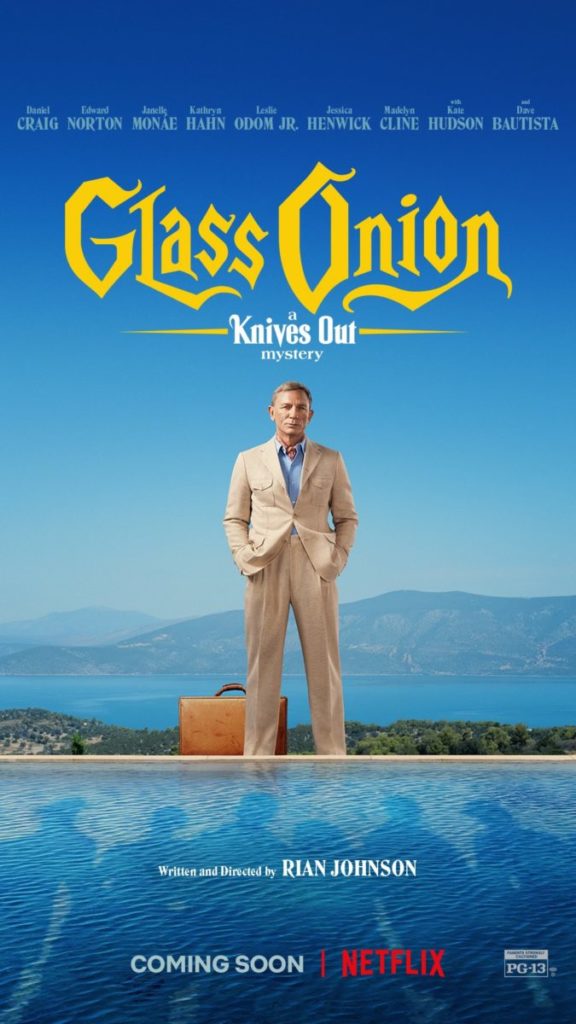 Glass Onion is a con job. It temporarily fools the viewer into thinking it original and clever and yet it is actually derivative and dumb. The ending left me bitter. It should be noted, however, that it is artfully constructed and the authors knew what they were doing. Benoit Blanc, the detective, stands in for the audience and comes to the same conclusion, “it’s all so obvious and also so stupid.” The name also gives a clue—it appears to be multi-layered but it’s glass so you can just look and see what is going on.
The Fabelmans—a paean to movie making and a close biography of Spielberg. He waited till his parents had died to make this movie. Yes, his mother actually brought home a monkey as a pet. The parents, the arty, flighty wife and the analytical, scientific husband couldn’t make it together but produced Spielberg who can and does—the opening scene with Spielberg watching his first movie between his parents says it all.
Avatar 2 I saw it in IMAX 3D. As spectacle it was great, especially the quieter water scenes. As movie it was good but broke no new ground. Indeed, Avatar 2 was exactly the same as Avatar only with more water. If you can’t see it in 3D or at least on a giant screen don’t bother.
The Recruit (Netflix): A fun CIA series which is ridiculous but rises a bit above the genre with some insight into the functions of a bureaucracy which kills people but attempts to do so legally.
 Acapulco (Apple TV). On the surface it’s a situation comedy about Maximo, a young Mexican man who sees opportunity in Los Colinas, the local resort run by a coterie of oddball characters, including the aging ex-starlet owner, Diane, who is fast approaching Norma Desmond territory. The situation is narrated by an older Maximo who has become rich and fabulously successful. At first the narration seems to be a mere device, but, over time, we begin to see that the writers are aiming at something bigger. How did Maximo become so rich? What lessons about life and business did he learn at Las Colinas? The second, hidden story line gives deeper meaning to the events of the first. Season one of Acapulco is almost entirely about Las Colinas. Only in season two do the two stories begin to converge. Can the writers pull off a denouement that brings everything together? I don’t know but the purposeful pacing and the fact that the writers aren’t showing all their cards makes me think we are seeing more than we first imagine. The opposite of Glass Onion in many ways.
My Conversation with Ken Burns
Here is the transcript, audio, and video. Here is part of the episode summary:
Ken joined Tyler to discuss how facial expressions in photos have changed over time, where in the American past he’d like to visit most, the courage of staying in place, how he feels about intellectual property law, the ethical considerations of displaying violent imagery, why women were so prominent in the early history of American photography, the mysteries in his quilt collection, the most underrated American painter, why crossword puzzles are akin to a cup of coffee, why baseball won’t die out, the future of documentary-making, and more.
And an excerpt:
COWEN: Why are women so prominent in the early history of American photography — compared, say, to painting or sculpture?
BURNS: It’s interesting, I think, because at the beginning we’re recording ourselves, our families. The first one is a self-portrait. (Of course, being an American it would be a self-portrait.) But families are involved.
There’s so many ways in which we transcend — the Declaration of Independence did not apply to any women. It’s 144 years after the Declaration that women get the right to vote: basic thing. When the Declaration and the Constitution were there, they had no rights. But they were part of the landscape.
They are a majority of the population, and have been. What you have is the beginning of photographs being a much more democratic and accessible medium, that is going to be populated by the people who actually exist. I think it’s that that’s helpful to break down.
As you see in this book, there are lots of images of women from the earliest time involved in things like abolition, involved in things like slavery unions, involved in things like women’s suffrage, involved in just playing, having a good time on the beach in Massachusetts in your bloomer swimming suits dancing, or three gals stealing a cigarette in the early part of the 19th century.
This film is about darkness and light, about black and white — both in the photographic process but in the American dynamic: there are many Native Americans, there’s lots of landscapes of the beauty of the country. There’s lots of horrible signs of discrimination and war and death and suffering and grief.
And that’s us. That’s the story of us. I’ve been trying to tell that complicated history with my films, and this was an opportunity to stop and allow the viewer this time to be the director. That is to say, in most performance art, as film is, I set the time that you get to look at that photograph and you see what you’re able to see in that. If you want to spend an hour with one photograph in this book, you’re welcome to.
If you want to go through this over-amount of time, these photographs, and then hold your thumb in the back matter and go back and forth between the full page of the photograph, that might say “Gettysburg, 1863,” and then the description of people reading the list of the dead outside a newspaper in New York City just after the Battle of Gettysburg in July of ’63 — you can learn a lot more about the photograph, but in a different way. I first wanted the photographs to speak for themselves, un- . . . diminished — I guess, is the word — by words.
There is much more at the link. And I liked Ken’s new book Our America: A Photographic History.
What should I ask Ken Burns?
I will be doing a Conversation with him, here is the beginning of his rather formidable Wikipedia entry:
Kenneth Lauren Burns (born July 29, 1953) is an American filmmaker known for his documentary films and television series, many of which chronicle American history and culture. His work is often produced in association with WETA-TV and/or the National Endowment for the Humanities and distributed by PBS.
His widely known documentary series include The Civil War (1990), Baseball (1994), Jazz (2001), The War (2007), The National Parks: America’s Best Idea (2009), Prohibition (2011), The Roosevelts (2014), The Vietnam War (2017), and Country Music (2019). He was also executive producer of both The West (1996), and Cancer: The Emperor of All Maladies (2015). Burns’s documentaries have earned two Academy Award nominations (for 1981’s Brooklyn Bridge and 1985’s The Statue of Liberty) and have won several Emmy Awards, among other honors.
His forthcoming book is the lovely Our America: A Photographic History. So what should I ask?
What to Watch
The Rehearsal (HBO): The new Nathan Fielder show has a strange premise. Fielder helps a real person rehearse an upcoming event that they are worried about. In the first episode, Kor has told a friend he has a MA when in fact he has a BA. The fib has tormented him for years. For the rehearsal, Fielder builds a life-sized replica of Kor’s favorite bar where the confession will take place and he stocks it with actors. The  confession is run through multiple times, ala Groundhog Day. The rehearsal probably cost five hundred thousand or more. The enormous difference between the scale of the rehearsal and the fib is part of the point. Kor is an expert on the trivial. Fielder himself rehearses the rehearsal. It’s ridiculous but why don’t we do this more often? How about rehearsing a pandemic?
I confess that on first watching I missed that the ending was a rehearsal (like missing the gorrilla on the basketball court). Very meta. Strange but recommended. Tyler would like it and I don’t normally say that kind of thing.
The Old Man (HULU/FX): Jeff Bridges seems miscast as an action hero, even an aging action hero. Yet, the writers turn that to their advantage and make the action scenes slower, more realistic, and more brutal than is typical. The Old Man builds as it slows. Excellent performances from Bridges, John Lithgow and especially Amy Brenneman. A reverse Stockholm effect. The underlying story in which an Afghan warlord seems to control the US government at the very highest level is a bit absurd and there is an entirely unnecessary substory with another old man but the ending is superb, logical, meaningful, and deepening and changing everything that came before.
The Alpinist on Netflix. Recommend to me after I recommended 14 Peaks: Nothing is Impossible but I could only handle 10 minutes. Too scary. Too nuts. Like watching Roman gladiators battling to the death, it just felt wrong to watch. When I came to write this review, I was not surprised to find that Leclerc had perished.
Westworld S4 (HBO): Season One was one of the best seasons of television ever. S2-S4 are a waste of time. S4 I found incomprehensible.
Borgen, season four (only spoilers are at the meta-level)
My Bloody Valentine did a follow-up album twenty years later and it was pretty good, unexpectedly good. Well, this reboot of Borgen, seven years later, is mostly better than the original, even if some of the original characters (Kasper) are missed. It is now titled Borgen: Power and Glory, and can be found on Netflix.
Some people disliked the original Borgen for its possibly naive portrait of social democracy in Denmark, but season four stands all that on its head. It represents a radical departure from political and also media discourse these days.
By far the main theme of season four is how it affects women when they hold major positions of power, in both the public and private sector. How do their characters evolve? How do they handle power? What are their family relations like? How happy do they become? I won’t say any more here, only that I can’t imagine today’s Hollywood putting out this content. Nor can I think of any other art work that explores this theme so consistently. Critics might call the series misogynistic. They might be right.
Some other themes are relevance are:
1. The nature of Danish imperialism, and how Denmark is incapable of treating Greenland as an equal partner.
2. How left parties manipulate indigenous causes for their own ends.
3. The corruption and pettiness of indigenous societies, such as are found in Greenland.
4. How the media really operate.
5. The hypocrisy of “green” politics.
In other words, what you get is “right-wing Borgen,” and with a vengeance. Yet the proceedings are all cloaked in the same kind of superficial Danish triumphalism that characterized seasons 1-3. I wish the content had more of “my kind of liberalism,” but maybe the right-wing cultural critique makes for better TV. (I keep on thinking that something ought to be privatized…with apologies to David Brooks. But it should! You can give the government half the revenue. And no, Russian and Chinese state-affiliated buyers do not count. And while we are at it, how about “one billion Greenlanders“? I’d settle for a million.)
It is no surprise that the reviews of this season are largely mediocre. Yet for me it is the best Borgen yet, recognizing that it will not be everyone’s cup of tea. But if any show has the street cred to deliver these messages, it is Borgen. The show also tells us once again that Denmark is not quite the left-wing country you might think, because none of the reactionary content put on the screen comes across as unnaturally Danish.
Do you need to have seen seasons one thru three for season four to make sense? It seems to me yes, but who knows maybe you can just start this one from scratch?
My excellent Conversation with Matthew Ball
Here is the audio, video, and transcript. Here is part of the summary:
Ball joined Tyler to discuss the eventual widespan transition of the population to the metaverse, the exciting implications of this interconnected network of 3D worlds for education, how the metaverse will improve dating and its impacts on sex, the happiness and career satisfaction of professional gamers, his predictions for Tyler’s most frequent uses of the metaverse, his favorite type of entrepreneur, why he has thousands of tabs open on his computer at any given moment, and more.
Here is one excerpt:
COWEN: As I read your book, The Metaverse, which again, I’ll recommend highly, I have the impression you’re pretty optimistic about interoperability within the metaverse and an ultimate lack of market power. Now, if I look around the internet — I mean, most obviously, the Apple Store but also a lot of gaming platforms — you see 30 percent fees, or something in that neighborhood, all over the place. Will the metaverse have the equivalent of a 30 percent fee? Or is it a truly competitive market where everything gets competed down to marginal cost?
BALL: I think neither/nor. I wouldn’t say that market power diffuses. There’s currently this ethos, especially in the Web3 community, that decentralization needs to win and that decentralization can win.
It’s a question of where on the spectrum are we? The early internet was obviously held back by heavy decentralization. This is one of the reasons why AOL was, for so many people, the primary onboarding experience. It was easy, cohesive, visual, vertically integrated down to the software, the browser experience, and so forth. But we believe that the last 15 years has been too centralized.
At the end of the day, no matter how decentralized the underlying protocols of the metaverse are, no matter how popular blockchains are, there are multiple forms of centralization. Habit is powerful. Brand is powerful — the associated trust, intellectual property, the fundamental feedback loops of revenue and scale that drive better product investment for more engineers.
So I struggle to imagine the future isn’t some form of today, a handful of varyingly horizontal-vertical software and hardware-based platforms that have disproportionate share and even more influence. But that doesn’t mean that they’re going to be as powerful as today.
The 30 percent fee is definitely going to come by the wayside. We see this in the EU, whose legislation dropped yesterday. I have absolute certainty that that is going to go away. The question is the timeline. A lawyer joked yesterday, Apple is going to fight the EU until the heat death of the universe, and that’s probably likely. But Apple will find other ways to control and extract, as is their profit motive.
COWEN: Where is the most likely place for that partial market power or centralization to show up? Is it in the IP rights, in the payment system, the hardware provider, a cross-platform engine, somewhere else? What’s the most likely choke point?
BALL: There seem to be two different answers to that. Number one is software distribution. This is your classic discovery and distribution of virtual experiences. Steam does that. Roblox does that. Google does that, frankly, the search engine. That gateway to virtual experiences typically affords you the opportunity to be the dominant identity system, the dominant payment system, and so on and so forth.
The other option is hardware. We can think of the metaverse as a persistent network of experiences, but as with the internet, it may exist literally and in abstraction, but you can only access it through a device. Those device operators have an ever-growing network of APIs, experiences, technologies, technical requirements, and controls through which they can shape it.
Recommended, interesting throughout.
My excellent Conversation with Marc Andreessen
I’ve been wanting to do this one for some while, and Marc did not disappoint. Here is the audio, transcript, and video. Here is the summary:
Marc joined Tyler to discuss his ever-growing appreciation for the humanities and more, including why he didn’t go to a better school, his contrarian take on Robert Heinlein, how Tom Wolfe helped Marc understand his own archetype, who he’d choose to be in Renaissance Florence, which books he’s reread the most, Twitter as an X-ray machine on public figures, where in the past he’d most like to time-travel, his favorite tech product that no longer exists, whether Web will improve podcasting, the civilization-level changes made possible by remote work, Peter Thiel’s secret to attracting talent, which data he thinks would be most helpful for finding good founders, how he’d organize his own bookstore, the kinds of people he admires most, and why Deadwood is equal to Shakespeare.
And the opening:
COWEN: Simple question: Have you always been like this?
ANDREESSEN: [laughs] Yes. I believe that my friends would say that I have.
COWEN: Let’s go back to the junior high school Marc Andreessen. At that time, what was your favorite book and why?
ANDREESSEN: That’s a really good question. I read a lot. Probably, like a lot of people like me, it was a lot of science fiction. I’m one of the few people I know who thinks that late Robert Heinlein was better than early Robert Heinlein. That had a really big effect on me. What else? I was omnivorous at an early age.
COWEN: Why is late Robert Heinlein better?
ANDREESSEN: To me, at least to young me — see if older me would agree with this — a sense of exploration and discovery and wonder and open-endedness. For me, it was as if he got more open-minded as he got older. I remember those books, in particular, being very inspiring — the universe is a place of possibilities.
COWEN: What’s the seminal television show for your intellectual development in, say, junior high school?
ANDREESSEN: Oh, junior high school — it’s hard to beat Knight Rider.
COWEN: Why Knight Rider?
ANDREESSEN: There was a wave of these near science fiction shows in the late ’70s, early ’80s that coincided with . . . Some of it was the aftermath of Star Wars, but it was the arrival of the personal computer and the arrival of computer technology in the lives of ordinary people for the first time. There was a massive wave of anxiety, but there was also a tremendous sense of possibility.
Recommended, excellent throughout.
What should I ask Matthew Ball?
I will be doing a Conversation with him, here is some background:
Metaverse, metaverse, metaverse! You hear it everywhere. It’s mainstream, it’s a trendy buzzword, it’s even corporate strategy du jour.
But that wasn’t the case in early 2018. And this is when Matthew Ball, a former head of strategy at Amazon Studios, began writing a series of metaverse-themed essays – long, lucid, influential essays – that are almost uncanny in their prescience.
Matthew is now a venture capitalist as well and he has a forthcoming and already much-discussed book The Metaverse: And How It Will Revolutionize Everything. Here is his home page and here is Matthew on Twitter. So what should I ask him?