Category: Uncategorized
Monday assorted links
1. Paul McCartney on Phil Spector. And McGuinn/Richard Thompson sea shanty.
2. Don’t tell Alex.
3. Painted bunting spotted at Great Falls Park.
4. New site to ease the availability/matching for Massachusetts vaccines.
5. “Another eleventh-century medieval Chinese coin found in England.” And Dominic Lawson with more on the UK Covid performance.
6. The more contagious strain is now significant in Los Angeles (NYT).
7. Progress on corporate carbon removal (NYT).
What I’ve been reading
1. Jan Golinski, Science as Public Culture: Chemistry and Enlightenment in Britain, 1760-1820. One of the best books on the history of Enlightenment science, in addition to the core material it focuses on how the leading researchers went about creating public audiences for their investigations and for the scientific questions that interested them. Indirectly, it is also a good book for understanding the importance of social media today. And unlike many books of science, it properly places the “could you actually make a career out of doing this?” question in the forefront.
2. The Letters of T.S. Eliot, Volume 1: 1898-1922. It is striking how quickly in his life Eliot is corresponding with very famous people, including Bertrand Russell, Ezra Pound, Conrad Aiken, Julian Huxley, Herbert Read, Wyndham Lewis, and others, all before Eliot himself is renowned. I also enjoy the 23 March 1917 letter to Graham Wallas where Eliot boasts about his new job at Lloyds, praises the extraordinary nature of banking work, and roots for a salary boost. Later Hermann Hesse and James Joyce and Virginia Woolf are added to the mix, and this is only volume one (out of eight). I have ordered more. Simply reading the short bios of the letter writers, at the end of the book, is better than most other books.
3. Lara Lee, Coconut and Sambal: Recipes from my Indonesian Kitchen. Yes, I have been learning how to cook Indonesian food, a natural extension of my previous interest in cuisines from India, Malaysia, and Singapore. This is an excellent book for several reasons, and a better book yet for a pandemic. First, you can fold it open easily on the kitchen counter. Second, the pages can take some wear and tear. Third, the key ingredients are readily storable. Galangal, turmeric, and narrow red chiles all freeze very well. Refrigerated lemon grass stays good for at least a few weeks. Shallots and garlic and coconut milk and cream are easy enough to buy and store. This is actually the #1 issue for a cookbook, if like me you cannot so often plan your cooking in advance. The Thai grocery in Falls Church has all the “marginal’ ingredients as well. On top of everything, the resulting food product is yummy!
Sunday assorted links
1. The Economist on science, innovation, and R&D (and Fast Grants).
2. Milton Friedman cancel culture.
3. Phil Spector has passed away (music clip). I say judge him by the body of work, which is very impressive.
4. Saliva tests do seem to be better.
5. “…while the most intuitive-seeming solution — having the driver and the passenger each roll down their own windows — was better than keeping all the windows closed, an even better strategy was to open the windows that are opposite each occupant. That configuration allows fresh air to flow in through the back left window and out through the front right window and helps create a barrier between the driver and the passenger.” NYT Link here.
*The Data Detective: Ten Easy Rules to Make Sense of Statistics*
That is the new book by Tim Harford, due out February 2.
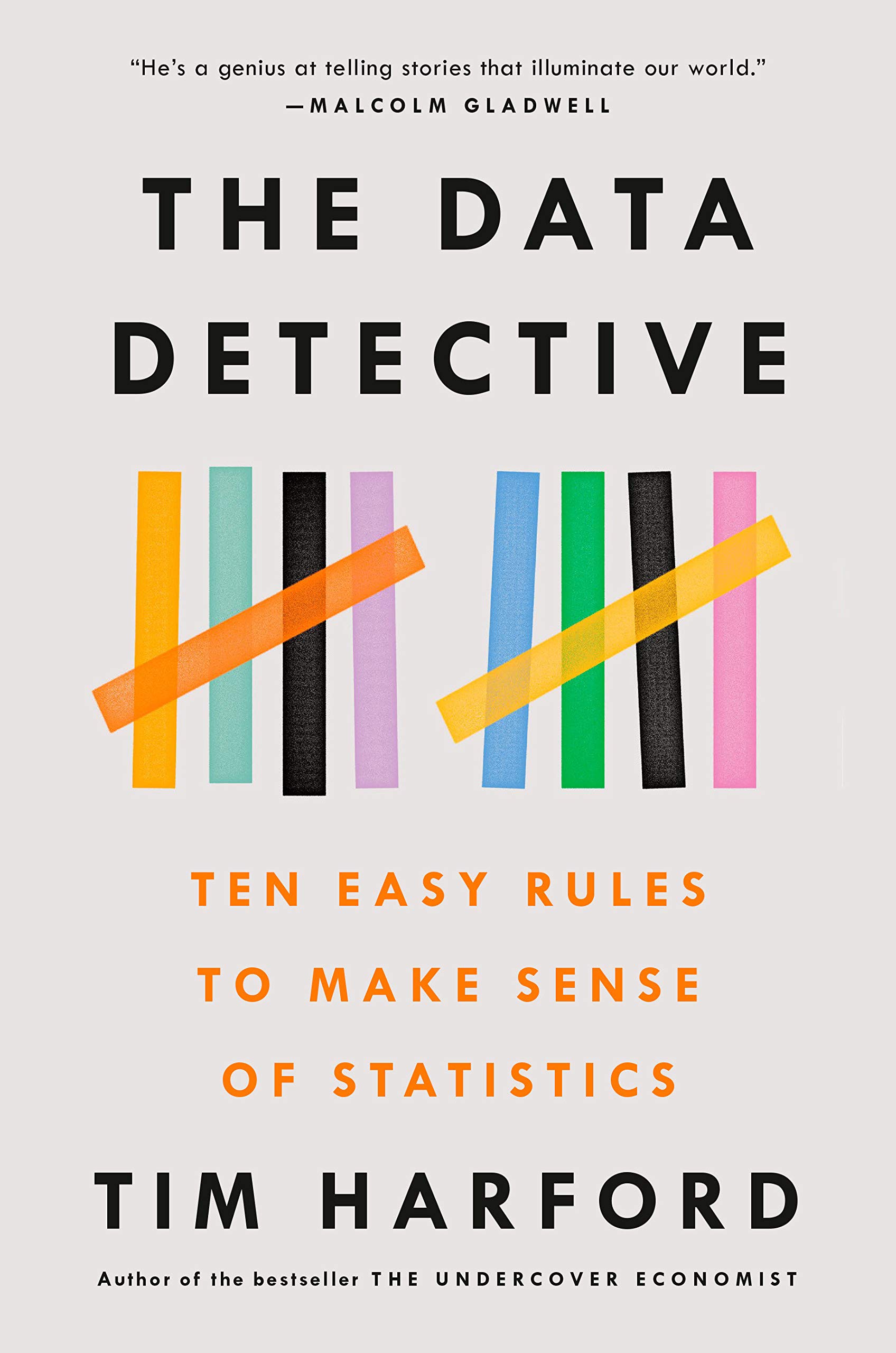 Here is the Amazon bit:
From “one of the great (greatest?) contemporary popular writers on economics” (Tyler Cowen) comes a smart, lively, and encouraging rethinking of how to use statistics.
Paying workers to vaccinate
Trader Joe’s is the latest business to offer an incentive for workers getting the COVID-19 vaccine.
The Monrovia, California-based grocery chain said Thursday it will give employees two hours of pay per dose for getting the vaccine and will also shift around schedules to make sure employees have time to get vaccinated.
Online grocery delivery company Instacart also announced Thursday it will begin paying its workers $25 to offset them taking time to get the COVID-19 vaccine.
The San Francisco-headquartered company, which has about 500,000 workers that shop to fill and deliver orders from more than 40,000 stores, said it will begin giving the vaccine support stipend Feb. 1 to eligible workers as the vaccination programs roll out across the U.S. and Canada…
Dollar General, which operates nearly 17,000 stores in 46 states, said Wednesday it will give employees the equivalent of four hours of pay if they get the vaccine.
Here is the full story, via Anecdotal. Nudges of this kind often work, even when the explicit incentive appears to be small…
Saturday assorted links
1. The power of suggestion things as they ought to be.
2. Economist William Allen has passed away.
3. The evolution of Ivor Cummins.
4. Ayn Rand on the Fairness Doctrine.
5. A critique of Tether (what would Milton Friedman have said?).
6. From July 2020: “The UK’s decision not to join an EU plan to distribute a potential coronavirus vaccine to its most vulnerable citizens has been described as “unforgivable” and condemned by health charities and opposition politicians.” Or read this one from March.
7. Profile of Annie Duflo (WSJ).
Praise the British
Britain has fully vaccinated more people against #COVID19 than every other nation on earth combined.
Link and picture here. That is as of January 13, at least. You may recall my previous and much-attacked July Bloomberg column suggesting that along a number of dimensions the UK pandemic response actually was quite good.
Addendum: Numerical correction from Alex on America, though you still can praise the British.
Friday assorted links
Corporate donations are good for political moderation
This article demonstrates that limits on campaign contributions—which alter a candidate’s ability to raise money from certain types of donors—affect the ideologies of legislators in office. Using an original data set of campaign contribution limits in some US states over the last 20 years, I exploit variation across and within states over time to show that higher individual contributions lead to the selection of more polarized legislators, while higher limits on contributions from political action committees (PACs) lead to the selection of more moderate legislators. Individual donors prefer to support ideologically extreme candidates while access-seeking PACs tend to support more moderate candidates. Thus, institutional changes that limit the availability of money affect the types of candidates who would normally fund-raise from these two main sources of campaign funds. These results show that the connection between donors and candidates is an important part of the story of the polarization of American politics.
That is from a new paper by Michael J. Barber. Via Matt Grossman.
Money-maximizing macaque thieves demand ransoms
At the Uluwatu temple in Bali, monkeys mean business. The long-tailed macaques who roam the ancient site are infamous for brazenly robbing unsuspecting tourists and clinging on to their possessions until food is offered as ransom payment.
Researchers have found they are also skilled at judging which items their victims value the most and using this information to maximise their profit.
Shrewd macaques prefer to target items that humans are most likely to exchange for food, such as electronics, rather than objects that tourists care less about, such as hairpins or empty camera bags, said Dr Jean-Baptiste Leca, an associate professor in the psychology department at the University of Lethbridge in Canada and lead author of the study.
Mobile phones, wallets and prescription glasses are among the high-value possessions the monkeys aim to steal. “These monkeys have become experts at snatching them from absent-minded tourists who didn’t listen to the temple staff’s recommendations to keep all valuables inside zipped handbags firmly tied around their necks and backs,” said Leca.
After spending more than 273 days filming interactions between the animals and temple visitors, researchers found that the macaques would demand better rewards – such as more food – for higher-valued items.
Bargaining between a monkey robber, tourist and a temple staff member quite often lasted several minutes. The longest wait before an item was returned was 25 minutes, including 17 minutes of negotiation. For lower-valued items, the monkeys were more likely to conclude successful bartering sessions by accepting a lesser reward.
Here is the full story, via David Curran.
Insurrections are contagious
That is the topic of my current Bloomberg column, here is one bit:
Put aside U.S. politics for a moment and view the events of the last week from a global perspective. Without backing from the military, a crowd entered the Capitol building and disabled the U.S. Congress, and almost succeeded in achieving more violent goals yet.
The question is not what people should infer, or what most people will think. It’s what the people at the extremes will think and do. Even if many foreign citizens conclude that the events of last week were not a big deal, the most determined and rebellious observers might give them a different and more radical gloss. (Besides which, it actually was a big deal.) As the
Now imagine you live in Hungary, Uganda, Myanmar or any country that is experiencing political turmoil. If you had a violent plan against your own government, do you now rate your chances of success as lower or higher? Organizing a storming mob may have just become more appealing, especially since your adversary is almost certainly less formidable than the U.S. government.
And what if you express your surprise over recent events?:
Yet this very surprise, while justified, may itself induce a dangerous contagion effect. The surprise carries an implicit message: “It may not seem like you have many allies, but in fact you do, including in some powerful places.” So you can imagine how a supporter of say QAnon might come to believe that there are secret allies everywhere. And those beliefs may in turn encourage political violence.
And this:
One implication is that the media needs to be very careful about how they portray the perpetrators of the Jan. 6 events. Most media organizations have been publicizing the identities and deeds of these criminals, as they should. A lot of Americans need to be shocked out of their complacency about what happened, or at least nudged out of various theories of false equivalence. The more information becomes public, the more it becomes clear that at least part of the Capitol-storming group was conspiring and intent on violence and mayhem — and for very bad political ends: in essence, the destruction of American democracy.
Yet there is such a thing as too much information. In other contexts, the news media withhold the names, images and causes of many terrorists and criminals. To the extent those individuals are doing it for recognition, denying them that recognition may discourage future wrongdoers.
There are further arguments at the link.
Thursday assorted links
1. Mental health slow boil pandemic edition. And what is the implied discount rate here?
2. Are Israeli flying ambulances on the way?
3. What wine meant to Roger Scruton. Not my view of course.
4. The “telephone problem” of sequential communication may lead to excess negativity.
5. Marginal Revolution University supply and demand instructional unit for high schools (and others!).
6. Dose delay and viral resistance, recommended. First Doses First is looking better all the time.
7. Did Jupiter kill Venus? And Margo St. James has passed away.
What should I ask Sarah Parcak?
Yes I will be doing a Conversation with her. Here is part of her Wikipedia entry:
Sarah Helen Parcak is an American archaeologist, Egyptologist, and remote sensing expert, who has used satellite imaging to identify potential archaeological sites in Egypt, Rome, and elsewhere in the former Roman Empire. She is a professor of Anthropology and director of the Laboratory for Global Observation at the University of Alabama at Birmingham. In partnership with her husband, Greg Mumford, she directs survey and excavation projects in the Faiyum, Sinai, and Egypt’s East Delta.
And here is Sarah on Twitter. Here is her very useful bio page. Here is her book Archaeology from Space: How the Future Shapes the Past. So what should I ask her?
The volatility of events is correlated (and not always in a good way)
That is the topic of my latest Bloomberg column, here is one excerpt:
Consider bad economic news, which is relatively unambiguous. With stock market returns, volatility is correlated over time, and it is higher in bear markets. To some extent the bad mood is contagious, and the bad events behind the volatility may be interlinked as well.
To be clear, the stock market has done fine lately. The latest bad news is about politics and public health, not corporate earnings. Still, the stock market is readily measurable and can offer clues about how broader social processes are connected over time — and one obvious conclusion is that volatility tends to feed upon itself, not usually in positive ways.
And:
Another problem is what my colleague Bryan Caplan has labeled “the idea trap.” Social science research indicates that in troubled times people are more likely to turn to bad ideas. The distressed German economy of the 1920s and early 1930s, for example, helped to breed support for the Nazis.
More recently, the global economy has been very much a mixed bag since the financial crisis of 2008. So people might begin to embrace worse ideas, which in turn will breed subsequent volatility. Such a cycle can worsen over time, and a ragged recovery from the Covid-19 deep recession could exacerbate this dynamic. It simply isn’t good for decision-making if everyone is feeling frazzled and stressed.
Recommended.
Wednesday assorted links
1. Don’t let them tell you that ZMP workers are not for real.
2. Why was vaccination so much faster in 1947?
3. A new mRNA vaccine for multiple sclerosis?
4. “Business is the only institution that is now perceived as being both ethical and competent enough to solve the world’s problems.” Full study here.
5. Attempted Quebec regulatory arbitrage: “Quebec Woman Fined For Putting Leash on Her Partner, Taking Him for a Walk.”