Category: Uncategorized
“The People’s Budget”
It is endorsed by Paul Krugman and also Jeffrey Sachs, so I thought I would give it a look. It is from the Congressional Progressive Caucus. One simple question is to ask how the rich are taxed:
1. There are separate rates in the mid- to high forties for millionaires, with strict limits on itemized deductions.
2. “Raise the taxable maximum on the employee side to 90% of earnings and eliminate the taxable maximum on the employer side.” With volatile incomes, it’s tricky to translate that into an expected marginal rate or to figure out how much is infra-marginal. See the technical appendix, p.8, for more details, though I find the entire proposal here poorly explicated. In any case, it’s a big tax increase.
3. Tax capital gains and dividends at the normal income rates. (I am not sure how loss offsets are to be treated, though it could make a big difference and significantly boost the demand for volatile stocks.)
4. I’m not sure what happens with state-level income tax rates but there’s certainly, in the proposal, no talk of them going down. And since they’re probably not free market deregulators at the state and local level, I suppose I expect those taxes to go up, given Medicaid burdens, pension problems, ailing educational systems, and so on.
5. Estate taxes would be raised significantly (sock it to Boy Mankiw!), as would corporate income taxes, there would be new financial transactions taxes, there would be a new bank tax, and tax enforcement would be stiffer.
6. There are, by the way, no proposed cuts in benefits.
What is the final net income and also capital gains rate for wealthy taxpayers? It’s hard to say exactly, but north of seventy percent for income rates (including state and local rates), and near fifty percent for capital gains rates, is not hard to believe.
Quick quiz #1: What are the capital gains tax rates in the European social democracies?
Quick quiz #2: From the climate change debates we learn the value of scientific consensus; what percentage of Democratic public finance economists would favor top income and capital gains rates in the neighborhood of seventy and fifty percent? Some of them have read and digested, for instance, this paper by the impressive Raj Chetty.
Quick quiz #3: Does the technical report offer estimated labor supply and investment elasticities in response to these higher tax rates? (p.s. the answer is “no.”)
I can tell you this: in the technical appendix; the assumption is that the net effect on growth, from investment changes, after all the new public sector investment is called into place, is a positive [sic] 0.3%.
There have been some good criticisms of the funny assumptions behind the Ryan plan, but actually this budget isn’t better, either in terms of its final conclusions, its adherence to best scientific practices, or its transparency in getting to its results. Should we not apply equally high standards to both the Ryan budget and this? There are plenty of good arguments that taxes have to go up, but this particular proposal isn’t one of them. INSERT SNARKY CLOSING OF YOUR CHOICE I WON’T DO IT FOR YOU.
Assorted links
1. Maundy money coincides with Queen’s birthday!
3. Bureaucratics (photo show, excellent, recommended, I am glad I went through them all).
4. “Imagining the button” – worth a reread.
Are “green” products declining?
The number of household cleaners with green claims introduced in 2008 was 144, up from 29 in 2007. By 2009 that had dropped to 105, according to Mintel, a research firm. Green dishwashing liquid followed a similar pattern, with 14 introductions in 2007, 85 in 2008, then 58 in 2009.
The story (1/20) is here, and it is adequate to stick with that quotation above (not worth one of your twenty). Some of this switch is due to the recession, but I wouldn’t assume that green products will make a big comeback with better times (there is related comment here). Consumer brand stickiness is legendary, altruistic trends need a big oomph to get off the ground and they need to be seen as cool and up-and-coming, and consequently there is no reason to favor a Whig interpretation of history in this matter. Possibly the bubble has been burst.
Religious conversion as an anti-poverty strategy
Adam writes to me:
Hypothetical for you: would a massive conversion of low-income people to Mormonism reduce poverty? Utah looks to have some good demographics, which must be somewhat due to to the fact that 60% belong to the LDS church: http://www.adherents.com/largecom/lds_dem.html
They have the lowest child poverty rate in the country, the highest birth rate but the lowest out-of-wedlock birthrate.
Is Mormon conversion a viable development policy?
A viable *policy*, no, but a viable solution *yes*. Many of the costs of poverty are sociological rather than narrowly economic per se. In other words, many of the poor do not have what could be called Mormon lifestyles. This point holds all the more strongly in Latin America, where alcoholism is arguably a larger economic problem than in the United States. It is not uncommon for a rural village to have a male alcoholism rate of up to fifty percent.
A political conservative is more likely to make this point than to simply focus on the lack of money earned by the poor. A political liberal is more likely to assume that the rate of strict religiosity can rise only so high, and take that as a background constraint. Furthermore, under the exogenous thought experiment of many more poor people converting to Mormonism, positive selection bias diminishes and perhaps the religion as a whole becomes less strict.
The truth of the Mormonism insight doesn’t necessarily have strong implications for cash-based social aid policies in the meantime. Mormonism, as a variable, is difficult for political agents to manipulate, although they (possibly) can squash it. Raising this point, however, makes the poor look less like victims and more like a group partially complicit in their own fate. That framing does have “marketing” implications for the politics of how many resources the poor will receive. For this reason, liberals sometimes underrate the conservative point, because they do not like its political implications, and this leads liberals to misunderstand poverty. The conservatives end up misunderstanding poverty policy. Almost everyone ends up a little screwy and off-base on this issue, victims of the fallacy of mood affiliation.
Here is an article about the poorest community in the United States, in terms of measured income, it is mostly Hasidic Jews (1/20). It doesn’t have most of the problems which we usually associate with poor communities.
Assorted links
Assorted links
1. Markets in everything: 2-D glasses.
2. More correlations from OK Cupid.
3. What is not covered by private health insurance, an oft-forgotten list when health care policy is debated.
Markets in everything the culture that is Denmark
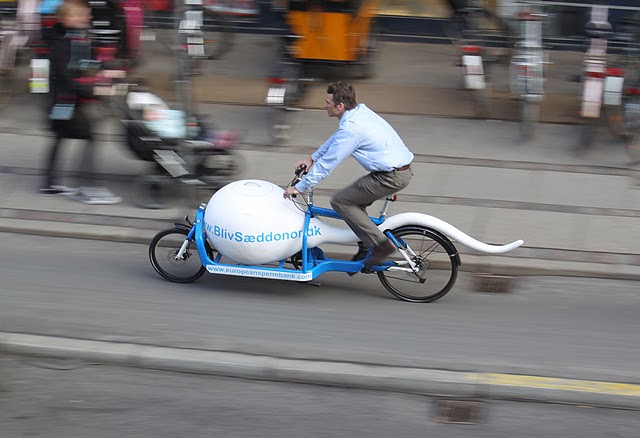
It is intended as an environmentally friendly way to carry sperm to fertility clinics scattered around Copenhagen.
But is it actually environmentally friendly or is it, as is so often the case, an advertising gimmick? The bike has its own cooler and:
Producing the Sperm Bike was no easy task. It was constructed by the Danish company 10 Tons – who specialise in zoological and botanical models as well as paleontologic reconstructions, including full-size whales and dinosaurs.
With the tail, the bike is 2.9 metres long and fully-loaded with… um… sperm… it weighs 50 kg.
For the pointer I thank James Hohman.
Assorted link
1. The value of land, China (?) Pigou sparks video of the day.
Assorted links
Self-recommending
Poor Economics: A Radical Rethinking of the Way to Fight Global Poverty, by Abhijit Banerjee and Esther Duflo.
More Than Good Intentions: How a New Economics is Helping to Solve Global Poverty, by Dean Karlan.
Both are about the randomized control movement in development economics. Here is my earlier post on RCTs in development economics.
*The Long Goodbye*
That is Meghan O’Rourke’s new book about dealing with the death of her mother. It is difficult to excerpt usefully, but I found it striking and memorable. It melds prose and poetic styles very effectively (O’Rourke is a well-known poet and a very good one) and it covers some relatively unexplored emotional space. I don’t know a better book on grief.
Here is one good review of the book (1/20). Here is another good review (1/20), combined with a justfied attack on the (to me) virtually unreadable new Francisco Goldman book.
David Leonhardt wins a Pulitzer Prize
Well-deserved (NYT link), he also has excellent taste in food.
Assorted links
1. A better approach to controlling Mexican drug violence.
2. The culture that is Japan; “The sole person in Japan who is not obliged to use honorifics, or rather, is prohibited from using them, is the emperor.”
3. David Frum on the welfare state.
4. The culture that is Mexico.
5. Edward O. Wilson changes his mind on altruism.

A convincing smile is difficult to fake
Here is a new paper by a few authors, including Paul Seabright:
We test the hypothesis that “genuine” or “convincing” smiling is a costly signal that has evolved to induce cooperation in situations requiring mutual trust. Potential trustees in a trust game made video clips for viewing by potential trusters before the latter decided whether to send them money. Ratings of the genuineness of smiles vary across clips; it is difficult to make convincing smiles to order. We argue that smiling convincingly is costly, because smiles from trustees playing for higher stakes are rated as significantly more convincing, so that rewards appear to induce effort. We show that it induces cooperation: smiles rated as more convincing strongly predict judgments about the trustworthiness of trustees, and willingness to send them money. Finally, we show that it is a honest signal: those smiling convincingly return more money on average to senders. Convincing smiles are to some extent a signal of the intrinsic character of trustees: less honest individuals find smiling convincingly more difficult. They are also informative about the greater amounts that trustees playing for higher stakes have available to share: it is harder to smile convincingly if you have less to offer.
Here is another paper by Paul and co-authors, about the end of low-hanging fruit in the pharmaceuticals market.
Why do Brazilians emigrate so infrequently?
It is a populous country, yet there are few major Brazilian communities in the United States. Only parts of Massachusetts, Queens, and Newark, New Jersey come to mind. The U.S. Census estimates about 250,000 Brazilians living in the United States, which is many fewer than come from El Salvador, namely about two million. Why is there such a difference? The Brazilian number may well be an undercount but unofficial estimates still lie well below those of El Salvador.
1. Could it be that Brazil is too much fun to leave? Or too much fun to generate the norms of upward mobility which encourage poorer people to leave for greater ambition? If you live on the beach in northeastern Brazil, what exactly do you aspire to?
2. Do inhabitants of large, populous countries face larger cultural costs in leaving and adjusting their perspective?
3. Has Brazil had so much construction (including Brasilia), in its fairly wealthy sectors, that internal migration is a good enough substitute for external migration?
4. Brazil has a particular history of viewing the United States as a rival; El Salvador does not.
5. It seems that most Brazilian emigrants are ashamed to admit that they are emigrating to the United States, instead they claim they are simply “passing through,” or something similar.
What other points are relevant? Here is a study (pdf) of Brazilian migrants to Massachusetts.
Brazil also does not attract many (recent) migrants, even though in some sectors the economic opportunities are strong. It could be that external migrants have to compete too strongly with internal migrants from the poorer regions of Brazil.
Leonardo Monasterio restates the initial question in Portuguese.