Category: Uncategorized
Assorted links
1. Is the black market in metereorite fragments a good or bad development? (NYT)
2. Salamander has algae living inside its cells. And Reihan on Lula.
3. China famine facts of the day.
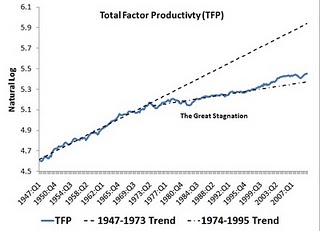
4. Breaking down the decline in TFP; note the importance of sectoral shifts into lower-growing sectors, as discussed here by Gordon Bjork and in the comments by Andy Harless.
5. Dan Gardner on nuclear power.
6. How San Francisco parking pricing will work.
7. How the world’s economic center of gravity has been shifting.
New Design
We have now successfully moved from Typepad to WordPress; most of the kinks of the move and the new design appear to have been worked out. Here is the place to report, however, any remaining issues that you may be experiencing. By the way, if you are interested in moving your own blog, see here.
Choice-based Medicare cost controls
Let’s say it’s 2027 and I’ve just turned 65. I fill out a Medicare application on-line and opt for a plan with superior heart coverage (my father died of a heart attack), not too much knee coverage and physical therapy (my job doesn’t require heavy lifting), no cancer heroics (my mother turned them down and I wish to follow her example), and lots of long-term disability.
Is that so terrible an approach? Is it obviously worse than having the Medicare Advisory Board make all of those choices for me?
Over the next few days you will read a lot of “downgrade and dismiss” directed at Paul Ryan and his plan and indeed it is quite possible his proposal is not a workable one (I haven’t read it yet). But don’t fall for the downgrade and dismiss bait, keep on returning to the question of how much individual choice should be allowed into health care cost control. Why not divvy up the cost control work between the Board and some degree of individual choice across Medicare benefits? You don’t have to combine that choice with the cost-increasing aspects of Medicare Advantage-like plans.
Many ACA defenders simply do not want to enter into a debate where the framing is “we’re all for cost control, when it comes to Medicare benefit selection it’s a question of government board vs. individual choice.”
I can think of a few reasons why individual choice will sometimes fail as a method of cost control:
1. Individuals have serious misconceptions about the science, or the badness of a particular condition, even in light of government or other third-party advice. Or perhaps individuals simply do not understand the nature of all of the choices at hand.
2. Perhaps an individual will choose “no coverage for lung cancer,” but the government cannot precommit to the outcome of no coverage. Of course as cost control becomes more pressing, we’ll have to learn precommitment for at least some issues, one way or the other, so this cannot be a decisive objection. The entire premise behind the discussion is that we cannot cover all treatments through government subsidy.
3. Over time, perhaps a government Board can rebalance the mix of coverage better than an individual can. People age, possibly lose some mental faculties, science advances, costs change, and so on.
Those are good arguments. They are good arguments for a mixed system. They are not good arguments for ruling out all individual choice of benefits. They are not good arguments for ruling out a scenario like that outlined in the first paragraph of this blog post.
Here is Megan McArdle on the difference between boards and individual choice:
It seems quite likely to me that vouchers are going to be better at controlling health care cost growth than a central committee. Every committee decision that cuts off a potentially useful treatment (and I’m afraid it can’t all be back surgery and hormone replacement therapy) will trigger a lobbying explosion from affected groups. Each treatment is a decision with a small marginal cost to the taxpayer; it’s in aggregate that they become expensive. Which means that the congressional tendency is always going to be to override–and while there are supposed to be structural barriers against this in the bill, they aren’t very strong . . .
Whereas if you put the decision about what treatments to cover in the hands of the patient, the lobbying you face is to increase the overall value of the voucher. To be sure, this will have a larger (and therefore more powerful) group behind it. But it will also come with an enormous pricetag, making it much harder for our politicians to rationalize the decision.
There are lots of comments from Reihan here. Ezra associates the Ryan reforms with Medicare Advantage. Maybe so, and maybe that’s bad, but we return to how much individual choice should we allow into health care cost control, with or without the cost-increasing aspects of the Ryan plan.
We shouldn’t let “downgrade and dismiss” distract our attention from that fundamental question about individual choice.
Assorted links
1. There is no Great Stagnation (video).
2. Perry Anderson on Brazil (worth the free registration, one of the best articles this year so far).
3. I second Matt’s recommendation of What Hath God Wrought?
4. Plans to reform Britain’s NHS are falling apart.
Total Factor Productivity
Assorted links
1. One measure of the value of computers.
2. Karl Smith on Garett Jones and TARP.
3. Photograph taken from Borders, a theory of optimal bundling, and yet the restroom in my house works just fine. They even let me take books into it for reading.

4. “Everything is obvious once you know the answer,” a new Duncan Watts book.
Assorted links
1. National serviceman needs maid to carry his backpack (Singapore, Adam Smith, decline of martial virtue, via Chris F. Masse).
2. Paul Krugman on the 1921 recovery.
3. Robin Hanson and Brian Christian.
4. Unemployment duration still going up.
5. Brad DeLong, slouching toward recalculation. And his response.
China price request of the day
Unilever, the Anglo-Dutch consumer goods group, has bowed to pressure from Beijing to delay planned price increases, highlighting a new regulatory risk in an inflationary climate.
…Chinese consumers, increasingly alarmed at the rising cost of living, cleared supermarket shelves this week of shampoos, soaps and detergents after state media said four consumer goods companies – including Unilever and Guangzhou Liby Enterprise Group – would raise prices by between 5 per cent and 15 per cent.
The full story is here.
Seminal books for each decade
Andrew asks a tough question:
what do you think is more or less the equivalent of the great gatsby in every decade after the 20s?
Here are my picks:
1930s: The Grapes of Wrath, John Steinbeck.
1940s: Farewell, My Lovely, by Raymond Chandler.
1950s: Invisible Man, by Ralph Ellison, with Kerouac’s On the Road as a runner-up.
1960s: Catch-22, by Joseph Heller, with The Bell Jar and Herzog as runners-up.
1970s: This is tough. There is Vonnegut’s Breakfast of Champions, Stephen King, and even Peter Benchley’s Jaws. I’ll opt for Benchley as a dark horse pick, note that these aren’t my favorites but rather they must be culturally central. Jonathan Livingston Seagull is another option, as this truly is an era of popular literature.
1980s: Tom Wolfe, The Bonfire of the Vanities.
1990s: The Firm, by John Grisham, or Barbara Kingsolver, The Poisonwood Bible. Maybe Brokeback Mountain.
2000s: Malcolm Gladwell, The Tipping Point.
The Hayek Twitter game
The game: Take a sentence or two on Hayek’s clause and qualification ridden Germanic prose, and turn it into a 144 character twitter feed.
Example. Here’s a brief passage from Hayek 1976 essay “Socialism and Science” posted a few days ago in the comments by Richard Ebeling:
“A society in which everyone is organized as a member of some group to force government to help him get what he wants is self-destructive. There is no way from preventing some from feeling that they have been treated unjustly — that feeling is bound to be wide spread in any social order — but arrangements which enable groups of disgruntled people to extort satisfaction of their claims — or in the recognition of an ‘entitlement’, to use the new-fangled phrase — make any society unmanageable.”
And here it is as a 144 character twitter feed:
When everyone is organized to force government to get them what they want, many will be left feeling that they have been treated unjustly.
Ho hum! I would have done “Rent-seeking groups lead to perceptions of unfairness.”
When did the big gains in agricultural productivity come?
I had the general and indeed correct impression that U.S. agricultural productivity has been rising for a long time. It’s less commonly known how big was the productivity acceleration in agriculture in the 1940s. Between 1880 and 1940, agricultural productivity in this country rose at the rather modest rate of about one percent a year. After World War II, the trend rate of growth jumps to 2.8 percent annually. Multi-factor productivity in agriculture skyrockets in the mid-1930s, not earlier.
The information is from Bruce Gardner’s American Agriculture in the Twentieth Century: How it Flourished and What it Cost, pp.20-21, p.44.
My favorite things South Africa
Torr writes to me:
Please will you consider doing a “favorite things South Africa” on Marginal Revolution. I’m also curious: have you ever visited South Africa?
I have yet to go, but here is what I admire so far:
1. Visual artist (you can’t quite call him a painter): William Kentridge. He is one of the contemporary artists who is both a realist and has a lot of the emotional power of the classics. His extraordinary body of work spans film, drawings, prints, and mixed media. Here are some images.
2. Home design: I am an admirer of the Ndebele, some photos of their colorful homes are here. They are better represented in picture books than on the web.
3. Movies: I don’t know many. I enjoyed The Gods Must be Crazy, even though some might find it slightly offensive. Nonetheless I hand the prize to District 9 for its interesting take on ethnic politics, its deconstruction and mock of Afrikaaner settler myths, and its commentary on how South Africans view Zimbabwean immigrants to their country.
4. Movie, set in: Zulu, 1964 with Michael Caine.
5. Novels: My favorite Coetzee is Disgrace, though I like most of them very much, including the early Life and Times of Michael K and Waiting for the Barbarians and the later semi-autobiographical works. Nadine Gordimer I find unreadable, call the fault mine. Same with Alan Paton. A dark horse pick is Trionf. Agaat sits in my pile, waiting for the trip of the right length.
6. Music: Where to start? Malanthini, for one. As for mbqanga collections, The Indestructible Beat of Soweto series is consistently excellent. Singing in an Open Space, Zulu Rhythm and Harmony 1962-1982 is a favorite. Random gospel and jazz collections often repay the purchase price and in general random CD purchases in these areas bring high expected returns.
7. Economists: Ludwig Lachmann was an early teacher of mine and I owe him my interest in post Keynesianism and also financial fragility hypotheses. G.F Thirlby remains underrated. W.H. Hutt was one of the most perceptive critics of Keynes and his insights still are not absorbed into the Keynesian mainstream. His book on the economics of the colour bar remains a liberal classic. Who am I forgetting?
The bottom line: There’s a lot here. Here are previous MR posts about South Africa.
Assorted links
Assorted links
1. Facebook and TGS, and Robin Hanson reviews TGS. Mike Mandel responds to Karl Smith.
2. Is envy a stronger motivator than admiration?
3. Passing to yourself off the backboard (video).
4. Yet another way of viewing our labor market troubles, or in other words, start-ups have suffered too (NYT blog).
5. Via Chris F. Masse, when will China overtake the U.S. in science? (NB: I’m not convinced by this article).
The fallacy of mood affiliation
Recently I wrote:
It seems to me that people are first choosing a mood or attitude, and then finding the disparate views which match to that mood and, to themselves, justifying those views by the mood. I call this the “fallacy of mood affiliation,” and it is one of the most underreported fallacies in human reasoning. (In the context of economic growth debates, the underlying mood is often “optimism” or “pessimism” per se and then a bunch of ought-to-be-independent views fall out from the chosen mood.)
Here are some further examples:
1. People who strongly desire to refute those who predicted the world would run out of innovations in 1899 and thus who associate proponents of a growth slowdown with that far more extreme view. There’s simply an urgent feeling that any “pessimistic” view needs to be countered.
2. People who see a lot of net environmental progress (air and water are cleaner, for instance) and thus dismiss or downgrade well-grounded accounts of particular environmental problems. There’s simply an urgent feeling that any “pessimistic” view needs to be countered.
3. People who see a political war against the interests of the poor and thus who are reluctant to present or digest analyses which blame some of the problems of the poor on…the poor themselves. (Try bringing up “predatory borrowing” in any discussion of “predatory lending” and see what happens.) There’s simply an urgent feeling that any negative or pessimistic or undeserving view of the poor needs to be countered.
4. People who see raising or lowering the relative status of Republicans (or some other group) as the main purpose of analysis, and thus who judge the dispassionate analysis of others, or for that matter the partisan analysis of others, by this standard. There’s simply an urgent feeling that any positive or optimistic or deserving view of the Republicans needs to be countered.
In the blogosphere, the fallacy of mood affiliation is common.