Wednesday assorted links
1.Another good reason for not trusting Mundell-Fleming intuitions, this one from Olivier Blanchard and Co.
2. Migration can counteract global warming costs in middle income but not poor countries.
3. Izabella Kaminska transcribes the Star Trek conversation.
5. More on the relative impotence of more progressive taxes.
A conversation with Angus Deaton about RCTs
The interrogator is Timothy N. Ogden, here is one bit from Deaton:
Something I read the other day that I didn’t know, David Greenberg and Mark Shroder, who have a book, The Digest of Social Experiments, claim that 75 percent of the experiments they looked at in 1999, of which there were hundreds, is an experiment done by rich people on poor people. Since then, there have been many more experiments, relatively, launched in the developing world, so that percentage can only have gotten worse. I find that very troubling.
If the implicit theory of policy change underlying RCTs is paternalism, which is what I fear, I’m very much against it.
The conversation is interesting throughout. Tim indicates:
This is a chapter from the forthcoming book Experimental Conversations, to be published by MIT Press in 2016. The book collects interviews with academic and policy leaders on the use of randomized evaluations and field experiments in development economics. To be notified when the book is released, please sign up here.
The book will contain an interview with me as well.
Economics and the Modern Economic Historian
That is a new NBER paper by Ran Abramitzky, the abstract is here:
I reflect on the role of modern economic history in economics. I document a substantial increase in the percentage of papers devoted to economic history in the top-5 economic journals over the last few decades. I discuss how the study of the past has contributed to economics by providing ground to test economic theory, improve economic policy, understand economic mechanisms, and answer big economic questions. Recent graduates in economic history appear to have roughly similar prospects to those of other economists in the economics job market. I speculate how the increase in availability of high quality micro level historical data, the decline in costs of digitizing data, and the use of computationally intensive methods to convert large-scale qualitative information into quantitative data might transform economic history in the future.
I have for a while been pleased that GMU has one of the largest collections of economic historians (I would say four,) of any department around, UC Davis being another major presence in that area.
What is stupid?
Should there not be more research on this apparently simple yet elusive question? Here is a new paper by Acezel, Palfi, and Kekecs:
This paper argues that studying why and when people call certain actions stupid should be the interest of psychological investigations not just because it is a frequent everyday behavior, but also because it is a robust behavioral reflection of the rationalistic expectations to which people adjust their own behavior and expect others to. The relationship of intelligence and intelligent behavior has been the topic of recent debates, yet understanding why we call certain actions stupid irrespective of their cognitive abilities requires the understanding of what people mean when they call an action stupid. To study these questions empirically, we analyzed real-life examples where people called an action stupid. A collection of such stories was categorized by raters along a list of psychological concepts to explore what the causes are that people attribute to the stupid actions observed. We found that people use the label stupid for three separate types of situation: (1) violations of maintaining a balance between confidence and abilities; (2) failures of attention; and (3) lack of control. The level of observed stupidity was always amplified by higher responsibility being attributed to the actor and by the severity of the consequences of the action. These results bring us closer to understanding people’s conception of unintelligent behavior while emphasizing the broader psychological perspectives of studying the attribute of stupid in everyday life.
What do you think people, a smart paper or a stupid paper?
For the pointer I thank Michelle Dawson.
Deaton on Deaton
It was during my time at Bristol that John Muellbauer and I worked together on our book. The computer facilities at Bristol were terrible — the computer was a mile away, on top of a hill, so that boxes of punched cards had to be lugged up and down. I was told to get a research assistant, which was sensible advice, but I have never really figured out how to use research assistance: for me, the process of data gathering — at first with paper and pencil from books and abstracts — programming, and calculation has always been part of the creative process, and without doing it all, I am unlikely to have the flash of insight that tells me that something doesn’t fit, that not only this model doesn’t work, but that all such models cannot work. Of course, this process has become much easier over time. Not only are data and computing power constantly and easily at one’s fingertips, but it is easy to explore data graphically. The delights and possibilities can only be fully appreciated by someone who spent his or her youth with graph paper, pencils, and erasers.
Given how far it was up the computer hill, I substituted theory for data for a while, and wrote papers on optimal taxation, the structure of preferences, and on quantity and price index numbers, but I never entirely gave up on applied work.
The entire biographical essay is of interest (pdf).
Tuesday assorted links
1. The world’s first airport for drones is being built in…Rwanda.
2. Clive Crook reviews Dani Rodrik on economic method.
3. Robber uses Uber for getaway car. Gets caught. And how many students cheat?
4. The Fairfax police understand search theory, sort of.
5. Did the number of people enrolled in the health care exchanges drop by fifteen percent?
The Case for Getting Rid of Borders—Completely
In The Atlantic I present the case for open borders. Here is one bit:
No standard moral framework, be it utilitarian, libertarian, egalitarian, Rawlsian, Christian, or any other well-developed perspective, regards people from foreign lands as less entitled to exercise their rights—or as inherently possessing less moral worth—than people lucky to have been born in the right place at the right time. Nationalism, of course, discounts the rights, interests, and moral value of “the Other,” but this disposition is inconsistent with our fundamental moral teachings and beliefs.
Freedom of movement is a basic human right. Thus the Universal Declaration of Human Rights belies its name when it proclaims this right only “within the borders of each state.” Human rights do not stop at the border.Today, we treat as pariahs those governments that refuse to let their people exit. I look forward to the day when we treat as pariahs those governments that refuse to let people enter.
Read the whole thing.
Addenda: I was asked to write this piece for a forthcoming volume called How to Save Humanity that will feature essays by Steven Pinker, Martin Rees, Nick Bostom and others.
Open Borders seems to be having a moment. Time also featured a piece on migration by Bryan Caplan.
The comment section at The Atlantic reminded me of how good the comment section at MR can be. Amusingly, I was called both a zionist Jew and an anti-semite out to destroy Israel. On the other hand, my article has 31,000 likes and counting so I can’t complain.
Is it getting harder to move beyond minimum wage jobs?
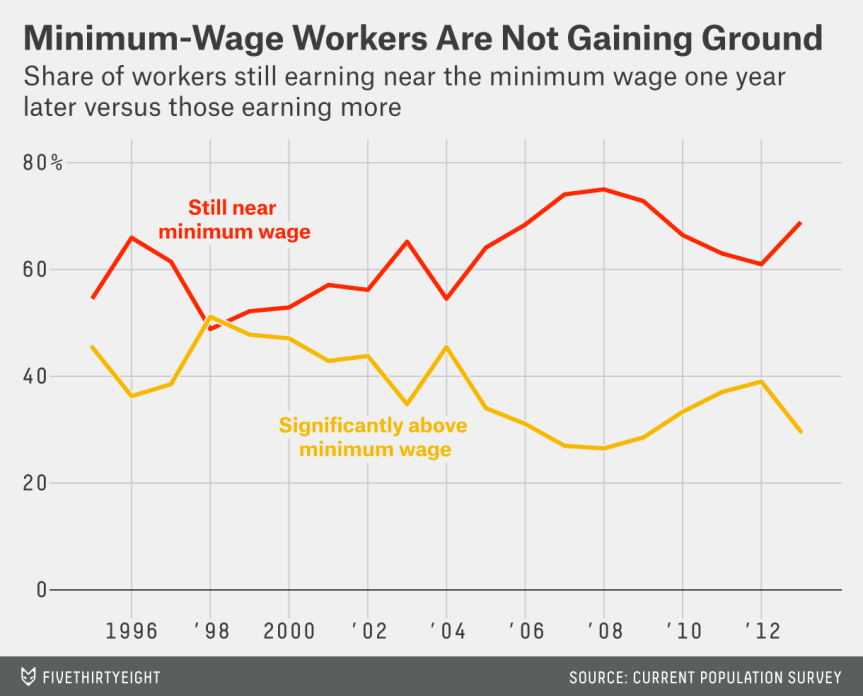
Ben Casselman has a good piece on this question, here is one excerpt:
During the strong labor market of the mid-1990s, only 1 in 5 minimum-wage workers was still earning minimum wage a year later. Today, that number is nearly 1 in 3, according to my analysis of government survey data. There has been a similar rise in the number of people staying in minimum-wage jobs for three years or longer…
Even those who do get a raise often don’t get much of one: Two-thirds of minimum-wage workers in 2013 were still earning within 10 percent of the minimum wage a year later, up from about half in the 1990s. And two-fifths of Americans earning the minimum wage in 2008 were still in near-minimum-wage jobs five years later, despite the economy steadily improving during much of that time.
The piece is of interest throughout.
Angus Deaton update
Angus Deaton wins the Nobel
Angus Deaton of Princeton University wins the Nobel prize. Working with the World Bank, Deaton has played a huge role in expanding data in developing countries. When you read that world poverty has fallen below 10% for the first time ever and you want to know how we know— the answer is Deaton’s work on household surveys, data collection and welfare measurement. I see Deaton’s major contribution as understanding and measuring world poverty.
Measuring welfare sounds simple but doing it right isn’t easy. How do you compare the standard of living in two different countries? Suppose you simply convert incomes using exchange rates. Sorry, that doesn’t work. Not all goods are traded so exchange rates tend to reflect the prices of tradable goods but a large share of consumption is on hard-to-trade services. The Balassa-Samuelson effect tells us that services will tend to be cheaper in poorer countries (I always get a haircut when in a poor country but I don’t expect to get a great deal on electronics). As a result, comparing standards of living using exchange rates will suggest that developing countries are poorer than they actually are. A second problem is the cheese problem. Americans consume a lot of cheese, the Chinese don’t. Is this because the Chinese are too poor to consume cheese or because tastes differ? How you answer this question makes a difference for understanding welfare. A third problem is the warring supermarkets problem. Two supermarkets each claim that they have the lowest prices and they are both right! How is this possible? Consumers at supermarket A buy more of what is cheap at A and less of what is expensive at A and vice-versa for B. Thus, it would cost more to buy the A basket at store B and it would also cost more to buy the B basket at store A! So which supermarket is better? Comparing standards of living across countries isn’t easy and then you want to make these comparisons consistently over time as well! Deaton, working especially with the World Bank, helped to construct price indices for all countries that measure goods and services and he showed how to use these to make theoretically appropriate comparisons of welfare. Deaton’s presidential address to the American Economic Association in 2010 covers many of these issues.
I see Deaton’s work on world poverty as a tour de force, he made advances in theory, he joined with others to take the theory to the field to make measurements and he used the measurements to draw attention to important issues in the world.
Earlier in his career, Deaton developed tools to bring theory to data on consumption. A key contributions is the Almost Ideal Demand System. We all know that demand curves slope down which means that a fall in the price of the good in question increases the quantity demanded but in fact economic theory says that the demand for good X depends not just on the price of good X but at least potentially on the prices of all other goods. If we want to estimate how a change in policy will influence people’s choices we need to allow demand curves to interact in potentially many ways but we still want to constrain those reactions according to economic theory. In addition, economic theory tells us that an individual’s demand curve slopes down but it doesn’t necessarily imply that the aggregation of individual demand curves must slope down. Aggregation is tricky! The Almost Ideal Demand system, due initially to Deaton and Muellbauer, in 1980 and further developed since then shows how we can estimate demand systems on aggregates of consumers while still preserving and testing the constraints of economic theory.
The study of consumption leads naturally to the study of savings, consumption in future periods. Here we have Keynes’s famous propensity to consume theory (consumption is a fraction of current income), Milton Friedman’s permanent income hypothesis (consumption is a fraction of estimated lifetime income), Modigliani’s Life Cycle Hypothesis (borrow young, save when middle aged, dissave when old). Robert Hall, building on the work of Ramsey, showed in the 1970s that rational expectations implies the famous Euler equation that bedevils graduate students, which shows that suitably discounted changes in marginal utilities should follow a random walk. Deaton played a big role in testing the new theories, mostly finding them wanting.
Deaton’s book, The Great Escape, on growth, health and inequality is accessible and a good read. A controversial aspect of this work is that Deaton falls squarely into the Easterly camp (Deaton’s review of Tyranny of Experts is here) in thinking that foreign aid has probably done more harm than good.
Here is Deaton on foreign aid:
Unfortunately, the world’s rich countries currently are making things worse. Foreign aid – transfers from rich countries to poor countries – has much to its credit, particularly in terms of health care, with many people alive today who would otherwise be dead. But foreign aid also undermines the development of local state capacity.
This is most obvious in countries – mostly in Africa – where the government receives aid directly and aid flows are large relative to fiscal expenditure (often more than half the total). Such governments need no contract with their citizens, no parliament, and no tax-collection system. If they are accountable to anyone, it is to the donors; but even this fails in practice, because the donors, under pressure from their own citizens (who rightly want to help the poor), need to disburse money just as much as poor-country governments need to receive it, if not more so.
What about bypassing governments and giving aid directly to the poor? Certainly, the immediate effects are likely to be better, especially in countries where little government-to-government aid actually reaches the poor. And it would take an astonishingly small sum of money – about 15 US cents a day from each adult in the rich world – to bring everyone up to at least the destitution line of a dollar a day.
Yet this is no solution. Poor people need government to lead better lives; taking government out of the loop might improve things in the short run, but it would leave unsolved the underlying problem. Poor countries cannot forever have their health services run from abroad. Aid undermines what poor people need most: an effective government that works with them for today and tomorrow.
One thing that we can do is to agitate for our own governments to stop doing those things that make it harder for poor countries to stop being poor. Reducing aid is one, but so is limiting the arms trade, improving rich-country trade and subsidy policies, providing technical advice that is not tied to aid, and developing better drugs for diseases that do not affect rich people. We cannot help the poor by making their already-weak governments even weaker.
Here is Tyler’s post on Deaton.
Addendum: Chris Blattman offers a very good perspective and appreciation.
The Economics Nobel Prize winner is Angus Deaton
A brilliant selection. Deaton works closely with numbers, and his preferred topics are consumption, poverty, and welfare. “Understanding what economic progress really means” I would describe as his core contribution, and analyzing development from the starting point of consumption rather than income is part of his vision. That includes looking at calories, life expectancy, health, and education as part of living standards in a fundamental way. I think of this as a prize about empirics, the importance of economic development, and indirectly a prize about economic history.
Think of Deaton as an economist who looks more closely at what poor households consume to get a better sense of their living standards and possible paths for economic development. He truly, deeply understands the implications of economic growth, the benefits of modernity, and political economy. Here is a very good non-technical account of his work on measuring poverty (pdf), one of the best introductions to his thought.
He brought a good deal of methodological individualism to the field of consumption studies, most of all by using household surveys more than macroeconomic data.
I think of this as a prize for “a whole body of work” rather than for one or two key papers. David Leonhardt has a good NYT summary of some his work and its deep underlying optimism about the situation of the poor in the global economy.
Here is the popular version of the Committee statement, here is the more detailed version (pdf), an excellent overview.
Deaton was born in Scotland but has taught at Princeton for some time. Here is Deaton on Wikipedia. Here is Deaton’s home page. Here are some recent working papers, he even has published in Review of Austrian Economics, an interesting review of Bill Easterly on experts. Here are previous MR mentions of Deaton, there are many of them. Here is Deaton on Google Scholar. Here is a Russ Roberts EconTalk with Angus Deaton. I think of Deaton as someone who is relatively willing to share himself with the world, let’s hope the Prize doesn’t ruin that openness. Here is 21 minutes of Angus on YouTube, on his core ideas.
He is married to Princeton economist Anne Case, a notable scholar in her own right and sometimes a co-author with Deaton. Here are their co-authored papers, many dealing with South Africa.
Deaton has long had a special working relationship with India and South Africa. Here are his key pieces on measuring poverty and poverty reduction in India. Here is his work on the Indian health survey. Here is his 2010 AER piece on how to measure poverty globally in a consistent manner, by the way he suggests that asking people should be part of the answer.
He also has written on gender discrimination within the family in developing nations. Some of his work has helped direct our attention to the viability of cash transfers as a way of fighting poverty.
At first, say circa 1980, he was known for his work in developing Almost Ideal Demand Systems for analyzing consumer expenditures; much of this early work was with Muellbauer. That made a big splash, but it was more of a theoretical and technical advance than what was to follow. One message was that studies based on the idea of a “representative consumer” were likely to prove misleading.
It is interesting to note the trajectory of his career, as Alex noted on Twitter. He first did theory, then filled in the numbers and did empirics, applying the theory. Eventually he took theory + empirics and used it to tackle some of the big issues of poverty and development.
Here is his long survey piece on foreign aid and growth. He favors the move away from project evaluation, is skeptical of instrumental variable methods, and believes that RCTs need to be supplemented with a better theoretical understanding of mechanisms. He knows a lot about many, many topics.
I do not know him, but he is described by many as a colorful character. Dani Rodrik has strong praise for Deaton as a teacher.
Here are short, popular essays by Angus Deaton; you can call that the “what he really thinks page.” He is critical of the Republican war against ACA and connects that topic to Downton Abbey. He argues for regional price indices for the United States. He discusses American inequality and why it is often ignored as an issue. He warns against the creeping regulation of science. And he considers why the Stern report had a greater impact in the UK than in America.
I very much liked Deaton’s recent book The Great Escape, which focuses on how modernity revolutionized standards for consumption.
This award is no surprise at all and he has been on the short list for a while. Is it a slight surprise that Deaton won this prize on his own? Many thought he would be paired with Anthony Atkinson, but I see Deaton as worthy of a stand-alone prize and Atkinson’s chance has not passed him by. In any case, Tirole was a stand-alone prize too, so maybe in that regard there has been a shift in the Swedish regime.
Last but not least here is Alex’s post on Deaton.
Olivier Blanchard on the European economies
His very good point does not receive enough attention:
“I thought that the zero interest rate, the decrease in the price of oil, the depreciation of the euro, the pause in fiscal consolidation, would help more than they have”, he said.
Perhaps we should consider the possibility that many of the European economies are at margins where “one offs” just don’t help very much. That is perhaps easiest to rationalize in a multiple equilibria model where investors are waiting for signs that the European economies are truly committed to growth, but not finding so many such signs. And this:
But Mr Blanchard, who departed the IMF two weeks ago, said radical visions for a full-blown “fiscal union” would not solve fundamental tensions at the heart of the euro.
“[Fiscal union] is not a panacea”, Mr Blanchard told The Telegraph. “It should be done, but we should not think once it is done, the euro will work perfectly, and things will be forever fine.”
The article is here. Today is Nobel day! (later)
Sunday assorted links
1. Laura Miller on Neil Strauss.
2. “They called me The Book.” The story of a super face recognizer.
3. Anand on Fischer.
Why has productivity dispersion across firms gone up?
Yesterday Alex outlined the facts, which I take to be not in dispute. Firms at the frontier have seen significant productivity gains, the others not so much. Alex calls this a “lack of innovation diffusion” and considers whether IP law might be one cause.
My framing is somewhat different. The result reminds me of the international trade literature on why so few firms export. The notions of increasing returns to scale, and fixed costs to trade abroad, provide the beginnings of an answer. In such a setting, let’s say the world has become more globalized, more IRS, and more based on learning curves, much of those trends being attributable to information technology. In that case we would expect a growing bifurcation of firm productivity outcomes, just as we find a strong bifurcation of export outcomes, with a relatively small percentage of firms doing most of the international trade, or innovating, as the case may be. The “only a small percentage of firms export” and the “only a small percentage of firms are on the productivity frontier” may sometimes even be the same way of describing the same basic fact.
The on the ground reality I observe is that the large, famous, exporting firms put together fantastic O-Ring teams of talent in a way the smaller, medium-size enterprises do not. That is the relevant diffusion barrier, but of course there may be limits on that diffusion as well. Eliminating barriers across firms is a good idea but not enough either.
And does the presence of relatively strict IP law subsidize such O-Ring teams, or limit their diffusion? You can argue it either way.
The wedding culture that is Argentina markets in everything metaphors of decline
With fewer and fewer young Argentinians getting married for real, groups of friends in their 20s and 30s are instead paying around $50 (£32) each to attend staged events.
“It all started two years ago with a group of friends: we realized we hadn’t been to a wedding in a long time because hardly anybody is getting married anymore,” says 26-year-old publicist Martín Acerbi. Together with four friends from the university town of La Plata, 32 miles (50km) south of the capital city of Buenos Aires, Acerbi decided to organize a fake wedding instead.
To their surprise the event was a roaring success, and the one-off wedding became a business: Acerbi and his friends founded the Falsa Boda company in November 2013 – and have had steady work ever since.
The company hires real wedding locations, caterers and DJs for the parties, Acerbi said. “These wedding professionals have become our strategic allies, we organize it like it’s the real thing, except the marriage itself is fake,” he said.
Hired actors play the bride, groom and a surprise third party: a spurned lover or secret boyfriend who arrives “unexpectedly” – and with dramatic results.
“Our guests get all the fun of a wedding party with none of the commitment, or the problem of finding someone who is actually getting married,” says Acerbi.
A typical “fake wedding” hosts about 600 or 700 paying guests, with soap-opera style drama and a party lasting until 6am the next morning – the normal timetable for a real wedding in hard-partying Argentina.
The full story is here.