Makers vs. takers
The correct point is not about slotting particular individuals into one category or the other. Rather, on a given policy issue what is the relevant political influence of — on that issue — the makers vs. the takers? Very often the takers are the classic better-mobilized concentrated interest groups, a’la Mancur Olson. Consider farm policy and patents as examples but the list is long.
Many commentators are framing the matter in terms of raising or lowering the relative status of aid recipients. So it’s the aspiring student, the virtuous retiree, and the brave veteran, rather than the irresponsible bums. That’s a distraction (albeit a legitimate correction), as the real question is whether the political equilibrium is shifting toward takers. That’s takers as roles in particular political struggles, not individuals with “taker” stamped on their foreheads.
Various forms of crony capitalism arguably are on the rise. Is the political influence of the issue-specific takers, relative to the issue-specific makers, a growing problem in American politics? What does the evidence actually suggest?
It seems Romney got a lot wrong in his remarks, but I haven’t seen many of the commentators move the ball to even that simple place on the field.
Patent Policy on the Back of a Napkin

How do the new Honduran “charter cities” differ from those of Romer?
Here is a very useful article and interview, excerpt:
Segundo, nuestro modelo donde los residentes siguen el acceso a las mejores leyes sin ser gobernados por extranjeros es mucho más respetuoso de la autonomía local y soberanía del país.
Tercero, aunque al final será el gobernador, que será hondureño, quien decidirá qué sistemas legales estarán disponibles en la RED, proponemos que los hondureños sean permitidos a decidir usar ley hondureña en sus contratos si la prefieren a los otros sistemas que proveeremos.
De esta forma, nuestra visión es simplemente expandir otros mecanismos legales aplicados a los contratos y no restringir el derecho a las leyes de Honduras y no estamos de acuerdo con imponer un sistema legal extranjero sin que la persona pueda personalmente adherirse a él.
La diferencia final entre nuestro modelo y el de Romer es que el de MGK no depende de una concesión de tierra por parte del Gobierno de Honduras.
Fewer concessions to foreigners and foreign laws, for a start. More corporatist. For the pointer I thank M.
Dan Searle fellowships in economics
The Dan Searle Fellowships in Economics offer the opportunity for newly minted PhDs to spend two years pursuing research as postdoctoral fellows before entering the academic job market. Before applying, applicants must identify an appropriate mentor in a highly ranked economics department and reach a tentative arrangement to spend two years at the prospective host department.
There is more information here. I know a fair number of people who have benefited greatly from this program.
Warp 7, Mr. Scott
The only problem is, previous studies estimated the warp drive would require a minimum amount of energy about equal to the mass-energy of the planet Jupiter.
But recently White calculated what would happen if the shape of the ring encircling the spacecraft was adjusted into more of a rounded donut, as opposed to a flat ring. He found in that case, the warp drive could be powered by a mass about the size of a spacecraft like the Voyager 1 probe NASA launched in 1977.
Furthermore, if the intensity of the space warps can be oscillated over time, the energy required is reduced even more, White found.
Assorted links
1. Lots more in this comments section about Honduran charter cities.
2. Have the Chinese been enslaved by Friedrich Hayek?
3. Peter Chang to open new Sichuan place in Williamsburg. He plans to build up capital and then return to around here.
4. How much does poverty aid discourage work effort? (pdf)
5. The economy is indeed not so great for Obama, contra the new conventional wisdom.
Eurozone sticky wage update
From the always essential FT Alphaville:
Société Générale points out that unit labour costs — basically, wages — have been falling quite rapidly in the peripherals, and that this is probably due to austerity measures. New data from Eurostat breaks out what the agency calls ‘non-business’ wages: the education, health services, and public administration sectors. In otherwords, ‘non-business’ is a rough proxy for the public sector:
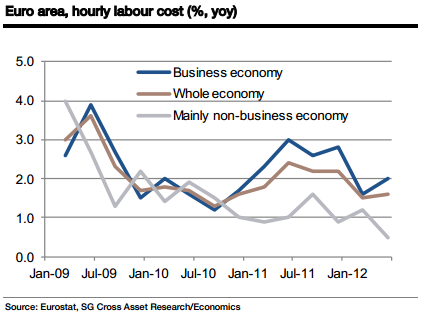
The logical follow-on from the above being that “non-business” sectors are a big contributor to the rapidly falling unit labour costs in the periphery, especially given their large state sectors:
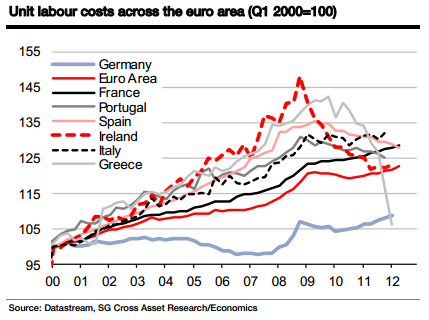
SocGen’s Michel Martinez writes that there are outright wage declines in Greece while in the other peripherals, labour productivity (as measured by ULC) is outpacing wage gains.
TC again: No one should doubt that depreciation and expansionary monetary policy are a much easier path to lower real wages. Yet the claim that wages are outright sticky for long periods of time, when economic pressures dictate wage declines, isn’t holding up that well.
And I would add this: They are not as wealthy as they thought they were.
Why 8 1/2 x 11?
Most books aren’t printed on 8 1/2 x 11 paper so why are these the standard paper dimensions? Paul Stanley offers an answer:
…we have ended up with paper sizes that were never designed or adapted for printing with 10-12 point proportionally spaced type. They were designed for handwriting (which is usually much bigger) or for typewriters. Typewriters produced 10 or 12 characters per inch: so on (say) 8.5 inch wide paper, with 1 inch margins, you had 6.5 inches of type, giving … around 65 to 78 characters: in other words something pretty close to ideal. But if you type in a standard proportionally spaced font (worse, in Times — which is rather condensed because it was designed to be used in narrow columns) at 12 point, you will get about 90 to 100 characters in the line.
The standard paper dimensions are thus not optimized for reading using printed fonts so typographers try to make adjustments. One adjustment is to abandon the standard paper size which is what books do. Another is to make the margins very wide which is the Latex default.
[Another] answer — which is what most wordprocessors did — was to stick to the standard “document design” (margins of an inch or so) and just use proportionally spaced fonts as if they were typewriter text. This produces very long lines, which are not comfortable to read. But that discomfort can be somewhat alleviated by increasing the space between lines (1.5 or double space), which helps prevent “doubling”, and by avoiding type sizes below about 11 or 12 points (depending very much on the design of the font).
Another possibility is to use the margins for marginalia, which I like. (Stanley points to the Latex tufte class as a way to do this.) One could also a two-column format or just make the text bigger.
Stanley concludes:
These are all potentially valid design choices. I happen to think that the most conventional one (stick with 1 inch margins, and add line spacing to prevent doubling) is probably the worst of them, and that it only seems “right” because we are accustomed to it. And it doesn’t generally save paper, because unless you use single spacing you lose vertically the extra space that you gain horizontally.
We need to fix this problem. Now is the time for a margin revolution.
Hat tip: John Cook at The Endeavour.
Small business under Proposition 37 (GMO labeling in California)
I advise anyone who favors Proposition 37 to read the text of the law. It is full of bad ideas and questionable distinctions, many of which are not apparent from the more superficial descriptions of the proposal. Here is one of them:
Retailers (such as grocery stores) would be primarily responsible for complying with the measure by ensuring that their food products are correctly labeled. Products that are labeled as GE would be in compliance. For each product that is not labeled as GE, a retailer generally must be able to document why that product is exempt from labeling. There are two main ways in which a retailer could document that a product is exempt: (1) by obtaining a sworn statement from the provider of the product (such as a wholesaler) indicating that the product has not been intentionally or knowingly genetically engineered or (2) by receiving independent certification that the product does not contain GE ingredients. Other entities throughout the food supply chain (such as farmers and food manufacturers) may also be responsible for maintaining these records.
I call this the “how to kill off small farmers and retailers” provision. And what would it do to local farmers’ markets to have the burden of proof so shifted? Who is best situated to handle possible lawsuits or shakedown lawsuits? The larger corporations.
It is interesting to see what receives an exception from the labeling provisions: alcohol, restaurant food, and animal meats raised from genetically engineered crops. (Lobby much?) For varying reasons, those are some of the outputs most likely to be harmful to you or to the environment.
Prop. 37 also exempts milk, cheese, and meat and it exempts “small” amounts of transgenic material in foodstuffs. According to critics of the bill it exempts 2/3 or so of the food products which Californians consume.
I do not think it is very well thought through.
Fox and Mitchum on the Flynn Effect and how it works
James R. Flynn recommends this paper, by Fox and Mitchum, in his new book:
Secular gains in intelligence test scores have perplexed researchers since they were documented by Flynn (1984, 1987). Gains are most pronounced on abstract, so-called culture-free tests, prompting Flynn (2007) to attribute them to problem solving skills availed by scientifically advanced cultures. We propose that recent-born individuals have adopted an approach to analogy that enables them to infer higher-level relations requiring roles that are not intrinsic to the objects that constitute initial representations of items. This proposal is translated into item-specific predictions about differences between cohorts in pass rates and item-response patterns on the Raven’s Matrices, a seemingly culture-free test that registers the largest Flynn effect. Consistent with predictions, archival data reveal that individuals born around 1940 are less able to map objects at higher levels of relational abstraction than individuals born around 1990. Polytomous Rasch models verify predicted violations of measurement invariance as raw scores are found to underestimate the number of analogical rules inferred by members of the earlier cohort relative to members of the later cohort who achieve the same overall score. The work provides a plausible cognitive account of the Flynn effect, furthers understanding of the cognition of matrix reasoning, and underscores the need to consider how test-takers select item responses.
The paper is here (pdf).
Markets in everything
Remember “Murderer’s Park”? Wasn’t that Walter Block’s idea? Here is the summary of a new service:
It is Las Vegas’s latest thrill: absolute beginners flying aerobatic planes in aerial dogfights
The dogfighting sequences cost $999 and up, and the full story is here (FT$). Other links and ads for the service are here. I would have expected this first in New Zealand.
Assorted links
1. Thomas Nagel reviews Plantinga, and a criticism of that review.
2. How much will the IRS enforce the mandate?
3. Miles Kimball reviews Cowen and Tabarrok Modern Principles.
4. New survey paper on what economists know about the “brain drain” (“brain gain”).
5. Malcolm Gladwell on how child molesters get away with it.
Should there be required labeling of GMOs?
Here is one on-the-mark take (of many):
…there have been more than 300 independent medical studies on the health and safety of genetically modified foods. The World Health Organization, the National Academy of Sciences, the American Medical Association and many others have reached the same determination that foods made using GM ingredients are safe, and in fact are substantially equivalent to conventional alternatives. As a result, the FDA does not require labels on foods with genetically modified ingredients because it acknowledges they may mislead consumers into thinking there could be adverse health effects, which has no basis in scientific evidence.
Or try the National Academy of Sciences from 2010:
Many U.S. farmers who grow genetically engineered (GE) crops are realizing substantial economic and environmental benefits — such as lower production costs, fewer pest problems, reduced use of pesticides, and better yields — compared with conventional crops, says a new report from the National Research Council.
Here is a good NYT summary Op-Ed on that report. There is not the scientific evidence for Mark Bittman’s recent evaluation that:
G.M.O.’s, to date, have neither become a panacea — far from it — nor created Frankenfoods, though by most estimates the evidence is far more damning than it is supportive.
It’s the tag there that is problematic. He doesn’t offer a citation, nor has he in past columns offered convincing material to back this evaluation (you can read here for a somewhat more detailed account from Bittman; it simply minimizes benefits and does not support “by most estimates the evidence is far more damning than it is supportive”). This earlier critique of Bittman is on the mark on virtually every point.
The standards of evidence being applied here are extremely weak. In that last Bittman link he wrote that:
…The surge in suicides among Indian farmers has been attributed by some, at least in part, to G.E. crops…
The link is to a sensationalistic Daily Mail (tabloid) story, yet that gets translated into “has been attributed by some.” In that story, the suicides were caused by indebtedness and supposedly the debts were in part caused by a desire by farmers to buy GMO crops. In comparable terms one could write that anything one spends money on could cause suicide through the medium of indebtedness.
By the way, the Wikipedia treatment gives some more detailed citations suggesting that GMO crops are not a significant cause of farmer suicides in India. The most careful study of the matter reports this:
We first show that there is no evidence in available data of a “resurgence” of farmer suicides in India in the last five years. Second, we find that Bt cotton technology has been very effective overall in India. However, the context in which Bt cotton was introduced has generated disappointing results in some particular districts and seasons. Third, our analysis clearly shows that Bt cotton is neither a necessary nor a sufficient condition for the occurrence of farmer suicides. In contrast, many other factors have likely played a prominent role.
I would in fact be more supportive of the GMO labeling idea if renowned food writers such as Bittman, and many others including left-wing economists, would come out and boldly proclaim the science about GMOs to their readers. Too often the tendency is to use a “I’ll try not to say anything literally incorrect, while insinuating there are big problems” method of scoring points against big agriculture. (Another common trope is to switch the discussion to “distribution” and to suggest, either explicitly or implicitly, that a net benefit technology such as GMOs is somehow unnecessary or undesirable; dare I utter the words “mood affiliation“?) GMO labeling is the one issue which has gained legal traction, so critics of “Big Ag” just can’t bring themselves to give it up.
Bittman’s whole column is about GMOs, but he gets at the important point only in his final sentence:
[With better information] We’d be able to make saner choices, and those choices would greatly affect Big Food’s ability to freely use genetically manipulated materials, an almost unlimited assortment of drugs and inhumane and environmentally destructive animal-production methods.
Overuse of antibiotics and animal treatment (both cruelty and environmental issues) — now those are two very real problems, backed by overwhelming scientific evidence. The fact that the California referendum is instead about GMOs — which have overwhelming scientific evidence for net benefit and minimal risks — is the real scandal.
It’s time that our most renowned food writers woke up to that difference. In the meantime, they are doing both us and themselves a deep disservice.
Assorted links
From a loyal MR reader
I read through the Heckman debate. He does what he always does. One response is terrible (quality of early intervention doesn’t matter, just do a lot of it) but most of them make decent points. Carol Dweck hints at the problem of writing people off.
No one considers neurodiversity. No one considers that many successful people take big risks, follow their impulses, fail to comply, have bad habits, and otherwise misbehave. Heckman himself may be an example.