Trump proposes 100% tariff on movies shot outside the United States
Here is one link. Of course the proposal is not easy to understand. If it is a Jason Bourne movie, do they add up the number of scenes shot abroad and consider those as a percentage of the entire movie? Does one scene shot abroad invoke the entire tariff? o3 guesstimates that about half of major Hollywood releases are shot abroad to a significant degree, with many more having particular scenes shot abroad.
Imagine the new Amazon release: “James Bond in Seattle.” And it actually would be Seattle — do they have baccarat there?
Furthermore, virtually all foreign films are shot abroad rather than in the U.S. The incidence in this case is interesting. Assuming the movie would have been made anyway, most of the tax burden falls on the producer, not the American consumer, because the marginal cost of sending the extra units of the film to America is low. Nonetheless lower American revenue will force those films onto lower budgets. Possibly Canadian and also English movies will suffer the most, because they are most likely to have the U.S. as their dominant market.
Of course the U.S: is by far the world’s number one exporter of movies, so we are vulnerable to retaliation on this issue, to say the least.
Facts about robots
The robot is also just a fraction of the expense of integrating automation into a factory. A robot that stacks goods on to pallets can cost up to $150,000 to install when sensors, safety fencing, conveyors and other infrastructure are taken into account, according to Jorg Hendrikx, chief executives of robotics marketplace Qviro. Such costs put robotics out of the reach of many US manufacturers.
Just 20 per cent of factories with between 50 and 150 employees have a robot, half the rate of those with more than 1,000 staff, according to the US Census Bureau.
Sunday assorted links
1. Some underrated effects on AI on privacy-related issues.
2. How far are you from India, measured in units of India?
3. Roots of Progress blog-building fellowship.
4. Naipaul memories.
5. “Despite rising income inequality, intergenerational mobility remained largely stable in both countries.” [Sweden and the US]
6. Todd Kashdan makes the case for the “48 percent aligned.”
Not De Minimis
Commerce Secretary Howard Lutnick:
Ending the “de minimis loophole” is a big deal. This rule allowed foreign companies to avoid paying tariffs on small shipments, giving them an unfair advantage over American small businesses. To small businesses across the country: we have your back.
The Value of De Minimis Imports by Fajgelbaum and Khandelwal:
A U.S. consumer can import $800 worth of goods per day free of tariffs and administrative fees. Fueled by rising direct-to-consumer trade, these “de minimis” shipments have exploded in recent years, yet are not recorded in Census trade data. Who benefits from this type of trade, and what are the policy implications? We analyze international shipment data, including de minimis shipments, from three global carriers and U.S. Customs and Border Protection. Lower-income zip codes are more likely to import de minimis shipments, particularly from China, which suggests that the tariff and administrative fee incidence in direct-to-consumer trade disproportionately benefits the poor. Theoretically, imposing tariffs above a threshold leads to terms-of-trade gains through bunching, even in a setting with complete pass-through of linear tariffs. Empirically, bunching pins down the demand elasticity for direct shipments. Eliminating §321 would reduce aggregate welfare by $10.9-$13.0 billion and disproportionately hurt lower-income and minority consumers.
In other words, eliminating the de minimis rule is a significant tax on poorer Americans.
Frankly, it’s also a pain in the ass to have your international shipments delayed at broker (who often charges you exorbitant rates, more than the customs tax) and then have to go down to the customs office to pay the stupid tax. Yes, I am speaking from experience.
Driverless trucks on their way?
Aurora Innovation, Inc. (NASDAQ: AUR) has successfully launched its commercial self-driving trucking service in Texas. Following the closure of its safety case, Aurora began regular driverless customer deliveries between Dallas and Houston this week. To date, the Aurora Driver has completed over 1,200 miles without a driver. The milestone makes Aurora the first company to operate a commercial self-driving service with heavy-duty trucks on public roads. Aurora plans to expand its driverless service to El Paso, Texas and Phoenix, Arizona by the end of 2025.
Here is the story, via Joe Brenton.
Has international travel to the U.S. really collapsed?
But despite some ominous signs, a close look at the data shows that travel to the United States is largely holding up — at least so far.
Nearly as many foreign travelers have arrived at American airports this year than during the same period last year, according to an analysis by The New York Times of entry data collected from every international airport in the country.
International arrivals did drop more than 10 percent in March compared with last year, but this was largely because Easter fell unusually late this year, pushing back a popular travel window for European tourists. More recent figures from April show that travel over the holiday looked similar to previous years.
Here is more from the NYT. The main major difference is for Canadians, who are indeed more skittish, and their ticket sales are down 21 percent.
Buffett’s Alpha
Berkshire Hathaway has realized a Sharpe ratio of 0.76, higher than any other stock or mutual fund with a history of more than 30 years, and Berkshire has a significant alpha to traditional risk factors. However, we find that the alpha becomes insignificant when controlling for exposures to Betting-Against-Beta and Quality-Minus-Junk factors. Further, we estimate that Buffett’s leverage is about 1.6-to-1 on average. Buffett’s returns appear to be neither luck nor magic, but, rather, reward for the use of leverage combined with a focus on cheap, safe, quality stocks. Decomposing Berkshires’ portfolio into ownership in publicly traded stocks versus wholly-owned private companies, we find that the former performs the best, suggesting that Buffett’s returns are more due to stock selection than to his effect on management. These results have broad implications for market efficiency and the implementability of academic factors.
Here is the paper by Andrea Frazzini, David Kabiller, and Lasse Heje Pedersen. Quite the run, now over. Via J.
Saturday assorted links
1. New terms for AI-assisted communication.
2. The great Alexandra Kleeman on Cronenberg and Shrouds (NYT).
3. Temperature and productivity in soccer.
4. Interview with David Autor, I would say do not be surprised when bad protectionism is what you get. Many trade-skeptical economists are not updating their priors as they should, often because they think of trade as a technocratic rather than a public choice problem.
5. Stella Tsantekidou on the fiscal costs of UK immigrants.
6. “At least for the time being, explicit normative instructions are not fully able to realign AI advice with the normative convictions of the legislator.” Though I do not interpret this exactly as they do.
7. Why different system of organized crime demand different solutions.
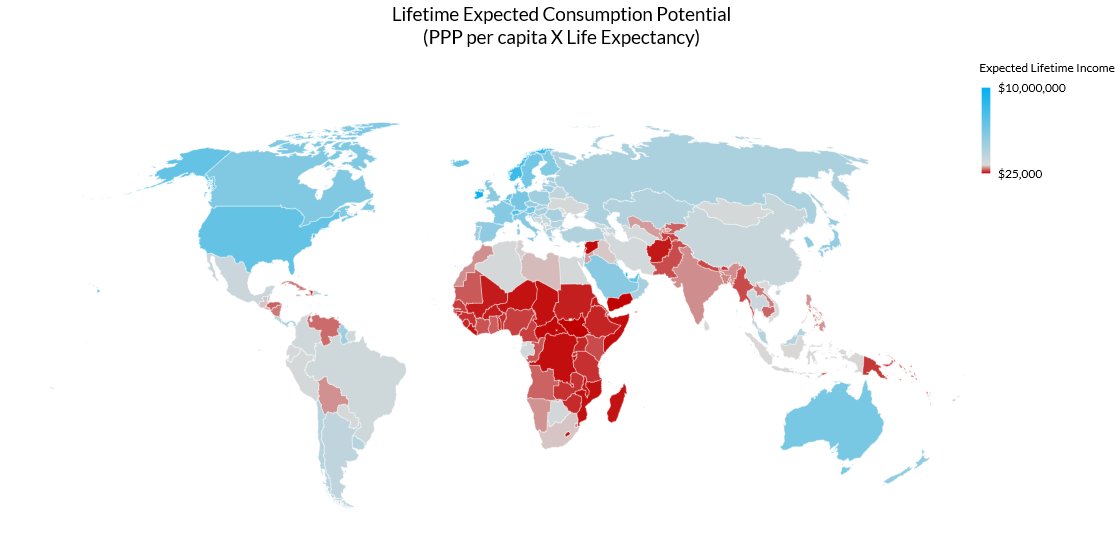
Lifetime Expected Consumption
What does it mean to be wealthy and how should we factor in say, life expectancy? Lyman Stone offers an interesting measure, lifetime consumption, taking in account (roughly) both years lived and how much one consumes in those years.
That was then, this is now
In late 2022, Daisy Rodriguez, a U.S. citizen and owner of a small restaurant in the town of Sweetwater, Tennessee, said goodbye to her husband for what she thought would be a short stay in Guatemala. He had recently received approval to attend an immigration interview that would grant him a green card to live in the United States. Little did Rodriguez know her husband would not be returning to the U.S. Upon arriving at the consulate in Guatemala, her husband, Santos Maudilio Saucedo Rivas, was accused by U.S. consular officials of membership in a gang based on a tattooed set of initials on his body.
The officials denied Rivas a green card, separating him from his American wife and the restaurant they ran together, while cutting him off from the U.S., the country where he had spent nearly his entire adult life.
Rivas’s case is now the subject of a lawsuit filed today by the American Immigration Council and Consular Accountability Project, which is suing the U.S. State Department in the Eastern District of Tennessee. The lawsuit alleges that U.S. officials failed to review evidence showing that Rivas was never part of the “Barrio Azteca” gang and that the government violated the U.S. Constitution by denying him a green card after having him travel to Guatemala for the interview.
Here is the full story. Precedent matters. I had never heard of this 2022 case until I came across it randomly. One lesson is simply that U.S. treatment of migrants has been unfair for a long time.
Democracy in danger
Germany’s domestic intelligence agency on Friday designated the far-right Alternative for Germany party, or AfD, as an “extremist endeavor,” a move that lowers hurdles for the spy agency in conducting certain kinds of surveillance on the party, the second-largest in Germany’s parliament.
The reclassification — AfD was previously designated a “suspected” extremist group — is likely to reignite debate over potentially banning the party via Germany’s Constitutional Court. Such a move would initiate a lengthy legal process lasting years that experts and even the AfD’s fiercest critics say may carry greater risks than rewards.
The decision could put public funding of the AfD at risk, while civil servants who belong to an organisation classified as ‘extremist’ face possible dismissal, depending on their role within the entity, according to Germany’s interior ministry.
Here is the first story. Although I do not like the AfD, there is an alternative solution here. Other German parties, including the ruling coalition, could move closer to median voter sentiment on migration issues. (Whether or not one agrees with the median voter stance, it is, believe it or not, an alternative democratic strategy.) Heaven forbid!
And didn’t France just stop Le Pen from running in the next election? I am very much opposed to the efforts of the Trump administration to intimidate the U.S. judiciary, but I find it weird when Europeans tell Americans concerned with democracy to move to Europe.
China estimate of the day
Jensen: “First thing to understand: 50% of the world’s AI researchers are Chinese.”
Here is the link.
Friday assorted links
We are solving for the equilibrium
White House officials have in recent weeks brainstormed strategies for enshrining into law the government cuts implemented by billionaire Elon Musk’s team, aiming to turn the U.S. DOGE Service’s moves into lasting policy shifts.
So far, however, administration officials are running into resistance not just from Democrats, but also from congressional Republicans, who have in private conversations made clear that it would be difficult to codify even a small fraction of the measures that Musk’s team unilaterally implemented, according to lawmakers and several other people familiar with the discussions.
Here is more from The Washington Post.
AI and time allocation
We present evidence on how generative AI changes the work patterns of knowledge workers using data from a 6-month-long, cross-industry, randomized field experiment. Half of the 6,000 workers in the study received access to a generative AI tool integrated into the applications they already used for emails, document creation, and meetings. We find that access to the AI tool during the first year of its release primarily impacted behaviors that could be changed independently and not behaviors that required coordination to change: workers who used the tool spent 3 fewer hours, or 25% less time on email each week (intent to treat estimate is 1.4 hours) and seemed to complete documents moderately faster, but did not significantly change time spent in meetings.
That is from a new paper by Eleanor Wiske Dillon, Sonia Jaffe, Nicole Immorlica, and Christopher Stanton, via the excellent Kevin Lewis. In the early stages of strong AI, a lot of the gains will come in the form of time savings. For instance, I can complete many research tasks more quickly, but it does not improve the quality of the final product, which is still bounded by my talent, not the capabilities of the AI. This will make it hard to see or estimate the gains from AI. Let’s say it saves each of us forty minutes a day — is that a big or a small gain? What exactly will be do with that time? Just work more? Is it value well-measured by prevailing wage rates?