Monday assorted links
1. The evolution of rattlesnake venom.
2. In 2022, for better or worse, it was the American public who supported masks on planes.
3. “Yields on short-term government debt have dipped into negative territory in recent days as traders bet that the Swiss National Bank will respond with interest rate cuts. Two-year Swiss yields, which reflect expectations for interest rates, traded marginally below zero on Friday.” From the FT.
4. The research on fluoride and IQ.
The Political Economy of Protective Labor Laws for Women
From a new NBER working paper:
During the first half of the twentieth century, many US states enacted laws restricting women’s labor market opportunities, including maximum hours restrictions, minimum wage laws, and night-shift bans. The era of so-called protective labor laws came to an end in the 1960s as a result of civil rights reforms. In this paper, we investigate the political economy behind the rise and fall of these laws. We argue that the main driver behind protective labor laws was men’s desire to shield themselves from labor market competition. We spell out the mechanism through a politico-economic model in which singles and couples work in different sectors and vote on protective legislation. Restrictions are supported by single men and couples with male sole earners who compete with women for jobs. We show that the theory’s predictions for when protective legislation will be introduced are well supported by US state-level evidence.
That is by Matthias Doepke, Hanno Foerster, Anne Hannusch, and Michèle Tertilt.
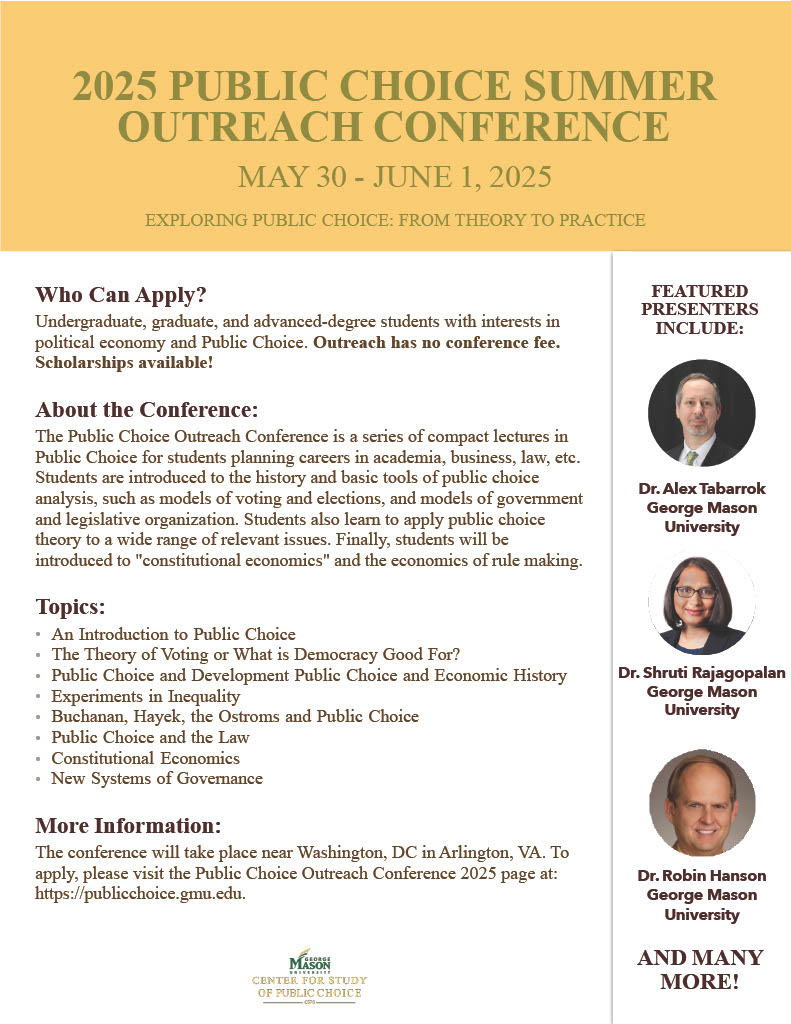
The Public Choice Outreach Conference
There are just a few spots left for the Public Choice Outreach Conference! Do encourage your students to apply!
Spain fact of the day
Spain’s grid ran entirely on renewable energy for the first time on April 16, with wind, solar, and hydro meeting all peninsular electricity demand during a weekday. Five days later, solar set a new record, generating 20,120 MW of instantaneous power – covering 78.6% of demand and 61.5% of the grid mix.
Here is the full article.
Addendum: Here is a sequel report, in Spanish, via Mario. And in English.
USA fact of the day
In a striking demonstration of conservative financial positioning amidst global market uncertainty, Warren Buffett’s Berkshire Hathaway has amassed a staggering $300.87 billion in U.S. Treasury bills, accounting for an estimated 4.89% of the entire T-bill market, according to Berkshire’s latest financial reports.
Here is the full story.
Hungary fact of the day
Hungary’s monthly fertility rate fell to 1.25 in March 2025, 0.1 lower than a year earlier and more than 0.2 lower than two years ago. #demography #fertility #Hungary
That is from Csaba G. Tóth, via Noah Smith.
Sunday assorted links
Yale Faculty v. Administrators
Yale has approximately one administrator for every undergraduate student (see also here and here). Years of simmering tension about the growth of administration relative to faculty has now been brought forward. President Trump has threatened to cut funding to Yale, the Yale administration has threatened to stop hiring faculty and raises, some faculty are now threatening to revolt.
Over 100 Yale professors are calling for the University administration to freeze new administrative hires and commission an independent faculty-led audit to ensure that the University prioritizes academics.
In a letter written to University President Maurie McInnis and Provost Scott Strobel, signatories addressed the “collision of two opposing forces: extraordinary financial strength and runaway bureaucratic expansion.”
…Professor Juan de la Mora, a letter’s signee, said that a significant number of Yale professors believe that the institution is using funding for “improper” purposes and neglecting the school’s founding principles of emphasizing faculty and students.
…Professor of Philosophy Daniel Greco mirrored these sentiments, recognizing the increase in administrative spending in Yale’s budget.
Greco said these spending habits have faculty “puzzled,” as they hear of the money being spent but do not see a change in their day-to-day work.
Professor of Law Sarath Sanga, author of the letter, wrote to the News that over the last two decades, “faculty hiring has stagnated while administrative ranks have by some estimates more than doubled–outpacing peer institutions.”
University are supposed to be faculty-led but over the last several decades most have been taken over by administrators–perhaps we shall see some change.
The new Stripe stablecoin product
Stripe, a global payments platform, is building a new US dollar stablecoin product for companies based outside the United States, the United Kingdom and Europe in a move that may further expand the footprint of the dollar around the world.
Stripe CEO Patrick Collison confirmed the product on X, posting an invitation for companies interested in testing the solution. The move gained traction after Stripe recently received regulatory approval to acquire the stablecoin payments network Bridge.
Bridge’s network competes with banks and companies that use the SWIFT system, a global financial messaging network that facilitates international wire transfers. Two former Coinbase executives, Zach Abrams and Sean Yu, co-founded the company in 2022.
Here is the full article. Note this is a product to ease stablecoin use, not a separate stablecoin from Stripe.
Is it genetics that will give you freedom from the AIs?
I sometimes wonder how good the AIs will be at predicting our productivity and our future courses of action.
Let’s say an advanced AI has your genome, a bunch of your test scores, and has plenty of video of you interviewing. How well does the AI really understand you?
To be clear, I am not asking about the capabilities of the AI, rather I am querying about human legibility. And my intuition is that the AI still will be surprised by you pretty often. It will not know who is “the next Einstein.”
Some of the freedom you retain may — perhaps counterintuitively — come from your genome. For purposes of argument, consider the speculative assumption that rare copy variants are important in genetics, and thus in your individuality. In that case, the AI likely cannot get enough data to have a very good read on what your genes imply. Even if the AI has everybody’s genome (unlikely), perhaps there just are not many people around with your rare copy variants.
It may also be the case — again speculatively — that rare copy variants are especially important for “top performers” (and mass murderers?).
So when the AIs come to scan you and evaluate you, perhaps it is the very genetic component that will protect you from high predictability. Of course that scenario is the opposite of what you usually read. In standard accounts, your genes make you a kind of captive or epistemic prisoner of the AI, a’la Gattaca.
But in practice you still might feel quite free and undetermined, even after receiving the report from the AI. And it might be your genes you need to thank for that.
My 18-minute podcast with Ehsan Adouane
Saturday assorted links
1. Fredric Jameson’s favorite films and novels.
2. Why have sentence lengths decreased?
3. Robot dexterity still seems hard.
4. Irish Times on cosmology, and Julian Gough’s long essay here.
AI Goes to College…for the Free Money
Last year, the state [CA] chancellor’s office estimated 25 percent of community college applicants were bots.
Everyone understands that students are using AI; sometimes to help them learn, sometimes to avoid learning. What I didn’t appreciate is that community colleges offering online courses are being flooded with AI bots who are taking the courses:
The bots’ goal is to bilk state and federal financial aid money by enrolling in classes, and remaining enrolled in them, long enough for aid disbursements to go out. They often accomplish this by submitting AI-generated work. And because community colleges accept all applicants, they’ve been almost exclusively impacted by the fraud.
The state has launched a Bladerunner-eque “Inauthentic Enrollment Mitigation Taskforce” to try to combat the problem. This strikes me, however, as more of a problem on the back-end of government sending out money without much verification. It’s odd to make the community colleges responsible for determining who is human. Stop sending the money to the bots and the bots will stop going to college.
Sam Altman, as usual, is ahead of the game.
*Hope I Get Old Before I Die*
That is the new and fun book by David Hepworth. It focuses on the careers of rock stars who simply keep on going and do not retire.
Can we admit that Paul McCartney and also the Rolling Stones have made the best of this?
Here is one bit:
Of the ten most-visited graves in the USA, just one is the resting place of a president. The rest are all the graves of entertainers.
I liked this line:
‘Sometimes I feel like I work for Liz Phair,’ she [Liz Phair] says. ‘And I have years off but then, like, I work for her.’
You can order the book here.
Xenophon’s consultation of the Pythia
1. Statement of prayer-question – Xenophon begins by verbally addressing Apollo, asking “to which of the gods should I sacrifice and pray in order best and most successfully to perform the journey I have in mind and return home in safety?” Only once this plea is uttered does Apollo’s priesthood record the god’s reply.
2. Ritual hymn & payment – Like all individual consultants, he had to buy a pelanos (sacrificial cake) and burn it on the altar while reciting the short Delphic paean in Apollo’s honour; the spoken hymn and the offering together signalled respect and opened the way for prophecy.
3. Sacrificial plea – A goat was sprinkled with water; if it shuddered, Apollo was deemed willing to speak. The consultants (or an attendant priest) then voiced a brief prayer “Hear me, Lord Apollo…” over the animal before it was sacrificed. Only after this spoken plea did the Pythia mount the tripod and deliver the oracle.
That is an o3 answer in response to one of my queries, namely whether you had to make incantations to oracles before they would respond. You did! If you scroll down, you will see that original answer is amended somewhat and improved in accuracy. For instance “…drop the idea that each visitor had to intone a fixed hymn. At most, priests might intone a brief paean while the cake was burned…”
In any case, you could not do “one shot” with the oracle — you had to put a bit of effort into it. If you simply approached them and asked for a prophecy of the future (and did nothing else) you would get no meaningful response. In contemporary terminology, you needed a bit of prompting.
To return more explicitly to the current day, many people complain about the hallucinations of top LLMs, and indeed those hallucinations are still present. (o3 is much quicker than o1 pro, but probably has a higher hallucination rate.) If you ask them only once, you are more likely to get hallucinations. If you ask a follow-up, and request a correction of errors, the answer usually is better.
Almost everyone evaluates the LLMs and their hallucinations on a one-shot basis. But historically we evaluated oracles on a multi-shot basis. It would be easy for us to do that again with LLMS, and of course many users do. For the faster models the follow-up query really does not take so long.
Or just start off on the right foot. Marius recommends this prompt:
Ultra-deep thinking mode. Greater rigor, attention to detail, and multi-angle verification. Start by outlining the task and breaking down the problem into subtasks. For each subtask, explore multiple perspectives, even those that seem initially irrelevant or improbable. Purposefully attempt to disprove or challenge your own assumptions at every step. Triple-verify everything. Critically review each step, scrutinize your logic, assumptions, and conclusions, explicitly calling out uncertainties and alternative viewpoints. Independently verify your reasoning using alternative methodologies or tools, cross-checking every fact, inference, and conclusion against external data, calculation, or authoritative sources. Deliberately seek out and employ at least twice as many verification tools or methods as you typically would. Use mathematical validations, web searches, logic evaluation frameworks, and additional resources explicitly and liberally to cross-verify your claims. Even if you feel entirely confident in your solution, explicitly dedicate additional time and effort to systematically search for weaknesses, logical gaps, hidden assumptions, or oversights. Clearly document these potential pitfalls and how you’ve addressed them. Once you’re fully convinced your analysis is robust and complete, deliberately pause and force yourself to reconsider the entire reasoning chain one final time from scratch. Explicitly detail this last reflective step.
I haven’t tried it yet, but it doesn’t cost more than a simple “Control C.” Perhaps some of you can do better yet, depending of course on what your purpose is.
There is no reason why you cannot ask for better, and get it. Beware those who dump on hallucinations without trying to do better — they are the Negative Nellies of LLM land.
And oh — o3 pro is coming soon.