Assorted links
Does Larry Bird hate Adam Smith?
From Christopher Veldman:
I saw this interview with Larry Bird on ESPN yesterday and thought you might find it interesting.
“‘The one thing that bothers me the most is guys taking big pay cuts for a year to go down there and try to win a championship,’ Bird told ESPN. ‘There’s a lot of guys who like to ride the coattails of the best and they’ll take a pay cut just to have an opportunity to win that ring.'”
Joseph Cropsey has passed away at age 92
There is one account here, very sad news of course.
For the notice I thank John Farr.
The Iceland dust-up
There has been enough coverage that I won’t summarize the entire debate, suffice to say that Krugman offered a picture like this:

Some writers from the CFR (I am not completely sure how to attribute authorship), offered this picture, along with some analysis and links (and further pictures). The key point is that the second picture considers a longer time horizon, and all of a sudden the relative performance of the different countries has changed:
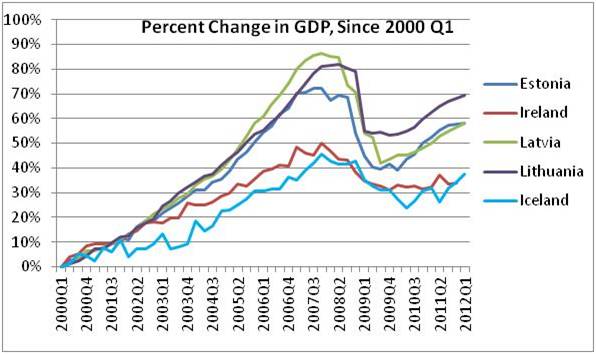
They argue that in this light, looking over the longer time horizon, the Icelandic story appears mediocre rather than impressive relative to some of the other small countries. A few points:
1. Arvind Subramanian argues we should look at per capita growth and also PPP vs. market exchange rates, read here.
2. Arvind’s point aside, that the pictures give different impressions is more important than either picture taken alone.
3. The second picture brings value-added to the debate, and it suggests stories which the first picture taken alone does not. I’ll come back to that.
4. The debates have mixed together a few different questions, such as “how well have the countries done?,” “how well have the countries’ policies done?,” and “should we be looking at both pictures?” Since the answer to the first two is obviously agnostic — too soon to tell — I will focus on the last of these questions and the answer is yes, we definitely should be looking at both pictures.
Krugman’s response, once you get past the inappropriate insults, doesn’t serve up much. He has arguments against the view “Don’t look at the first picture” but no good arguments against “Look at both pictures very carefully and integrate.”
Ryan Avent offers a more polite response here. He focuses on convergence (maybe we should have expected the Baltics to have outperformed Iceland, so a tie means Krugman wins), but this estimate suggests the fixed exchange rate did not really cost the Baltics much in the way of convergence points. In any case I fear the goalposts are being shifted and what we know about convergence and its speed is iffy anyway; for instance anyone worried about bad monetary policy, and opposing 1980s style RBC theories, should be a convergence pessimist for the short run.
Most importantly, there is still no argument against looking at both pictures in a serious way.
So what additional thoughts come to mind looking at the second picture, which you might not get so much from the first picture alone? Here are two:
a. Some countries simply may be more volatile than others, and this may or may not have to do with their policy responses. I’ll note Cowen’s Second Law, namely that there is a literature on this and the people who work in that literature consider this to be a plausible proposition (which does not mean it is here the operative explanation, however).
b. The size of an initial run-up, possibly bubbly at that, is correlated with the size of the later collapse and also the difficulty of recovering from that later large collapse.
There is a literature on that too, start here, it is not an absurd proposition by any means.
By the way, did I mention a 2009 IMF Staff Report which concluded that Latvian “output exceeded potential by 9 percent in 2007.”? That supports the relevance of b) and possibly a) as well, and it discriminates against Krugman’s story of the peak being a point reattainable through policy management.
I take Krugman to be suggesting something like c): all the relevant information for understanding performance is contained in post-bust policy, so we needn’t look at earlier years and in fact doing so may mislead us.
Yet this attempts to pre-settle the dispute by putting all of the explanatory burden on post-crash policy. In general commentators often overattribute results to policies and in any case we should not build in this bias a priori.
Are you a fan of Dani Rodrik’s “every country is different” hypothesis? If so, you probably should think that both graphs are important. Country characteristics don’t morph away overnight, so earlier data points should matter for understanding current policy results.
If we look carefully at both pictures, I say we still don’t know what is going on, but we do have a richer sense of the possibilities.
From now on these two pictures should be shown and considered together.
*Your Sister’s Sister*
I found this film to be a minor masterpiece. It incorporates Girard, Shakespeare, how uncertainty eases deals, and some interesting and possibly true claims about two vs. three-person bargaining games. It is a deep and politically incorrect question to ask why the movie does not start with the Coase theorem already working. I cannot reveal its Straussian propositions about “loser men” without spoiling the plot surprises.

Note: the characters in the film do not seem to consume much information.
David Gordon emails me on the workplace
Tyler,
I enjoyed reading your excellent post on the Crooked Timber workplace coercion piece. Many of their complaints also hold for the university classroom, e.g., limits to free speech, students have no say in what work is required, etc.; and often there are costs to refusing to enroll in classes the student finds onerous, such as failing to obtain the desired degree. But I doubt Bertram and his friends would regard this situation as coercive.
Best wishes,
David
Nor is it always easy to switch schools…
Who in power would really be any different?
A new report shows that Hollande faces a tougher budget situation than had been expected (by whom? Not me.). Here is one bit:
“There will be tax increases; there will be spending cuts,” said the finance minister, Pierre Moscovici, last week. “But I reject any talk of austerity. We must avoid a budget policy that hurts economic activity.”
But it is not clear how the government plans to go about that, since both spending cuts and higher taxes tend to depress already lackluster economic activity even further. Nicholas Spiro, who runs a sovereign risk consulting agency in London, said that the report by the auditors “throws the scale of the fiscal challenge facing Mr. Hollande into sharp relief.”
And this:
But thus far the Hollande government has not been specific about any spending cuts, only tax increases. It will not raise the value-added tax on consumption, but says it will repeal an increase in the tax instituted by Mr. Sarkozy. Nor has the government outlined any structural reforms to reduce unemployment, which remains at a record high in the euro zone.
At least they are trying to get people away from using the misleading word “austerity.” But it is funny how they too are finding it necessary to engage in some form of fiscal consolidation.
Salzburg fact of the day
Data released by Eurostat reveals just how divergent and paints a fairly consistent, and depressing, picture. So we have Salzburg in Austria sitting pretty with only 2.5 per cent of its populations in the jobless category while Andalucia in Spain has to grapple with a rate of 30.4 per cent. The youth unemployment divide is even starker – 65.8 per cent in Ceuta, Spain versus 4.3 per cent in Tubingen, Germany.
Here is more.
Contractionary devaluations in Eastern Europe, again
Also known as the continuing case for agnosticism, especially when it comes to small countries. There is actually a paper on this topic (Cowen’s Second Law!), let’s look at the end part:
Currency depreciation is said to stimulate aggregate demand by increasing its net export component. On the other hand, it is said to discourage aggregate supply by increasing cost of imported inputs. The ultimate impact is ambiguous on theoretical grounds. A recent review article reveals that in developing countries, devaluation or real depreciation is indeed contractionary in the short run. In the long run, however, devaluation is neutral in most countries. Emerging economies have received no attention and we try to fill this gap in this paper.
In this paper we consider the experience of nine emerging countries of Belarus, Czech Republic, Estonia, Hungary, Latvia, Lithuania, Poland, Russia, and Slovak Republic with currency depreciation. Using the bounds testing approach to cointegration and error-correction modeling that distinguishes the short-run effects from the long-run effects, the results turn out to be country specific. In the short run we find that real depreciation is expansionary in Belarus, Latvia, Poland, and Slovak Republic; contractionary in Czech Republic, Estonia, Hungary, and Russia; and has no effect in Lithuania. In almost none of the countries, the short-run effects lasted into the long run.
A few remarks on this:
1. I have read dozens or maybe hundreds of blog discussions about the wage effects of depreciation/devaluation. I can’t recall very many on the input and portfolio effects. I can’t recall any serious assessment of which effects are more import (sorry if I have forgotten your post or didn’t read it). I also don’t see many discussions of whether observed short-run effects persist in the longer run.
2. I am not trying to push the particular conclusion of this paper on you (“Ah, now I understand where Belarus falls!”), rather I wish to indicate that the matter is not so simple as to always favor floating rates. I am myself usually in the floating rate camp, but with far more agnosticism than I usually see when this topic is tossed around these days. Furthermore the growth literature does not in general indicate that simply sticking with a fixed rate offers inferior long-run performance.
3. It is fine to argue that this 2008 paper may not apply to the conditions of 2012. That would again leave us will very little sound basis to go on for assessing 2012, as we would be asserting that the previous evidence no longer is relevant. Such an attitude should not then push us into a dogmatic point of view, one way or the other.
4. In general I worry that the literature on contractionary devaluation does not have clearly defined exogenous events, or good independent measures of how bad the economic situation is in the first place.
5. The people who actually study this topic, if I dare introduce them into this discussion, very often end up believing that country-specific factors are extremely important. This makes “Econ 101” (or is that 306?) discussions of the topic misleading.
6. It is not the fault of any single individual, but overall I find it disconcerting, and not reflecting so favorably on the econ blogosphere, how disconnected this discussion has been from the actual literature.
7. As a good rule of thumb, any time you hear a dogmatic macroeconomic pronouncement in the econ blogosphere, or the assertion that someone else doesn’t know what he or she is talking about, the actual reality is usually far less certain than the view which is being pushed on you.
Either later today or tomorrow I will address some remarks to the latest dust-up over Iceland, but you can take this post as useful background.
Assorted links
Assorted links
Libertarianism and the Workplace II
Over at Crooked Timber Chris Bertram, Corey Robin and Alex Gourevitch are upset about what they call lack of freedom in the workplace. (Tyler offers his excellent comments immediately below.) They give a grab bag of peculiar examples such as workers can be fired for donating a kidney to their boss, carrying on extramarital affairs, participating in group sex at home, cross-dressing, and more. They seem especially incensed that workers can be commanded to pee or be forbidden to pee. (I will put aside that mandatory drug tests are greatly encouraged by the war on drugs.)
In other words, the CTrs have discovered that the most basic US employment law is at-will employment which means that workers can be fired for just about any reason, outside of a few protected categories such as race, sex, and age. Simply put, an employer can fire you if she doesn’t like you. This is a surprise? No one has a right to a job, a job is an agreement to exchange services for cash and compensation and both parties must agree to the exchange to make it legitimate.
The CTrs do not adequately acknowledge that workers have the same rights as employers. Workers can quit for any reason and they can refuse to work for any employer. If you don’t like the politics of Monsanto, or the NRA or Georgia-Pacific you don’t have to work or even apply for those jobs. Indeed, workers have more rights than employers since workers are not subject to anti-discrimination law; that is, employers are prohibited from discriminating against African American workers but workers are not prohibited from discriminating against African American employers.
If you think that the freedom to quit is without value bear in mind that under feudalism and into the early 19th century in the U.S. and a bit later in Britain employers and even potential employers could prevent workers from quitting and from moving. The freedom to quit was hard won. We should not disparage the liberation brought by a free market in labor.
Turning to the economics, the CTrs are so outraged by an employer’s legal possibilities that they fail to notice that most employers do not in fact fire their workers for having extra-marital affairs. Why not? The reason is that these rights are often more valuable to the employee than to the employer and thus both employee and employer can be made better off if the employee keeps the rights. If the employer values the right more than employee then the employer buys the right with a higher wage. If the employee values the right more than the employer then the employee retains the right at an otherwise lower wage. The employer gets the right only when the employer pays. The same thing is true of control rights, residual rights not explicitly noted in the contract (because of complexity and unforeseen events). The employer buys these rights from the worker when doing so maximizes the total value of the exchange. This is not to say that abuses do not occur, they do, as in all relationships and on both sides, but the CTrs lump abuses and mutually profitable exchanges together–that’s dangerous because in regulating abuses it is very easy to do away with mutually profitable exchanges.
The greater the productivity of workers and the higher their incomes the less workers will be willing to sell rights for higher wages (i.e. the more willing they will be to pay for better working conditions with lower wages). Workers gain more autonomy as they and their society become more productive. Thus, the best protector of worker autonomy is high productivity and economic growth. (The best protector not the only protector, unions can also serve a useful purpose in this regard as can shareholders and human resource departments.)
If the CTrs were merely arguing for greater economic growth there would be little with which to argue –who doesn’t want bigger televisions and better working conditions? The CTrs, however, confuse wealth and political freedom. Bigger televisions don’t make you more free and neither do better working conditions, even though both goods are desirable.
A job is an exchange with mutual consent and benefits on both sides of the bargain. The freedom is in the right to exchange not in the price at which the exchange occurs. A worker who is paid for 8 hours of work is not a serf 1/3rd of the day. We all sell our labor and we would all like to sell at a higher price but that does not make any of us serfs. From the minimum wage waiter to the highly-paid sports superstar there is dignity in work freely chosen.
To understand freedom and true coercion let us remember that American workers have the freedom to bargain and exchange with American employers, a freedom that gun, barbed wire and electrified fence deny to many millions of less fortunate workers from around the world.
“Libertarianism and the workplace”?
Numerous readers have asked me for a response to this lengthy post from Crooked Timber. Travel commitments limit me from offering anything close to a full treatment, but here are a few points:
1. Is the complaint that workers aren’t getting enough of the pie? Let’s consider giving them cash instead of workplace regulations.
2. It would be nice to see an estimate of how much the workers cared about the issues raised in this post, say in terms of willingness to pay. I would start with that number.
3. Is the complaint that workers are getting an inefficient mix of money and workplace freedoms? Maybe so, but I’ve yet to see the argument. And what if it turned out they were getting too many workplace freedoms and not enough money, say because of intra-family externalities and the intra-family tax rate on the money?
4. Is the complaint is that workers should be getting the mix of money that the authors desire to see in place, rather than what the workers themselves wish to have, taking opportunity costs into account? If so, I’m probably not on board but in any case let’s see the authors fess up to that upfront and then defend it. Let’s see how many of the workers they can convince.
5. How about a brief mention of the fact that labor-managed firms are mostly not a big success? Or that some rights can involve a notion of property? I’d like to see an empirical paper on what kinds of workplace freedoms are allowed by labor-managed firms, more or less?
6. How about a brief mention of the fact that workplace regulations, in practice, very often are used to protect insiders and restrict employment for outsiders?
I find many (most?) of the cited restrictions on labor freedom, if that is the right phrase, defensible. Consider this:
They can be fired for donating a kidney to their boss (fired by the same boss, that is), refusing to have their person and effects searched, calling the boss a “cheapskate” in a personal letter, and more.
The latter two seem obvious to me, and on the first perhaps it is better to give your kidney to a complete stranger. Become friends later on, as Virginia Postrel did with Sally Satel, to avoid putting the other person in a conflict of interest situation. (I do agree that a moral boss should have quit, but not that the firing should be legally prohibited per se.) Presenting these and other mentions as self-evidently objectionable I don’t find so compelling. I also see a big difference between “I can find a case settled like this” and “this is always the law” and on that we are left a bit at sea.
I am not comfortable with the mood affiliation of the piece. How about a simple mention of the massive magnitude of employee theft in the United States, perhaps in the context of a boss wishing to search an employee?
When I was seventeen, I had a job in the produce department of a grocery store. They made me wear a tie. They did not let me curse. Even if there was no work at the moment, I could not appear to be obviously slacking for fear of setting a bad example. They had the right to search me, including for illegal drugs. I suspect that “contract indeterminacies” gave them other rights too.
The company kept each and every one of its promises to me and they paid me on time every two weeks. The company also taught me a lot. I honor that company to this day. I also did my best to keep each and every promise to them.
What I did observe was massive employee shirking, rampant drug use including what appeared to be on the job, regular rule-breaking, and a significant level of employee theft, sometimes in cahoots with customers.
I understand full well that’s only one anecdote and only one side of the picture, and yes the company did fire vulnerable workers and quite possibly not always with just cause. Still I get uncomfortable when this other side of the story is ignored. When I hear the phrase “workplace coercion,” the first thing I think of is employee theft, estimated by the U.S. Chamber of Commerce at over $50 billion a year.
Addendum: If I ponder my workplace at GMU, I see many more employees who take advantage of the boss, perhaps by shirking, or by not teaching well, than I see instances of the bosses taking advantage of the employees. Make that two anecdotes.
More on Debtor’s Prisons
In my post Debtor’s Prison for Failure to Pay for Your Own Trial I wrote:
Debtor’s prisons are supposed to be illegal in the United States but today poor people who fail to pay even small criminal justice fees are routinely being imprisoned. The problem has gotten worse recently because strapped states have dramatically increased the number of criminal justice fees.
I then discussed how a small debt can spiral out of control:
Failure to pay criminal justice fees can result in revocation of an individual’s drivers license, arrest and imprisonment. Individuals with revoked licenses who drive (say to work to earn money to pay their fees) and are apprehended can be further fined and imprisoned.
The New York Times is now on the case and gives an example:
Three years ago, Gina Ray, who is now 31 and unemployed, was fined $179 for speeding. She failed to show up at court (she says the ticket bore the wrong date), so her license was revoked.
When she was next pulled over, she was, of course, driving without a license. By then her fees added up to more than $1,500. Unable to pay, she was handed over to a private probation company and jailed — charged an additional fee for each day behind bars.
For that driving offense, Ms. Ray has been locked up three times for a total of 40 days and owes $3,170, much of it to the probation company.
Stephen Williamson has doubts about ngdp targeting
Do read his entire post, it is full of content and difficult to excerpt. I would make a few points:
1. A reasonable range of monetary regimes may not matter so much under good times, but we are choosing the regime for the occasional very bad time when a strong response is needed.
2. Williamson’s points about the instability of seasonal ngdp are good, but arguably considering seasonal cycles renders all or most macro theories somewhat incoherent. Given the extreme agnosticism we should then end up in, what is a good policy rule?
3. I believe overnight financial markets could adjust to a variety of reasonable regimes, and indeed the evidence across nations appears to confirm this.
4. Scott for one would definitely admit the all-importance of eliminating interest on reserves.
5. I would add a Straussian reading of ngdp targeting: “The Fed won’t ever do it, because they don’t like to tie their hands. But talking about it may steel their will, and give them a policy rationale, when more expansionary action would be desirable.”
Oddly Williamson does not consider what I consider to be the strongest objection to ngdp targeting, namely that in times of extreme crisis, when loan markets are collapsing, it may force the central bank into a dangerous-and-not-really-output-restoring ratio of currency/credit to meet the ngdp target.
On the off chance that Scott writes a reply to Williamson’s critique, I will link to it in due time. Update: Here it is, I read it after writing my post. It is interesting to compare our responses.