*The Washington Post* covers *An Economist Gets Lunch*
Cowen fears the effects of gentrification, which tends to drive up real estate rates and drive out ethnic restaurants. It can also lead to blander food. But if defense funding is cut, and the impact is felt locally, that would be a good thing for ethnic restaurants, if not for the populace in general, Cowen said.
And finally, some more helpful tips for ethnic restaurant exploration: ”It’s all about the ordering,” Cowen said. The best places have smaller menus, so they aren’t trying to please everyone, and likely do several things very well. Don’t ask the waiter what’s good, “that will only confuse them.” Instead, ask, “What dish do you have here which is special?” or “What are your regional specialties.”
That is from Tom Jackman, here is more. Also from the Post today, Tim Carman adds further discussion.
*The Great Inversion and the Future of the American City*
The author is the excellent Alan Ehrenhalt, here is one bit:
Walking the streets of the Financial District today, one can’t help but think that it is, indeed, a throwback to an earlier version of the city’s life. But not to the Wall Street of a century ago: That was an economically segregated one-use neighborhood, with offices and virtually nothing else, no residents, hardly a place to shop, only a handful of restaurants to cater to the financial workforce.
But look back farther than that, and you begin to see a resemblance. In some ways, lower Manhattan in the early twenty-first century has come to resemble lower Manhattan in the late eighteenth and early nineteenth: brokers, investors, and insurance agents who live in the neighborhood and walk to work; a social life that does not disappear at quitting time, the way it did twenty years ago; a modest but growing number of families with young children. Ron Chernow offers a picture of this early lower Manhattan in his biography of Alexander Hamilton, who lived there both as a college student and as a young lawyer.
Recommended, you can buy it here.
Assorted links
Austan Goolsbee is now blogging
He has started with a post on Glenn Hubbard and the budget. He closes with this:
I agree with Glenn that one of the key debates in the election should be about how America should deal with our long run budget challenge (that comes from the aging of our population).
And that debate is coming down to one camp saying let’s have cuts to spending and interest around $3 trillion and tax revenue of $1 trillion to hit the deficit cutting target and the other camp saying let’s have cuts of$7 trillion to hit the deficit target plus pay for $3 trillion of tax cuts.
Hubbard closed his op-ed by saying that he just wants people to see the prices on the menu. Well then, next item: The Romney Budget. Glenn, you may want to practice your Heimlich maneuver.
Memory as a consumer durable
From Garett Jones, now guest-blogging (!):
…the idea of a durable is more important than any official definition: And memory, wholly intangible, is quite durable.
People often shrink from driving to a distant, promising restaurant, flying to a new country, trying a new sport–it’s a hassle, and the experience won’t last that long. That’s the wrong way to look at it. When you go bungee jumping, you’re not buying a brief experience: You’re buying a memory, one that might last even longer than a good pair of blue jeans.
Psych research seems to bear this out: People love looking forward to vacations, they don’t like the vacation that much while they’re on it, and then they love the memories. Most of the joy–the utility in econospeak–happens when you’re not having the experience.
Vacation purchases jump around just the way you’d expect if they were a durable: People spend a lot less on them during recessions, about 15% less in the Great Recession. Food spending, by contrast, only fell 5%.
Read the whole thing.
Just arrived
Enrico Moretti, The New Geography of Jobs.
Steven E. Landsburg, The Armchair Economist: Economics and Everyday Life, revised and updated for the 21st century.
Denominational constraints in Zimbabwe
Zimbabweans call it “the coin problem.” Simply put, the country hardly has any. Coins are heavy, making them expensive to ship here. But in a nation where millions of people live on a dollar or two a day, trying to get every transaction to add up to a whole dollar has proved a national headache.
Still, the new predicament is an improvement. By virtually wiping out inflation, analysts say, use of the United States dollar saved Zimbabwe from total economic collapse and brought the country back from the brink. The country’s political future remains deeply unsettled since the disputed 2008 election gave way to a shaky power-sharing government. But its economy is growing, if from a very low base.
Zimbabweans have devised a variety of solutions to get around the change problem, none of them entirely satisfactory. At supermarkets, impulse purchases have become almost compulsory. When the total is less than a dollar, the customer is offered candy, a pen or matches to make up the difference. Some shops offer credit slips, a kind of scrip that has begun to circulate here.
The story is here, and they need to issue commercial scrip. Is anyone trusted enough to do that?
Milan bleg
I’m not there yet, but pretty soon. I haven’t spent serious time in the city since about twenty years ago. What do you all recommend? Thanks in advance. My talks are through the Bruno Leoni Institute, one in Milan, one in Ravenna.
Assorted links
1. Eight things he learned reading The Economist.
2. Economist J. Barkley Rosser has a very unusual review of my recent book.
3. Wilkinson on Gray on Haidt, also read Gray on Haidt.
4. Markets in everything, the demand for concealed carry wear.
5. Economists on health care licensing, and on the other side stranded cities and an argument for airline reregulation.
Some simple public choice observations about the periphery
1. Their governments have been obsessed with protecting insider interests for decades.
2. They use “make work” jobs as macroeconomic automatic stabilizers. A “pro growth” plan would eliminate these jobs, but of course in the short run and possibly medium run too, that would lower the rate of growth for Keynesian reasons. They are stuck.
3. There does not exist any coherent, workable, political incentive-compatible plan whereby these governments borrow more, spend more, and “invest for growth.”
4. There does not exist any coherent plan whereby Germany invests in the periphery at a level which will boost growth.
5. Their governments are in various stages of “clinging to power,” and that makes true pro-growth policies, and tackling major interest groups, more difficult.
6. As Angus has pointed out, “they’re tired of austerity” really means something more like “they want a greater backstop from the Germans.” Of course they do.
7. A boost to AD will not bring them back to where they were five years ago or anything close. Their competitiveness has been revealed to be weaker, their institutions have been revealed to be weaker, EU institutions have been revealed to be weaker, their financial systems have been revealed to be weaker, and there is the possibility of macroeconomic multiple equilibria with no flip switch to get back to where they were. AD is obviously a problem, but the notion that this is a nearly exclusively AD-based phenomenon is an idea which is held by many academics and bloggers but hardly anyone in those countries themselves.
8. Probably he was joking, but in this post Paul Krugman seems to suggest that France needs higher taxes.
The falling returns to venture capital
Noah Smith has a very interesting post on this topic, here is one picture, explained more at his link:
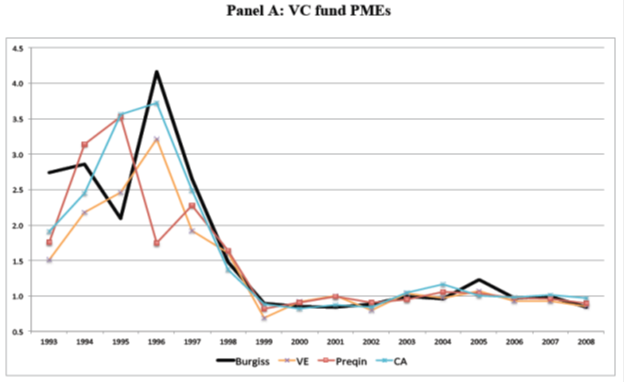
Noah wrote:
…that graph sure looks like a structural break to me. Something looks like it broke the VC business model after the dot-com crash. Maybe the new tech bubble (Facebook, etc.) will pump those returns back up, but there have been some big IPOs and some big acquisitions in Tech Bubble 2.0, and VC returns haven’t really bounced back yet, so I’d be cautious. What’s more, I’m starting to read about a slump in venture funding…Could this be the (temporary) end of the VC industry? If so, is it a harbinger of technological stagnation, or simply the passing of a financial fad?
He is drawing upon this recent paper by Harris, Kaplan, and Jenkinson (pdf). As I remarked at a party recently: “We are all stagnationists now.”
Addendum: Tim Worstall adds comment.
Development economics of education bleg
What should I read? There is no need to re-recommend Banerjee and Duflo, Lant Pritchett, or James Tooley on this topic, namely education in developing countries. What else? I thank you in advance for your counsel.
The reductio
For instance, what if you are yourself a beautiful woman? What if you are a beautiful woman who wants to dine out with a number of your beautiful friends? According to Mr. Cowen, you shouldn’t go to whatever restaurant you happen to go to.
Here is more, from the Toledo Blade.
Assorted links
1. Is this a golden age for inventors? And what is the asteroid-mining business plan?
2. Is this a golden age of Hunger Games econometrics?
3. Should gamblers be made to stand?
4. “The fundamental question is: “Why is government’s share of the voluntary donations market so damn small?” “, more here. Furthermore “There are plenty of redistributionist goals which do not require concerted collective action or threshold levels of contribution.”
5. Shout it from the rooftops! (some results about auction pricing)
*The Great Recession: Market Failure or Policy Failure?*
By Robert Hetzel, market monetarist, now out, I very much liked the draft I read. For the pointer I thank David Levey.