Do demographic changes matter for financial market returns?
Be careful when predictable factors appear to shape financial market returns, but nonetheless this result, written up by Robert Arnott and Denis Chaves,is intriguing:
It seems natural that the shifting composition of a nation’s population ought to influence GDP growth and perhaps also capital markets returns. Entrepreneurialism, innovation, and invention tend to be associated with young adults. Accordingly, GDP growth should perhaps be best when there is a preponderance of young adults in a population. Investing for retirement is associated with middle-age, with a shift in preferences toward bonds with late-middle-age. So, stock and bond returns might be best in populations with growing rosters of these age groups, respectively. Our data – spanning over 60 years and 22 countries in our main tests and roughly 175 countries in out-of-sample robustness checks – support all of our priors.
We confirm what others have already demonstrated, but we extract markedly more statistical significance by adapting a polynomial curve-fitting technique pioneered by Fair and Dominguez (1991), to this new purpose. In our work, we find that a growing roster of young adults (age 15-49) is very good for GDP growth, a growing roster of older workers is a little bad for GDP growth, and a growing roster of young children or senior citizens is very bad for GDP growth.
This is in accord with some of Brink Lindsey’s recent observations. For the pointer I thank Sami, a loyal MR reader.
*Dance of the Furies*
The author is Michael S. Neiberg and the subtitle is Europe and the Outbreak of World War I. This book stunned me, in a positive way. It argues for six main propositions, a few of which can be summarized quickly:
First…few Europeans expected a war and even fewer wanted one. Europe was not a place of white-hot nationalist passions looking for a spark…Virtually no one in Europe sought a war to correct supposed inequities stemming from the turbulent nineteenth century or as a way to adjust borders. Even in France, there was no desire for war as a way to avenge the loss of Alsace-Lorraine…
Third, the people of Europe accepted the necessity of war primarily because they believed their wars to be defensive.
Fourth, disillusion with the war…was well in place by the end of the war’s first year.
Sixth, despite their concerns and suspicions, societies kept fighting. Their reasons for doing so included a desire to avenge the losses of 1914, the quite real threats to their existence which remained from foreign armies, and an awareness that the hatreds unleashed by the war as early as the end of the first month made anything short of total victory or total defeat unthinkable.
I do not have the specialized knowledge required to judge these claims, but I found the evidence cited in the book quite strong and I consider myself provisionally persuaded. For those versed in public choice economics, and behavioral public choice, Neiberg’s account is much more intuitive than the popular analyses one often hears. Definitely recommended.
I also found reading this book to be a depressing experience: Neiberg’s third point implies that a major war in our future is more likely than I had thought. For instance the German government was scheming aggressively, but the German people genuinely believed, and with some justification given the information they had at the time, that they were fighting a war of defense.
Assorted links
1. Restaurants cherry pick parties by size.
2. Interview on the new Tim Harford book.
4. Josh Barro on The Great Stagnation and goofing off.
5. I believe you can watch my Wednesday debate with Roger Scruton here.
6. Philadelphia Orchestra puts subscription money into escrow, not a good sign.
Loser men
David Brooks (don’t forget his new book) writes:
…in 1954, about 96 percent of American men between the ages of 25 and 54 worked. Today that number is around 80 percent. One-fifth of all men in their prime working ages are not getting up and going to work. According to figures from the Organization for Economic Cooperation and Development, the United States has a smaller share of prime age men in the work force than any other G-7 nation. The number of Americans on the permanent disability rolls, meanwhile, has steadily increased. Ten years ago, 5 million Americans collected a federal disability benefit. Now 8.2 million do. That costs taxpayers $115 billion a year, or about $1,500 per household.
…There are probably more idle men now than at any time since the Great Depression, and this time the problem is mostly structural, not cyclical. These men will find it hard to attract spouses. Many will pick up habits that have a corrosive cultural influence on those around them.
The rise in disability comes across a time horizon when jobs are becoming much safer and health care is improving.
I am struck by the difference between how some economists talk about “the job market,” and how they talk about the job market in academia, which of course is the job market they know the most about.
When it comes to the job market in academia, most economists have few hesitations about blaming many of the jobless for their fate and applying extreme meritocratic views. “He spent seven years finishing.” “Her specification was not robust.” “He self-destructed in the interview.” Or, believe it or not, “We don’t even look at people from that school.”
(And as Robin Hanson noted, there is little talk of redistributing grades, Ph.d.s, enforcing mandatory co-authorship for job market papers, or redistributing other measures of academic accomplishment.)
Nonetheless there is clearly a significant cyclical component to academic unemployment, based largely on state government budgets for higher education; as of a few years ago, seventy-eight percent of students were in the state sector. If your department doesn’t have a slot, you probably can’t hire anybody, although a willingness to work for (much) less can lead to an adjunct job, even if many people won’t take one.
That cyclical component accounts for a lot of the short-run variation in hiring, but if you’re estimating the response to a demand shock, longer-term supply trends matter too and often they matter a great deal. If Ph.d. programs were stricter about enforcing standards of quality and relevance, rather than stringing along students to maintain the flow of revenue to the graduate program, the short run negative demand shocks would lead to a much less severe queuing problem. That’s simple microeconomics, and it should be macroeconomics too.
Furthermore short run negative demand shocks can reveal an unsustainable long-run trend in a new and sudden way, just as they do in financial crises.
When it comes to the jobless it is incorrect — and often hypocritical — to dismiss the common sense talk of traditional meritocratic factors, including structural problems on the supply side.
Addendum: Matt responds to Brooks, but his numbers don’t support his case. As I’ve argued before, it’s a lot “harder” to get a shift from ten to twenty percent unemployment than it is to get a shift from one to two percent. The cross-sectional distribution in unemployment, and its recent changes, are fully consistent with and indeed support the notion of major structural problems in the most vulnerable sectors, threshold-triggered by negative demand shocks. Again, it’s two blades of the scissors, not one.
How to bribe your kids?
From Gareth Cook, here are some tips for how to make the bribes work and avoid the undermining of intrinsic motivation:
Based on what is now known, Pierce and others suggest a set of guiding principles.
Choose a specific, positive behavior. “Have at least three bites of a vegetable every dinner for a week.’’ (Good.) “Don’t annoy me.’’ (Not good.)
Choose smart rewards. Work with your kid to choose the prize, investing them and ensuring it’s one they truly desire. A few selections from the LEGO catalogue were all it took me to solve an Olympian parenting problem: thumb sucking. But a reward need not be large.
Stay positive. In our house, we call them “challenges.’’ It is not about “fixing’’ a negative. Don’t nag. Let it be their choice. Pile on the praise.
Small steps first. Faced with an overwhelming task, start with easy goals, and small rewards, and slowly build. So, you might start with “avoid thumb one day between breakfast and nap.’’ Consider a detailed progress chart.
Those are largely good ideas, whether or not you are bribing your kids.
Nominal shocks
Samoa, the tiny Pacific Ocean island state, is travelling through time to improve its economic prospects.
In a vote of confidence for the Asian century, the country has decided to shift the jagged International Date Line to its east at the end of this year, which will bring it a day closer to Asia and Australasia.
The clocks in Apia, the capital, are 21 hours behind Canberra but only four hours behind San Francisco.
That reverses a decision 119 years ago to move the line to the west, following lobbying by Samoa’s merchants who wanted better to accommodate business with trading ships from the US and Europe.
It is not the first overhaul of a long-standing convention by Tuilaepa Sailele Malielegaoi, prime minister, who in 2009 switched the nation from driving on the right to the left, to align it more closely with the practice in Australasia and Japan.
“In doing business with New Zealand and Australia we’re losing out on two working days a week,” Mr Tuilaepa said. “While it’s Friday here, it’s Saturday in New Zealand and when we’re at church Sunday, they’re already conducting business in Sydney and Brisbane.”
Australia and New Zealand combined account for more than half of Samoa’s imports and more than 85 per cent of total exports, which largely consist of coconut products and fish.
…However, the move has not been universally welcomed, particularly in tourism, as the island will no longer be the last place on earth to see sunset. It will be joining the countries that see the sunrise first.
“After the date change, it will just be another sunset, no longer that special,” said Andrew Tiatia, a tour guide.
Mr Tuilaepa, however, points to another advantage. By flying one hour from American Samoa, on the other side of the date line, it will be possible to celebrate the same day twice and mark birthdays or wedding anniversaries twice over.
I enjoy stories like this more than is reasonably justified.
New York tips
1. Tulsi, 211 E. 46th, between 1st and 2nd. The most authentic Indian food I’ve had in the U.S., ever, get the vegetables. Not a cheap mom and pop, but by Manhattan standards this is reasonably priced for its quality. Jones Wood Foundry is an excellent gastropub.
2. Incendies joins Of Gods and Men and Even the Rain as one of my favorite films of the year. It is French-Canadian, set in Lebanon, and involves a journey of family discovery; I read it as an explicitly Christian movie.
3. Flushing, Queens, Golden Mall, go eat the Chinese food in the basement food court. For visitors, convenient from LaGuardia airport by taxi.
If you live in New York, or visit frequently, this is my best blog post ever.
Assorted links
2. Public choice take on the Der Spiegel story on Greece possibly leaving the eurozone.
3. Markets in everything: “A Sicilian social movement is organizing trips that patronize only businesses that do not pay protection money to the Mafia.” (1/20) Higher chance of arson, for one thing.
5. Seatbelts and offsetting behavior, a counter-revisionist view.
Books about America, by foreigners, bleg
George Hawkey writes to me:
I know you’ve posted “best books” queries on the site before, so here goes. Do you have any input on the best books about American History and Culture, but written from a non-American point-of-view?
Obviously Tocqueville, and there’s a whole raft of Canadian published books on the US culture as well. What I’m looking for is more like: what would “The Best and the Brightest” be if it were written by a Japanese journalist. Or what if Taylor Branch’s “Parting the Waters” trilogy was written by a Russian sociologist? “The World Is Flat” but written about the US by an Indian?
In many cases, I’m guessing these texts are not yet or will never be translated, but I’m still interested in finding greater perspective on the US than what’s provided by the traditional pundits, authors and historians.
I’ll recommend these five works of fiction, starting with Nabokov and how about Ayn Rand as well? The comments are open for your further suggestions…
Selling Government Assets
In November of 2008 I wrote:
The Federal Government owns more than half of Oregon, Utah, Nevada, Idaho and Alaska and it owns nearly half of California, Arizona, New Mexico and Wyoming. See the map (PDF) for more [N.B. the vast majority of this land is NOT parks, AT 2011]. It is time for a sale. Selling even some western land could raise hundreds of billions of dollars – perhaps trillions of dollars – for the Federal government at a time when the funds are badly needed and no one want to raise taxes. At the same time, a sale of western land would improve the efficiency of land allocation.
The Obama administration is beginning to implement just such a proposal. Jonathan Easley of Salon summarizes:
The administration has identified a massive asset class worth unloading. The federal government is the largest owner of real estate in the nation, sitting on hundreds of millions of acres of land that takes up about 30 percent of the country’s surface. The value of Uncle Sam’s nondefense real estate portfolio is estimated at $230 billion, and it carries a maintenance cost of around $20 billion a year.
If Congress moves ahead on the White House’s recommendation, 60 percent of sale proceeds from properties the White House has deemed excess will go to paying down the deficit, with 40 percent to cover costs on other government-run facilities. In addition to the one-time cash from the sale, the government can begin generating tax revenues on land that was previously an expense.
The first set of assets proposed to go on the auction block are mostly empty or little used warehouses, office buildings, barracks and other properties, quite a few of which are now scheduled to be demolished. The total acreage up for sale is very small so Easley greatly exaggerates when he says the proposed sale is Obama’s “libertarian turn,” but heh, it’s a start.
Karl Smith on aggregate demand
It is an excellent post, read the whole thing. To pull out one point, here is the hospitality sector, expressed in levels:
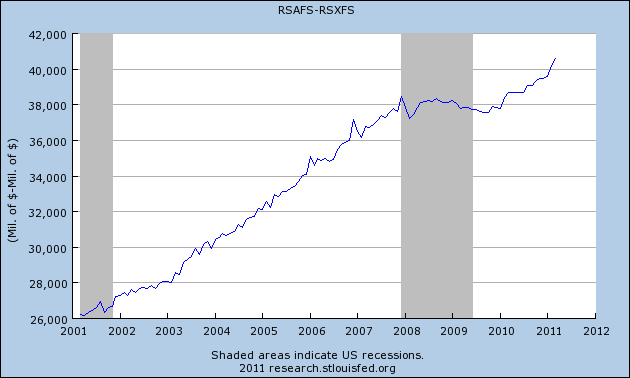
It’s clearly below trend, had there been no financial crisis. But will sticky nominal wages cause significant unemployment? In terms of absolute levels, business is above where it was before the crisis. At first glance, that should seem enough to support the nominal wage levels of 2007. You also can see that the initial downward dip really doesn’t last for long (two months?) before the older absolute level of business activity is restored.
One approach is to place a lot of the explanatory power in the labor market lags, thereby invoking real variables, above-average risk premia and option values, zero marginal product workers, credit constraints, and so on.
To save an AD story for this sector, one might try the “wandering relative prices” add-on. This graph shows an aggregate. As time passes, especially when AD is relatively stagnant, some prices in this sector fall quite a bit, more so than is indicated by measures of totals or averages. The more that some prices are otherwise inclined to “wander” quite low, the more that rising nominal expenditure flows are required to keep demands high enough so that those sectors aren’t faced with having to cut nominal wages.
The funny thing is, the data on relative prices don’t exactly fit the standard Keynesian story; read this excellent post by Stephen Williamson.
Basically, it’s complicated.
Assorted links
TEDx talk on Monday
My TEDx New York talk is sometime right at or slightly after 4:50 p.m. Monday, EST. I will cover The Great Stagnation. You can watch on-line the other talks too, the link, which includes a list of speakers, is here.
The new Florida Medicaid plan
It has passed the legislature, there is a 1/20 summary here, and an ungated piece here. Here are a few salient points:
1.Most of the patients will be moved into managed care.
2. In most cases malpractice awards — for Medicaid patients only — will be capped at $300,000.
3. “Last month, the federal government advised legislators to choose the payment system that would guarantee that a percentage of the money, in this case 90 percent, would go to patient services. Instead, the Legislature chose the other option: to share profits with managed-care companies.”
By what percentage will the real value of Florida Medicaid benefits be eroded? What does this imply about the future political equilibrium of where spending cuts will come? Will Medicaid as we know it survive?
It remains to be seen whether the Federal government, which has the ability to veto the plan, will approve the proposal.
One reason why independence for Scotland would be a bad idea
There is now talk of a referendum, but let’s scroll back to 2008:
The massive bailout of banks has been widely received as welcome and necessary across the United Kingdom. But it has not been lost on Scots that the largest shareholder in Scotland’s two largest banks is now the British government.
…Brown said the $65 billion bailout of the Royal Bank of Scotland and the bank formed by the merger of Lloyds TSB and the Halifax Bank of Scotland (HBOS) proved that the United Kingdom was “stronger together.”
“We were able to act decisively with 37 billion pounds; that would not have been possible for a Scottish administration,” said Brown, whose own political fortunes have been boosted by his handling of the crisis.
Others have pointed out that the bailout for eight major British banks — including capital for banks and government loan guarantees — is worth a total of almost $700 billion, which is about five times Scotland’s annual gross domestic product.
Here is more. The conceptual point is simple. If you think that the world is now more prone to financial crises (and I do), the optimal size for a nation-state has gone up. Risk-sharing really matters.