The Coming Education Revolution
From Metafilter:
Stanford’s ‘Introduction to Artificial Intelligence’ course will be offered free to anyone online this fall. The course will be taught by SebastianThrun (Stanford) and PeterNorvig (Google, Director of Research), who expect to deal with the historically large course size using tools like Google Moderator.
There will two 75 min lectures per week, weekly graded homework assignments and quizzes, and the course is expected to require roughly 10 hours per week. Over 10,000 students have already signed up.
 In 2003, I argued that professors were becoming obsolete, giving a 10 to 20 year time for a big move to online education. Later, I pointed out that the market was moving towards superstar teachers, who teach hundreds at a time or even thousands online. Today, we have the Khan Academy, a huge increase in online education, electronic textbooks and peer grading systems and highly successful superstar teachers with Michael Sandel and his popular course Justice, serving as example number one.
One of the last remaining items holding back online education is a credible system to credential and compare student achievement across universities. Arnold Kling has that covered with a new business model.
For superstars and strong researchers, life in the ivory tower remains good. But for most teachers the cushy life is gone; tenure is just a dream for a majority of university teachers, salaries are low and teaching requirements have risen.
As in other fields what we are seeing is an increase in teaching inequality, at the top are high-salary superstars surrounded by apprentices who work long hours at low pay for a lottery ticket that for most will not payoff and at the bottom are lots of mid-skill adjuncts who do the drudge work of teaching remedial English and math.
Addendum: Tim Worstall points to the UK’s University of London as a model for the future.
State-contingent markets in at least a few things
MF Global Holdings Ltd. (MF) took the cult of the Wall Street chief executive officer to a new level with its sale of bonds that pay a higher rate if Chairman and CEO Jon Corzine quits to take a job from the U.S. president.
The futures broker sold $325 million of five-year unsecured notes, the company said today in a statement. The notes will pay an extra percentage point of interest if Corzine is named to a federal post and confirmed by the Senate before July 2013, New York-based MF Global said yesterday in a regulatory filing.
Here is more.
Sad sentences
“Europe’s plan was to have growth fix the problem. America’s plan was to have growth fix the problem. And that’s not going to work,” said Kenneth Rogoff, an economics professor at Harvard. “I think it’s really starting to sink in that we’re not anywhere near an endgame.”
Here is more, though most of the article is well-known. Brad DeLong had a very good post:
You Know, If You Had Told Me a Year Ago That on August 5, 2011 S&P Would Downgrade the U.S, and the 10-Yr Treasury Would Yield 2.5%…
… I would have laughed at you. I would have said that while there were possible futures in which each of those things happened, they were disjoint futures.
One way to solve that conundrum is to think about what expected real rate of return fits into both facts.
What I’ve been reading
1. Jo Nesbø, The Redbreast. These days it’s odd to read a fictional book about neo-Nazi cults in Norway, including a murderous villain who leaves behind a manuscript explaining his ideas and purpose. I didn’t love it, but I liked it and I never considered putting it down; I will likely try another book by Nesbø. The author, by the way, graduated from the Norwegian School of Economics.
2. Félix J. Palma, The Map of Time. Spanish speculative fiction, now in English. It never feels deep, but finally we have a time travel novel chock full of new (and good) ideas. Recommended to all those who find that sufficient, but not for those who don’t.
3. Tim Congdon, Money in a Free Society. Neo-monetarist tract! With plenty on all the different notions of the liquidity trap out there, which are often confused.
4. Kate Christensen, The Astral: A Novel. About marriage, self-deception, and general decay and destruction. Her best book so far.
5. Isaac Asimov, Franchise. Only a short story, but available in stand-alone form. Asimov considers a future world where AI is so advanced that elections can be settled by asking a few questions to a computer-identified “typical” voter and adding that input to the calculations of the computer. One of his deepest works, recommended for all students of public choice.
Sentences to ponder markets in everything
Only children’s books or specialist scuba diving titles currently boast to be fully water-resistant.
A waterproof paperback book will be hitting the market next year, hat tip goes to Bookslut, who knows of one other waterproof title.
And here is another Markets in Everything, hat tip to TW.
By the way, the (possible) salt water flows on Mars were in part discovered by a 21-year-old Nepalese undergraduate, and it seems he had the key contribution.
Assorted links
A few quick thoughts on the likely pending S&P downgrade
1. The Republican Party made a big, big mistake passing up a chance for a “grand bargain” with Obama. It’s time to be a realist about revenue increases, rather than signaling ideological purity. And let’s get a better rather than a worse version of revenue increases, combined of course with significant spending cuts and a good, credible long-term fiscal plan, enforced by tough triggers. A lot of Republican or conservative intellectuals know better on revenue increases, and have said as such, but corruption, intellectual and otherwise, prevented their voices from being heeded in the larger political context.
2. Democrats need to choose on entitlements. Ross Douthat nails it. It’s time for Obama to lead.
3. I don’t expect anyone to change their mind at this point, but the “we should have had a much bigger stimulus” argument is unlikely to go down in intellectual history as the correct view. Instead, Ken Rogoff and Scott Sumner are likely to go down as the prophets of our times. We needed a big dose of inflation, promptly, right after the downturn. Repeat and rinse as necessary. But voters hate inflation and, collectively, we proved to be cowards. Too bad.
4. As a simple rule of thumb, if at this point, in response to this news, a commentator attacks the ratings agencies for their previous mistakes and stupid, corrupt behavior, it’s a sign the commentator is trying to muddy the broader issues at stake. Such commentators may well be correct in their criticisms, but probably they are not facing up to their recent mistakes and seeking to shift the blame. Watch out for this.
5. I’m not sure how markets will respond, and I don’t think that an alarmist reaction about the market would be appropriate. A letter grade is a letter grade and the facts on the ground did not change today. It may or may not lead to a major sell-off. Still, years from now today may well be seen as a turning point of significance.
6. If this really does happen, let’s hope it serves as the needed wake-up call. If it doesn’t, well, back to…
S&P downgrade of the U.S. government?
The word on Twitter is that it is coming late this afternoon or this evening. Who knows? I’ll try to give you an update and analysis, though I’ll be away from the computer for the dinner hours.
Job markets in everything
It’s the economy, stupid! Drive players to invest in our game economy by analyzing the subtleties of behavioral economics and pondering the pitfalls of specialization and free trade. Theorize why people make irrational economic choices and use the tricks you’ve learned to ensure players only make the irrational choices you want them to. Create an economic system that will fulfill a player’s needs just as much as shooting an alien in the face.
The Economy Designer at Bungie will develop a robust and rewarding game economy that drives player behavior toward intended goals and validate those systems through intense simulation, testing and iteration. You’ll design the systems and mechanics which drive in-game trade, satisfy the players’ need for possessions and wealth whilst ensuring rewards retain their intended value despite attempts to exploit or grief the system. You will determine what data is necessary to mine, ensure we have all of the hooks necessary to gather that data, and come up with all of the interesting metrics and questions we should ask of that data. You will run simulations of these mechanics based on expected player behavior and test these simulated results against actual player behavior; tuning the live system accordingly.
Assorted links
1. Nepotism in Italian academia.
2. I liberate books, he imprisons them. Who is the greater lover?
3. Chile’s budget rules, by Edwin Dolan, still one of the most underrated econ bloggers.
Keynes v. Hayek Debate
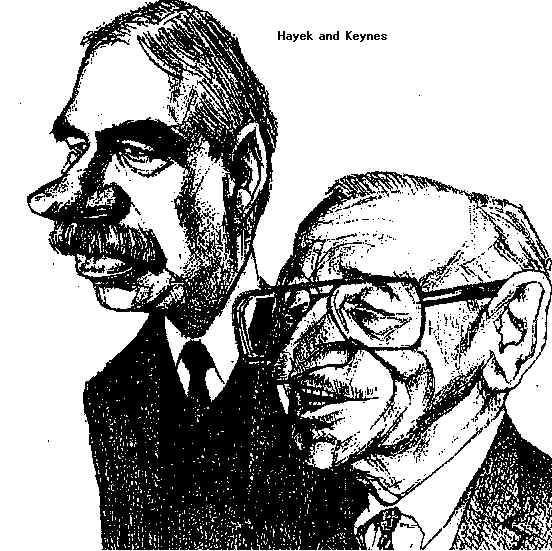
The Keynes v. Hayek BBC debate at the LSE which pits Lord Robert Skidelsky and Duncan Weldon arguing for Keynes against George Selgin and Jamie Whyte arguing for Hayek is now available in an online podcast.
On the Debt Deal and the unBBA
TIME has five economists react to the debt deal, Mohamed El-Erian, Douglas Holtz-Eakin, Simon Johnson, Stephen S. Roach and yours truly.
Holtz-Eakin really works his apocalyptic imagery:
The river of entitlement red ink courses through a broken budgetary landscape. America is borrowing $58,000 every second—more than the median income of its households—and the gross debt already exceeds the level (90% of gross domestic product) that has historically been seen as toying with danger. Even worse, the federal debt promises to explode in the next decade, which will surely result in a Greece-style debt crisis. Erskine Bowles, co-chair of the President’s fiscal reform commission has called it the “most predictable crisis in history.”
When the crisis inevitably arises, the painful memories of 2008—panic; no credit; monthly job losses in the hundreds of thousands; Main Street businesses shuttering their windows and closing their doors; highly-qualified college graduates despairing of ever finding real work—will seem quaint and mild by comparison.
Stephen S. Roach wonders what will happen as China rebalances.
For China, the fiscal crisis and Great Recession was a wake-up call — a signal to rebalance away from unsustainable external demand toward untapped internal consumption. Such efforts now appear to be underway. And that’s where it comes full circle. China, the world’s biggest surplus saver, gets it. It will now save less and consume more. Conversely, the United States, with world’s biggest savings deficit, doesn’t get it. At least, that’s the message to take from the disappointing outcome of the debt ceiling debate.
…Absent the Chinese buyer of Treasuries, who will step up and fill the void? And on what terms? That latter point is key. With increasingly skittish foreign lenders now likely to require concessions in the form of a weaker dollar and higher U.S. interest rates, there will be new pressures on U.S. inflation and growth.
The timing of Roach’s comments are odd since interest rates are falling madly. On the other hand, the Chinese credit rating agency did just downgrade US debt.
I discuss the virtues of an unbalanced budget amendment. I won’t repeat what I wrote earlier but here are a few added remarks:
The idea of an unbalanced budget amendment is not new. Sweden’s government has been required since 2000 to budget for a 1% surplus over the business cycle. Since implementing their unBBA, Sweden has successfully brought their budget into balance and created a surplus.
Even more ancient sources are supportive of an unBBA. In the Bible, Joseph doesn’t advise the Pharaoh to balance the budget instead he tells the Pharaoh, save during the seven fat years so you are prepared for the seven lean. An unbalanced budget amendment reflects this simple and ancient wisdom.
For more, Ed Dolan has a good post on Sweden’s fiscal rules. See also this IMF paper for an extensive look at fiscal rules around the world. A hat tip to Ennuigogo.
Getting out of the euro?
Nick Rowe writes:
Eurozone governments and banks that cannot pay their obligations in Euros may end up paying their obligations in a scrip that is not pegged to the Euro. A scrip issued by each national government that is worth whatever people think it is worth. And if people start using that scrip as a medium of exchange, and medium of account, it becomes a new money. Sure, Greek supermarkets might prefer payment in Euros, but if their customers can only pay in New Drachmas, then it’s either accept New Drachmas or let the vegetables rot on the shelves. And the supermarkets’ suppliers might prefer payment in Euros, but it’s either accept New Drachmas or let the vegetables rot in the fields. And the workers picking the vegetables might prefer payment in Euros, but it’s either accept New Drachmas or nothing….
But how exactly does a government scrap the old money? It’s not as obvious as it sounds. How can it stop people measuring prices in “old” dollars, and using old dollars for their shopping? (It’s easier in the case of hyperinflation, when the old money is already heading for extinction anyway).
First, the government starts doing its own shopping in New Dollars. The government is a big shopper. Just as we tend to use the same language as those around us are using, so we tend to use the same money as those around us are using.
Second, the government stops enforcing new contracts requiring payment in old dollars, and lets old contracts be paid in New Dollars.
Third, the government stops making change in old dollars. The reason a $20 bill is worth two $10 bills is that the central bank is willing to convert one into the other. And that mutual convertibility makes $20 bills and $10 bills fungible and easy to use as money.
Fourth, as a final resort, stop enforcing laws against counterfeiting old dollars.
I haven’t seen a better idea, but does this address my two main concerns? The first is that, as the transition occurs, there is no credible promise not to confiscate euro-based bank accounts. So the banking system collapses due to runs.
The second is that is takes a few months to produce the scrip and in the meantime the banks are collapsed, and even if nationalized the government can’t make good on all the deposits. Now the government stands up and tries to push its new, crummier currency. Eh (Girton and Roper 1981). Alternatively, the government could confiscate the euro deposits when it nationalizes the banks, and turn them into drachmas, in which case the “scrip” is already there in the banks. But in the short run there is no new currency, the banks are iffy, and even Argentina has never tried something that extreme.
Imagine having a severe shortfall of both banks and currency for a few months. How much would gdp fall? At least thirty percent? How much could foreign banks and abstract loan credits step in to fill the gap? How quickly would such an economy bounce back? I don’t know. It seems to me that all transition paths lead to that outcome, one way or another. Maybe it’s worth it in the longer haul, but you can see why many people believe there is no path out of the eurozone.
If it happens, it will be through markets forcing this solution upon periphery governments, through silent bank runs, rather than the governments deliberately opting to leave the eurozone. Can you imagine a Prime Minister voluntarily accepting a gdp drop of thirty percent over the next six months?
Addendum: Here is a good update on the silent bank runs.
Ukraine Modigliani-Miller tax arbitrage


Today I received some tax saving wisdom from a taxi driver in Ukraine. He told me that people who import cars to Ukraine sometimes cut the car in two separate pieces and carry it through the customs this way. By doing this, they save a fortune on import tax. A car carried in two pieces is seen as spare parts and therefore is taxed at a much lower rate than a normal car.
When in Ukraine, the car is welded back into one piece. After that, it’s usually sold locally at a good price. I looked through forums and apparently this is a common practise in developing countries, particularly in post-Soviet states such as Ukraine.
The full story, with more pictures, is here. For the pointer I thank Joe C.
Jack Goldstone is now blogging
*The* Jack Goldstone, who by the way is a colleague at GMU. Find his posts here.