The best sentence I read today
So showing that the state is not legitimate need not entail that it is morally indefensible.
That’s from Will Wilkinson and for those of you on EST I read it yesterday. The whole post is interesting.
What works in development economics?
Seven papers,
all by first-rate authors on topics of critical importance. I haven’t
had time to read these yet but I can recommend them nonetheless. I’ll
print them out once I’m back from Japan in the meantime they are yours.
The pointer is from Chris Blattman.
Who should be bounced from The Great Books series?
Before leaving for Japan, I’d been pawing through these volumes lately — you know, the U. Chicago fat tomes with two columns on each page? The obvious question is which books belong and which do not; overall I’m surprised at how well the 1952 picks have held up and yes that is tribute to the University of Chicago or at least its influence.
I’m sad that Hume doesn’t get his own volume, including many of his shorter essays. Plus I’d like to add Dickens’s Bleak House and at least the first two books of Proust. And who to bounce? I nominate Plotinus as the obvious choice, noting that he has only about 24,000 cites on scholar.google.com, not even as many as Joseph Stiglitz.
In 1990 they dropped four books: Apollonius’ On Conic Sections, Laurence Sterne’s Tristram Shandy, Henry Fielding’s Tom Jones, and Joseph Fourier’s Analytical Theory of Heat. The loss of Sterne is regretted but the others we can do without. You’ll find a list of the added books in 1990 at the first link, about halfway down and yes they did include Swann’s Way. Little Dorrit is not the best or even the second best Dickens selection. Most are good picks though I would have left the Bergson, the Dewey (unreadable), and tossed out some of the shorter works in favor of Ulysses. More William James is never a bad idea; how about The Varieties of Religious Experience? None of the science books will age well. And how about a wee bit of Mises and Hayek to reflect the failures of socialism? Absalom, Absalom would help cover race and maybe Mill on The Subjection of Women should be there too.
Free banking in Second Life
Yes, economic activity in Second Life continues to rise. I am interested in the Second Life currency, Linden Dollars, which trades against the U.S. dollar at a market-determined exchange rate.
Free banking economists used to debate whether a private sector fiat currency could succeed. Hayek, in his Denationalisation of Money, said yes but most other people said no. The obvious problem is time inconsistency, namely that the fiat currency issuer will at some point inflate away its value to the seigniorage-maximizing margin, noting that such a margin changes with the passage of time and not necessarily in a favorable direction.
Who would have foreseen that maximizing income from "land" sales might check this outcome? I think of Linden Dollars as akin to legal tender currencies: you can’t buy anything in Second Life without them. Since the goods and services in Second Life have value the currency does too.
Who had expected that the next generation of private currency suppliers would make it work by, in God-like fashion, supplying accompanying worlds as well? What other problems can be solved this way? Or are Linden Dollars the next bubble waiting to burst?
Department of No Clue
Christopher Hayes writing in The Nation.
The vast majority of interest groups in
Washington, from the Sierra Club to the AFL-CIO to Planned Parenthood,
are pursuing what Edsall calls "substantive reform"–attempting to push
legislation and enact policies that will provide public goods, protect
citizens from harm and redistribute benefits, rights and privileges away
from the powerful and toward middle-class citizens and disenfranchised
minorities.
And if you believe that, might I mention that if you act quickly I have some land in Florida just ripe for development.
Complexity theory in economics
Profile of Larry Lessig
By Christopher Hayes. Lessig is now determined to fight the influence of money in politics, a possibly Quixotic quest. Whether you think his program is either possible or desirable is a major question of politics. Excerpt:
"There’s a speech that Reagan gives in
1965," Lessig says, "where he talks about how democracy always fails
because once the people recognize they can vote themselves largess, they
just vote themselves largess and the fiscal policy is destroyed. Well,
Reagan had it half-right. It’s not as if it’s the poor out there who
have figured out how to suck the money out of the rich. It’s exactly the
other way around."
Horsemeat sushi
It’s very tasty, definitely gamy, extremely tender, and delicious but only in small quantities. Eat it first in your sushi order, not last. Here is more information.
Addendum: Do visit the comment left at 8:19 p.m.
Libertarian heresies
Here is a good report on my libertarian heresies, summarizing a talk I gave at the Institute for Humane Studies a few weeks ago. Excerpt:
Russia, he pointed out, is failing as a free society not because it
is poor – Putin’s shrewed management of high commodity prices has put
paid to much Russian poverty – but because Russians tend to privilege
their friends and contacts above all else, leading to epic levels of
corruption. Corruption, of course, is a signal rule of law failure.He then asked, somewhat rhetorically, if liberty was confined (and
defined) by culture: ‘We should not presume that our values are as
universal as we often think they are’. What happens, he asked
rhetorically, if – in order to enjoy the benefits of liberty and
prosperity – societies have to undergo a major cultural transformation,
including the loss of many appealing values? Cowen focussed on Russian
loyalty and friendship, but there are potentially many others. Think,
for example, of the extended family so privileged throughout the
Islamic world, or the communitarian values common in many indigenous
societies.
The Education Transformation of China
University education in China is skyrocketing. In 1996 China had less than 1 million freshmen, in 2006 there were over 5 million freshmen. The freshman class is continuing to grow and university graduates, of course, are just 4 years behind. About half of the entering students are in a hard science or engineering program. As a result, China today produces 3 times more engineers than the United States and will quickly overtake the U.S. in total graduates.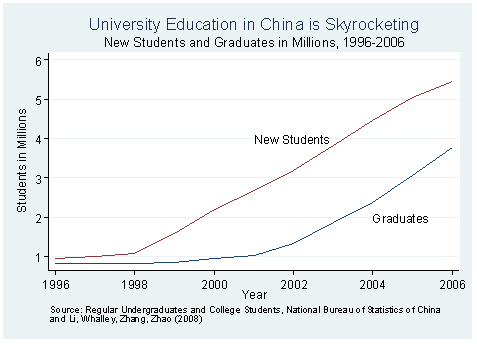
Many people worry about what the Chinese education explosion means for
the United States but I am optimistic. First, as China and other countries grow wealthy the
incentive to invest in R&D is increasing. If China and India were as wealthy as the U.S. the market for cancer drugs, for example, would be eight times larger than it is today – and a larger market means more new drugs for everyone.
Second, the growth in Chinese education is
increasing the supply of new ideas and that too is a benefit to people around the world.
Surprisingly, China’s education system is being
transformed to a
considerable degree by private forces. As late as 1999 the Chinese government
paid for most university education but from 2001 onwards tuition and
fees account for more than half of total educational expenditures.
I have drawn much of the data in this post from a fascinating new paper, The Higher Educational Transformation of China and its Global Implications by Li, Whalley, Zhang and Zhao. The paper has much else of interest.
I will be traveling to China to give a talk at Yunnan University in late June and will report on the transformation as it looks on the ground.
How do markets set the profit-maximizing level of air conditioning?
Ben M, a loyal MR reader, asks:
How does an office/shopping mall/theater decide how low to set its air
conditioning? It seems like they’ve found a bizarre and expensive
equilibrium where the "normal" indoor temperature is 63 degrees (in
August) and everyone carries an extra long-sleeve layer to keep warm.
How did it get this way, and is there some way to fix it?
This is perhaps the most common European complaint about visiting the United States, noting that they also don’t like ice in drinks and think freely circulating cold air can kill small babies.
I believe the goal of high-powered AC is to give customers the feeling of luxury, the feeling that anything can be afforded, and the feeling that the store will spare no expense toward the end of comfort. I do not believe that either the average or the marginal buyer actually — marketing effects aside — prefers that temperatures be so low. This implies that low margin stores will set the AC at lower levels; does anyone know if this is true? For instance businesses offices should be somewhat warmer than Nordstrom or Macy’s.
I find many movie theatres to be infernally cold, perhaps because they seek to be viewed as a respite from the summer heat. Appealing to dating moviegoers, who may wish to cuddle together, or be forced to do so, may be another reason.
And still I wonder why it is so loud in the pachinko parlors…

Allocating the Arctic
Today’s declaration said that all five nations would abide by the 1982
Law of the Sea, which determines territorial claims according to
coastlines and undersea continental shelves.
Here is the full story. The good news is that unclaimed territories, historically, have led to violent clashes. Settling the property rights in advance minimizes the chances of global instability. The bad news — if you think the cost of fossil fuels is too low — is that supply restrictions are far more effective than a Pigouvian tax on carbon.
Oil for Blood
In order to give blood donors a break from gas prices, the Red Cross [in Greensboro, NC. AT] is entering
all volunteer blood donors, who give blood between June 1, 2008 and June 30,
2008, into a drawing for one of two $750 gas cards.
Markets in everything
French fry tempura; that’s in case they didn’t fry them right the first time around. You might find it in the food basement of a Takeshimaya department store.
The "sushi pizza" (melted cheese on your sushi) is also delicious and it is served in very good restaurants.
Did I mention that Japan has arguably the world’s best baked desserts?
Questions that are rarely asked
This time it’s Robin Hanson’s turn:
…why exactly would learning that
the world is a brutal place make one less interesting in learning more
about that world? Wouldn’t learning help one to avoid brutality?
That’s in response to Paul Graham, who had written:
We want kids to be innocent so they can
continue to learn. Paradoxical as it sounds, there are some kinds of
knowledge that get in the way of other kinds of knowledge. If you’re
going to learn that the world is a brutal place full of people trying
to take advantage of one another, you’re better off learning it last.
Otherwise you won’t bother learning much more.Very smart adults often seem unusually innocent, and I don’t think
this is a coincidence. I think they’ve deliberately avoided learning
about certain things. Certainly I do. I used to think I wanted to know
everything. Now I know I don’t.