Do not underrate the elasticity of supply
When I first read about the discovery of a vast new deposit of lithium in a volcanic crater along the Nevada-Oregon border, I can’t say that I was surprised. Not because I know anything about geology — but because, as an economist, I am a strong believer in the concept of elasticity of supply…
Now about elasticity of supply, in which we economists tend to have more faith than do most people. Time and again over the centuries, economists have observed that resource shortages are often remedied by discovery, innovation and conservation — all induced by market prices. To put it simply: If a resource is scarce, and there is upward pressure on its price, new supplies will usually be found.
Not surprisingly, the Lithium Americas Corporation put in a lot of the work behind the discovery. Searching for new lithium deposits has been on the rise worldwide, as large parts of the world remain understudied and, for the purposes of lithium, undersampled. Just as Adam Smith’s invisible hand metaphor would lead one to expect, that set off many new lithium-hunting investigations.
Sometimes the new supplies will be for lithium substitutes rather than for lithium itself. In the case of batteries, relevant potential substitutes include aqueous magnesium batteries, solid-state batteries, sodium-based batteries, sodium antimony telluride intermetallic anodes, sodium-sulfur batteries, seawater batteries, graphene batteries, and manganese hydrogen batteries. I’m not passing judgment on any of these particular approaches — I am just noting that there are many possible margins for innovation to succeed.
Here is the rest of my Bloomberg column.
Ho hum model this
The Mexican government releases some of its footage. And more. Here is 4.5 hours, I have not watched it. Here is lots of Twitter commentary. And one snatch of detail on the corpse.
Is this just the Virgen of Guadalupe all over again? But with photos and sensor readings? Por favor, explica’ me a mi!
Tuesday assorted links
The shaming of one-parent families
Matt Yglesias writes:
…(continue to be confused by the widespread claim that the elites won’t tell you about this idea)
Matt is referring to the two-parent family and the notion that elites will (after some point) lead fairly culturally conservative lives, but preach a more outgoing, tolerant, liberal morality at the social level, a morality which “the lower classes” perhaps cannot handle. But do the elites in fact do that? Do the elites fail to tell the “lower classes” about the virtues of their (eventual) culturally conservative lifestyles?
I view the issue in terms of shame. In an earlier America, and indeed in many other societies in world history, there has been a certain amount of shame surrounding single parent families. I don’t view the Left as very willing to shame along this dimension. It does not fit their basic worldview, and furthermore single-parent women are such loyal Democratic voters it would be electorally counterproductive. So the net influence of the Left is to limit the amount of shame surrounding single-parent families.
Now to be fair, I think the Right wing shames on this issue much less than it used to. Some of that may be the Trump thing, some may be the rise of the “post-religious Right,” and some may be a simple recognition that such shaming has become counterproductive. It does not have a critical mass of social support behind it, not any more. But some significant segment of the Right wishes we once again could have a world where such shaming had real effect.
This point is perhaps easiest to see with suicide. Does the Left “refuse to tell people that suicide is bad”? Of course not. But does the Left shame those who commit suicide? If they do, I never see that on Twitter. Instead I see lots of sympathy and sorrow. But in traditional Christianity suicide is seen as a sin. Is that latter approach better? I don’t know! But I see people choosing their stances on this issue using mood affiliation, rather than obsessing over the data. I would in fact like to know whether shaming suicide (or how about bringing the shame upon the entire family?) limits the number of suicides.
The “elite Democrats” of course will shame on a large number of other issues, just not on those ones.
If you ever want to know what is going on with a particular issue, start by looking at who is willing to shame what, or not.
China fact of the day
China is set to become the world’s biggest car exporter this year, overtaking Japan. The watershed moment will mark the end of decades of dominance by European, American, Japanese and South Korean groups.
Here is more from the FT. Note that as recently as three years ago, China for car exports was not in the top fifteen.
How Credible is the Credibility Revolution?
When economists analyze a well-conducted RCT or natural experiment and find a statistically significant effect, they conclude the null of no effect is unlikely to be true. But how frequently is this conclusion warranted? The answer depends on the proportion of tested nulls that are true and the power of the tests. I model the distribution of t-statistics in leading economics journals. Using my preferred model, 65% of narrowly rejected null hypotheses and 41% of all rejected null hypotheses with |t|<10 are likely to be false rejections. For the null to have only a .05 probability of being true requires a t of 5.48.
That is from a new NBER working paper by Kevin Lang.
U.S. immigration policy is slightly better than you think
Keep in mind that Canadian immigration policy also is U.S. immigration policy. Currently Canada is taking in about 400,000 people a year, with plans to raise that to 500,000. At the same time, the U.S. is doing little to boost high-skilled immigration. But Canada is serving as a kind of farm system for the U.S. The very best Canadian arrivals — or their children — have the best chance of getting into the United States, if only through O-1 visas.
So if the quantity of Canadian immigration is going up, the quality of U.S. immigration is going up too, through Canada in this case. Call it cherry-picking if you like.
Not surprisingly, neither side in the immigration debate wants to scream this loudly from the rooftops. The pro-immigration side wants to present the status quo as dire. The immigration-skeptical side does not want to stress that there are perfectly good ways of screening for immigrant quality, some of which already are in place.
Monday assorted links
Why is the minor key rising in popularity?
Another telltale sign of sad songs is the minor key. This rise in minor key songs has been dramatic. Around 85% of songs were in a major key back in the 1960s, but in more recent years this has fallen in half.
My favorite guru of music data analytics, Chris Dalla Riva, has sent me this chart showing the increasing share of Billboard #1 hits in a minor key. (By the way, I highly recommend Chris’s Substack Can’t Get Much Higher.)
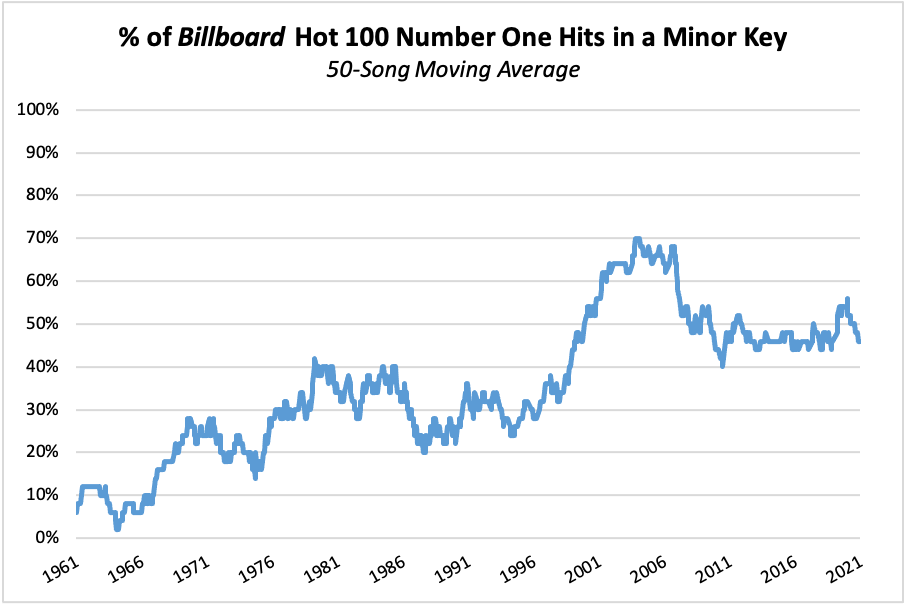
Here is more from Ted Gioia.
The Bat the Ball and the Hopeless
You will no doubt be familiar with the bat and ball problem;
- A bat and a ball cost $1.10 in total.
- The bat costs $1.00 more than the ball.
- How much does the ball cost? ____ cents.
In a paper in Cognition, Meyer and Fredrick test multiple versions of the bat and ball and related problems to try to uncover where people’s intuitions go wrong. The most remarkable two versions of which are shown below:
- A bat and a ball cost $110 in total.
- The bat costs $100 more than the ball.
- How much does the ball cost?
- Before responding, consider whether the answer could be $5.
- $_____
———–
- A bat and a ball cost $110 in total.
- The bat costs $100 more than the ball.
- How much does the ball cost?
- The answer is $5.
- Please enter the number 5 in the blank below.
- $_____
Remarkably, even when told to consider $5, most people continue to answer $10. Even more shockingly, most people get the answer right when they are explicitly told the answer and instructed to enter it, yet 23% still get the answer wrong! Wow.
The authors conclude:
…this “hinted” procedure serves to partition respondents into three groups: the reflective (who reject the common intuitive error and solve the problem on the first try), the careless (who answer 10, but revise to 5 when told they are wrong), and the hopeless (who are unable or unwilling to compute the correct response, even after being told that 10 is incorrect)
…many respondents maintain the erroneous response in the face of facts that plainly falsify it, even after their attention has been directed to those facts….the remarkable durability of that error paints a more pessimistic picture of human reasoning than we were initially inclined to accept; those whose thoughts most require additional deliberation benefit little from whatever additional deliberation can be induced.
As an economist, I would have liked to see an incentivized version (maybe some people are pulling the authors legs) but I don’t actually think that explains the results. Quite a few people are indeed hopeless.
Korea Japan (China) fact of the day
…the most significant destruction on the Korean Peninsula was wrought by the Japanese invasions of the late sixteenth century. Nearly two million Koreans, a staggering 20 percent of the population, perished during the Imjin Wars, Toyotomi Hideyoshi’s campaigns of 1592-1598 to subjugate the Korean Peninsula. Hideyoshi’s object was the conquest of Ming China (1368-1644) but the result was to turn Korea into a ruined land.
That is from the new and interesting The Other Great Game: The Opening of Korea and the Birth of Modern East Asia, by Sheila Miyoshi Jager.
The Value of Communication for Mental Health
Mental health disorders account for a significant share of the overall global disease burden. The economic losses from such disorders are staggeringly large, particularly in low-income countries, where people are faced with several unexpected shocks. We test whether improved communication can mitigate such mental health disorders. Partnering with a major telecommunications company, we implement low-cost communication interventions that provide mobile calling credits to a nationally representative set of low-income adults in Ghana during the COVID-19 pandemic. Individuals’ inability to make unexpected calls, need to borrow SOS airtime, and to seek digital loans decreased significantly relative to a control group. As a result, the programs led to a significant decrease in mental distress (-9.8%), the likelihood of severe mental distress by -2.3 percentage points (a quarter of the mean prevalence), and domestic violence, with null impact on consumption expenditure. The effects are stronger for monthly mobile credits than a lump-sum. We present evidence that improvements in both business-related services and social inclusion and/or protection are relevant explanations. Simple cost-benefit analysis shows that providing communication credit to low-income adults is a cost-effective policy for improving mental health. Communication – the ability to stay connected – meaningfully improves mental well-being and interventions about communication are particularly valuable when implemented as many installments.
Here is the full NBER working paper, I am happy to see economists tackling the all-important set of mental health problems.
Russia-Africa facts of the day
Since invading Ukraine, Russia has sought to increase the region’s share of its total global trade above the current 3.7%, with specific attention to increasing African primary commodity exports to Russia. However, African exports to Russia still make up a tiny 0.4% of the region’s total exports. In addition, Russian foreign direct investments in Africa amount to about 1% of the total flow. These numbers are not what one would expect from an alleged geopolitical heavyweight that is supposedly about to remake the region’s alliance terrain.
While Moscow is a leading arms supplier to a number of African states — a fact that is often cited a multiplier of its influence in the region — the actual numbers are inarguably underwhelming. Earlier this year SIPRI, a Swedish tracker of conflicts and trade in arms, noted that Russia had increased its share of weapons supply to Africa to 26% of the regional market share. The report was greeted with the usual willfully ignorant shock and alarm. Yet the figure quickly loses its punch once one realizes that it represents less than $115m in flows to a region of 54 sovereign states. Arms sales in Africa simply aren’t what they used to be (see below).
Here is more from Ken Opalo.
Sunday assorted links
1. Beauty induces higher stock market participation and thus higher returns.
2. “Afuera!”
3. Sri Lankan food is becoming more popular.
4. Those old service sector jobs. Circa 1933, with Einstein.
5. The new Katherine Rundell book (UK only) is receiving rave reviews (Times of London).
6. New Knausgaard novel is coming.
7. Markets in everything, security breach division, dept. of uh-oh.
Did Katrina boost freedom, wreck state capacity, or both?
We find that Hurricane Katrina had lasting impacts on Louisiana’s formal institutions. In the post-Katrina period, we find that actual Louisiana had persistently higher economic freedom scores for both GE [government employment] and PT [property tax] than the synthetic Louisiana that did not experience the hurricane. These findings imply that the hurricane led to a reduction in both PTs and GE, which indicates a decrease in the relative size of the public sector as a share of the state’s economy.
That is from a new paper by Veeshan Rayamajhee, Raymond J. March, and Corbin C.T. Clark, via the excellent Kevin Lewis.