Is growing conference size a problem?
In practice, they [scientists] more so blamed the human organization problems — essentially administrative issues — that they saw all around them. The growing conference sizes made it much more difficult to keep up with adjacent fields and scientific meetings. Seminars began to cater to narrower and narrower sub-branches of work rather than broad ones.
These were the places that many researchers leveraged to actually keep up to date on new work and problems in their fields as well as others. But, as money began to funnel into their field in the post-War era, there were more and more researchers and logistical decisions had to be made on how to do things like run conferences and decide who sits in what seminars.
The following Richard Feynman excerpt — taken from a 1973 oral history interview, which was one of a series of interviews between Charles Weiner and Feynman — goes into why, in the early 1970s, Feynman felt physics conferences had begun to grow far less useful than they were during the initial interviews for the series — where Feynman had told positive stories about the state of conferences as recently as 1956…
The conference size hypothesis almost surely is not the main problem, yet this is a new and interesting set of claims. The discussion of conference size comes fairly late in this piece by Eric Gilliam, plus there is a discussion of poetry toward the very end. For the pointer I thank Henry Oliver.
Orwell Against Progress
Orwell was deeply suspicious of technology and not simply because of the dangers of totalitarianism as expounded in 1984. In The Road to Wigan Pier, Orwell argues that technology saps vigor and will. He quotes disparagingly, World Without Faith, a pro-progress book written by John Beever, a proto Steven Pinker in this respect.
It is so damn silly to cry out about the civilizing effects of work in the fields and farmyards as against that done in a big locomotive works or an automobile factory. Work is a nuisance. We work because we have to and all work is done to provide us with leisure and the means of spending that leisure as enjoyably as possible.
Orwell’s response?
…an exhibition of machine-worship in its most completely vulgar, ignorant, and half-baked form….How often have we not heard it, that glutinously uplifting stuff about ’the machines, our new race of slaves, which will set humanity free’, etc., etc., etc. To these people, apparently, the only danger of the machine is its possible use for destructive purposes; as, for instance, aero-planes are used in war. Barring wars and unforeseen disasters, the future is envisaged as an ever more rapid march of mechanical progress; machines to save work, machines to save thought, machines to save pain, hygiene, efficiency, organization, more hygiene, more efficiency, more organization, more machines–until finally you land up in the by now familiar Wellsian Utopia, aptly caricatured by Huxley in Brave New World, the paradise of little fat men.
What’s Orwell’s problem with progress? He is a traditionalist. Orwell thinks that men need struggle, pain and opposition to be truly great.
…in a world from which physical danger had been banished–and obviously mechanical progress tends to eliminate danger–would physical courage be likely to survive? Could it survive? And why should physical strength survive in a world where there was never the need for physical labour? As for such qualities as loyalty, generosity, etc., in a world where nothing went wrong, they would be not only irrelevant but probably unimaginable. The truth is that many of the qualities we admire in human beings can only function in opposition to some kind of disaster, pain, or difficulty; but the tendency of mechanical progress is to eliminate disaster, pain, and difficulty.
..The tendency of mechanical progress is to make your environment safe and soft; and yet you are striving to keep yourself brave and hard.
I will give Orwell his due, he got this right:
Presumably, for instance, the inhabitants of Utopia would create artificial dangers in order to exercise their courage, and do dumb-bell exercises to harden muscles which they would never be obliged to use.
Orwell’s distaste for technology and love of the manly virtues of sacrifice and endurance to pain naturally push him towards zero-sum thinking. Wealth from machines is for softies but wealth from conquest, at least that makes you brave and hard! (See my earlier post, Orwell’s Falsified Prediction on Empire). Orwell didn’t favor conquest but it’s part of his pessimism that he sees the attraction.
Another of Orwell’s tragic dilemmas is that he doesn’t like progress but he does favor socialism and thus finds it unfortunate that socialism is perceived as being favorable to progress:
…the unfortunate thing is that Socialism, as usually presented, is bound up with the idea of mechanical progress…The kind of person who most readily accepts Socialism is also the kind of person who views mechanical progress, as such, with enthusiasm.
Orwell admired the tough and masculine miners he spent time with in the first part of Wigan Pier. In the second part he mostly decries the namby-pamby feminized socialists with their hippy-bourgeoise values, love of progress, and vegetarianism. I find it very amusing how much Orwell hated a lot of socialists for cultural reasons.
Socialism is too often coupled with a fat-bellied, godless conception of ’progress’ which revolts anyone with a feeling for tradition or the rudiments of
an aesthetic sense.…One sometimes gets the impression that the mere words ‘Socialism’ and ‘Communism’ draw towards them with magnetic force every fruit-juice drinker, nudist, sandal-wearer, sex-maniac, Quaker, ‘Nature Cure’ quack, pacifist, and feminist in England.
…If only the sandals and the pistachio coloured shirts could be put in a pile and burnt, and every vegetarian, teetotaller, and creeping Jesus sent home to Welwyn Garden City to do his yoga exercises quietly!
What Orwell wanted was to strip socialism from liberalism and to pair it instead with conservatism and traditionalism. (I am speaking here of the Orwell of The Road to Wigan Pier).
It’s still easy today to identify the sandal wearing, socialist hippies at the yoga studio but socialism no longer brings to mind visions of progress. Today, fans of progress are more likely to be capitalists than socialists. Indeed, socialism is more often allied with critiques of progress–progress destroys the environment, ruins indigenous ways of life and so forth. A traditionalist socialism along Orwell’s lines would add to this critique that progress destroys jobs, feminizes men, and saps vitality and courage. Thus, Orwell’s goal of pairing socialism with conservatism seems logically closer at hand than in his own time.
Playing repeated games with Large Language Models
They are smart, but not ideal cooperators it seems, at least not without the proper prompts:
Large Language Models (LLMs) are transforming society and permeating into diverse applications. As a result, LLMs will frequently interact with us and other agents. It is, therefore, of great societal value to understand how LLMs behave in interactive social settings. Here, we propose to use behavioral game theory to study LLM’s cooperation and coordination behavior. To do so, we let different LLMs (GPT-3, GPT-3.5, and GPT-4) play finitely repeated games with each other and with other, human-like strategies. Our results show that LLMs generally perform well in such tasks and also uncover persistent behavioral signatures. In a large set of two players-two strategies games, we find that LLMs are particularly good at games where valuing their own self-interest pays off, like the iterated Prisoner’s Dilemma family. However, they behave sub-optimally in games that require coordination. We, therefore, further focus on two games from these distinct families. In the canonical iterated Prisoner’s Dilemma, we find that GPT-4 acts particularly unforgivingly, always defecting after another agent has defected only once. In the Battle of the Sexes, we find that GPT-4 cannot match the behavior of the simple convention to alternate between options. We verify that these behavioral signatures are stable across robustness checks. Finally, we show how GPT-4’s behavior can be modified by providing further information about the other player as well as by asking it to predict the other player’s actions before making a choice. These results enrich our understanding of LLM’s social behavior and pave the way for a behavioral game theory for machines.
Here is the full paper by Elif Akata, et.al.
The incidence of loans for graduate education
In 2006, the federal government effectively uncapped student borrowing for graduate programs with the introduction of the Graduate PLUS loan program. Access to additional federal loans increased graduate students’ borrowing and shifted the composition of their loans from private to federal debt. However, the increase in borrowing limits did not improve access to existing programs overall or for underrepresented groups. Nor did access to additional loan aid result in significant increase in constrained students’ persistence or degree receipt. We document that among programs in which a larger share of graduate students had exhausted their annual federal loan eligibility before the policy change—and thus were more exposed to the expansion in access to credit—federal borrowing and prices increased.
That is from a new NBER working paper by Sandra E. Black, Lesley J. Turner, and Jeffrey T. Denning. Via Brett.
The changing classic book culture that is German
I visited the best and largest bookstore in Konstanz, a university town and a town with above-average wealth. The bookstore had three floors.
In times past, you might have expected to find hundreds of classic German-language novels in such a store. This visit I found only a single shelf devoted to such novels, and most of them were not German-language heritage at all. (In contrast, the section for English-language books was about three times larger.) I saw Italienische Reise by Goethe and Wilde Phantasien by Tieck, and…? Maybe two or three others? There was plenty of Sherlock Holmes, a fair amount of Dickens and Austen and Melville, and so on. No Kafka, Musil, Mann…you can keep on going and no it wasn’t there. Nowhere to be found in the store. You might do better looking for those works (in English) in an American Barnes and Noble.
Do the classic German book buyers simply use Amazon? Or is the shift in reading habits so dramatic? Is this another international conformity effect, and can I somehow blame the Woke? Maybe immigrants are a modest factor too, or you might not wish to post your reading of such books on social media.
Wednesday assorted links
1. How does winning (or losing) a Grammy change an artist’s subsequent music?
2. Greater job churn in the red states?
3. The costs of banning targeted advertising.
4. “Vitalik Buterin holding Zuzu, the puppy rescued by people of Zuzalu.” (Interview)
5. My thirty-minute podcast with Ryan Chern of U. Washington, was lots of fun.
Wheeling and Dealing: How Auto Dealers Put The Brakes on Direct Sales
Alexander Sammon attends the the annual convention of the National Automobile Dealers Association:
Now car dealers are one of the most important secular forces in American conservatism, having taken a huge swath of the political system hostage. They spent a record $7 million on federal lobbying in 2022, far more than the National Rifle Association, and $25 million in 2020 just on federal elections, mostly to Republicans. The NADA PAC kicked in another $5 million. That’s a small percentage of the operation: Dealers mainline money to state- and local-level GOPs as well. They often play an outsize role in communities, buying up local ad space, sponsoring local sports teams, and strengthening a social network that can be very useful to political campaigns. “There’s a dealer in every district, which is why their power is so diffuse. They’re not concentrated in any one place; they’re spread out everywhere, all over the country,” Crane said. Although dealers are maligned as parasites, their relationship to the GOP is pure symbiosis: Republicans need their money and networks, and dealers need politicians to protect them from repealing the laws that keep the money coming in.
The political power of dealers is why many states still prohibit car manufacturers from selling direct to the public, an absurd restriction that I have been complaining about for years. Some progress has been made but also plenty of pushback:
After years of litigation, Michigan, the birthplace of the dealership, recently agreed to let Tesla sell and service cars in-state. Half of states have loosened dealer protections more (red states, ostensibly “pro-business,” tend to have the most binding restrictions), but dealers are still making record profits. Even Florida Gov. Ron DeSantis, despite launching his presidential bid with Tesla’s Elon Musk, has raised millions from dealers and given no indication he’d veto two restrictive, dealer-sponsored bills passing through the Florida Legislature. (These bills would make it illegal for car manufacturers to set transparent prices and allow buyers to order EVs from legacy manufacturers online.)
Even “pro-business” Texas, which Elon Musk now calls home, and where Tesla and SpaceX are major employers still doesn’t allow Tesla to sell its cars direct to consumers. As a result:
Teslas made in Texas have to be shipped out of the state and then reimported across state lines to any buyers in Texas who purchase them online, one of many ridiculous workarounds born of dealer-protection laws.
Absurd.
Hat tip: Market Power.
The value of informal mentoring
We document a largely unrecognized pathway through which schools promote human capital development – by fostering informal mentoring relationships between students and teachers, counselors, and coaches. Using longitudinal data from a nationally representative sample of adolescents, we explore the nature and consequences of natural mentoring relationships by leveraging within-student variation in the timing of mentorship formation as well as differences in exposure among pairs of twins, best friends, and romantic partners. Results across difference-in-differences and pair fixed-effect specifications show consistent and meaningful positive effects on student attainment, with a conservative estimate of a 9.4 percentage point increase in college attendance. Effects are largest for students of lower socioeconomic status and robust to controls for individual characteristics and bounding exercises for selection on unobservables. Smaller class sizes and a school culture where students have a strong sense of belonging are important school-level predictors of having a K-12 natural mentor.
That is from a new NBER working paper by Matthew A. Kraft, Alexander J. Bolves, and Noelle M. Hurd.
Are We Running Out of Exhaustible Resources?
No, or so says a new paper by Felix Pretis, Cameron Hepburn, Alex Pfeiffer, and Alexander Teytelboym:
Mineral and material commodities are essential inputs to economic production, but there have been periodical concerns about mineral scarcity. However, there has been no systematic recent study that has determined whether mineral commodities have become scarcer over the longer run. Here we provide systematic evidence that worldwide, near-term exhaustion of economically valuable commodities is unlikely. We construct and analyse a new database of 48 economically-relevant commodities from 1957–2015, including estimates of worldwide production, reserves and reserve bases, prices, and production, using publicly-available data and further data requested from the United States Geological Survey. We explore trends in prices, reserves-to-production ratios, and production itself, on a commodity-by-commodity basis, using econometric techniques allowing for structural changes, and further estimate overall trends robust to outlying observations. For almost all commodities, we cannot reject the null hypothesis of no trend in prices and exhaustion, while production has increased. Price signals appear to have guided consumption and provided incentives for innovation and substitution. Concerns about mineral depletion therefore appear to be less important than concerns about externalities, such as pollution and conflict, and ecosystem services (e.g. climate stability) where price signals are often absent.
Julian Simon lives…
Via Jason Crawford.
The changing nudity culture that is German
Some while back, sunbathers in Germany, say on the river banks of a city, would be about 2/3 fully nude. Circa 2023, they are 100% wearing bathing suits or more.
I believe the causes here are threefold: a) a Woke/prudery effect, b) an international conformity effect, and c) a fear of being posted on social media or circulating as a jpeg effect. The increased number of migrants to Germany is possibly a fourth factor, especially when people go in groups.
Tuesday assorted links
1. Digging through the Extropian archives. By Max T.
2. David French on the Right and masculinity, also relevant for understanding the MR comments section (NYT).
3. One million new galaxies discovered, ho hum.
4. The economics of augmented and virtual reality.
5. Vending machine eggs. Canadian.
Orwell’s Falsified Prediction on Empire
In The Road to Wigan Pier, George Orwell argued:
…the high standard of life we enjoy in England depends upon our keeping a tight hold on the Empire, particularly the tropical portions of it such as India and Africa. Under the capitalist system, in order that England may live in comparative comfort, a hundred million Indians must live on the verge of starvation–an evil state of affairs, but you acquiesce in it every time you step into a taxi or eat a plate of strawberries and cream. The alternative is to throw the Empire overboard and reduce England to a cold and unimportant little island where we should all have to work very hard and live mainly on herrings and potatoes.
Wigan Pier was published in 1937 and a scant ten years later, India gained its independence. Thus, we have a clear prediction. Was England reduced to living mainly on herrings and potatoes after Indian Independence? No. In fact, not only did the UK continue to get rich after the end of empire, the growth rate of GDP increased.
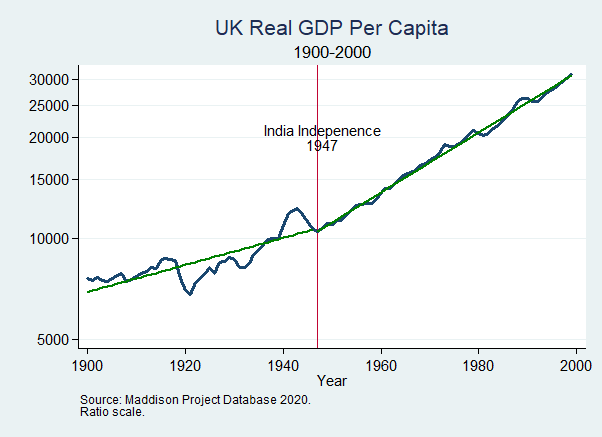
Orwell’s failed prediction stemmed from two reasons. First, he was imbued with zero-sum thinking. It should have been obvious that India was not necessary to the high standard of living enjoyed in England because most of that high standard of living came from increases in the productivity of labor brought about by capitalism and the industrial revolution and most of that was independent of empire (Most. Maybe all. Maybe more than all. Maybe not all. One can debate the finer details on financing but of that debate I have little interest.) The second, related reason was that Orwell had a deep suspicion and distaste for technology, a theme I will take up in a later post.
Orwell, who was born in India and learned something about despotism as a police officer in Burma, opposed empire. Thus, his argument that we had to be poor to be just was a tragic dilemma, one of many that made him pessimistic about the future of humanity.
Armin Rosen on the Saudi reforms
An excellent piece, to be read through in its entirety, here is one excerpt:
MBS is gambling that the fruits of openness and modernity can be reaped on Saudi terms, and that prosperity, stability, and a recharged, secularized sense of national purpose won’t shatter existing norms or generate dangerous civic appetites. The reforms have created a rising class of ambitious executives, entrepreneurs, and artists, and for now almost everyone seems to accept the idea of a national horizon defined by the wisdom and vision of a single family, and perhaps even a single man. His program has created an atmosphere muggy with floating potential, as the palace carries out an uncertain experiment on tens of millions of people. MBS’s subjects could be the engine and the beneficiaries of the only successful 21st-century governance project in any populous Middle Eastern state—or they could mark the disastrous limits of utopia declared from on high.
Recommended.
What I’ve been reading
Bjorn Lomborg’s Best Things First delivers the expected dose of correct common sense.
Charles Horsnby, Kenya, A History since Independence is a very good long treatment of everything up to about 2010, conceptual too.
David Schleicher, In a Bad State: Responding to State and Local Budget Crises. An important, unfortunately timely, and very intelligent book on how the federal government has responded to state and local insolvency in the past. My main complaint is that at 171 pp. of text it is far too short.
Norman Lebrecht, Why Beethoven: A Phenomenon in One Hundred Pieces. A good introduction to Ludwig van, even if some parts do rush by too quickly. Also a good introduction for how to think about different recorded versions of the same piece.
There is Markus K. Brunnermeier and Ricardo Reis, A Crash Course on Crises: Macroeconomic Concepts for Run-ups, Collapses, and Recoveries.
And also Angus Deaton, Economics in America: An Immigrant Economist Explores the Land of Inequality.
Kelly Smith offers his account of Prenda micro-schools in his A Fire to Be Kindled: How a Generation of Empowered Learners Can Lead Meaningful Lives and Move Humanity Forward.
Patrick Mackie, Mozart in Motion: His Work and his World in Pieces is a good introduction to what the title promises.
*The Corporation and the Twentieth Century*
The author is Richard N. Langlois, and the subtitle is The History of American Business Enterprise. 551 pp. of text. I’ve taught Ph.D Industrial Organization for a good while now, and have always wanted a text that provides an overview and introduction to U.S. business history, with sophistication and good economics, and without being out of date. This is that book, so I am happy indeed.