That was then, this is now, hail Nat Friedman edition!
We're using a particle accelerator and AI to read a lost library from a dead empire.
People have been trying to read the Herculaneum Papyri for 275 years.
With your help, we'll do it in 2023.
Thrilled to announce the Vesuvius Challenge:https://t.co/KYVyona2fW pic.twitter.com/Fl8o0kp1O6
— Nat Friedman (@natfriedman) March 15, 2023
Here is further commentary from Nat:”This is how you know we’re running low on training data…How would the ancient Romans feel if they knew that 2000 years later, we would be using particle accelerators and supercomputers to read their words, preserve them for eternity, and whisper them into the ear of a baby god?…Ascension”
Wednesday assorted links
How good is current stress testing?
To me, the biggest culprit in SVB’s failure is that the fed’s most severe stress test scenario in 2022 didn’t even consider the possibility of rising interest rates. Asleep at the wheel. pic.twitter.com/pidlaMUDnm
— Will Diamond (@wdiamond_econ) March 15, 2023
I know how easy it is for some of you to write your Op-Eds calling for more, more, more regulation, but banking is already a remarkably regulated sector. Maybe sometimes those regulations just don’t work so well. (I still recall the earlier call for “have them hold more government securities!”) And you can’t just blame that on the “plutocrats,” the “tech bros,” or whatever.
Not your grandfather’s crypto?
“Crypto prices soar on support for depositors” (FT)
Bitcoin and ether jump 20% in the last three days after US authorities intervene
I’ve said it before and I’ll say it again. Crypto is a “luxury,” long-term financial intermediation project which may or may not succeed. It comoves with the market, stability, low interest rates, and long time horizons. It is not a potential substitute for fiat currency.
A Major Shock Makes Prices More Flexible and May Result in a Burst of Inflation or Deflation
From the excellent Robert E. Hall:
The US and other advanced countries suffered bursts of severe inflation in 2021 and the first half of 2022, followed by declines of inflation later in 2022, in some countries. In times of high volatility of price determinants—cost and productivity—inflation can jump upward and fall downward at high speed, contrary to the uniformly sticky behavior associated with traditional Phillips curves. This paper establishes that sectors with standard New Keynesian price stickiness are vulnerable to rapid transitions from stickiness to flexibility, as sellers elect to reset their prices and abandon anchoring. The paper shows that the cross-industry volatility of price determinants grew substantially in the inflation episode accompanying the pandemic. Volatility remained elevated even in late 2022. The logic of the New Keynesian model of the Phillips curve links inflation to volatility, because a larger fraction of sellers are pushed out of their regions of inaction when volatility is elevated. The New Keynesian Phillips curve becomes much steeper in volatile times.
Here is the full NBER working paper. I also liked these sentences from the first page:
A seller in a more volatile environment will adopt policies that involve more frequent adjustments of the seller’s price, compared to one is a less volatile environment. Consequently, prices will respond more quickly to driving forces and the relation between inflation and driving forces will be steeper.
Very likely a part of the broader inflation story.
Ho hum (via Alex)
🚨 HUGE news in AI: Google just launched Generative AI across ALL of Google Workspace — Gmail, Docs, Sheets, Slides, Images — EVERYTHING.
They made a video showing off the new AI's capabilities. It's AWESOME. pic.twitter.com/bL9uxafrvW
— Ben Parr (@benparr) March 14, 2023
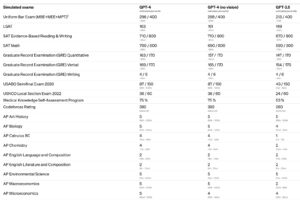
GPT-4
Tuesday assorted links
1. Open source LLMs? And more here. And running LLMs on consumer GPUs. And more.
2. Michael Jackson markets in everything.
3. Surveillance in the Danish welfare state (Wired).
4. Claim that the teen mental health dilemma started well before 2012.
5. LLMs vs. Chomsky. And more on Visual ChatGPT.
The Impact of AI on Productivity
We don’t yet know the impact that AI will have on productivity but some evidence is starting to come in. Peng et al. (2023) hired programmers on Upwork to write an HTTP server in Javascript; half of the programmers got access to CoPilot (this was before CoPilot was widely available) half did not.
Conditioning on completing the task, the average completion time from the treated group is 71.17 minutes and 160.89 minutes for the control group. This represents a 55.8% reduction in completion time. The p-value for the t-test is 0.0017, and a 95% confidence interval for the improvement is between [21%, 89%]. There are four outliers with time to completion above 300 min. All outliers are in the control group, however our results remain robust if these outliers are dropped. This result suggests that Copilot increases average productivity significantly in our experiment population. We also find that the treated group’s success rate is 7 percentage points higher than the control group, but the estimate is not statistically significant, with a 95% confidence interval of [-0.11, 0.25].
The authors extrapolate wildly:
In 2021, over 4.6 million people in the United States worked in computer and mathematical occupations,1 a Bureau of Labor Statistics category that includes computer programmers, data scientists, and statisticians. These workers earned $464.8 billion or roughly 2% of US GDP. If the results of this study were to be extrapolated to the population level, a 55.8% increase in productivity would imply a significant amount of cost savings in the economy and have a notable impact on GDP growth.
Still, worth thinking about.
The roots of misinformation fears?
Alarmist narratives about the flow of misinformation and its negative consequences have gained traction in recent years. If these fears are to some extent warranted, the scientific literature suggests that many of them are exaggerated. Why are people so worried about misinformation? In two pre-registered surveys conducted in the United Kingdom (Nstudy_1 = 300, Nstudy_2 = 300) and replicated in the United States (Nstudy_1 = 302, Nstudy_2 = 299), we investigated the psychological factors associated with perceived danger of misinformation and how it contributes to the popularity of alarmist narratives on misinformation. We find that the strongest, and most reliable, predictor of perceived danger of misinformation is the third-person effect (i.e. the perception that others are more vulnerable to misinformation than the self) and, in particular, the belief that “distant” others (as opposed to family and friends) are vulnerable to misinformation. The belief that societal problems have simple solutions and clear causes was consistently, but weakly, associated with perceived danger of online misinformation. Other factors, like negative attitudes toward new technologies and higher sensitivity to threats, were inconsistently, and weakly, associated with perceived danger of online misinformation. Finally, we found that participants who report being more worried about misinformation are more willing to like and share alarmist narratives on misinformation. Our findings suggest that fears about misinformation tap into our tendency to view other people as gullible.
That is from new work by Sacha Altay and Alberto Acerbi, via the excellent Kevin Lewis.
Machine Learning as a Tool for Hypothesis Generation
While hypothesis testing is a highly formalized activity, hypothesis generation remains largely informal. We propose a systematic procedure to generate novel hypotheses about human behavior, which uses the capacity of machine learning algorithms to notice patterns people might not. We illustrate the procedure with a concrete application: judge decisions about who to jail. We begin with a striking fact: The defendant’s face alone matters greatly for the judge’s jailing decision. In fact, an algorithm given only the pixels in the defendant’s mugshot accounts for up to half of the predictable variation. We develop a procedure that allows human subjects to interact with this black-box algorithm to produce hypotheses about what in the face influences judge decisions. The procedure generates hypotheses that are both interpretable and novel: They are not explained by demographics (e.g. race) or existing psychology research; nor are they already known (even if tacitly) to people or even experts. Though these results are specific, our procedure is general. It provides a way to produce novel, interpretable hypotheses from any high-dimensional dataset (e.g. cell phones, satellites, online behavior, news headlines, corporate filings, and high-frequency time series). A central tenet of our paper is that hypothesis generation is in and of itself a valuable activity, and hope this encourages future work in this largely “pre-scientific” stage of science.
Here is the full NBER working paper by Jens Ludwig and Sendhil Mullainathan.
Sentences to ponder
Big banks’ behavior this time has been shaped by the fallout from 2008. Why isn’t Dimon buying S.V.B.? He has complained about the headaches of buying Bear Stearns and Washington Mutual at the government’s behest in 2008, having spent years fighting litigation and paying fines for those firms’ bad behavior. Bank executives who were around back then remember that.
That is from Dealbook 2.0, NYT, via TO. File under “The Costs of Intervention and Regulation and Political Grandstanding are Higher than You Think.”
Monday assorted links
1. Contrarian perspective on the current Israeli disputes.
2. Running cognitive pipelines on cheap hardware. And additive prompting.
3. Maxims. 17th century, Hansonian.
4. Turkey fact of the day: “Turkey borders seven different countries all of which use different alphabets.” Significant.
5. Machine learning as a tool for hypothesis generation.
6. “This sea slug cut off its own head — and lived to tell the tale.” And readjusting our expectations about the Fed, future rate hikes, and presumably inflation as well. Be ready people.
Can the SVB crisis be solved in the longer run?
The failure and closure of Silicon Valley Bank (SVB) raise immediate issues as to how policymakers should react. I’d like to step back and consider what this implies for banking regulation more generally in the longer run. The main lesson is that successful bank regulation is an ongoing, dynamic problem, unintended secondary consequences are rife, and neither more regulation or less regulation can be guaranteed to succeed.
If you think of the FDIC/Fed/Treasury as a consolidated entity, the broader question is how many financial institution liabilities they should guarantee, whether explicitly or implicitly. Let us consider why in fact the government felt compelled to guarantee all of the deposits.
An unwillingness to guarantee all the deposits would satisfy the desire to penalize businesses and banks for their mistakes, limit moral hazard, and limit the fiscal liabilities of the public sector. Those are common goals in these debates. Nonetheless unintended secondary consequences kick in, and the final results of that policy may not be as intended.
Once depositors are allowed to take losses, both individuals and institutions will adjust their deposit behavior, and they probably would do so relatively quickly. Smaller banks would receive many fewer deposits, and the giant “too big to fail” banks, such as JP Morgan, would receive many more deposits. Many people know that if depositors at an institution such as JP Morgan were allowed to take losses above 250k, the economy would come crashing down. The federal government would in some manner intervene – whether we like it or not – and depositors at the biggest banks would be protected.
In essence, we would end up centralizing much of our American and foreign capital in our “too big to fail” banks. That would make them all the more too big to fail. It also might boost financial sector concentration in undesirable ways.
To see the perversity of the actual result, we started off wanting to punish banks and depositors for their mistakes. We end up in a world where it is much harder to punish banks and depositors for their mistakes.
Another unintended secondary consequence is that lots of funds would flow out of the banking system and into U.S. Treasuries. In other words, our private businesses would find it harder to borrow and our government would find it easier to borrow and thus government would command more resources. That hardly seems like a desirable outcome for a policy decision that had some initially libertarian motives.
Alternatively, you might think it is a simple way out for the government to guarantee all those deposits, as indeed was done last evening.
That decision too will prove to have unintended secondary consequences. Raising the FDIC protection limit from $250,000 to ??? raises political eyebrows in a dramatic manner. For one thing, the FDIC would then be seen as guaranteeing a much larger part of the financial system. Over time, the pressures for the government to protect yet additional parts of the financial system will grow, just as they did after the bailouts from the 2008-2009 financial crisis. Furthermore, if the FDIC keeps on increasing its protections in the quest for financial stability, that means a larger FDIC, a larger regulatory apparatus, perhaps higher capital requirements, and over time higher premia for banks to pay to the FDIC. (As a side note, worthy of another post, we are also hearing calls that somehow VCs need to be regulated now, if they are going to “receive bailouts”.)
As that scenario unfolds, there will be all the more incentives to supply more lending and also deposit-taking services outside the formal and more heavily regulated banking sector. Rather than pushing more resources into the larger banks, this policy would push additional resources outside the formal banking system altogether. That would mean less power, oversight and scrutiny from the Fed and also from other regulatory bodies. Typically American banks are more tightly regulated and monitored than are non-bank financial entities.
This kind of problem is likely to unfold slowly, but it is no less real. The initial policy was an expansion of FDIC regulatory authority, but the end result could well be less total regulation of lending and depository functions. Once again, the policy decision may fail at achieving its initially intended goals.
The core problem is this: regulators can only protect so much of the financial system. Yet in a wealthy, peaceful economy the financial system often grows more rapidly than does gdp, if only because the financial system is based on the intermediation of wealth, not income. Simple accumulation boosts the ratio of wealth to income over time, thereby creating regulatory dilemmas for finance. Neither “regulating more and more of it” nor “letting more and more of it continue in a less regulated manner” are entirely satisfactory solutions.
But those of course are the only options available to us.
“Authorities Reinstate Alcohol Ban for Aboriginal Australians”
Geoff Shaw cracked open a beer, savoring the simple freedom of having a drink on his porch on a sweltering Saturday morning in mid-February in Australia’s remote Northern Territory.
“For 15 years, I couldn’t buy a beer,” said Mr. Shaw, a 77-year-old Aboriginal elder in Alice Springs, the territory’s third-largest town. “I’m a Vietnam veteran, and I couldn’t even buy a beer.”
Mr. Shaw lives in what the government has deemed a “prescribed area,” an Aboriginal town camp where from 2007 until last year it was illegal to possess alcohol, part of a set of extraordinary race-based interventions into the lives of Indigenous Australians.
Last July, the Northern Territory let the alcohol ban expire for hundreds of Aboriginal communities, calling it racist. But little had been done in the intervening years to address the communities’ severe underlying disadvantage. Once alcohol flowed again, there was an explosion of crime in Alice Springs widely attributed to Aboriginal people.
Here is more from Yan Zhuang at the New York Times. Via Rich Dewey.