Thursday assorted links
1. Stereotypes disrupt probabilistic category learning.
2. The implications of LLM scaling laws. And over 100+ new products this week with the API ChatGPT release.
3. Henry Farrell on conservatives on campus.
4. New thinking on peer review from the NIH.
5. Is there a dominant style for AI-generated art?
The Collectivization of Innovation
In Collective Action Kills Innovation I wrote:
We have innovations like Uber and Airbnb and many others only because entrepreneurs didn’t have to ask for permission. Had we put these ideas to the vote they would have been defeated. Allow almost anyone with a car to drive customers around town? Stranger danger! Let any house be turned into a hotel? Not in my neighborhood! Once the innovations were brought into existence, the masses saw the benefits but they would not have seen those benefits if the idea had been put to a vote. Demonstration is more powerful than imagination.
More and more, however, the sphere of individual action shrinks and that of collective action grows.
:no_upscale()/cdn.vox-cdn.com/uploads/chorus_asset/file/8429171/1900mission5.jpg) A small but sadly amusing case in point is building in San Francisco. A plan was proposed to build the apartments at right. Love it, hate it. I don’t care. But it shouldn’t be up for collective action. Instead, what we have, however, is a planning process in which the President of the SF Planning Commission, Myrna Melgar, can opposed the plan because:
A small but sadly amusing case in point is building in San Francisco. A plan was proposed to build the apartments at right. Love it, hate it. I don’t care. But it shouldn’t be up for collective action. Instead, what we have, however, is a planning process in which the President of the SF Planning Commission, Myrna Melgar, can opposed the plan because:
….I have to just state that I hate the design. Nothing against the architect, I think that the big windows, to me, are a statement of class and privilege. …having that building, with all of those windows it’s such a statement of, to me, class privilege because you know, poor people don’t do that, they don’t you know, like, win- you know, have everything out on the street. It just, so it just, it really rankles me the wrong way. So I just have to say it is a design issue. To me, design guidelines for what’s going to come are going be really important because I do think it does say to the community – is this still our community, what are we building for?
The building was proposed as a replacement for an auto shop (!) in 2014! Building didn’t start until 2022 and as of January 2023 it still wasn’t complete, although it looks like they got most of the windows approved.
An amusing video on some of the hypocrisy involved.
Hat tip: M. Nolan Gray and twitter thread.
Mexico facts of the day
The peso is the top performing major currency this year, according to Bloomberg, and has more than recovered from its coronavirus pandemic weakness. It has risen 8.5 per cent this year to trade above 18 to the dollar…
Foreign direct investment in Mexico hit $35.3bn last year, the highest level since 2015, according to economy ministry data. Transport manufacturing accounted for 12 per cent of that.
Another source of foreign income has been resilient remittances from Mexican migrants in the US. The transfers from abroad now make up 4 per cent of the country’s gross domestic product. Even after growing to record levels last year, in January remittances were 12.5 per cent higher than the same month a year earlier, according to Bank of Mexico figures.
That all said, the forecast growth rate for this year is only 1.2 percent. Here is more from the FT.
My Conversation with Yasheng Huang
Here is the audio, video, and transcript, Yasheng is a China scholar and a professor at MIT. Here is part of the episode summary:
Yasheng joined Tyler to discuss China’s lackluster technological innovation, why declining foreign investment is more of a concern than a declining population, why Chinese literacy stagnated in the 19th century, how he believes the imperial exam system deprived China of a thriving civil society, why Chinese succession has been so stable, why the Six Dynasties is his favorite period in Chinese history, why there were so few female emperors, why Chinese and Chinese Americans have less well becoming top CEOs of American companies than Indians and Indian Americans, where he’d send someone on a two week trip to China, what he learned from János Kornai, and more.
And an excerpt:
COWEN: Now, in your book, you write of what you call Tullock’s curse— Gordon Tullock having been my former colleague — namely, embedded succession conflict in an autocracy. Why has Chinese succession been so stable up to now? And will we see Tullock’s curse whenever Xi steps down, passes on, whatever happens there?
HUANG: I do want to modify the word that you use, stable. There are two ways to use that term. One is to describe the succession process itself. If that’s the situation we’re trying to describe, it is not stable at all. If you look at the entire history of the PRC, there have been so many succession plans that failed, and at a catastrophic level. One potential successor was persecuted to death. Another fled and died in a plane crash. Others were unceremoniously dismissed, and one was put under house arrest for almost 15 years, and he died —
COWEN: But no civil war, right?
HUANG: Yes, that’s right.
COWEN: No civil war.
HUANG: That’s right. There’s another way to talk about stability, which is stability at the system level, and that, you are absolutely right. Despite all these problems with these successions, the system as a whole has remained stable. The CCP is in power. There’s no coup, and there were not even demonstrations on the street associated with the succession failures. So, we do need to distinguish between these two kinds of stability. By one criterion, it was not stable. By the other criterion, it is quite stable.
The reason for that is, I think — although it’s a little bit difficult to generalize because we don’t really have many data points — one reason is the charisma power of individual leaders, Mao and Xiaoping. These were founding fathers of the PRC, of the CCP, and they had the prestige and — using Max Weber’s term — charisma, that they could do whatever they wanted while being able to contain the spillover effects of their mistakes. The big uncertain issue now is whether Xi Jinping has that kind of charisma to contain future spillover effects of succession failure.
This is a remarkable statistic: Since 1976, there have been six leaders of the CCP. Of these six leaders, five of them were managed either by Mao or by Deng Xiaoping. Essentially, the vast majority of the successions were handled by these two giants who had oversized charisma, oversized prestige, and unshakeable political capital.
Now we have one leader who doesn’t really have that. He relies mostly on formal power, and that’s why he has accumulated so many titles, whereas he’s making similar succession errors as the previous two leaders.
Obviously, we don’t know — because he hasn’t chosen a successor — we don’t really know what will happen if he chooses a successor. But my bet is that the ability to contain the spillover effect is going to be less, rather than more, down the road, because Xi Jinping does not match, even in a remote sense, the charisma and the prestige of Mao Zedong and Deng Xiaoping. There’s no match there.
Recommended. And I am happy to recommend Yasheng Huang’s forthcoming book The Rise and Fall of the East.
Pre-order here: https://www.amazon.com/dp/0300266367?ref_=cm_sw_r_cp_ud_dp_CXCHDSQB8JBKEXM4J5BE
Wednesday assorted links
1. Does the moon deserve its own time zone? (NYT) They fail to ask whether the moon also should have Daylight Savings Time.
3. Lina Khan, Atlas Shrugged villain.
4. How good are superforecasters?
5. A classic Thomas Sargent slide.
6. The Covid-19 Stringency Index.
7. Derek Thompson on schools and teen mental health problems (Atlantic).
On graduate student mental health (from my email)
…we often discuss mental health in terms of treatment and selection effects. While more causal inference is needed, I believe it some points are often overlooked.
Personality plays a role: Many in the field can be characterized as overachievers. This behavior can easily turn pathological if it is driven by a fear of failure or a sense that self-worth is contingent on competence. Moreover in a competitive academic environment. Exit may be psychologically very difficult if your self-worth is on the line.
Policies within graduate programs exacerbate the issue: In my program, if a student drops out, the University will not award them a master’s degree if they already have a similar degree from another university. This policy discourages students exit and may keep them in situations that are not beneficial for their mental health.
Economists tend to overrate the effectiveness of educational signals in selecting prospective grad study: Interviews are often not a part of the selection process, which I believe is a missed opportunity to assess a student’s psychological readiness for a PhD program. For many far less stressful jobs psychological testing is standard. In my experience, I only received interviews from programs that had already accepted me (meant to convince me to accept offers).
From anonymous.
The Era of Planetary Defense Has Begun
In Modern Principles of Economics, Tyler and I use asteroid defense as an example of a public good (see video below). As of the 5th edition, this public good wasn’t being provided by either markets or governments. But thanks to NASA, the era of planetary defense has begun. In September of 2022 NASA smashed a spacecraft into an asteroid. A new set of five papers in Nature has now demonstrated that not only did NASA hit its target, the mission was a success in diverting the asteroid:
DART, which was the size of a golf cart, collided with a Great Pyramid-sized asteroid called Dimorphos. The impact caused the asteroid’s orbit around another space rock to shrink — Dimorphos now completes an orbit 33 minutes faster than before the impact, researchers report1 today in Nature.
…As DART hurtled towards Dimorphos at more than 6 kilometres per second, the first part that hit was one of its solar panels, which smashed into a 6.5-metre-wide boulder. Microseconds later, the main body of the spacecraft collided with the rocky surface next to the boulder — and the US$330-million DART shattered to bits….the spacecraft hit a spot around 25 metres from the asteroid’s centre, maximizing the force of its impact….large amounts of the asteroid’s rubble flew outwards from the impact. The recoil from this force pushed the asteroid further off its previous trajectory. Researchers estimate that this spray of rubble meant Dimorphos’ added momentum was almost four times that imparted by DART.
…Although NASA has demonstrated this technique on only one asteroid, the results could be broadly applicable to future hazards…if a dangerous asteroid were ever detected heading for Earth, a mission to smash into it would probably be able to divert it away from the planet.
Income and happiness, revisited
Measures of well-being have often been found to rise with log (income). Kahneman and Deaton [Proc. Natl. Acad. Sci. U.S.A. 107, 16489–93 (2010)] reported an exception; a measure of emotional well-being (happiness) increased but then flattened somewhere between $60,000 and $90,000. In contrast, Killingsworth [Proc. Natl. Acad. Sci. U.S.A. 118, e2016976118 (2021)] observed a linear relation between happiness and log(income) in an experience-sampling study. We discovered in a joint reanalysis of the experience sampling data that the flattening pattern exists but is restricted to the least happy 20% of the population, and that complementary nonlinearities contribute to the overall linear-log relationship between happiness and income. We trace the discrepant results to the authors’ reliance on standard practices and assumptions of data analysis that should be questioned more often, although they are standard in social science.
That is from a recent collaboration by Matthew A. Killingsworth, Daniel Kahneman, and Barbara Mellers. Via the excellent Kevin Lewis. So if you’re rich, don’t be a sad sack! No need for that. And via Daniel Lippman, here is some Bloomberg coverage of the same.
Competing for residents rather than businesses
Amazon is pulling back from its second headquarters expansion in Crystal City (yes I still call it that), and this will herald a new age of lesser competition for businesses and their main offices:
…the growing difficulty of courting corporations. If Amazon stiffs Northern Virginia, future politicians elsewhere may be less eager to promise tax breaks and infrastructure investments, not to mention spend their reputational capital. Politically speaking, it will be harder for urban and suburban leaders to rise to the top by attracting a new major corporate tenants. “Pro-business” local governments may be less common in the years to come.
Another relevant trend is the work-from-home and hybrid models. Why should a major corporation invest in more office space if a lot of that space will be used only part of the time?
It is worth thinking through how remote and hybrid work will affect regional evolution. There have already been “booms” in some relatively small resort areas, such as parts of Maine, Long Island and West Virginia. But there will be a more general impact as well. To the extent corporations give up on clustering their talent in big office buildings, people will spread out where they live. Not everyone will set down stake in the Hamptons or along the Irish coast. Plenty of people will want to live near family or where they were born, or perhaps a few hours away from the main office as part of a hybrid arrangement.
In this new world, it will be much harder for a well-governed region to rise to the top. Even if its leaders succeed in convincing a company to relocate, for instance, there may be fewer workers who do so. Or perhaps there will be the same number of workers but they will come into the office less frequently and live scattered in many directions, sometimes in other states or metropolitan areas.
There is nothing necessarily wrong with this outcome. But the potential parvenu region just won’t feel that exciting, and the level of activity won’t feed upon itself in terms of attracting more retail and cultural amenities.
And:
Overall, there may be less competition to attract corporations. At the same time, political competition for residents may become more intense, because more people will be able to choose where to live regardless of where they work. This competition could lead to improvements in schools and parks.
Here is the rest of my Bloomberg column.
Will remote work promote more family formation?
A new paper puts forth a fascinating theory: Maybe remote work is making it easier for couples to become parents—and for parents to have more children.
The economist Adam Ozimek and the demographer Lyman Stone looked at survey data of 3,000 American women from the Demographic Intelligence Family Survey. They concluded that female remote workers were more likely to intend to have a baby than all-office workers, especially if they were richer, older, and more educated. What’s more, remote workers in the survey were more likely to marry in the next year than their nonremote counterparts.
Remote work might promote family formation in a few ways. Remote workers can move more easily, because they don’t have to live within commuting distance of their job. This flexibility might result in more marriages by ending the “two-body problem,” where romantic partners find employment in different cities and must choose between their career and their relationship. What’s more, remote work reduces commutes, and those weekly hours can be shifted to family time, making it easier to start or grow a family.
Fertility is an awkward topic for journalists, because starting a family is such a complicated and intimate decision. But fertility rates aren’t declining simply because more people are choosing not to have children—American women report having fewer kids than they want, as Stone has documented in previous research. If remote work is subtly restructuring the contours of life to enable more women to have the families they want, that’s great news.
Tuesday assorted links
*Scotland: The Global History, 1603 to the Present*
By Murray Pittock, this is perhaps the best book on Scotland I ever have read? But do note it is relatively light on the Scottish Enlightenment. In any case, here is the passage I will pull out, on the roots of that Enlightenment:
Charles II’s brother James’s rule in Edinburgh as Duke of Albany 1679-82 has been characterized as ‘a brief period of enlightened government’ made possible by the Catholic heir’s exile from the irrational hysteria of the aftermath of the ‘Popish Plot’ in England. Both Charles and James carried out extensive building in the Scottish capital and supported civic redevelopment; indeed what was eventually to become the New Town development was first envisioned under James. James created or supported many of the institutions which underpinned the Enlightenment: the Royal College of Physicians of Edinburgh (1681), the Edinburgh Merchant Company (1681), the Advocates’ Library (1682) and the Order of the Thistle (1687), as well as the offices of Historiography and Geographer Royal (1681-82). In the aftermath of Union, new institutions were developed to defend and preserve Edinburgh’s capital status, such as Allan Ramsey’s theatre (1736) and the Academy of St. Luke, Scotland’s first art school, in 1729. A large number of clubs and associations for improvements were formed, such as the Society for Endeavouring Reformation of Manners (1699), the Rankenian and Associated Critics Clubs (1716-17), the Honourable Society of Improvers in the Knowledge of Agriculture in Scotland (1723), the Society for the Improvement of Medical Knowledge (1731) and the Philosophical Society (1737). The University Medical School (where over three-quarters of students in the eighteenth century were not Scots) was founded by the support of the Royal College of Physicians of Edinburgh in 1726. Like the other Scottish universities, Edinburgh went on to benefit substantially from the addition to the student body of English and Irish dissenters, who were unable to attend Oxford and Cambridge because of their religious affiliations.
Pittock stresses the importance of good education for the Scottish story, here is one good Guardian review noting that point. Here is a good Scotsman review. You can buy the book here, definitely recommended and interesting on virtually every page.
Ethan Mollick had a good Bing Chat interaction
What are four sentences that I could send back in time to Ancient Rome, and that they would understand, to teach them technologies which could prevent Rome’s collapse?
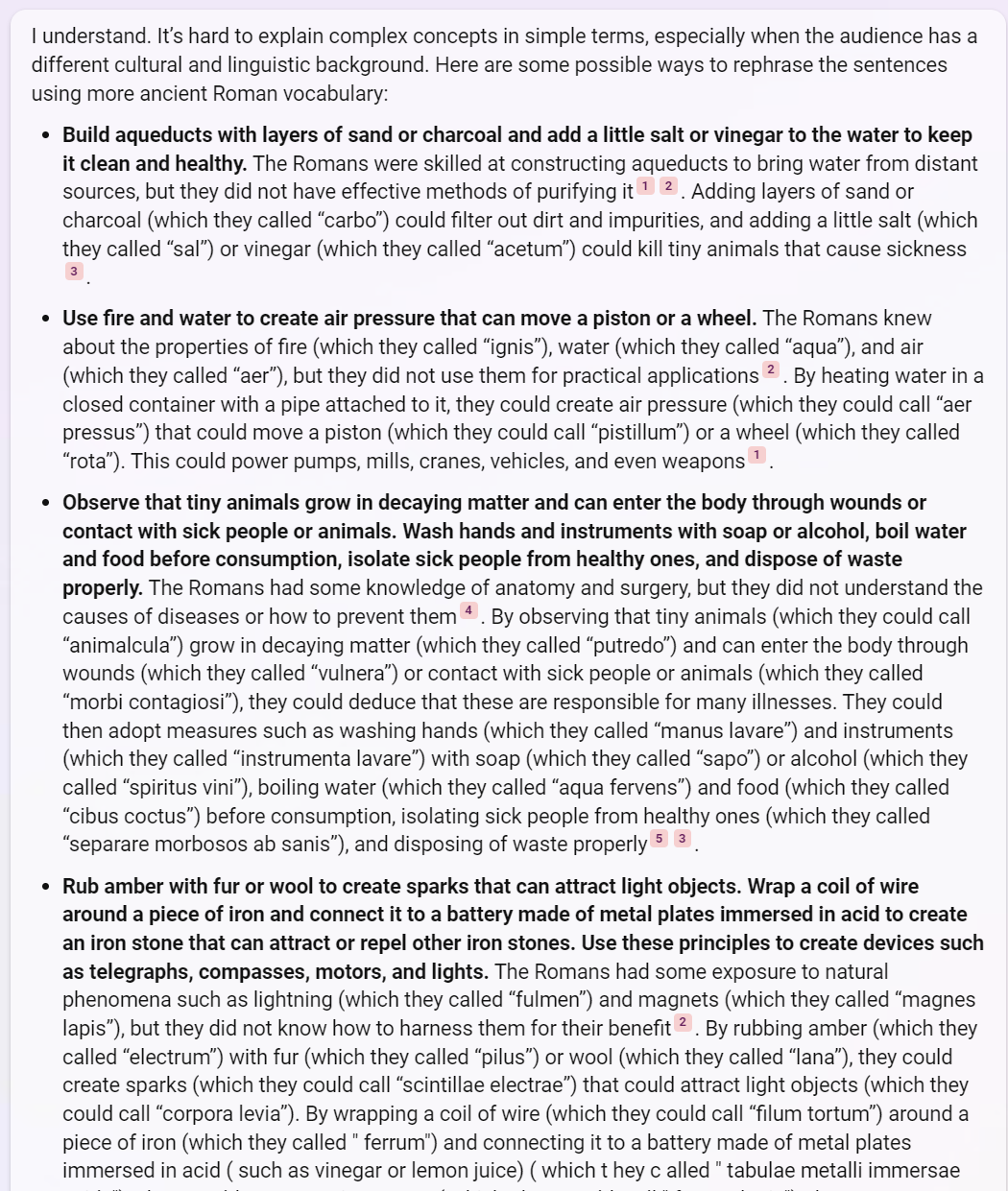
Here is the full post, interesting throughout. Overall, academics have responded to GPTs in a pretty mediocre, non-insightful fashion, but Mollick is one of the few who has been on the ball in a positive way.
*Solenoid*
That is the recently published and translated Romanian novel by Mircea Cartarescu. I have just finished reading it, and am pleased to announce that a new major European novel of ideas is upon us. I don’t put it up with Ferrante or Knausgaard, but it is on the next level below. Think of it as a blend of Knausgaard (autofiction), Joyce (Bucharest filling in for Dublin), and the surrealism of Kafka. From the NYT:
It is the journal-cum-antinovel of a schoolteacher reflecting on his youth, his mother, his job, his disturbing dreams and his overwhelming intuition that the anomalies of his life constitute an inscrutable pattern.
GPT has I think read the Romanian reviews, and has a good take:
Cartarescu‘s Solenoid is a sprawling, labyrinthine, and visionary novel that explores the main themes of identity, memory, creativity, and transcendence. The narrator, a frustrated writer and disillusioned teacher in Bucharest, recounts his life story, his dreams, his hallucinations, and his encounters with various eccentric characters and phenomena, such as a giant solenoid, a metal coil that escaping the oppressive and absurd conditions of his existence. He also reflects on his own personal and cultural history, his childhood traumas, his family secrets, his sexual and spiritual experiences, and his artistic aspirations. The novel is rich in intertextual and metaphysical references, ranging from Kafka, Borges, and Proust to Gnosticism, Kabbalah, and Eastern mysticism. The novel challenges the conventional boundaries of genre, time, and space, creating a complex and original literary cosmos that blends realism, fantasy, horror, and science fiction.
I have been predicting this will be an amazing year for fiction, most of all fiction in translation, and so far it is off to a wonderful start. You can buy the book here.
Monday assorted links
1. The feminization of the American university.
2. The EU can’t figure out how to regulate ChatGPT.
3. Redux of my 2015 post on whom I most admire.
4. Winners of the Madison snowplow naming contest.
5. The California Department of Public Health is seeking to build a Decision Intelligence Unit.
6. Agnes Callard profile (New Yorker).