Tajikistan fact of the day
Tajikistan’s remittances are worth nearly half the country’s GDP—
In Tajikistan, remittances — the money sent or brought back by migrants — amounted to 48% of GDP in 2024. The chart places this figure in context by comparing it with other countries with data for the same year. Nicaragua and Honduras receive remittances worth around a quarter of their GDP — high by global standards, but still far below Tajikistan’s level. Remittances here include two types of flows: money migrants abroad send home to their families, and money cross-border workers bring home from short-term jobs abroad.
Both of these flows play a role in Tajikistan, where most remittances come from labor migrants in Russia. In addition to the roughly 400,000 Tajiks settled there, hundreds of thousands more cross the border for seasonal and short-term work.
According to a report from the International Organization for Migration, about 1.2 million Tajiks were in Russia in mid-2024, which is more than a tenth of Tajikistan’s total population.
The World Bank’s latest Tajikistan Economic Update says that much of the country’s recent rapid economic growth (above 8% since 2021) was supported by these remittance inflows.
That is from Our World in Data, with a picture at the link.
Old space policy vs. new space policy
The emergence of firms like SpaceX and Blue Origin has made space a leading example of how private enterprise drives innovation, marking what many see as a sharp break between Old Space and New Space. Yet little systematic evidence documents when the transition to this new phase of space innovation occurred and which firms drove it. We use patent data to provide this measurement and find that the largest surge in space innovation occurred in the 1990s, coinciding with demand-side market creation, and preceding the entry of high-profile startups after 2005. Throughout this period and since, incumbent aerospace firms account for most of the space-related patenting, with entrants contributing a growing but minority share. The same geographic regions that dominated space innovation during the post-Apollo era remain dominant today. These patterns are consistent with directed technical change: incumbents direct R&D toward policy-created markets accessible from existing capabilities, while entrants bring science-based insights into domains requiring new paradigms. Our findings suggest that New Space is more closely connected to Old Space than prevailing narratives imply, and that government’s most consequential role in space innovation may lie in constructing appropriable markets. We make patent data on space-related technologies available for future research.
That is from a recent NBER working paper by
Tuesday assorted links
1. AI-written story published in Granta, wins major literary prize.
2. JFV on smart phones as accelerators of fertility declines.
3. Maryland markets in everything.
4. Polling Chinese on a top one hundred books.
5. From the excellent Samir Varma, could alien drone probes decelerate in time? And here is analysis from GPT.
6. “I am thrilled to announce the launch of Totei.com. Totei is a magazine devoted to craft and craftsmanship in all its forms. The name Totei comes from the ancient Japanese word for apprentice.” From Gaurav Kapadia.
Repugnant Economics
I spoke on a panel at AEI with Nobelist Al Roth about his new book, Moral Economics, which covers “repugnant markets,” from prostitution to surrogacy to kidney exchange. A fun book!
My case study was acting. Acting was considered repugnant for over 2,000 years. In Rome, actors could not vote, hold office, or be trusted to give an oath in legal proceedings. So why don’t we find acting repugnant today?
One lesson: weighing costs and benefits is not enough. Roth discusses empirical research showing that legalizing prostitution cut STDs and sexual assaults—against prostitutes and others. But evidence alone won’t shift a repugnance norm. You also have to reframe the activity. Acting, for example was reframed from body rental to a skill requiring intelligence, training and ability. So I went out of my way to say that I am a fan of Aella—though not her only fan—and that I see no reason why escorting should not be considered a skill, requiring intelligence, training, and ability. I can think of few better ways of raising social welfare than making sex 10% better!
I also spoke on human challenge trials. Roth and I agree: challenge trials could have sped up COVID vaccines and saved tens of thousands of lives. We should be angry this didn’t happen. Why didn’t it? Even though most people think human challenge trials are a good idea, there was a repugnance bottleneck because the minority who did find human challenge trials repugnant were in charge. I discuss how to change this.
Al leads the discussion. My comments start at 25:15.
“Wokeness has peaked. What followed is worse.”
That is the topic of my latest column for The Free Press. Excerpt:
It is important to distinguish between the positive side of wokeism and the unreasonable side. The positive side supported gay rights and discouraged racism in the public sphere. The unreasonable side brought us cancel culture, stifled discussion, insisted on very particular views of race and gender identity, boosted DEI and other race-discriminatory policies, and generally made America a more intolerant place. It was most of all about who had the right to steer the agenda of public discourse, and who had the right to push out dissenters.
The unreasonable side, since it was about power and control, had negative vibes built into its core. Fortunately, American society pushed back against many of the most objectionable manifestations of those negative vibes, but did we get rid of the negative vibes themselves? I do not think so. The American people still seem pretty low in trust, unhappy with America’s position in the world, glum about the economy and cost of living, and increasingly skeptical of both AI and billionaires. That is all happening at a time when the American economic situation, while mixed, is by no means as terrible as it was in, say, 2009. Happiness and mental health seem to be lagging behind the country’s actual achievements.
So what has been happening? The forces behind wokeism no longer command so much public attention and respect when they argue about terms and pronouns. Instead, left-adjacent movements have arisen with a contrasting emphasis on action, and often action of a terrible sort. California is considering, for instance, an unworkable tax on billionaires in the state, one that even most left-leaning Democratic politicians do not support. It might nevertheless pass through via referendum…
What’s more, it is possible we are entering an era with a new culture of assassinations. There have been assassinations of Charlie Kirk, of healthcare CEO Brian Thompson, and several attempts on the life of President Trump. It can be debated how many of these killers had direct connections to the political left, but it is hard to avoid the conclusion that left-wing rhetoric about democracy destruction helped make such actions conceivable.
The social energies of the American left have moved away from the realm of speech and into plans for concrete action, whether in politics, through attempted wealth confiscations, or through organizing violence. In retrospect, wokeism, for all its problems, was a relatively harmless way of distracting activists and keeping them Negative busy with wars over words—a less-bad allocation of social energies than what we are now seeing. So while I would not say I long for the return of high wokeism, I recognize it has been replaced by a left-adjacent movement that is worse.
Worth a ponder, do read the whole thing. I should note I do not let the right off the hook either, though the column is mainly about what has succeeded Wokeism. Negative emotional contagion has affected both the left and right wings today. Here is one simple case in point.
Monday assorted links
Who is losing out in marriage market competition?
Over the past half-century, U.S. four-year colleges have shifted from enrolling mostly men to enrolling mostly women, while the economic position of non-college men has weakened markedly. We examine how these changes correspond with the evolving structure of marriage markets across cohorts and places. As college men have become increasingly scarce, college women have maintained stable marriage rates by marrying high-earning non-college men. This shift—combined with the broader economic decline of non-college men—has sharply reduced the pool of economically stable partners available to non-college women: the share of non-college men who earn above the national median and are not married to college women has fallen by more than 50%. Cross-area evidence shows that education gaps in marriage are smaller where non-college men face lower rates of joblessness and incarceration. Taken together, the evidence suggests that deteriorating outcomes for men have primarily undermined the marriage prospects of non-college women.
That is from a new NBER working paper by
What else is special about southeastern Michigan? (from my email)
Thanks for swinging by Southeastern Michigan. He are two things other things that this area continues to produce and export at scale that don’t get as much notice:
* Mortgages – The two largest residential mortgage lenders are located in Detroit: United Wholesale Mortgage ($164B of mortgage originations for 2025) and Rocket Mortgages ($113B). It’s a fragmented industry, but to give you a sense of their comparative scale, Chase is #3 lender @ $66B in originations. Detroit continues to be the home of financial services for many Americans’ largest purchase.
* Food – Michigan, not NY or Italy, is responsible for the scaling of pizza. Domino’s, Little Caesar’s, and Jet’s were all founded in Southeastern Michigan. Domino’s is the largest pizza company in the world, and in many global markets, Domino’s defines “pizza.” For instance, Domino’s market share of pizza in the UK is over 50%. So, the UK has adopted Michigan’s, not Italy’s, understanding of pizza.
One narrative for Michigan should be that it has continued to shape global culture, through scaled production of mortgages and pizza. It doesn’t get more American than cars + mortgages + pizza, does it?
That is from Jeff Withington.
Why I am skeptical on the relationship between smart phones and fertility

That is from Alex Nowrasteh. And for some country by country graphs:

Here is that link. There might be some connection to smart phones, but it just does not seem that strong? Perhaps the phones give a fillip and a modest acceleration to an already in place trend? And are Kenya’s phones really all that “smart,” even today?
Sunday assorted links
1. University of Vermont enrollments expected to fall fifteen percent this year.
2, New NSF initiative, which seems set to bypass universities?
3. Are firms migrating from the US to Europe, or vice versa?
4. Soft tissue star injuries in the NBA are getting worse.
5. NY high school has 21 valedictorians all with A+ averages.
Dwarkesh in the Datacenter
Dwarkesh tours one of Jane Street’s datacenters. It’s extraordinary how much compute goes into finance. (I once predicted that the finance AIs would be the first to become conscious, since they have the most compute.) More generally, however, this is a peek inside the remarkable economics, technology and physics of a datacenter. Did you know the electrical signal in a copper wire can travel faster than light in fiber…and that matters! Amazing.
“Is the scientific enterprise too risk-averse?”
I participated in an Open to Debate debate at Johns Hopkins not too long ago, argued yes, and my side saw a twelve-point shift in our favor. Here are some links:
Links to the full debate:
-
YouTube: https://youtu.be/AuPz09dpLSc
Also to be broadcast over NPR.
South Korea facts of the day
When I was young, the South Korean model was generally lumped in with places like Taiwan, Singapore and Hong Kong as a case of “export-led growth”. Even in the early 1970s, South Korea was still poorer than the North. There was no consensus that East Asia would do better than Latin America (or indeed that America would do better than the Soviet Union.)
I hate the term “export-led growth”, as on its face it would seem to imply that South Korea got rich by running trade surpluses. But exactly the opposite is true. During the three and a half decades of near double-digit growth (roughly 1963-97), Korea ran almost nonstop trade deficits, apart from a few years in the 1980s. This graph is from an excellent Doug Irwin paper that discusses the Korean reforms of 1964-65…
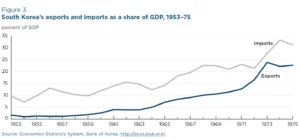
Here is more from Scott Sumner.
Revealing Life Preferences Through LLMs
Here is some Weberian verstehen (or is it?), but from unexpected quarters:
Large Language Models (LLMs) are trained on a prodigious corpus of human writing and may reveal human preferences over characteristics of life courses, such as income, longevity, and working conditions. We present OpenAI’s GPT-5.4 and a broadly representative sample of Americans with pairs of life stories and ask them to choose the life they would prefer for themselves. A person’s choice is better predicted by the LLM’s choice than by another person’s choice over the same stories, and LLM valuations of several life attributes are similar to those derived from human responses. Our results suggest that LLM responses offer a scalable and cost-effective complement to existing methods for studying human preferences.
That is from a new NBER working paper by