Xavier, Nick, and Tristan podcast with me
All three are from Queens College, I thought they did a great job, and mostly fresh material. They describe the episode as such:
Xavier, Tristan, and Nick talk about everything interesting under the sun, including aesthetic convergence, the probability that Tyler lives for many centuries, if Spain was the most culinarily optimal culture to colonize Mexico in the 16th century, if Tyler would have joined the fellowship of the ring, why we don’t yet have a GMU lunch podcast, and much more. We hope you have as much fun listening to it as we had recording it!
Recommended, this is a good argument for sometimes doing podcasts with semi-random people, though choose them wisely.
Wednesday assorted links
Some non-obvious reasons why AI will create some transitional problems in employment
I do not find the mass unemployment hypothesis persuasive, and I have covered this extensively in the past. But here are three other problems which may end up being noticeable in the short run, though likely absent longer term:
1. Many of the new jobs to be created may come in highly regulated sectors, and that will slow their creation. Energy and health care — especially biomedical trials — are two examples I have in mind here. Let’s say we opt for more nuclear power to ease constraints of compute — how long will it take for most of those jobs to come on line?
2. At least initially, job search and matching might be less efficient. We have lots of practice judging which workers are best for which jobs in a pre-AI world. But say most jobs involve working with AI in some manner? How well can actual HR departments judge who is good at that? Are the HR departments themselves even decent at that?
So expect slower matches, though at some point AI itself might give us better and faster labor market matches.
3. Government fiscal policy might be less effective at putting people to work in an efficient manner, given that the government is likely, at least for some while, to be a poor judge of who is good at working with AI. That may slow hiring, or lead to quicker dismissals and quits, or simply result is less output from the fiscal policy investments, thus making them less effective.
These features of the problem all could use a bit more consideration, and likely there are others I have not thought of.
Data centers are good
Data centers are the physical infrastructure behind cloud computing, artificial intelligence, and enterprise software. The rapid diffusion of artificial intelligence (AI) is intensifying demand for compute, accelerating investment in data centers, and raising concerns about the local economic and environmental footprint of these facilities. Their expansion creates a local policy tradeoff. A data center can bring capital investment, construction activity, and specialized employment, but it can also increase demand for electricity, land, and grid capacity. This paper studies these effects at the U.S. county level. We assemble a facility-level panel of global data centers with precise coordinates, scale metrics, and annualized revenue. We map facilities to U.S. counties and combine them with County Business Patterns, county-level IRS income, county-level house prices, and electricity prices. To address endogenous siting, we instrument for data center growth using two shift-share instruments, which leverage pre-existing proximity to InterTubes long-haul fiber nodes and the 1980 county share of U.S. urban college population as shares, and both Chinese and rest-of-the-world data center revenue growth as shifts. The IV estimates show positive effects on total employment, data-processing employment, construction employment, establishments, house prices, and electricity prices at different horizons after data center growth. We also find positive effects on tax returns, adjusted gross income, and wages, while annual payroll responds less robustly. The results suggest that data centers create measurable local activity, increase house prices, and affect local electricity markets through higher prices.
That is from a new NBER working paper by
Hollis Robbins on AI and higher education
There’s a growing idea I’ve seen in some circles that college could be replaced by conversations between an A.I. tutor and a student. When I think about your model, I wonder why college even needs to exist. If I can just seek out a tutor, somebody that I like, and they just charge me a little bit, and we go through these edge-knowledge cases together, what’s the degree for? Couldn’t you, as Hollis Robbins—not only a specialist in African American sonnet traditions but also an idiosyncratic thinker on the subject of A.I. and the future of the academy—just set up your own shop?
I was in Austin, Texas, a couple of times in March with a bunch of twenty-five-year-old billionaires. This is what they’re looking at. Instead of having the credential from the institution, why not have the credential from the professor? If you have a Hollis Robbins education, what would that signal? What would that credential mean as opposed to a degree from a university? There was some conversation about what that would look like, and one guy at the end of the dinner said, “Instead of OnlyFans, it’s like OnlyProfessors.”
Here is much more from The New Yorker.
Tuesday assorted links
1. Is it too expensive to sell a house? (NYT)
2. Sumner on Halperin on macro.
3. Why progress under Milei has stalled (WSJ).
4. Why is Latin America so violent?
5. Diet Coke parties are the rage in India.
6. Optimizing AI models for creativity. “They simply have not done it yet” is one of the most useful phrases to keep in your mind these days.
Ideas Behind Their Time: Part Two
In 2010 I wrote about Ideas Behind Their Time:
We are all familiar with ideas said to be ahead of their time, Babbage’s analytical engine and da Vinci’s helicopter are classic examples. We are also familiar with ideas “of their time,” ideas that were “in the air” and thus were often simultaneously discovered such as the telephone, calculus, evolution, and color photography. What is less commented on is the third possibility, ideas that could have been discovered much earlier but which were not, ideas behind their time.
I gave experimental economics, random clinical trials and view morphing (“bullet time”) as examples. Jason Crawford has a list discussing the wheel, the steam engine and bicycles among other possibilities. In some cases, further exploration indicates that an idea required precursors and so was not as behind its times as first suspected, in rare cases, however, good ideas really could have been invented much earlier.
Using Claude, Brian Potter has significantly expanded the list by looking systematically across a wide range of inventions and asking could they have been invented earlier? Most could not. Put the other way, most useful technologies tend to be invented quite quickly once they are possible–this is reassuring. The airplane, for example, could not have been invented before a high power-to-weight engine, which happened circa 1880 making the late 1880s the earliest feasible date for powered flight. Thus, the Wright Brothers (1903) were only just behind the earliest feasible date–and that is true for many inventions.
The ideas very far behind their time include the stethoscope, general anesthesia and reinforced concrete and quite far behind are the Jacquard loom and canning. Is there a pattern here?
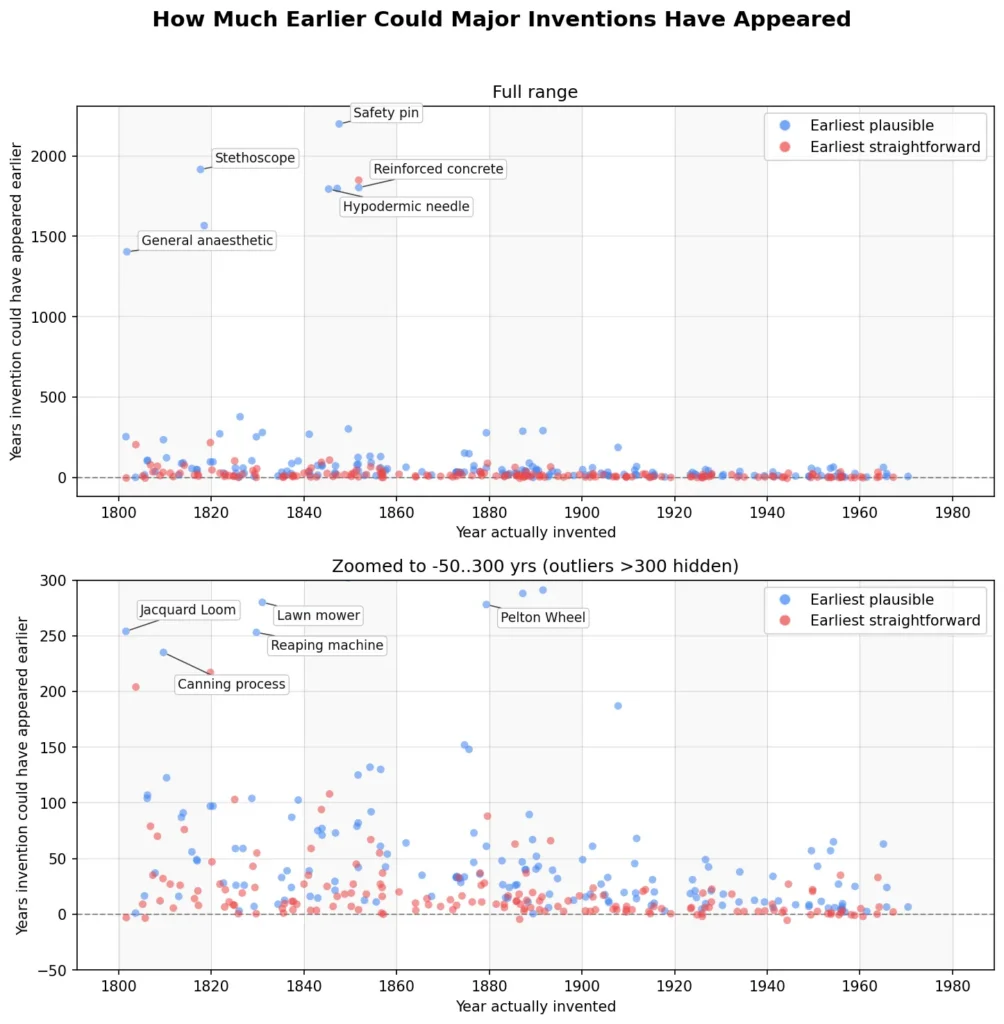
Addendum: Brian’s Github with the full prompt and output for each invention is here.
Early evidence on school smartphone bans and mental health
The word “early” is appropriate here and is to be stressed, nonetheless I am not surprised by these results, given the relative impotence of treatment effects in so many settings:
To provide causal evidence of the effects of these bans, I rely on synthetic difference-in-difference models and the National Survey of Children’s Health (NSCH) from 2016 to 2024. Currently, there are data for only one state with two post-ban periods and two states with one post-ban period, which makes the results preliminary evidence only. The outcome variables are screentime and measures of psychological wellbeing. Overall, these early results provide no clear evidence that the school ban policy reduced screentime or improved psychological wellbeing.
That is from a recent NBER working paper by Henry Saffer.
Using agents to build economic datasets
Constructing datasets from primary sources is one of the costliest tasks in empirical economics. We propose Deep Research on a Loop (DRIL), a methodology that uses AI agents to assemble datasets from publicly available sources. DRIL applies a fixed research instrument across a mapped unit space (e.g., countries by years), with a two-stage architecture separating design from implementation. The instrument specifies variables and coding rules, an evidence policy governs sources and citations, and data quality mechanisms track gaps and uncertainty explicitly. We exercise DRIL on a 2025 update of the Global Tax Expenditures Database for eight Latin American and Caribbean countries. The run produces 129 sources and 136 evidence records, covering 22 qualitative fields fully and 6 quantitative estimate types with documented gaps, at the cost of a standard LLM subscription comparable to a few hours of research-assistant work. We argue that even partial automation of dataset construction can shift the production function of empirical economics.
That is from a new NBER working paper by
Why are stock prices still so high?
That is the topic of my latest Free Press column, here is one excerpt, with the general theme that plenty is going well in the global economy:
A second important fact is that American presidents, whether Democrat or Republican, usually have very little influence on the economy. That is a hard truth for people to hear, since partisan sentiments often run strong, especially when it comes to President Trump. Yet the research literature is clear that most business cycles are not caused by presidents.
As for the current cycle, the core reality is that our economy continues to hum along. Yes, gas prices above $4 a gallon cause dismayed news stories and consumer worry. But energy prices have less influence on the overall economic picture than they once did. The chances of a recession have been falling, and a recent jobs report showed strong progress in hiring.
Of course the Trump administration will take credit for such developments, but mostly they are due to underlying structural factors.
And this:
During the current war, many parts of the global economy have shown more resilience and fortitude than might have been expected. Stocks in South Korea at first plummeted 20 percent, due largely to its dependence on Middle Eastern oil. Today, the Korean stock market, pushed along by the chip-making achievement of Samsung and memory maker SK Hynix, is reaching new highs.
…In previous times, sharp oil price hikes often brought catastrophe to the economies of Latin America. These days Latin American government bonds have held up well and are even considered a safe haven.
Recommended.
Monday assorted links
1. Why Dunkin’ Donuts failed in India.
2. Rents in the Middle East, and is the region less dependent on oil than before? And why is Jordan still relatively stable in economic terms?
3. Kakistocracy, the pending Richard Hanania book.
4. Brad Mehldau defends Billy Joel. Slowly, but even I am being brought around to this position.
5. Kurtis Hingl on the future of research papers: “But this will evolve to a demand-side system where “papers” are accompanied by a platform of all the tools used in the process, and the reader will ask their AI their “what if we did X instead of Y, does that change the estimate?” Like if I were reading an experimental chemistry paper, and it came with a pre-set lab with all the ingredients, a lab director and assistants, and I could ask them as I read the paper, “what if we tweaked the proportions by X?” and they did it right there in front of me and together we saw the outcome.”
6. Yes China understands their security risks from ChatGPT and other LLMs.
Another use of AI in research (from my email)
“Another thing we (John [Horton] and I) have thought about is having a swarm of AIs “fight” over a literature. They could take the cumulative datasets available and continuously argue until they understand the question. One line of thinking says they reach a stalemate (as scientists currently do). But we think not. More likely, they push evidentiary understanding to the limit and coalesce around what’s most probable — if not definitive!”
That is from Benjamin Manning.
The interstate trade effects of autonomous trucks
Recent advances in autonomous and semi-autonomous vehicle technologies promise substantial cost savings for goods shipped by truck. In this study, we quantify the impacts of these transport cost reductions on the US interstate trade using a structural gravity model of domestic trade. Based on projected cost savings from the widespread adoption of self-driving technologies, we estimate significant increases in total interstate trade value. State-level impacts vary from 40.3% of GDP in Mississippi to 5.9% in Florida, while the largest impacts in dollar value are observed in Texas and New York. The sectoral analysis highlights motorized vehicles, mixed freight, and electronics as the industries experiencing the largest trade value growth. Additionally, goods with low value-to-weight ratios—where shipping costs represent a large share of the delivered value—are expected to benefit most in relative terms. These findings underscore the transformative potential of autonomous vehicle technologies in reshaping US trade patterns and sectoral dynamics.
That is from a recent paper by Taejun Mo, et.al., via the excellent Kevin Lewis.
USA sectoral shift fact of the day
Healthcare and Social Assistance have added nearly 1.8 million private-sector jobs in the US since the end of 2023 while all of other industries combined have lost 127,800 jobs.
Here is the source (Charlie Bilello) and a graph. In relative terms, is this good or bad for men?
Sunday assorted links
1. What should be our Bayesian priors on von Neumann probes?
2. AI book mirrors.
3. Why power in Spain is so cheap.
4. The comments on Mick West here are pretty tough. We still do not know what it is, and yes the national security people have pondered these questions in advance. Most broadly, trust people who are in “explorer mode,” not debunker mode. Debunker mode is tempting, because you often end up right, and feeling good about yourself, but it also means you miss big discoveries when they come along.
5. More on the cell phone ban study.
6. Technological breakthroughs and the progress of science. The early papers based on digital computing techniques did very, very well, at least on average.