Tuesday assorted links
1. Chinese temples are being transformed into consumption opportunities, https://www.sixthtone.com/news/1017275
2. Andrew Batson visits India, https://andrewbatson.com/2025/07/27/india-and-the-invidious-comparison-with-china/
3. New paper on the economics of stablecoins, https://www.nber.org/papers/w34066#fromrss
4. Dan Wang on Breakneck, a new letter, https://danwang.co/breakneck/
5. What does YIMBY for Africa look like?, https://asteriskmag.com/issues/11/yes-in-my-bamako-yard
6. Ads in AI are OK, https://www.strangeloopcanon.com/p/yes-ads-are-inevitable-in-ai-its
7. It is not just selection, owning a small business makes people more conservative and more skeptical about government regulation, https://www.cambridge.org/core/journals/british-journal-of-political-science/article/politics-of-small-business-owners/492835B42B70C24F6613B352E4C3B83E
8. Long piece on Xi and Xi and power, https://jamestown.org/program/terminal-authority-assessing-the-ccps-emerging-crisis-of-political-succession/
A household expenditure approach to measuring AI progress
Often researchers focus on the capabilities of AI models, for instance what kinds of problems they might solve. Or how they might boost productivity growth rates. But a different question is to ask how they might lower cost of living for ordinary Americans. And while I am optimistic about the future prospects and powers of AI models, on that particular question I think progress will be slow, mostly though through no fault of the AIs.
If you consider a typical household budget, some of the major categories might be:
A. Rent and home purchase
B. Food
C. Health care
D. Education
Let us consider each in turn. Do note that in the longer run AI will do a lot to accelerate and advance science. But in the next five years, most of those advances may not be so visible or available. And so I will focus on some budgetary items in the short run:
A. When it comes to rent, a lot of the constraints are on the supply side. So even very powerful AI will not alleviate those problems. In fact strong AI could make it more profitable to live near other talented people, which could raise a lot of rents. Real wages for the talented would go up too, still I would not expect rents to fall per se.
Strong AI might make it easier to live say in Maine, which would involve a de facto lowering of rents, even if no single rental price falls. Again, maybe.
B. When it comes to food, in some long run AI will genetically engineer better and stronger crops, which in time will be cheaper. We will develop better methods of irrigation, better systems for trading land, better systems for predicting the weather and protecting against storms, and so on. Still, I observe that agricultural improvements (whether AI-rooted or not) can spread very slowly. A lot of rural Mexico still does not use tractors, for instance.
So I can see AI lowering the price of food in twenty years, but in the meantime a lot of real world, institutional, legal, and supply side constraints and bottlenecks will bind. In the short run, greater energy demands could well make food more expensive.
C. When it comes to health care, I expect all sorts of fabulous new discoveries. I am not sure how rapidly they will arrive, but at some point most Americans will die of old age, if they survive accidents, and of course driverless vehicles will limit some of those too. Imagine most people living to the age of 97, or something like that.
In terms of human welfare, that is a wonderful outcome. Still, there will be a lot more treatments, maybe some of them customized for you, as is the case with some of the new cancer treatments. Living to 97, your overall health care expenses probably will go up. It will be worth it, by far, but I cannot say this will alleviate cost of living concerns. It might even make them worse. Your total expenditures on health care are likely to rise.
D. When it comes to education, the highly motivated and curious already learn a lot more from AI and are more productive. (Much of those gains, though, translate into more leisure time at work, at least until institutions adjust more systematically.). I am not sure when AI will truly help to motivate the less motivated learners. But I expect not right away, and maybe not for a long time. That said, a good deal of education is much cheaper right now, and also more effective. But the kinds of learning associated with the lower school grades are not cheaper at all, and for the higher levels you still will have to pay for credentialing for the foreseeable future.
In sum, I think it will take a good while before AI significantly lowers the cost of living, at least for most people. We have a lot of other constraints in the system. So perhaps AI will not be that popular. So the AIs could be just tremendous in terms of their intrinsic quality (as I expect and indeed already is true), and yet living costs would not fall all that much, and could even go up.
Monday assorted links
1. For a start, so many people then are smoking and have PTSD.
2. Oops (music video).
3. Alpha school spreading? (NYT), https://www.nytimes.com/2025/07/27/us/politics/ai-alpha-school-austin-texas.html?smid=nytcore-ios-share&referringSource=articleShare
4. Dire results on inequality in South Africa, https://x.com/manysheva_k/status/1948833739230118077?s=61
5. The surprising durability of Africa’s colonial borders, https://www.noemamag.com/the-surprising-durability-of-africas-colonial-borders/
6. O3 on Edwardian naval fire clock computers, https://chatgpt.com/share/68865e84-7358-8010-8343-e99d050565a1
The Rising Cost of Child and Pet Day Care
Everyone talks about the soaring cost of child care (e.g. here, here and here), but have you looked at the soaring cost of pet care? On a recent trip, it cost me about $82 per day to board my dog (a bit less with multi-day discounts). And no, that is not high for northern VA and that price does not include any fancy options or treats! Doggie boarding costs about about the same as staying in a Motel 6.
Many explanations have been offered for rising child care costs. The Institute for Family Studies, for example, shows that prices rise with regulations like “group sizes, child-to-staff ratios, required annual training hours, and minimum educational requirements for teachers and center directors.” I don’t deny that regulation raises prices—places with more regulation have higher costs—but I don’t think that explains the slow, steady price increase over time. As with health care and education, the better explanation is the Baumol effect, as I argued in my book (with Helland) Why Are the Prices So Damn High?
Pet care is less regulated than child care, but it too is subject to the Baumol effect. So how do price trends compare? Are they radically different or surprisingly similar? Here are the two raw price trends for pet services (CUUR0000SS62053) and for (child) Day care and preschool (CUUR0000SEEB03). Pet services covers boarding, daycare, pet sitting, walking, obedience training, grooming but veterinary care is excluded from this series so it is comparable to that for child care.
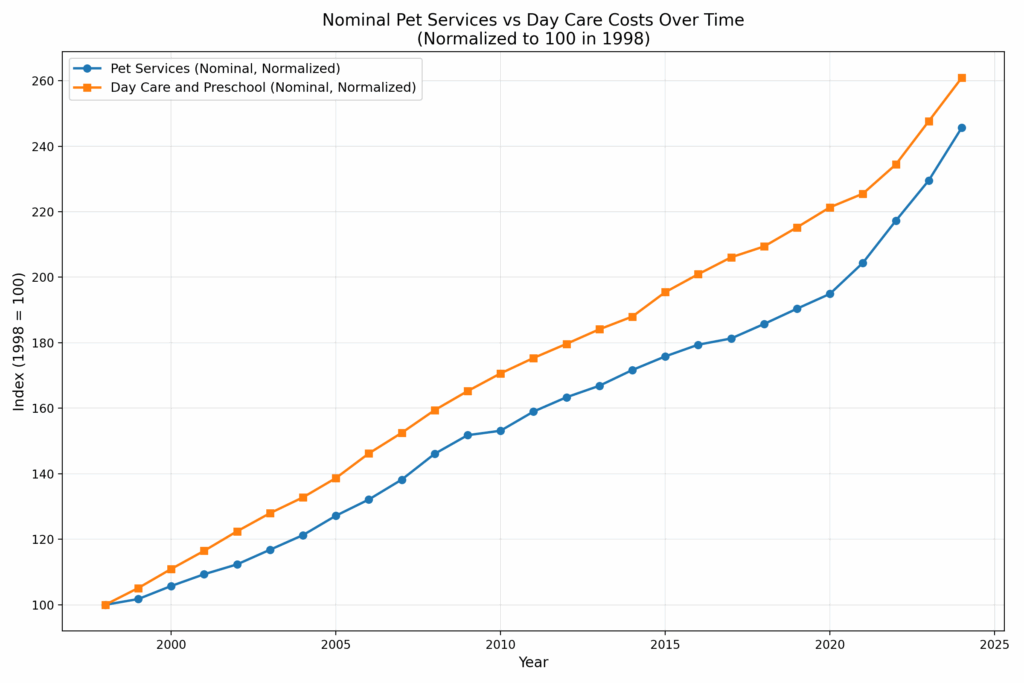
As you can see, the trends are nearly identical, with child care rising only slightly faster than pet care over the past 26 years. Of course, both trends include general inflation, which visually narrows the gap. When we normalize to the overall CPI, we get the following:
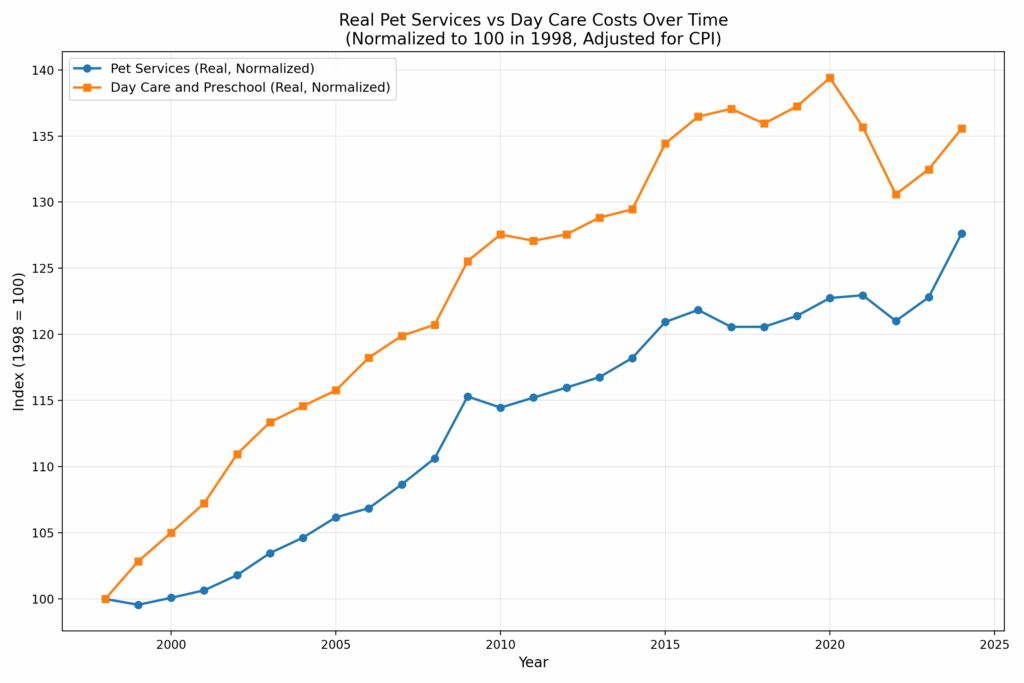
Over 26 years, the real (relative) price of Day Care and Preschool has increased 36%, while Pet Services have risen 28%. If regulation doesn’t explain the rise in pet care costs–and it probably doesn’t–then regulation probably doesn’t explain the rise in child care costs either. After all, child and pet care are very similar goods!
The similar rise in the price of child day care and pet day care/boarding is consistent with Is American Pet Health Care (Also) Uniquely Inefficient? by Einav, Finkelstein and Gupta, who find that spending on veterinary care is rising at about the same rate as spending on human health care. Since the regulatory systems of pet and human health care are very different this suggests that the fundamental reason for rising health care isn’t regulation but rising relative prices and increasing incomes (fyi this is also an important reason why Americans spend more on health care than Europeans).
Thus, my explanation for rising prices in child care and pet care is that productivity is increasing in other industries more than in the care industries which means that over time we must give up more of other goods to get child and pet care. In short, if productivity in other sectors rises while child/pet care productivity stays flat, relative prices must rise. Another way to put this is that to retain workers, wages in stagnant-productivity sectors must rise to match those in (equally labor-skilled) high-productivity sectors. That means paying more for the same level of care, simply to keep the labor force from leaving
But rising productivity in other sectors is good! Thus, I always refer to the Baumol effect rather than the “cost disease” because higher prices are not bad when they reflect changes in relative prices. As with education and health care the rising price of child and pet care isn’t a problem for society as whole. We are richer and can afford more of all goods. It can be a problem, however, for people who consume more than the average quantities of the service-sector goods and people who have lower than average wage gains. So what can we do? Redistribution is one possibility.
If we focus on the prices, the core problem is that care work is labor-intensive and labor has a high opportunity cost. One solution is to lower the opportunity cost of that labor. Low-skill immigration helps: when lower-wage workers take on support roles, higher-wage workers can focus on higher-value tasks. As I’ve put it, “The immigrant who mows the lawn of the nuclear physicist indirectly helps to unlock the secrets of the universe.” Same for the immigrant who provides boarding for the pets of the nuclear physicist.
Another solution is capital substitution—automation, AI, better tools. But care jobs resist mechanization; that’s part of why productivity growth is so slow in these sectors. Still, the basic truth remains: if we want more affordable day care—for kids or pets—we need to use less of what’s expensive: skilled labor. That means either importing more people to do the work, or investing harder in ways to do it with fewer hands.
*The Price of Victory*
The author is N.A.M. Rodger, and the subtitle is A Naval History of Britain, 1815-1945. An excellent book, volume three in a longer series. Here is one excerpt:
…the most significant of all material innovations of the nineteenth century was virtually invisible. It took twenty-five years of investment and some heavy losses, but the completion of the first reliable transatlantic telegraph cable in 1866 may be taken to mark the moment when intercontinental communication times fell instantaneously from months to hours. Contemporaries talked enthusiastically of the ‘practical annihilation of time and space,’ and for an imperial and naval power with more time and space to handle than anyone else, the submarine cable was truly revolutionary. This different and expensive technology offered secure communications almost invulnerable to interference (except in shallow water). Britain possessed most of the world’s capacity to manufacture underwater cables, had an effective monopoly of Gutta percha, the only good insulator, trained the majority of the world’s cable operators, owned (in 1904) more than twice as many cable-laying ships as the rest of the world put together, and alone had mastered the difficult art of recovering and repairing cables in deep water. The high fixed costs, advanced technology and very long life (seventy-five years on average) of undersea cables made it extremely difficult for foreigners to break into this monopoly.
I will be buying and reading other books by this author, as this is one of the very best books of this year.
My first students
To continue with some biography…
My first full-time teaching job was at UC Irvine in 1988, a school with very good undergraduate students, including in economics. I was fortunate enough to be assigned Honors Intermediate Micro for my very first class.
(My general view is that the second time I teach a given class is the best, but the very first time is the second best version of the class. After that, unless I have a break of years, some of the material starts to feel too familiar to me, and I explain it less well and with less enthusiasm.)
I used the Nicholson text, as it had been pre-assigned, but I wished it had more economic intuition.
In any case I had seventeen students, and sixteen of them were Asian or Asian-American. None of them were south Asian. That was UC Irvine in those days (and perhaps still now?).
All but perhaps one were very good students.
That first year in my first class I was lucky enough to teach Stephen Jen. Stephen, as you may know, later received a PhD from MIT, working with Paul Krugman. He is these days a famous and highly respected currency analyst (among other things), and you will see his name often in the Financial Times. He lives in London, and he and I had dinner but a few weeks ago.
Stephen at first was going to do electrical engineering, but it turned out economics was his true love. I encouraged him to apply to graduate school, and wrote a very positive letter for him to MIT. The rest is history, as they say.
I spent a good bit of time with Stephen outside of class, and even played basketball with him several times. The summer of 1988 I also stayed with his family in Taipei, during a long Asia trip that I will write about some other time.
Most recently, Stephen has been known for having an early and very good call that the USD is going to decline, as indeed it did.
My second year at UC Irvine I taught the same class again. I was lucky enough to have Jeffrey Ely in my class, and of course he did very well. Jeff ended up studying for an economics PhD at UC Berkeley.
These days Jeff is a very well-known game theorist at Northwestern, arguably the number one school for game theory. He took a more traditional academic path, whereas Stephen started at the IMF and then worked his way up through the world of finance.
Jeff for a while even had a presence in the blogosphere, and still you will find him on Twitter, though he has not posted in the last year. In game theory, Jeff is highly creative and he approaches all problems by thinking like an economist.
As a person, he was always a bit more “hippie” than was Stephen, and I recall him giving me a tape of the Bob Dylan song “Million Dollar Bash,” from The Basement Tapes.
At George Mason, my best undergraduates often have been Chinese, but in terms of professional impact those are my two most successful undergraduate students ever. Getting to know and teach them was one of the very best things about being at UC Irvine. My colleagues were great too, but that is the subject of another post.
Not many links for the next two days or so
I am for a short while separated from my laptop, and I find links harder and slower to do through other means. So for a brief while not many links here.
Links will resume in due time, in the meantime enjoy the plain text, etc.
Tom Lehrer, RIP
Sunday assorted links
Claims about DOGE and AI
The tool has already been used to complete “decisions on 1,083 regulatory sections” at the Department of Housing and Urban Development in under two weeks, according to the PowerPoint, and to write “100% of deregulations” at the Consumer Financial Protection Bureau (CFPB). Three HUD employees — as well as documents obtained by The Post — confirmed that an AI tool was recently used to review hundreds, if not more than 1,000, lines of regulations at that agency and suggest edits or deletions.
Here is the full story, I will keep you all posted…
Saturday assorted links
Friday assorted links
USA fact of the day
You know what’s cool… a quadrillion tokens. We processed almost 1,000,000,000,000,000 tokens last month, more than double the amount from May.
That is from Demis Hassabis. And here is Demis discussing his own work schedule.
Partisan Bias in Professional Macroeconomic Forecasts
Here is a recent paper by Benjamin S. Kay, Aeimit Lakdawala, and Jane Ryngaert:
Using a novel dataset linking professional forecasters in the Wall Street Journal Economic Forecasting Survey to their political affiliations, we document a partisan bias in GDP growth forecasts. Republican-affiliated forecasters project 0.3-0.4 percentage points higher growth when Republicans hold the presidency, relative to Democratic-affiliated forecasters. Forecast accuracy shows a similar partisan pattern: Republican-affiliated forecasters are less accurate under Republican presidents, indicating that partisan optimism impairs predictive performance. This bias appears uniquely in GDP forecasts and does not extend to inflation, unemployment, or interest rates. We explain these findings with a model where forecasters combine noisy signals with politically-influenced priors: because GDP data are relatively more uncertain, priors carry more weight, letting ideology shape growth projections while leaving easier-to-forecast variables unaffected. Noisy information therefore amplifies, rather than substitutes for, heterogeneous political priors, implying that expectation models should account for both information rigidities and belief heterogeneity. Finally, we show that Republican forecasters become more optimistic when tax cuts are salient in public discourse, suggesting that partisan differences reflect divergent beliefs about the economic effects of fiscal policy.
Here is the SSRN link.
What should I ask George Selgin?
Yes, I will be having a Conversation with him, live at the Cato Institute on September 26th, here is some basic information:
Website: https://www.cato.org/events/false-dawn-new-deal-promise-recovery-1933-1947
Registration: https://register.cato.org/false-dawn-new-deal-promise-recovery-1933-1947/register
We will start with George’s new and excellent book False Dawn: The New Deal and the Promise of Recovery 1933-1947. But of course George has a long and distinguished record in monetary economics, free banking, macro, and ngdp ideas, as well as productivity norms for monetary policy.
So what should I ask him?