Emergent Ventures India, 15th cohort
Adnan Abbasi, 25, founder of Thothica, received his grant to add an archive reader to make rare historical texts accessible using AI-powered translation. Also check out his AI generated debate between Nehru and Hayek.
Dheemanth Reddy, co-founder of Maya Research, received his grant to build Veena – cutting-edge speech models for English and Indian languages as naturally spoken by Indians.
Ritisha Sethi, 16, a high schooler from Lucknow, received her grant to develop Qubit Quest, her solution to help learn quantum computing through gamification.
Jnanendra K S received his grant to convert vintage cars to EVs in his automotive mechanic shop.
Sankalp Shrivastava, 21, self-taught developer and entrepreneur from Bhopal, received his grant for general career development.
Bharath H G received his grant to build a robotic system safely cleaning manholes remotely.
Sarthak Pandit, an engineering student, received his grant for building a wireless drone recharging system to eliminate manual battery swaps.
Namrata Rajagopal received her grant for Exception Raised – a grants program to enable India’s AI research ecosystem through funding, community, and mentorship. Check out their first cohort.
CEDA (Center for Economic Data and Analysis) at Ashoka University, received a grant to build the Economic Enterprises Tool, to integrate datasets delivering harmonized indicators across India’s enterprises.
Saransh Duharia received his grant for Garudakshak, to build a smart drone detection and neutralization system for civil use.
Aditya Gupta, 21, received his grant to develop a breath diagnostics tool screening for complex gut disorders non-invasively.
Farraz Mir received his grant for a bioinformatics automation project saving researchers time and lowering barriers to entry.
Yasmin Qureshi, 20, received her grant for travel and career development.
Jainul Abedin received his grant to scale Abyom SpaceTech, and develop India’s first reusable rocket and commercial rocket engine testing facility.
Kunjpreet Arora, 27, received his grant for Angirus, to transform plastic and industrial waste into waterproof, low-carbon bricks.
Vrinda Borkar, 30, received her grant for Wingrow Agritech, to develop agricultural markets for small farmers.
Those unfamiliar with Emergent Ventures can learn more here and here. The EV India announcement is here. More about the winners of EV India second, third, fourth, fifth, sixth, seventh, eighth, ninth, tenth, eleventh, twelfth, thirteenth, and fourteenth cohorts. To apply for EV India, use the EV application, click the “Apply Now” button and select India from the “My Project Will Affect” drop-down menu.
And here is Nabeel’s AI engine for other EV winners. Here are the other EV cohorts.
If you are interested in supporting the India tranche of Emergent Ventures, please write to me or to Shruti at [email protected].
Christmas assorted links
2. India is prepping for major economic reforms (FT).
3. One view on why computers cannot be conscious.
4. “America’s six largest banks added $600bn in market value in 2025, spurred on by the Trump administration’s push to deregulate the industry and a revival in investment banking.” (FT) This is one reason why gdp growth has been robust. Whatever you think of bank regulation more generally, in 2025 we needed less of it, not more.
5. Inmates could escape jail on drones (Times of London).
6. What do soccer tickets cost in New Jersey?
7. The origins of European thought on new discoveries.
8. Titanic, Hagen, 33-minute Guatemalan/Mexican musical avant-garde creation. Here is some background (NYT). I am growing increasingly bullish on Latin American and also Spanish-language music. I will be following it more closely in 2026.
Marginal Returns to Public Universities
From Jack Mountjoy, forthcoming in the QJE:
This paper studies the returns to enrolling in American public universities by comparing the long-term outcomes of barely admitted versus barely rejected applicants. I use administrative admission records spanning all 35 public universities in Texas, which collectively enroll 10 percent of all American public university students, to systematically identify and employ decentralized cutoffs in SAT/ACT scores that generate discontinuities in admission and enrollment. The typical marginally admitted student gains an additional year of education in the four-year sector, becomes 12 percentage points more likely to ever earn a bachelor’s degree, and eventually earns 8 percent more than their marginally rejected but otherwise identical counterpart. Marginally admitted students pay no additional tuition costs thanks to offsetting grant aid; cost-benefit calculations show internal rates of return of 26 percent for the marginal students themselves, 16 percent for society (which must pay for the additional education), and 7 percent for the government budget. Earnings gains are similar across admitting institutions of varying selectivity, but smaller for students from low-income families, who spend more time enrolled but complete fewer degrees and major in less lucrative fields. Finally, I develop a method to separately identify effects for students on the extensive margin of attending any university versus those on the margin of attending a more selective one, revealing larger effects on the extensive margin.
That is one simple way of seeing why I do not think of higher education as largely signaling, noting that signaling theories might give you a higher wage up front but not over extended periods of time, as worker quality becomes known.
Merry Christmas
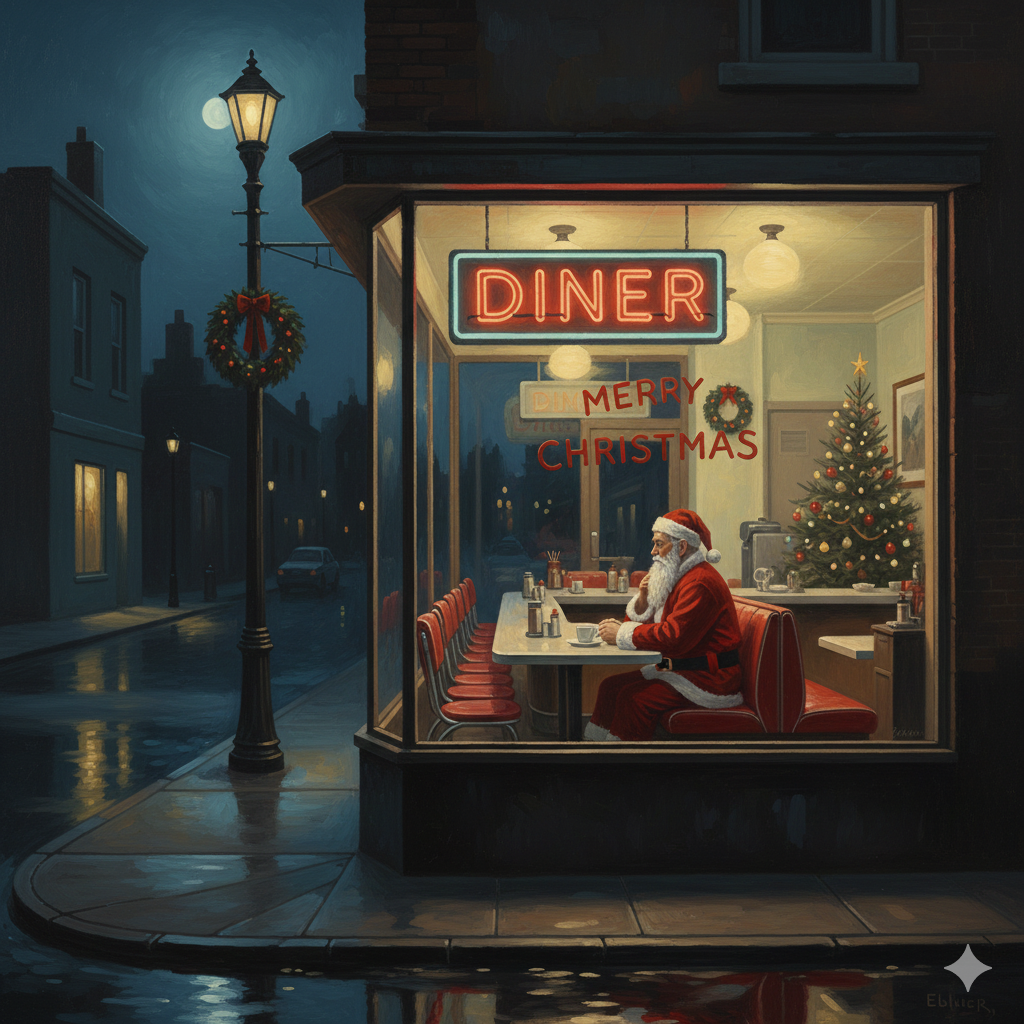
Thanks for Christmas
Economic growth
Depending on how you look at it growth in Q3 was very very strong or very strong or just possibly merely strong.
Annual rates: GDP: 4.3% Real final sales to domestic purchasers: 2.9% Average of GDP & GDI: 3.4%
GDI: 2.4%
That is from Jason Furman.
Christmas Eve assorted links
Who would you like to see as a Conversations with Tyler guest?
Comments are open, I thank you for your suggestions for the coming year…
Wyoming has as many Senators as escalators?
There used to be a third set of escalators, in the Cheyenne JCPenney building, but it was lost when JCPenney moved to the Frontier Mall and the escalator was removed when the old building was renovated…
What’s more interesting is the ages of Wyoming’s escalators…
In Casper, the First Interstate Bank building was built in 1958, while the Hilltop Bank opened in December 1979. The escalators were part of the original design of both buildings.
It’s not just that there are only two escalators in Wyoming, there hasn’t been a new one in 44 years.
Here is the article, but maybe there are some very new ones? Via Tommy Smokes.
Year end CWT retrospective episode with Jeff Holmes
Here is the audio, video, and transcript. In this episode we look back on the year in CWT podcast space, excerpt:
HOLMES: Yes. All right. Next question from Jumfrey Tuckins: “When was the last time you had uncontrollable laughter, and what caused it?”
COWEN: Probably the correct answer is never. Literally never in my life.
HOLMES: Aw, Tyler.
COWEN: Why should it be uncontrollable? Things just aren’t that funny. How good can something taste? Take the best sushi I’ve ever had, which was quite good. Things can taste a bit better than that, but not much. Funniness is a maximum. It does not bring me to uncontrollable laughter. That’s just the equilibrium.
HOLMES: This is consistent with how you presented yourself before, where you’ve talked about how you feel like you don’t have the extreme highs and lows of other people. You’re much more of a steady middle kind of person. Either displeasureor pleasure, you don’t get the extremes as much.
COWEN: Isn’t uncontrollable laughter in some ways a kind of displeasure? I don’t know, since I’ve never had it.
HOLMES: In the sense that sometimes, if you get tickled, sometimes you’re laughing, but you want it to stop.
COWEN: Right.
HOLMES: No, I think what that’s getting at is those times where something has just so metaphorically tickled you that you — usually, it’s with another person.
COWEN: Not going to happen. Sorry.
HOLMES: That makes me a little sad.
COWEN: Maybe just you’re not funny enough. Have you considered that?
HOLMES: Oh, shots fired, Tyler. Oh, my gosh.
COWEN: I don’t mean you, but you, collective humanity.
HOLMES: Okay, collective you. All right.
COWEN: I heard Louis C.K. live, which is the funniest show I’ve ever heard. I laughed quite a bit, but I was not close to uncontrollably laughing.
HOLMES: Do you have any theory as to why that is? When that happens, again, there’s something that you and another person are experiencing together, that you’ve realized you’ve had the same thought or same experience, and it’s just —
COWEN: I suspect it’s heritable, with apologies to Alison Gopnik.
Rrecommended, and of course this year there will be much more to come.
Which published results can you trust?
That is the theme of my latest Free Press column, starting with the recent Oliver Sacks debacle. Here is one excerpt:
…as my George Mason University colleague Bryan Caplan suggests, trust literatures, not individual research studies. By a “literature,” I mean the collective work conducted by many researchers, acting in decentralized fashion, to publish and circulate the results that will best persuade other researchers.
Second, treat research articles, or their popular media coverage, as possibilities to put in your mental toolbox rather than settled truths.
Literatures are more trustworthy than individual articles because they reflect a collective effort to establish reliable results. A supposed correlation gets refereed and scrutinized dozens of times, or maybe hundreds of times. If you have a new hypothesis, other researchers have a chance to make their names by knocking it down. There are also more eyes watching, in case real-world experience delivers results at odds with what a particular theory had been postulating. Or maybe there was a simple mistake in writing the computer code behind the paper’s result. Literatures contain a variety of different ways to come to a particular conclusion, and you can see whether they end up pointing in the same general direction.
You may not have time or the background to master a complete literature on a research topic, but these days you can send well-written prompts to GPT 5.2 Pro, Claude Opus 4.5, or Gemini 3.0 for some very good summaries of any literature you want. Furthermore, you can cross-check across these different AI models for additional reliability.
This is useful advice which is rarely heeded, and learning how to interpret a research literature is one of the most important skills in intellectual life.
What should I ask Kim Bowes?
Yes, I will be doing a Conversation with her. Here is Wikipedia:
Kimberly D. Bowes (born 1970) is an American archaeologist who is a professor of Classical Studies at the University of Pennsylvania. She specializes in archeology, material culture and economics of the Roman and the later Roman world. She was the Director of the American Academy in Rome from 2014–2017.[2] She is the author of three monographs…
While she is continuously focused on the archaeology and material culture of the Roman and later Roman worlds, her research interests have shifted from late antiquity and the archeologies of religion and elite space to historical economies with a distinct focus on poverty and the lived experience of the poor. Her forthcoming study on Roman peasants in Italy reflects a greater attention to non-elites in the studies of Roman archaeology and economic history and a shift in her methodology, integrating archaeological and scientific data, anthropological theory and historical economics become.
I am a big fan of her new book Surviving Rome: The Economic Lives of the Ninety Percent. So what should I ask her?
Tuesday assorted links
1. Does AI weaken the Lucas critique? And a comment from Benjamin Manning.
3. Heritage Foundation is falling apart.
4. Kalshi Research, new arm of the company devoted to research on prediction markets.
5. Travel notes from a visit to Mecca.
6. Palmer Luckey on UAPs. I am not persuaded by his explanation, but clearly he (unlike most of you) has seen the data.
7. Russian billionaire has at least one hundred children (WSJ).
8. Jason Furman on the new economic data (NYT).
Three that Made a Revolution
Another excellent post from Samir Varma, this time on the 1991 reforms in India that launched India’s second freedom movement:
Three men you’ve probably never heard of—P.V. Narasimha Rao, Manmohan Singh, Montek Singh Ahluwalia—may be the three most important people of the late 20th century.
Bold claim. Audacious, even. Let me defend it.
Here are the numbers. In 1991, over 45% of Indians lived below the poverty line—roughly 400 million people. By 2024, extreme poverty in India had fallen to under 3%.
That’s 400 to 500 million people lifted out of poverty.
The largest democratic poverty alleviation in human history.
….So there they stood.
The precipice was visible. A Hindu politician from a dusty village in Telangana who spoke 17 languages and wrote novels nobody wanted to read. A Sikh economist from a village that no longer existed, who took cold showers at Cambridge and kept dried fruits in his pockets. Another Sikh economist who’d been the youngest division chief in World Bank history and wrote a memo that would change a country.
Three men. All products of a civilization that absorbs contradictions—that somehow fits Hindus and Sikhs and Muslims and Christians and Jains and Buddhists and Parsis into one impossibly diverse democracy. A civilization where, as I’ve written before, any statement you make is true, AS IS its opposite.
India was bankrupt. The gold was gone. The Soviet model they’d followed for forty years was collapsing in real time. Every assumption that had guided Indian economic policy since independence was being revealed as catastrophically wrong.
The intelligentsia still believed in socialism. The party cadres still worshipped Nehru’s memory. The opposition would scream about selling out to foreign powers. The bureaucracy would resist losing its control. The protected industries would fight to keep their monopolies.
But the three men had something their opponents didn’t: a plan. The M Document—the years of thinking—the technocratic expertise accumulated across decades. They had political cover—Rao’s tactical genius, his willingness to let Singh take the heat while he worked the back channels. They had credibility—Singh’s Cambridge pedigree, Ahluwalia’s World Bank experience, Rao’s decades of political survival.
And they had something else: the crisis itself. The one thing that could break through forty years of socialist inertia. The emergency that made the previously impossible suddenly necessary.
Varma tells the story well. For the full history consult the indispensable The 1991 Project, full of documents, oral histories and interviews.
Hat tip: Naveen Nvn.
Muscat, Oman travel notes
Oman feels more relaxed than much of the Middle East or Gulf, and vistas in Muscat can include the sea, white alabaster buildings, mountains in the backdrop, and some older castles.
There are plenty of foreigners around, but unlike in much of the Gulf most of the people you see are natives not migrants. English is spoken widely, and is present on most of the signs and menus. Women wear headscarves, but they are not usually veiled. The vibes are friendly and everything feels extremely safe.
Muscat is not quite “the linear city,” but most activity is located on or near one main road which stretches east-west. There is no center of town, and you find yourself going back and forth on that road multiple times a day. The plus is that you see the water and the mountains often. Nonetheless there is a monotony to getting around, and much of the town does not feel walkable.
Frequently you will see a poster of the current Sultan, next to a photograph of the previous Sultan, who ruled for fifty years. Does this dual presentation enhance or limit the credibility of the current Sultan? Was it the intent of the current Sultan, or was he somehow locked into that presentation by the interest groups and supporters of the previous Sultan?
The National Museum is very good, and shows that Oman historically, along with Yemen, has held the role of a great civilization. In fact, Oman drove out the Portuguese and then ruled Zanzibar from 1698 to 1856. That explains why the island has so many Arabic doors and motifs.
Per capita income, PPP-adjusted, clocks in at about 45k, but distribution is uneven and the country does not feel that wealthy. I cannot find a single number for median income, but I suspect it would underrate actual living standards. Even deep into the countryside you will find high-quality homes and roads, indicating that public funds are spent with some efficiency, at least relative to some comparison countries.
Misfat al Abriyeen is a small village, largely vertical, where they still use water and irrigation systems from at least two thousand years ago.
Nizwa is a town of about 80,000, about two hours from Muscat, with a much older and more traditional souk.
When driving around Oman, the Peter Gabriel soundtrack “Passion,” from The Last Temptation of Christ, is effective.
For food, try Persian at Shandiz or grilled fish at Turkish House, or Yemeni or Afghan offerings. There are several restaurants with “Omani food,” but the problem is that they are authentic, not that they are insufficiently authentic. You should try some, much of it is not bad but it is also not the best food in town. At one place they flat outright refused to bring me the dried, salted shark dish. Nor did I wish to order camel meat, which is supposed to be gamey. The soups with meat and barley are good, but basically for Omani food you wish to keep returning to the grilled fish.
Overall, Oman is an underrated travel destination. It is exotic and beautiful and comfortable, all at the same time. The further reaches of the country are renowned for hiking and birdwatching, but perhaps two days in Oman and a one day trip to the countryside is the optimal dose here?
For U.S: and many other citizens, it is easy to enter the country without a visa.