My very fun Conversation with Blake Scholl
Here is the audio, video, and transcript. This was at a live event (the excellent Roots of Progress conference), so it is only about forty minutes, shorter than usual. Here is the episode summary:
Blake Scholl is one of the leading figures working to bring back civilian supersonic flight. As the founder and CEO of Boom Supersonic, he’s building a new generation of supersonic aircraft and pushing for the policies needed to make commercial supersonic travel viable again. But he’s equally as impressive as someone who thinks systematically about improving dysfunction—whether it’s airport design, traffic congestion, or defense procurement—and sees creative solutions to problems everyone else has learned to accept.
Tyler and Blake discuss why airport terminals should be underground, why every road needs a toll, what’s wrong with how we board planes, the contrasting cultures of Amazon and Groupon, why Concorde and Apollo were impressive tech demos but terrible products, what Ayn Rand understood about supersonic transport in 1957, what’s wrong with aerospace manufacturing, his heuristic when confronting evident stupidity, his technique for mastering new domains, how LLMs are revolutionizing regulatory paperwork, and much more.
Excerpt:
COWEN: There’s plenty about Boom online and in your interviews, so I’d like to take some different tacks here. This general notion of having things move more quickly, I’m a big fan of that. Do you have a plan for how we could make moving through an airport happen more quickly? You’re in charge. You’re the dictator. You don’t have to worry about bureaucratic obstacles. You just do it.
SCHOLL: I think about this in the shower like every day. There is a much better airport design that, as best I can tell, has never been built. Here’s the idea: You should put the terminals underground. Airside is above ground. Terminals are below ground. Imagine a design with two runways. There’s an arrival runway, departure runway. Traffic flows from arrival runway to departure runway. You don’t need tugs. You can delete a whole bunch of airport infrastructure.
Imagine you pull into a gate. The jetway is actually an escalator that comes up from underneath the ground. Then you pull forward, so you can delete a whole bunch of claptrap that is just unnecessary. The terminal underground should have skylights so it can still be incredibly beautiful. If you model fundamentally the thing on a crossbar switch, there are a whole bunch of insights for how to make it radically more efficient. Sorry. This is a blog post I want to write one day. Actually, it’s an airport I want to build.
And;
COWEN: I’m at the United desk. I have some kind of question. There’s only two or three people in front of me, but it takes forever. I notice they’re just talking back and forth to the assistant. They’re discussing the weather or the future prospects for progress, total factor productivity. I don’t know. I’m frustrated. How can we make that process faster? What’s going wrong there?
SCHOLL: The thing I most don’t understand is why it requires so many keystrokes to check into a hotel room. What are they writing?
What are they writing?
Thursday assorted links
1. Reddit thread on Beatriz Villaroel.
3. Suisun City and California Forever (NYT).
4. The male boom in Orthodox Christianity in the U.S. (NYT).
5. More on Harvard graduate cutbacks.
6. Paul Ekman, RIP. And more here.
7. GPT-5.1 has been released, pretty quietly.
8. Summers will not finish the semester teaching at Harvard.
Confidently Wrong
If you’re going to challenge a scientific consensus, you better know the material. Most of us, most of the time, don’t—so deferring to expert consensus is usually the rational strategy. Pushing against the consensus is fine; it’s often how progress happens. But doing it responsibly requires expertise. Yet in my experience the loudest anti-consensus voices—on vaccines, climate, macroeconomics, whatever—tend to be the least informed.
This isn’t just my anecdotal impression. A paper by Light, Fernbach, Geana, and Sloman shows that opposition to the consensus is positively correlated with knowledge overconfidence. Now you may wonder. Isn’t this circular? If someone claims the consensus view is wrong we can’t just say that proves they don’t know what they are talking about. Indeed. Thus Light, Fernbach, Geana and Sloman do something clever. They ask respondents a series of questions on uncontroversial scientific topics. Questions such as:
1. True or false? The center of the earth is very hot: True
2. True or false? The continents have been moving their location for millions of years and will continue to move. True
3. True or false? The oxygen we breathe comes from plants: True
4. True or false? Antibiotics kills viruses as well as bacteria: False
5. True or false? All insects have eight legs: False
6. True or false? All radioactivity is man made: False
7. True or false? Men and women normally have the same number of chromosomes: True
8. True or false? Lasers work by focusing sound waves: False
9. True or false? Almost all food energy for living organisms comes originally from sunlight: True
10. True or false? Electrons are smaller than atoms: True
The authors then correlate respondents’ scores on the objective (uncontroversial) knowledge with their opposition to the scientific consensus on topics like vaccination, nuclear power, and homeopathy. The result is striking: people who are most opposed to the consensus (7, the far right of the horizontal axis in the figure below) score lower on objective knowledge but express higher subjective confidence. In other words, anti-consensus respondents are the most confidently wrong—the gap between what they know and what they think they know is widest.
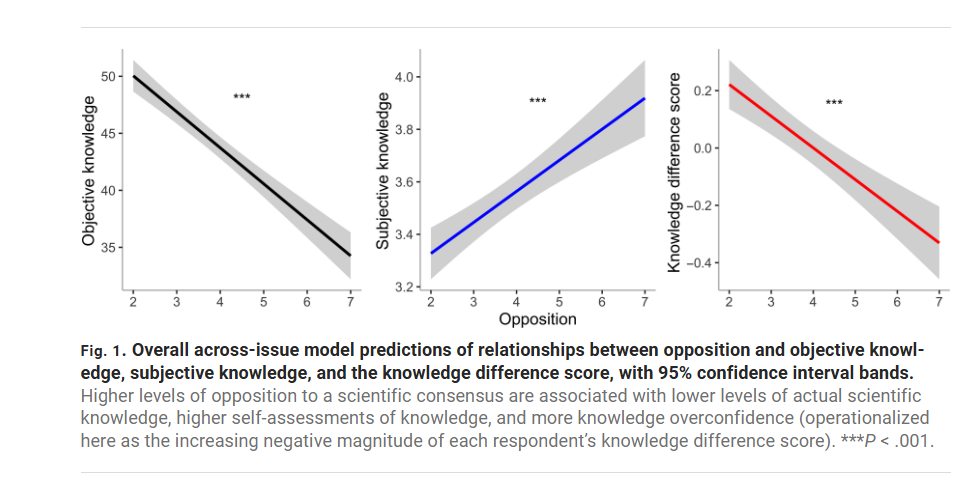
In a nice test the authors show that the confidently wrong are not just braggadocios they actually believe they know because they are more willing to bet on the objective knowledge questions and, of course, they lose their shirts. A bet is a tax on bullshit.
The implications matter. The “knowledge deficit” approach (just give people more fact) breaks down when the least-informed are also the most certain they’re experts. The authors suggest leaning on social norms and respected community figures instead. My own experience points to the role of context: in a classroom, the direction of information flow is clearer, and confidently wrong pushback is rarer than on Twitter or the blog. I welcome questions in class—they’re usually great—but they work best when there’s at least a shared premise that the point is to learn.
Hat tip: Cremieux
Mexico facts of the day
I have been expecting this for a long time, but it came more quickly than I thought:
Mexico is now the world’s top buyer of U.S. goods, according to data released by the U.S. government on Wednesday, outpacing Canada for the first time in nearly 30 years.
The data highlighted how Mexico and the United States have, despite periodic political tensions, become deeply intertwined in business, and how much global trade patterns have shifted in a short period. Only two years ago, Mexico became the country that sold the most goods to the United States, surpassing China.
“Mexico is the United States’ main trading partner,” said Marcelo Ebrard, Mexico’s economy minister, during the president’s daily news conference on Wednesday.
Here is more from the NYT. Via Brian Winter. As I have been telling people for decades now, visiting Mexico, learning about Mexico, and learning Spanish are very good investments in understanding the world, most of all if you live in the USA.
American democracy is very much alive, though not in all regards well
The Democrats who won in the November elections are all going to assume office without incident or controversy.
The Supreme Court is likely to rule against at least major parts of the Trump tariff plan, his signature initiative. Trump already has complained vocally on social media about this. He also preemptively announced that some of the food tariffs would be reversed, in the interests of “affordability.”
National Guard troops have been removed from Chicago and Portland, in part due to court challenges. The troops in WDC have turned out to be a nothingburger from a civil liberties point of view.
Here is an account of November 18 and all that happened that day:
* House votes 427-1 to release the Epstein files, a veto-proof+ majority
* A federal judge blocked GOP redistricting map in Texas, meaning net net with CA measure passed, Democrats could pick up seats for 2026, KARMA!
* A federal appeals court, including two Trump appointed judges, rejected Trump’s defamation lawsuit against CNN over the term “Big Lie,” finding the case meritless
* Corporate Public Broadcasting agree to fulfill its $36 million annual contract with NPR, after a judge told Trump appointees at CPB that their defense was not credible
* A NY judge dismissed Trump’s calling of New York’s law barring immigration arrests in state and local courthouses.
The Senate also sided with the House on the Epstein files. Nate Silver and many others write about how Trump is now quite possibly a lame duck President.
I do not doubt that there are many bad policies, and also much more corruption, and a more transparent form of corruption, which is corrosive in its own right. But it was never the case that American democracy was going to disappear. That view was one of the biggest boo-boos held by (some) American elites in recent times, and I hope we will start seeing people repudiating it.
I think the causes of this error have been:
1. Extreme dislike of the Trump administration, leading to emotional reactions when a bit more analysis would have done better.
2. Pessimism bias in the general sense.
3. Recency bias — for the earlier part of the term, Congress was relatively quiescent.
4. Cognitive and emotional inability to admit the simple truth of “democracy itself can lead to pretty bad outcomes,” thus the need to paint the status quo as something other than democracy.
5. The (largely incorrect) theory of good things happening in politics is “good people will them,” so from that starting point if you see bad people willing bad things you freak out. The understanding was never “spontaneous order” enough to begin with.
Any other?
Google Scholar Labs
Brings AI to Google Scholar, find it here. Via Joshua Gans. And yes this does mean that the academics also are, or at least ought to be, writing for the AIs.
Matt Yglesias on aphantasia
What I tend to approach from the outside are unpleasant experiences. Life is a mix of ups and downs, but I’m not really haunted by sad experiences or disturbing things that I’ve seen. I can tell you about the time I found a dead body in the alley and called the authorities to report it, and my recollection is it was pretty gross, but I certainly don’t have any pictures of that in my iPhone.
Sometimes I see something that causes me to update my views of the world. But when I saw the body, I was already aware, factually, that drug overdose deaths were becoming common in D.C., so I felt that I hadn’t really learned anything new. At the time I was victimized by crime, the amount of violent crime in this city had been on a steady downward trend for a very long time, so it didn’t cause me to change my views at all. Several years later, that downward trend started to reverse and, after a few years of gradual growth, there were some sharp jumps, and then I got worried and started calling for policy changes.
And I think this is a strength of the aphantasic worldview. Something bad happened to me that was statistically anomalous, so I didn’t change my views. When the broader situation changed, I did change my views, even though actually nothing bad happened to me personally. And that’s because the right way to assess crime trends is to try to get a statistically valid view of the situation, not overindex on the happenstance of your life.
Here is the full essay. Here is Hollis Robbins on related issues.
Wednesday assorted links
1. Roon visits DC.
2. The UK is outlawing ticket scalping?
3. How the internet made the far right.
4. NYT on Solvej Balle. And from The New Yorker.
5. Claims about risk and prediction markets.
6. On the dropping non-binary rates.
7. Some art prices, including one golden toilet arbitrage result (NYT).
Cyprus and multiple state sovereignties
I am struck by how many layers of sovereignty there are in Cyprus, sometimes but not always conflicting. There is Greek Cyprus, Turkish Cyprus (the Turkish interpretation), Republic of Cyprus under Turkish occupation (the Greek interpretation), unified Cyprus (recognized by the EU and also many Cypriot citizens, though the Turkish part is exempt from EU laws and obligations, in any case not recognized by Turkey), the EU, and last but not least Britain claims and possesses, as full sovereign, three percent of Cyprus territory, an arrangement contested by no one.
Arguably you could add “Turkey” to that list. The Turkish government does not claim sovereignty over any part of Cyprus, but they put the flag everywhere, they guarantee defense, the currency is the Turkish lira, and they have a de facto veto over major decisions. It is Turkey in everything but name, though there is a passport check when visitors fly in from Istanbul. Keep in mind that the earlier 1974 Turkish invasion deprived what is now Greek Cyprus of its then main cargo port and main airport.
While matters have been peaceful for some while now, I fear these political arrangements limit the ability of Cyprus to exploit scale. The island has only about 1.3 million people, so complications do not help their ability to attract high-productivity investment.
Is the AI sector currently a bubble?
Possibly, but do not jump to that conclusion too quickly, as I argued in my latest Free Press column. Excerpt:
Nvidia is often considered a bellwether AI stock. That’s because much of its revenue comes from selling graphics processing units to power advanced AI systems, meaning that its success gives investors insight into the health of the sector overall. Currently, Nvidia’s stock-price-to-earnings ratio is in the 54 to 55 range, roughly twice the typical market average. That means the market expects great things from this stock. Those projections may or may not be validated, but it’s hard to conclude they’re entirely divorced from reality…
Keep in mind that the tech sector as a whole is still earning more than it is shelling out in capital expenditures. The current AI boom is being financed by earnings more than by new issuance of debt, which makes it less prone to a sudden crash. By one estimate, capital expenditures in Big Tech are about 94 percent of cash flow in 2025. You could imagine that number moving into unstable territory, but so far, the U.S. tech sector is managing to pay its bills without going into debt.
You may recall we are coming off a period when everyone complained that the big tech companies were sitting on trillions of dollars in cash and capital. Now, they are spending it, and complaints are heating up once again. Damned if they do, damned if they don’t.
In fact, what we are seeing right now is a shortage in the AI sector’s capacity to meet demand. Major tech companies are investing in more computing capacity, but they still cannot serve all the customers who want access to AI systems. That augurs well for the future of the sector, even if there are dips and spills along the way.
As usual, we will see, but if you are calling it a bubble after an initial price dip or corporate shake-out, that is exactly the fallacy you are not supposed to be slipping into.
Tuesday assorted links
1. “Underrated reason for this [relative non-politicization] being true is not that econ has more political diversity (though it does) but instead a more *international* faculty than humanities and other social sciences. Like literally 2/3rd. Domestic politics and identity fights necessarily play a smaller role.” From Kevin A. Bryan.
3. Ruxandra on IVF (NYT).
4. And more from Gavin Leech, this time on Chinese AI models.
5. Has there been upward genetic drift for the British?
6. New J.S: Bach music discovered and now recorded. Starts at 15:30. Decent but not great.
The MR Podcast: Tariffs!
On The Marginal Revolution Podcast this week, Tyler and I discuss tariffs! Here’s one bit:
COWEN: I have a new best argument against tariffs. It’s very soft. I think it’s hard to prove, but it might actually be the very best argument against tariffs.
TABARROK: All right, let’s hear it.
COWEN: If you think about COVID policy, the wealthy nations did a bunch of things. Some of them were quite bad, and the poorer nations all copied that. They didn’t have to copy it, but there was some kind of contagion effect, or that seemed like the high-status thing to do. I believe with tariffs, something similar goes on. There’s a huge literature about retaliation. Of course, retaliation is a cost, that’s bad, but simply the copying effect that it was high status for the wealthy nations to have tariffs. They can afford it better, but then places like India had their own version of the same thing. That was just terrible for India at a much higher human cost than, say, it was for the United States. Again, it’s hard to trace or prove, but that I think could actually be the best argument against tariffs, simply that poorer countries will copy what the high-status nations are doing.
This is like Rob Henderson’s idea of luxury beliefs, beliefs which the elite can proffer at low cost but which have negative consequences when adopted by working and lower classes. Tariffs aren’t great for the US but the US is so large and rich we can handle it but if the idea is adopted by poorer nations it will be much worse for them. I wish I had been clever enough to say this during the podcast but I never know what Tyler will say in advance.
Here’s another bit:
TABARROK: Here’s the question which the Trumpers or other people never really answer is, what are we going to have less of? Yes, we’ll have more investment. Let’s say we get another auto plant. The unemployment rate is 4%, so it’s not like we have a lot of free resources around. Most of the time, we’re in full equilibrium. If we have more auto plant workers and more cars being produced in the United States, we’re going to have less of something. I think it is incumbent on people who want tariffs in order to get more employment in manufacturing or something like that to say, “Well, what are we going to have less of?”
COWEN: The more sophisticated ones of them, I think, would say, well, the US is super high on the consumption scale, even relative to our very high per capita incomes. If we end up spending some of that consumption on boosting real wages, it’s actually a good investment, if only in political sanity, stability, fewer opioid deaths. It’s a very indirect chain of reasoning. I would say I’m skeptical. Again, it’s not a crazy argument. It’s a weird kind of industrial policy where you channel resources away from consumption into investment and higher wages. A lot of those plants are automated. They’re going to be automated much yet. It’s further stuff, maybe to other robotics companies or the AI companies. Again, I think that’s what they would say.
TABARROK: I don’t think they would say that.
COWEN: No, the more sophisticated ones.
TABARROK: Are there? I haven’t seen too many of those….
Here’s the episode. Subscribe now to take a small step toward a much better world: Apple Podcasts | Spotify | YouTube.
Comparing health outcomes across countries (from the comments)
I think it has come up repeatedly on MR that comparing international statistics in health outcomes is nearly impossible — definitions of live-birth, infant mortality, maternal mortality, cancer survival, cause of death, etc etc are simply too different between countries. Patterns of driving behavior, military service and violence affect life expectancy independently of health care, as do patterns of immigration.
The US tends to compare quite well on life-expectancy in later life, which is the point at which quality of health care (rather than e.g. traffic accidents) is a key factor in survival.
That is from Marie. I take this understanding, and most of all its absence, as one of the key markers of whether a person is actually trying to think things through.
Do (human) readers prefer AI writers?
It seems so, do read through the whole abstract:
The use of copyrighted books for training AI models has led to numerous lawsuits from authors concerned about AI’s ability to generate derivative content. Yet it’s unclear whether these models can generate high quality literary text while emulating authors’ styles/voices. To answer this we conducted a preregistered study comparing MFA-trained expert writers with three frontier AI models: ChatGPT, Claude, and Gemini in writing up to 450 word excerpts emulating 50 awardwinning authors’ (including Nobel laureates, Booker Prize winners, and young emerging National Book Award finalists) diverse styles. In blind pairwise evaluations by 159 representative expert (MFA-trained writers from top U.S. writing programs) and lay readers (recruited via Prolific), AI-generated text from in-context prompting was strongly disfavored by experts for both stylistic fidelity (odds ratio [OR]=0.16, p < 10^-8) and writing quality (OR=0.13, p< 10^-7) but showed mixed results with lay readers. However, fine-tuning ChatGPT on individual author’s complete works completely reversed these findings: experts now favored AI-generated text for stylistic fidelity (OR=8.16, p < 10^-13) and writing quality (OR=1.87, p=0.010), with lay readers showing similar shifts. These effects are robust under cluster-robust inference and generalize across authors and styles in author-level heterogeneity analyses. The fine-tuned outputs were rarely flagged as AI-generated (3% rate versus 97% for incontext prompting) by state-of-the-art AI detectors. Mediation analysis reveals this reversal occurs because fine-tuning eliminates detectable AI stylistic quirks (e.g., cliché density) that penalize incontext outputs, altering the relationship between AI detectability and reader preference. While we do not account for additional costs of human effort required to transform raw AI output into cohesive, publishable novel length prose, the median fine-tuning and inference cost of $81 per author represents a dramatic 99.7% reduction compared to typical professional writer compensation. Author-specific fine-tuning thus enables non-verbatim AI writing that readers prefer to expert human writing, thereby providing empirical evidence directly relevant to copyright’s fourth fair-use factor, the “effect upon the potential market or value” of the source works.
That is from a new paper by Tuhin Chakrabarty, Jane C. Ginsburg, and Paramveer Dhillon. For the pointer I thank the excellent Kevin Lewis. I recall an earlier piece showing that LLMs also prefer LLM outputs?
John Cochrane understands the elasticity of supply
Everyone is focused on building, but “supply” is so much more than building. There is tremendous supply in using more efficiently what we have now. Most cities have laws against renting parts of single family homes, or sharing larger homes. Think how many spare bedrooms are empty every night. There is plenty of housing supply in the US, it’s just not in places where people want to move. Others moving out is “supply,” and greatly impeded. Older people stay in too-big houses and apartments, in locations close to work and school opportunities that young families desire, but the older people no longer need. Why? If they sell, they are taxed on capital gains, even just due to inflation. They lose property tax exemptions, and, of course, rent control protection. Each older person who cashes in, downsizes, or moves to a more neighborhood more suited to them, supplies a house or apartment. The non-portable fixed rate 30 year mortgage, an invention of our federal housing subsidy regime, leads people to stay where they are rather than move to where they want to go, and free up a scarce house or condo for someone else. Strong apparently “consumer protection” laws in rental contracts dry up the supply, especially to the marginalized. If you can’t kick people out, you’re much more careful who you let in. Limits on short term rentals limit rentals. Remove rent controls, permanently, and houses and condos can be rented. Many houses and apartments need rehab, not new construction, which can happen very quickly once owners know they will not be robbed of their investment. Even “affordable” housing leads people to stay where they are, rather than move to better opportunities for them and free up an apartment for someone else, because it’s rationed with long waiting lists.
The rest of the post is an excellent analysis of rent control. On one of John’s closing points, I should note I am not opposed to speculating about motivations.