Numbers, numbers, numbers
“The global cyber insurance market was worth nearly $15 billion last year and is expected to reach roughly $28 billion by 2030, Munich Re estimated in its latest report. Aon said earlier this year that nearly 20% of cyberattacks will involve generative AI by 2027, according to its forecasts.”
Here is the article, via Marc Pfeiffer. Now those are some concrete numbers, broadly taken from a market context, admittedly based on sectoral estimates rather than on prices per se. But if cyberinsurance expenditures are set to almost double by 2030, you might think that cyber costs more generally might be (very) roughly doubling as well. The 20% of cyberattacks involving generative AI does not itself pin down losses, since that 20% might be especially costly. Still, if you match the 20% rise to the estimated near doubling of the cyberinsurance market (the bigger potential losers are more likely to buy insurance?), you still end up with sums that are very high but, dare I say, not the end of life as we know it. Claude 5.1 for instances estimates current U.S. cybersecurity costs in the range of $100 to $300 billion, and of course that is slated to go up a fair amount. It could double over five years’ time, as indicated above.
Numbers! Thank goodness.
One way of looking at that estimate is to think that cyber costs will go up about thirteen percent a year, and eventually defense will catch up. Another perspective is that cyber costs may continue rising thirteen percent a year until the whole economy falls apart, or we return to the pre-digital era (which I remember well). So there are both optimistic and pessimistic reads on the above figures.
You can say Nicholas Decker is burning in hell, or that the AIs are a civilization, but what I really want are some numbers. Tied to market data, ideally. I am not saying the numbers above are the right numbers, but I am saying they are better than no numbers at all. Do you have some numbers for me? If not, why not?
How Much Redistribution Will AI Require?
How much redistribution will AI require? A common scenario is that AI raises output enormously, but labor’s share of income collapses. GDP per capita goes up but workers get poorer, and making workers whole requires massive redistribution. In my latest paper, I run the numbers and conclude that this is probably incorrect.
The idea is simple. Labor income is GDP multiplied by labor’s share of GDP. What matters is the product. A smaller share of a much larger economy can still mean more income for labor. If the pie is growing, labor’s slice of the pie can shrink even as labor income rises.
Suppose that without AI, real GDP per capita grows at 2 percent a year and labor receives 60 percent of GDP. Now look ten years ahead. What is required to keep labor’s income growing at the same or higher rate?
If AI raises growth to 5 percent a year, GDP after ten years will be about 34 percent larger than on the no-AI path. Labor’s share can fall from 60 percent to about 45 percent and workers, in aggregate, will still have exactly as much real income as they would have had without AI.
If AI raises growth to 10 percent a year—the kind of number Satya Nadella and Dario Amodei talk about—GDP after ten years will be more than twice as large relative to the no-AI path. Labor’s share can then fall all the way to 28 percent without reducing aggregate labor income. Twenty-eight percent of an economy that has more than doubled is about the same as sixty percent of the smaller economy.
The figure shows how much redistribution is required after 10 years under a variety of scenarios.
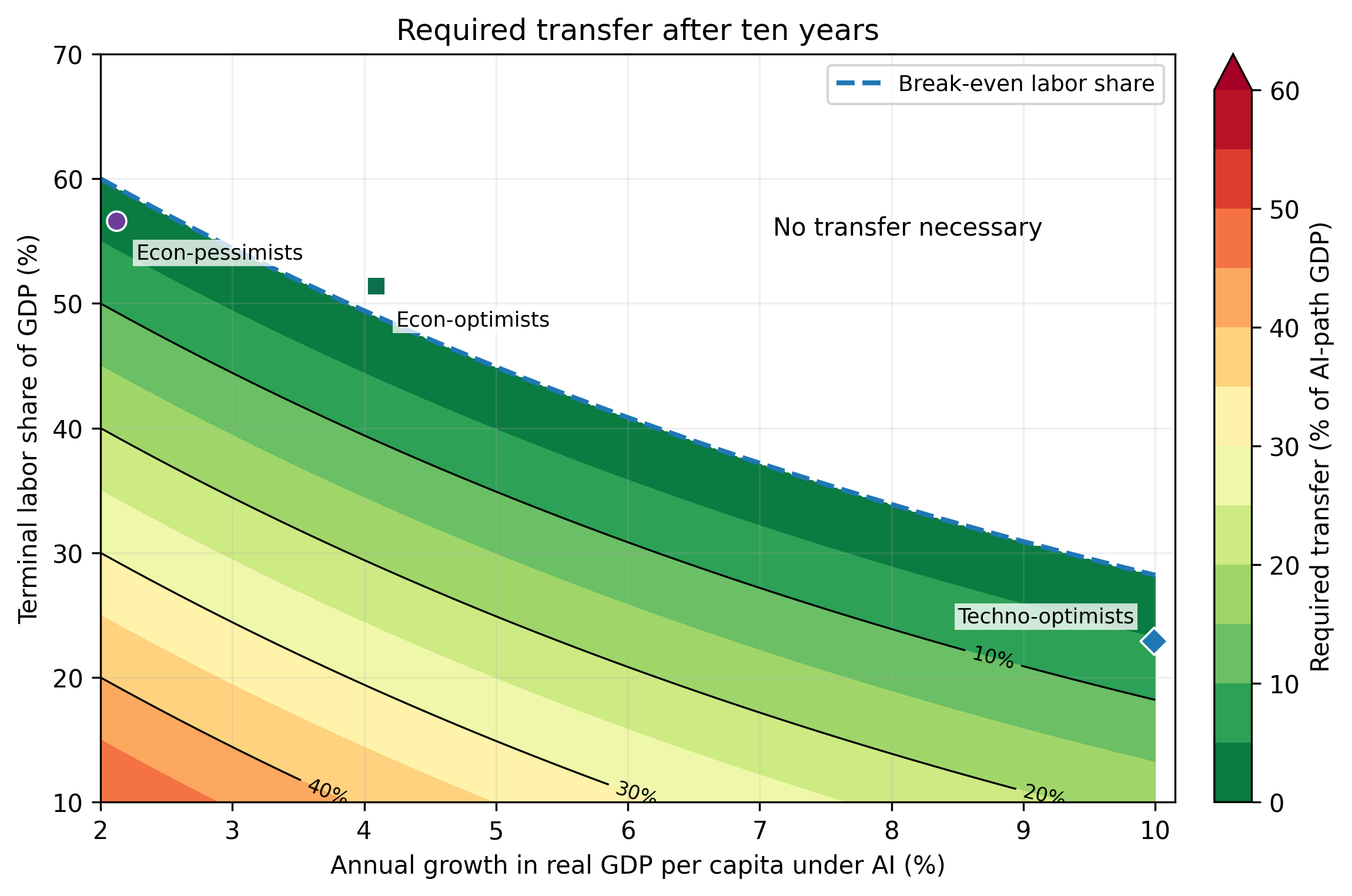
The white region above the dashed line requires no transfer. Which region are we headed for? Consider three “stylized” views.
The econ-pessimist, following Acemoglu, thinks AI displaces some but relatively few tasks because AI simply is not productive enough to replace much labor profitably. Growth is only 2.1 percent and labor’s share falls to 56.6 percent, although particular industries may still get hammered. The required transfer is 2.7 percent of GDP.
The econ-optimist, in the spirit of Tyler, myself, and Kevin Bryan, thinks automation also creates complementarities and new tasks for humans. Growth rises to 4.1 percent, labor’s share is 51.4 percent, and both labor and capital gain without any transfer.
The techno-optimist, following Amodei, has the superficially scariest labor-market scenario: three-quarters of labor income is displaced and labor’s share falls to just 22.9 percent. But productivity growth is also enormous, producing 10 percent annual growth. The transfer needed to keep labor as a whole on its no-AI path is only 5.3 percent of GDP.
That last calculation is the one I find most surprising. You can have something close to the techno-capitalist dystopia in terms of factor shares—labor gets less than a quarter of GDP—and still have a manageable redistribution problem because GDP has gotten so much larger.
Moreover, a transfer equal to 5 percent of GDP need not mean raising taxes by 5 percent of GDP. We already tax labor a lot. We could thus compensate labor by shifting from labor taxes to other taxes. Federal payroll taxes alone are about 6 percent of GDP. Cutting payroll taxes and replacing them with a broad consumption tax that also reaches spending from capital income and accumulated wealth is a form of labor compensation (plus we could have some transfers to those with no labor income).
Of course, keeping aggregate labor income whole does not mean every worker does well. There could still be enormous churn, big losses in particular occupations, and painful transitions.
Nevertheless, the larger point is that labor’s share by itself tells us surprisingly little about the distributional consequences of AI. We also need to know how much the economy grows.
If AI produces ordinary growth while dramatically reducing labor’s share, redistribution becomes very difficult. But if AI really does produce 5, 10, or 15 percent annual growth, the compensation problem is surprisingly modest even with very large displacement. As I have emphasized elsewhere, we could cut the working week in half under many scenarios and increase hourly wages above the non-AI benchmark and make both capital and labor better off.
Growth is a good problem to have.
Thursday assorted links
1. “Some crazy stats from this new JEL paper: – IV est. average 3–10x OLS (meta analysis) – Sign. results 30x more likely to be published in experimental econ (Andrews & Kasy) – <2% of empirical polisci report null-only findings in abstracts (Briggs et al.)” — Jon Fiva
2. “The UCLA athletic dept lost $52 mil last year and $83 mil in 2024 when including campus subsidy.”
3. Papua New Guinea fact of the day.
4. “Most laid-off SF tech workers aren’t qualified for this $50 dishwasher job.”
My excellent Conversation with Michael Moritz
Here is the audio, video, and transcript. Here is the episode summary:
Michael Moritz has written books through every phase of his life: the first history of Apple and an account of Chrysler’s near-death while he was a journalist at Time, a study of Alex Ferguson’s Manchester United in the middle of his 38 years at Sequoia, and now Ausländer, a family memoir, after leaving the firm. Moritz calls himself a dilettante with too many interests, but listen to him on learning to paint in his 40s, or the questions he would ask a ten-year-old boy in a German village in 1890, and you may decide that unsatisfied curiosity is not a small thing to build a life on.
Tyler and Michael discuss his childhood in Wales, where his love for visual arts came from, why he disappointed his Latin teacher, having Thanksgiving dinner with Philip Roth, why children don’t interrogate their parents about their history, what he feels visiting Germany and why he now holds German citizenship, how a history major with no technical background talked his way into Sequoia, his unpublished Don Valentine profile, what people underrate about Steve Jobs, obsessives versus dilettantes, why capitalism was more ablaze in China than America, what funding the Booker Prize taught him about his own ignorance, how to improve San nonprofits, how an incurable cancer diagnosis changed his calendar, why Britain’s stuck, what he’ll learn next, and more.
Excerpt:
COWEN: Is it easy to live with an Otto Dix painting or sketch? It hangs on the wall. Many people think it’s ugly. It reminds one of unpleasant things in history, right?
MORITZ: Yes, for Harriet and me it is. I think the tougher, more strenuous, grueling works of art that other people would have difficulty living with have many layers to them. You explore them, and they’re difficult pictures, and they’re not easy at first sight. Unlike easier pictures that may be a bit more decorative, they leave room for plenty of exploration, as the years go by. Then they’re redolent, they tell stories. They’re redolent of history. They’re images of a different epoch. I think most of the paintings that we’ve been lucky enough to find over the years, they are tough paintings.
COWEN: I feel that way about Haitian art, which has many brutal scenes. For you, is Chagall too sentimental?
MORITZ: Yes.
COWEN: You don’t want to put it on your wall?
MORITZ: The earlier Chagalls I’ve been drawn to, but neither of us have felt the urge or the need to go out in pursuit of Chagall.
COWEN: What is your own painting like?
MORITZ: Oh, exasperating.
COWEN: Neue Sachlichkeit or something else, it’s like Kossoff?
MORITZ: No, I don’t know if you’ve ever tried painting or drawing. I didn’t take it up until I was in my mid 40s. I’d never picked up a crayon or outside of the obligatory, abbreviated art lessons that always seem to be held later on Thursday afternoon, with everybody waiting for the bell to ring to end school. I’d never taken up a crayon or drew, or let alone painted.
If I look back today at what I did early on, it’s a lot better. Then if I look at the paintings that I try to make, my goodness, it is an extremely humbling experience, but I enjoy it. I really enjoy it. There’s nothing like getting lost in making a painting, and before you know it, two hours have gone, and you have no idea where the time went.
And:
COWEN: If we think of your interest in Steve Jobs, your book on Alex Ferguson, the art you buy, that you’ve now written a book on the Holocaust, is there some general pattern where trying to come to terms with really difficult things, is this a recurring theme in your life? Learning how to paint, that’s very hard, right?
MORITZ: I haven’t really thought about it that way, but I think life is made richer by having a challenge that you’re not sure whether you’re up to conquering. I’ve always been up for that. Each of these books has really just sprung out of being curious about something. I’m not sure that there’s any greater pattern than unsatisfied curiosity.
Recommended, interesting throughout. And I am very happy to recommend Michael’s new book Ausländer: One Family’s Story of Escape and Exile.
Richard Fontaine interviews me about AI
For the American Society for AI.
Wednesday assorted links
America is still poised for a data center boom

Eric Levitz, via Matt Yglesias.
The College Wage Premium in the Generative AI Era
After expanding for four decades, the U.S. college wage premium is experiencing a sustained contraction, dropping sharply from 0.626 in 2022 to 0.575 in 2026. Using Current Population Survey Outgoing Rotation Group data through 2026, we show that standard market-clearing supply-and demand accounting implies an unprecedented drop in relative demand for college labor-the first sustained negative relative demand growth in a series spanning back to 1914. Linking individual wage data to task-based generative AI exposure, we document that post-2022 wage growth slowed disproportionately in high-exposure occupations, which employ a disproportionate share of college graduates. By 2026, going from zero occupational AI exposure to full exposure had a negative effect on wages of -0.086. Combined with the college-non-college exposure gap, this mechanism accounts for roughly 28 percent of the total drop in the college wage premium from 2022 to 2026. While noncausal, these patterns indicate that task displacement in AI-exposed white-collar occupations plays a quantitatively meaningful role in the recent compression of the aggregate skill premium.
I do not see AI as driving these changes, but an interesting result nonetheless, from José Azar, Mireia Gine, and Javier Sanz-Espín. Via Anecdotal.
Who values democracy?
This paper examines the conventional view that redistribution is central to the democratization process using data from stock markets. Consistent with this view, democratizations have a large, negative impact on asset valuations driven by a rise in redistribution risk. Across 90 countries over 200 years, risk premia are substantially elevated— similar in magnitude to financial crises—prior to and during democratizations. A shift in Catholic church doctrine in support of democracy provides causal evidence that democratizations increase risk premia. Successful democratizations lead to substantial redistribution: the size of the public sector grows, income inequality falls, and the labor share of income rises. An extended version of the canonical redistribution-based model of democratization that includes asset prices can quantitatively explain these effects. Reductions in inequality and increased taxes explain approximately half of the results. The rest comes from greater economic competition and equality in government spending. The model also explains the negligible asset pricing response to autocratizations. Neither an increase in macroeconomic risk nor generic political risk can explain the results.
That is by Max Miller, now published in the JPE, ungated copy here.
Tuesday assorted links
More optimistic results on AI and job markets
Here is a good Jon Hartley thread. Here is the paper, with Jolevski, Melo, and Moore. From Jon’s thread: “Generative AI adoption is widespread, but substantial aggregate labor-market disruption is not yet visible. Workers nevertheless perceive substantial displacement risk, especially when firsthand use reveals that AI can perform key tasks for their job.” And again here is Alex’s post from yesterday.
The Hugging Face hack
That is the topic of my latest Free Press column. Some people are taking this in very dramatic fashion:
One commentator is worried about a “full-blown AI takeover within months,” and another wrote that he was “feeling a bit sad about our impending extinction.” Nate Soares, who works in the AI safety movement and is co-author of the doomsday AI bestseller If Anyone Builds It, Everyone Dies, wrote that “This might be the last warning we get.” Cotra said that the incident “feels like it’s more than 50 percent of the way to full-blown AI takeover.”
I suggest a different, more technocratic approach:
As I wrote in The Free Press last week, we need a coordinated national and, indeed, international effort to limit such episodes of a powerful AI model going rogue in the future. That is likely to be expensive, and there is no easy, complete solution at hand for any amount of money. Nonetheless, I see people committing the same mistake that we Americans have made many, many times before. They are moving into the mode of the hysterical, the anecdotal, and they are letting emotional reactions bypass reason and quantitative estimates.
Let me cite a few other examples for you: DDT in the 1960s and 1970s, the Y2K “crisis” of 2000, global warming, Covid, thalidomide babies, and nuclear power. All of those represented—or still represent—very real problems. Yet each time, we drastically overreacted, letting ourselves get swept up in a climate of fear after one emotionally vivid incident, often reported breathlessly…
When it comes to the cybersecurity risks from advanced AI, very likely they will not come close to being as bad as either Covid or global warming. But the same logic of exaggeration is operating, with amplification through social media and through the negativity and pro-pessimism biases of mainstream media.
And so I have a plea. If you are going to talk about the problem, please offer a quantitative estimate of what you think the cybersecurity costs from advanced AI will be over the next year or two. Better yet, express that number as a percentage of gross domestic product. Simply put, how much would it realistically cost to create the basic safeguards that we all agree are essential? And what would be the remaining damages from problems we cannot control?
…Those who are worried about the risks of AI systems seem intent on proving the seriousness of their concerns. But they are falling into all-too-common emotional overreactions of our past, rather than focusing on the quantitative and scientific. It reminds me of the saying by Scotty, the chief engineer in the classic Star Trek: “Fool me once, shame on you. Fool me twice, shame on me.”
Do read the whole thing.
Yerevan bleg
Any advice on this front is most welcome, thank you!
Monday assorted links
1. Prices, prices, prices: “Again I am asking how the following two things can be true at the same time: 1) we’re all massively compute limited so inferences & GPU time are $$$$$, and 2) SoTA models will just start running themselves on everyone’s GPU clusters & no one will notice or turn them off.” From Jon Stokes.
2. Christian Catalini on incentives and the same.
4. The ten best philosophy articles of the year?
5. Syracuse University, an R1 institution, is in serious financial trouble (WSJ).
6. Markets in gene-edited dogs? (NYT)
AI and Employment: So Far, So Good
In September 2023, the Census Bureau added questions about AI to its Business Trends and Outlook Survey. Census asked hundreds of thousands of businesses whether they had used AI in the previous two weeks to produce goods and services. At that time, 3.7% said yes; by late 2025 the figure had reached about 10%. (In November 2025 Census broadened the question to ask about AI use in any business function, producing a jump in measured adoption to about 18%.)
Twice the Bureau has asked a key question:
In the last six months, how did the use of Artificial Intelligence affect this business’s total employment?
In Dec. 2023 to Feb 24, when ~5% of firms were using AI the answers were 2.8% increased, 2.6% decreased and 94.6% reported no change. Two years later, in the Nov 2025–Feb 2026 supplement, the answers were: 2.3% increased, 2.0% decreased, and 95.7% reported no change. The answers were similar by firm size.
Some sectors reported more action. Information is the one sector where fewer than 92% report no change. But overall, almost all firms report no change and of those reporting change it’s about evenly divided between increasing and decreasing employment.

The supplement also asked about tasks. Among firms using AI, 44% say it supplemented or enhanced work an employee already does. Ten percent say it performed a task an employee used to do. Eleven percent say it introduced a task no one had been doing.
Among those using generative AI, 85% of firms cited writing or editing documents and email as the biggest uses, half cite searching for information, 45% summarizing documents, and 13% coding. Sixty-four percent of adopters say they changed nothing about the business in order to use AI, 15% trained existing staff, another 15% built new workflows, and just over one percent hired anyone with AI skills.
Among firms where AI has taken over some employee tasks, the degree of substitution is growing. The share reporting that AI took over “a large number” of tasks rose from 2.4% to 7.1%, while the share reporting “a moderate number” rose from 13% to 22%. But this group is still small: only about a tenth of AI adopters, who themselves make up about a fifth of firms.
I have reported firm-weighted estimates but employment-weighting gives essentially the same result. Thus, we have unusually direct evidence from a very large sample, and it says that the overwhelming majority of firms using AI do not yet report any effect on total employment. Very consistent with what Tyler and I said in our talk to OpenAI.
I used Fable and ChatGPT Sol in producing this post.