Is Facebook causing anti-refugee attacks in Germany?
Here is the key result, as summarized by the NYT:
Wherever per-person Facebook use rose to one standard deviation above the national average, attacks on refugees increased by about 50 percent.
Here is the underlying Müller and Schwarz paper. They consider 3,335 attacks over a two-year period in Germany. But I say no, their conclusion has not been demonstrated. Where to start?
Here is one picture showing a key correlation:
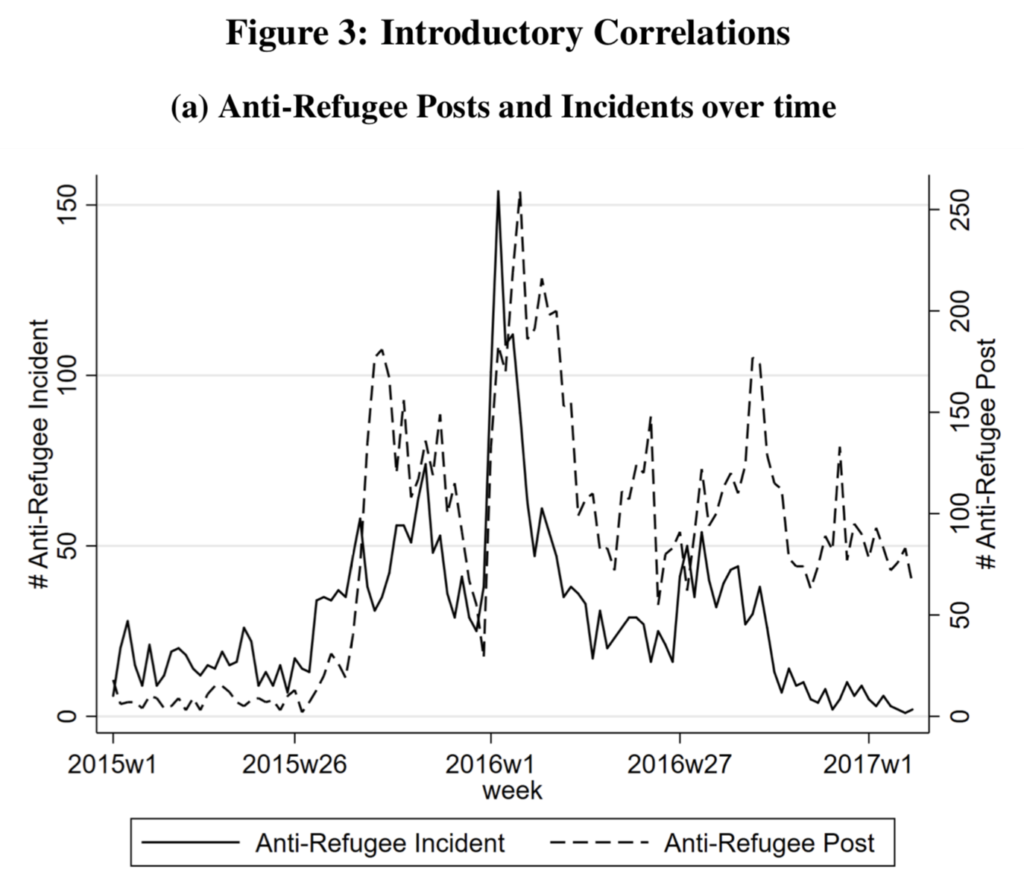 That looks pretty strong, doesn’t it? Nein! That is not how propaganda works, as an extensive literature in sociology and political psychology will indicate. That is how it looks when you measure what is essentially the same variable — or its effects — two different ways. For instance, that very big spike in the middle of the distribution? As Ben Thompson has pointed out, it represents the New Year’s harassment attacks in Cologne. Maybe that caused both Facebook activity and other attacks to spike at the same time? Will you mock me if I resort to the “blog comment cliche” that correlation does not show causation?
To continue with the excellent Ben Thompson (he is worth paying for!), the identification method used in the paper is suspect, and he focuses on this quotation from the authors:
In our setting, the share of a municipality’s population that use the AfD Facebook page is an intuitive proxy for right-wing social media use; however, it is also correlated with differences in a host of observable municipality characteristics — most importantly the prevalence of right-wing ideology. We thus attempt to isolate the local component of social media usage that is uncorrelated with right-wing ideology by drawing on the number of users on the “Nutella Germany” page. With over 32 million likes, Nutella has one of the most popular Facebook pages in Germany and therefore provides a measure of general Facebook media use at the municipality level. While municipalities with high Nutella usage are more exposed to social media, they are not more likely to harbor right-wing attitudes.
The whole result rests on assumptions about Nutella? What if you used likes for Zwetschgenkuchen? Has a robustness test been done? Was a simple correlation not good or not illustrative enough? I’ll stick with the simple hypothesis that some municipalities have both more Facebook usage, due to high AfD membership, and also more attacks on refugees, and furthermore both of those variables rise in tense times. AfD is the German party with the strongest presence on Facebook, I am sorry to say.
You will note by the way that within Germany the Nutella page has only verifiable 21,915 individual interactions, including likes (32 million is the global number of Nutella likes…die Deutschen are not that nutty), and that is distributed across 4,466 municipal areas. (If you are confused, see p.12 in the paper, which I find difficult to follow and I suspect that represents the confusion of the authors.) That should make you more worried yet about the Nutella identification strategy. They never tell us what they would have without Nutella, a better tasting sandwich I would say.
I also would note the broader literature on propaganda once again. Consider the research of Markus Prior: “…evidence for a causal link between more partisan messages and changing attitudes or behaviors is mixed at best.” These Facebook results are simply far outside of what we normally suppose to be true about human responsiveness — so maybe the company is undercharging for its ads!
Ben adds:
I am bothered by the paper’s robustness section in two ways: first, every single robustness test confirmed the results. To me that does not suggest that the initial result must be correct; it suggests that the researchers didn’t push their data hard enough. There is always a test that fails, and that is a good thing: it shows the boundaries of what you have learned. Second, there were no robustness tests applied to one of the more compelling pieces of evidence, that Internet and Facebook outages were correlated with a reduction in violence against refugees. This is particularly unfortunate because in some ways this evidence works against the filter bubble narrative: after all, the idea is the filter bubbles change your reality over time, not that they suddenly inspire you to action out of the blue.
The authors do present natural experiments from Facebook and internet outages. They find that “…for a given level of anti-refugee sentiment, there are fewer attacks in municipalities with high Facebook usage during an internet outage than in municipalities with low Facebook usage without an outage.” (p.28). Again I find that confusing, but I note also that “internet outages themselves…do not have a consistent negative effect on the number of anti-refugee sentiments.” That is the simple story, and it appears to exonerate Facebook. pp.28-30 then present a number of interaction effects and variable multiplications, but I am not sure what to conclude from the whole mess. I’m still expecting internet outages to lower the number of attacks, but they don’t.
Even if internet or Facebook outages do have a predictive effect on attacks in some manner, it likely shows that Facebook is a communications medium used to organize gatherings and attacks (as the telephone once might have been), not, as the authors repeatedly suggest, that Facebook is somehow generating and whipping up and controlling racist sentiment over time. Again, compare such a possibility to the broader literature. There is good evidence that anti-semitic violence across German regions is fairly persistent, with pogroms during the Black Death predicting synagogue attacks during the Nazi time. And we are supposed to believe that racist feelings dwindle into passivity simply because the thugs cannot access Facebook for a few days or maybe a week? By the way, in their approach if there is an internet outrage, mobile devices do not in Germany pick up the slack.
I’d also like to revisit the NYT sentence, cited above, and repeated many times on Twitter:
Wherever per-person Facebook use rose to one standard deviation above the national average, attacks on refugees increased by about 50 percent.
That sounds horrible, but it is actually a claim about variation across municipalities, not a claim about the absolute importance of the internet. The authors also reported a very different and perhaps more relevant claim to the Times:
…this effect drove one-tenth of all anti-refugee violence.
I would have started the paper with that sentence, and then tried to estimate its robustness, without relying on Nutella.
As it stands right now, you shouldn’t be latching on to the reported results from this paper.
Do Congresswomen Outperform Congressmen?
That is a 2011 AFPS paper by Sarah F Anzia and Christopher R Berry, here is the abstract:
If voters are biased against female candidates, only the most talented, hardest working female candidates will succeed in the electoral process. Furthermore, if women perceive there to be sex discrimination in the electoral process, or if they underestimate their qualifications for office, then only the most qualified, politically ambitious females will emerge as candidates. We argue that when either or both forms of sex‐based selection are present, the women who are elected to office will perform better, on average, than their male counterparts. We test this central implication of our theory by studying the relative success of men and women in delivering federal spending to their districts and in sponsoring legislation. Analyzing changes within districts over time, we find that congresswomen secure roughly 9% more spending from federal discretionary programs than congressmen. Women also sponsor and cosponsor significantly more bills than their male colleagues.
I also would consider the alternative hypothesis that the women legislators are simply more conscientious and less wrapped up in themselves. Nonetheless this result is one possible equilibrium relevant to the recent MR discussions on statistical discrimination.
Here is a paper showing female mayors have higher political skills, This paper shows that women do better in a minority party than in a polarized majority party setting.
For the pointer I thank Michelangelo L.
Wednesday assorted links
1. MIE: “Travel to the summit of Africa’s highest peak, Mount Kilimanjaro, where Three Twins Ice Cream’s founder will hand-churn a batch of ice cream with glacial ice from the mountain’s summit. The mountain’s glaciers are predicted to disappear within the next 10-15 years due to climate change – and your purchase helps raise awareness of this fact with a five-figure contribution to an African environmental non-profit. The sundae’s price also includes first class airfare to Tanzania, five-star accommodations, a guided climb, as much ice cream as you can eat and a souvenir t-shirt made from organic cotton.”
2. New South Wales town mobbed by thirsty emus.
3. Cowen’s Second Law there is a literature on everything including autistic zebrafish (110 papers).
4. It matters how seriously students take PISA testing.
5. Superb Samuel Hammond piece on codetermination.
6. Annie Lowrey on is pot too strong?
7. My Farnham Street podcast, mostly about how to reason, came out very well I thought. And you can buy a transcript at the link.
Sexy Selfies as Competition Strategy
Publicly displayed, sexualized depictions of women have proliferated, enabled by new communication technologies, including the internet and mobile devices. These depictions are often claimed to be outcomes of a culture of gender inequality and female oppression, but, paradoxically, recent rises in sexualization are most notable in societies that have made strong progress toward gender parity. Few empirical tests of the relation between gender inequality and sexualization exist, and there are even fewer tests of alternative hypotheses. We examined aggregate patterns in 68,562 sexualized self-portrait photographs (“sexy selfies”) shared publicly on Twitter and Instagram and their association with city-, county-, and cross-national indicators of gender inequality. We then investigated the association between sexy-selfie prevalence and income inequality, positing that sexualization—a marker of high female competition—is greater in environments in which incomes are unequal and people are preoccupied with relative social standing. Among 5,567 US cities and 1,622 US counties, areas with relatively more sexy selfies were more economically unequal but not more gender oppressive. A complementary pattern emerged cross-nationally (113 nations): Income inequality positively covaried with sexy-selfie prevalence, particularly within more developed nations. To externally validate our findings, we investigated and confirmed that economically unequal (but not gender-oppressive) areas in the United States also had greater aggregate sales in goods and services related to female physical appearance enhancement (beauty salons and women’s clothing). Here, we provide an empirical understanding of what female sexualization reflects in societies and why it proliferates.
From a new paper in PNAS.
The paper looks mostly at cross-sectional relationships but social media has increased the reach of sexy selfies so the payoff to advertising in this manner has gone way up. Furthermore, sexy selfies have launched more than one billionaire in recent years and not only through marriage so we would expect the trend to continue.
Azerbaijani road trip
About half the world’s mud volcanoes are in Azerbaijan, and some good ones are about an hour’s drive from the edge of Baku.

I saw a Koch Industries truck parked about ten miles down the road.
The Zoroastrian Fire Temple attracts scores of Indian tourists, unlike anything in Baku. It dates mostly from the 18th century. And:
Yanar Dag (Azerbaijani: Yanar Dağ, meaning “burning mountain”) is a natural gas fire which blazes continuously on a hillside on the Absheron Peninsula on the Caspian Sea near Baku, the capital of Azerbaijan (a country which itself is known as “the Land of Fire“). Flames jet into the air 3 metres (9.8 ft) from a thin, porous sandstone layer.

Has the space of possible political outcomes opened up?
That is the topic of my latest Bloomberg column, here is one bit:
Every now and then, one party will control all branches of government, and then the rhetoric and the expectations will be in place for some pretty big changes. Not long ago, I thought that even a 5-to-4 conservative Republican majority on the Supreme Court would essentially leave Roe v. Wade in place, for fear of taking this Republican-friendly issue off the national agenda. Now I’m not so sure. All of a sudden, Americans are getting used to the idea that extreme political change is possible, for better or worse, and that means many of them will demand it. In the Trump Era, if I may call it that, it is harder to tell your base that big changes just don’t happen that easily.
And:
There are also plenty of good ideas that don’t have a partisan tinge one way or the other. Five years ago, I thought the Federal Reserve was far away from adopting “nominal GDP targeting,” an idea supported by many economists on both the right and the left. Today it seems entirely possible that the Fed will move much further in that direction, if only because it wouldn’t be seen as such a big, radical change compared to so many other developments. Trump is probably going to tweet criticism at the Fed no matter what it does, so it might as well just go ahead and do some things it wants to do.
Do read the whole thing.
Do parents know best about schooling?
Diether W. Beuermann and C. Kirabo Jackson report:
Recent studies document that, in many cases, sought after schools do not improve student test scores. Three explanations are that (i) existing studies identify local average treatment effects that do not generalize to the average student, (ii) parents cannot discern schools’ causal impacts, and (iii) parents value schools that improve outcomes not well measured by test scores. To shed light on this, we employ administrative and survey data from Barbados. Using discrete choice models, we document that most parents have strong preferences for the same schools. Using a regression-discontinuity design, we estimate the causal impact of attending a preferred school on a broad array of outcomes. As found in other settings, preferred schools have better peers, but do not improve short-run test scores. We implement a new statistical test and find that this null effect is not due to school impacts being different for marginal students than for the average student. Looking at longer-run outcomes, for girls, preferred schools reduce teen motherhood, increase educational attainment, increase earnings, and improve health. In contrast, for boys, the results are mixed. The pattern for girls is consistent with parents valuing school impacts on outcomes not well measured by test scores, while the pattern for boys is consistent with parents being unable to identify schools’ causal impacts. Our results indicate that impacts on test scores may be an incomplete measure of school quality.
A neglected point…Arnold Kling, telephone!
Tuesday assorted links
1. The personal stylists who are training the bots to be personal stylists.
3. Man hospitalized after falling in an Anish Kapoor installation. And a short, weird excerpt from Stubborn Attachments.
5. Do self-driving cars require better pedestrians?
6. Sweetheart of the Rodeo. Roger McGuinn must have been the talent spotter in that group, with Gene Clark, Chris Hillman, David Crosby, Gram Parsons, and Clarence White as a pretty good record.
How many spies are there again? (those new service sector jobs)
Hedge funds, especially activist hedge funds, are established users of private-investigation services. Sometimes simply paying an investigator to go through publicly available information can yield valuable leverage in an investment. The hedge-fund investor Daniel Loeb, of Third Point, exposed misrepresentations on the résumé of Scott Thompson, the C.E.O. of Yahoo, who subsequently resigned. But some private-investigation firms or consultants will do much more for a well-paying client. “There are thousands of tiny shops out there, run by former C.I.A. operatives, MI6 guys, former Mossad people, or people on the fringes, who bring the tactics that they learned in the intelligence service to the investigative and corporate world,” the head of a boutique investigation firm told me. “Smaller players who will do whatever it takes.”
Here is the Sheelah Kholkatkar piece (New Yorker), via Hugo Lindgren.
World’s busiest air routes, 2017.
1. Jeju to Seoul
2. Melbourne to Sydney
3. Mumbai to Delhi
4. Fukuoka to Tokyo
5. Rio de Janeiro to Sao Paulo
6. Sapporo to Tokyo
7. LA to San Francisco
8. Brisbane to Sydney
9. Cape Town to Johannesburg
10. Beijing to Shanghai
Here is the source. Via Henry Farrell. It is striking how poorly America and of course Europe fare on this list.
Pictures of Hyperinflation
These elegant pictures from Reuters illustrate the price of goods in Venezuela as the inflation rate hits 82,700 percent.

This one suggests some obvious substitutions.

Gender-neutral tenure clock stopping doesn’t work
Using a unique data set on the universe of assistant professor hires at top-50 economics departments from 1980-2005, we show that the adoption of gender-neutral tenure clock stopping policies substantially reduced female tenure rates while substantially increasing male tenure rates.
That is from Heather Antecol, Kelly Bedard, and Jenna Stearns in a forthcoming AER, via Claire Lehmann
Monday assorted links
1. Is water common on exoplanets?
2. Options on health insurance.
3. Goat rental markets in everything.
4. MIE: art museum highbrow lingerie.
5. It matters where a woman is born (NYT), and has a persistent effect on her lifetime earnings: “…the beliefs a woman grows up with can shape her future behavior in a way that affects her career and salary.”
Baku bits, what to see in Baku
The vertigo starts, as upon arrival in the airport there are few direct clues as to which country you might be in. You will see people from every part of this hemisphere, and furthermore the Azerbaijanis won’t stand out as such. The facility itself looks like an average of five or six other airports, like how some TV shows film in Canada to get that generically American look.
Matters seem to go downhill as one rides into town — “Dubai, yet without the charm” is how I described it to Yana in an early, premature email. Yet this petro-city grows on you quickly, and I don’t just mean the cherry jam. Closer to town center there are interesting buildings in every direction, and of three sorts: the medieval Old City with walls, a blossoming of late 19th century European architecture (and they are still doing contemporary copies of it), and the Brasilia-Dubai like modern buildings.

In 1905 about half of the world’s oil was produced in or near Baku. In 1942, it was Stalingrad that stopped Hitler from taking the place over and perhaps changing the course of history. Not long ago, oil and gas were estimated to account for sixty percent of the gdp of Azerbaijan.
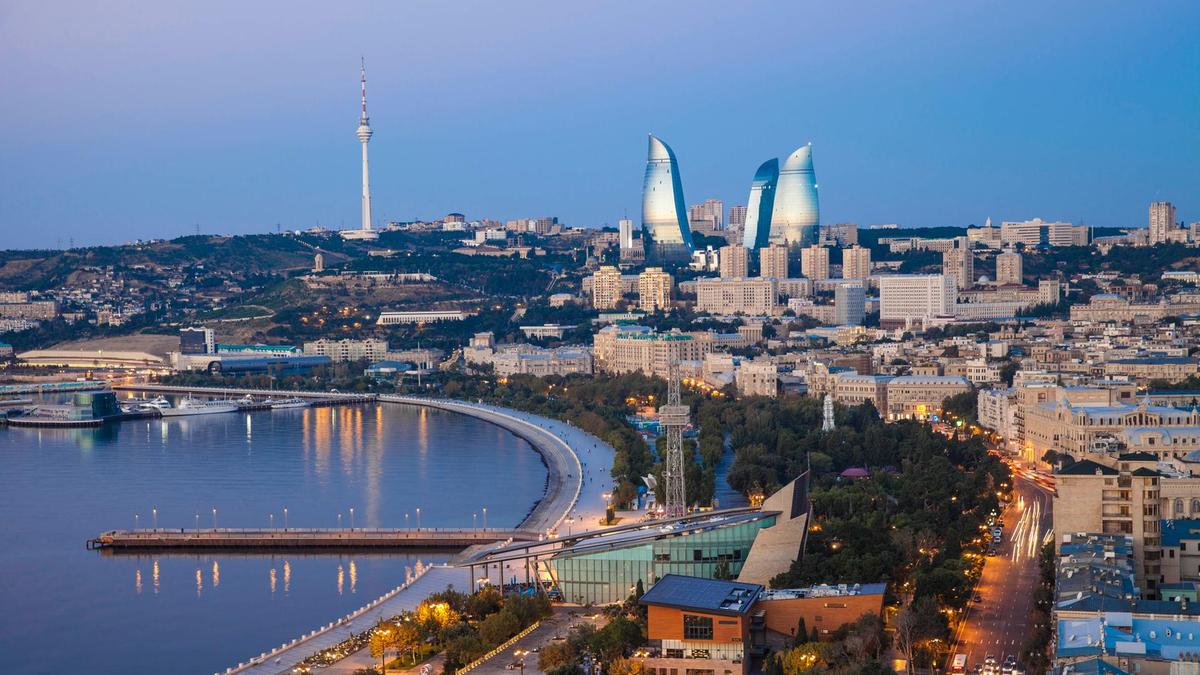
And you can see that money being spent, to the benefit of the tourist I might add. Baku has perhaps the most attractive and walkable seaside promenade. The walker has views of the Caspian, of spectacular buildings, of the port, and there are multiple paths with beautiful gardens and cactuses and baobab trees, benches everywhere, Eurasians in abundance, and in August the weather is perfect for a long stroll every night.
Baku is reputed to be the world’s lowest capital city, standing about 28 meters below sea level.
It is the first Shiite country I have visited, and it seems less conservative than say the Turkey of ten years ago, for instance in terms of dress and demeanor. A small percentage of women wear burkhas, most of all by the seaside walk, but the look of their companions suggests most are tourists or expats.
In short, several generations of communist-enforced atheism do have a persistent effect. One Azerbaijani, with whom I had an extended dialogue through a translator, stressed to me how much universal Soviet education elevated the region (and she was not pro-Soviet or pro-communist by any means). The Azerbaijanis address me in Russian, as few can converse with ease in English.
The police go to great lengths to limit jaywalking, which is in any case dangerous. The city roads are wide, and like some parts of central Brasilia have few traffic lights. Never have I wished so often that I was on the other side of the street as in Baku.
Baku has three working synagogues, and, unlike in almost every other country in the world, they do not require police protection. It is a remarkably safe city.
There is strong sentiment here that Nagorno-Karabakh, technically a part of Azerbaijan but not controlled by the government in over twenty years, is ruled by “Armenian terrorists,” backed by Putin. This issue, largely neglected outside the region, is likely to flare up again. When I applied for a visa, I had to answer whether I come from Armenian blood (no). It seems like a much less friendly conflict than say between the Israelis and the Palestinians.
Baku was the easternmost part of the Roman Empire — does that make it European?
“Relatives may eat your flesh but they won’t throw away your bones” is an old Azerbaijani saying.
Newborns are washed in salt water, to make them truthful and bold.
As a vacation spot, I recommend three to four days here for anyone looking for something off the beaten path, but without logistical difficulties. Here is Wikipedia on Baku.
The trade war: liquid resale markets react first
The prices at the Manheim auto auction have been better than usual lately, especially since President Donald Trump started pushing for new tariffs on imported vehicles, parts as well as the steel and aluminum used to make cars, said Jonathan Smoke, the chief economist of Cox Automotive. Cox runs the auction, which draws dealers from around the country to bid online or in person at the auction house.
Smoke tracks three-year old vehicles as an indicator of pricing for used cars, since that’s when a lot of leases are turned in and that vintage is the most common pre-owned vehicle for sale at any given time. A three-year-old Nissan Altima costs about $100 more now than it did just last month. A three-year-old Toyota Camry costs $400 more than it did a year ago.
“The fact this happened almost exactly two weeks after Trump announced he was going to enact tariffs can’t be ignored,” Smoke said, referring to tariffs Donald Trump has proposed on new vehicles imported to the United States…
While the tariffs on new car sales haven’t been enacted yet, the mere threat appears to be driving up prices on new cars. Auto dealers at the Manheim auction Aug. 10 theorized that consumers who might be in the market for a car in the next six to nine months are buying now to hedge against possible rising prices.
Here is the full story, via Michael Rosenwald and here is his history podcast.