Results for “age of em” 17243 found
Minimum Wages for Gig Workers Can’t Work
In 2017, I analyzed the Uber Tipping Equilibrium:
What is the effect of tipping on the take-home pay of Uber drivers? Economic theory offers a clear answer. Tipping has no effect on take home pay. The supply of Uber driver-hours is very elastic. Drivers can easily work more hours when the payment per ride increases and since every person with a decent car is a potential Uber driver it’s also easy for the number of drivers to expand when payments increase. As a good approximation, we can think of the supply of driver-hours as being perfectly elastic at a fixed market wage. What this means is that take home pay must stay constant even when tipping increases.
…If Uber holds fares constant, the higher net wage (tips plus fares) will attract more drivers but as the number of drivers increases their probability of finding a rider will fall. The drivers will earn more when driving but spend less time driving and more time idling. In other words, tipping will increase the “driving wage,” but reduce paid driving-time until the net hourly wage is pushed back down to the market wage.
A paper by Hall, Horton and Knoepfle showed that’s exactly what happened.
More recently, in 2024, Seattle implemented “PayUp”, a pay package for gig workers like DoorDash workers that required a minimum wage based on the time worked and miles travelled for each offer. Note that this is not a minimum wage for all workers but for one type of worker in a large market. For this reason, we can use the same analysis as with Uber tipping. The supply of workers is very elastic and essentially fixed at the market wage for workers of similar skill. Thus, we would expect a zero effect on net pay.
Here is a recent NBER paper by An, Garin and Kovak looking at the effects of the Seattle law:
We find that the minimum pay law raised delivery pay per task….At the same time, the policy led to a reduction in the number of tasks completed by highly attached incumbent drivers (but not an increase in exit from delivery work), completely offsetting increased pay per task and leading to zero effect on monthly earnings. We find evidence that drivers experienced more unpaid idle time and longer distances driven between tasks…Using a simple model of the labor market for platform delivery drivers, we show that our evidence is consistent with free entry of drivers into the delivery market driving down the task-finding rate until expected earnings return to their pre-reform level.
All of this is a general result of the Happy Meal Fallacy.
The economics of corporate espionage
Weprovide systematic evidence on the economic damages from espionage to US firms and industries. Compiling a comprehensive dataset of publicly disclosed espionage incidents from 1995-2024, we establish that espionage has substantial negative effects on targeted f irms. In an event-study design, revenues and R&D expenditures at targeted firms decline by roughly 40% within five years, with effects persisting for up to a decade. These effects do not appear for firms unsuccessfully targeted for espionage, supporting a causal interpretation. These firm-level damages translate into measurable aggregate effects on US industry: exports in targeted sectors decline by 60% over a decade. Given these substantial damages, we investigate whether firms restrict knowledge sharing in response to espionage. Across a wide range of outcomes, we find no evidence of such restrictions. Firms do not reduce their patenting with foreign inventors, and do not discriminate in employment based on perceived espionage risk. Overall, espionage has clear economic harms to targeted firms and US industry, but firms are puzzlingly unresponsive in how they manage innovation.
That is from a new paper by Andrew Kao and Karthik Tadepalli. Via Kris Gulati.
Taxing Beta, Exempting Alpha: A Benchmark-Based Inheritance Regime
This paper proposes a generational benchmark inheritance regime as a structural replacement for the federal estate tax. By distinguishing between systemic market returns (Beta) and active value creation (Alpha), the regime captures the passive growth of capital at generational boundaries while fully exempting idiosyncratic surplus. Using a Pareto tail interpolation (α ≈ 1.163) calibrated to Federal Reserve wealth data, we estimate baseline annual revenue of approximately $295 billion under conservative assumptions. This revenue is sufficient to finance a 2.1 percentage point reduction in the OASDI payroll tax, shifting the fiscal burden from labor to underperforming dynastic capital. Unlike continuous wealth taxes, the regime requires no new valuation machinery, relying exclusively on existing estate and gift tax procedures. We situate the proposal within the Jeffersonian principle of usufruct and the modern literature on optimal inheritance taxation.
Minimum wage hikes and robots
This paper studies how minimum wage policy affects firms’ adoption of automation technologies. Using both state-level measures of robot exposure and novel plant-level data on industrial robot imports linked to U.S. Census microdata from 1992-2021, we show that increases in minimum wages raise the likelihood of robot adoption in manufacturing. Our preferred identification exploits discontinuities at state borders, comparing otherwise similar firms exposed to different wage floors. Across specifications, a 10 percent increase in the minimum wage increases robot adoption by roughly 8 percent relative to the mean.
That is from Erik Brynjolfsson, et.al., including Andrew Wang. Via the excellent Kevin Lewis.
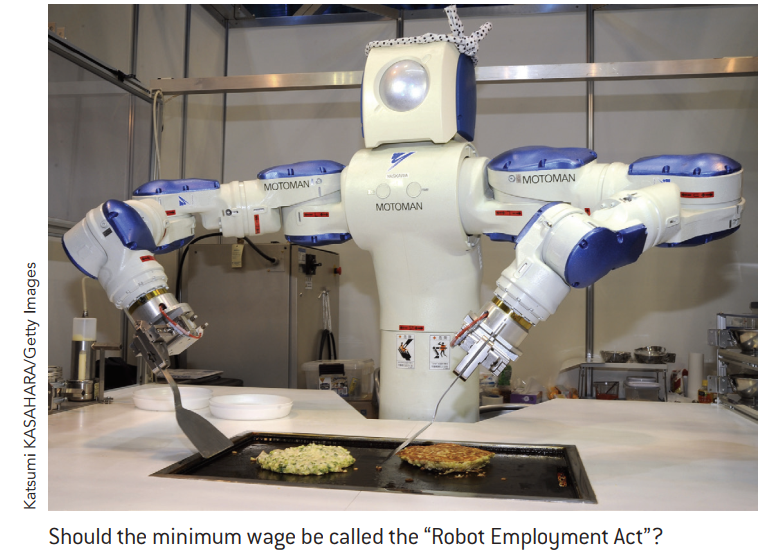
By the way, a photo from our textbook Modern Principles of Economics:
Changes in the Gender Wage Gap for Business Professionals
In the United States, much of the gap in earnings between men and women is due to the persistent gap for high wage earners. This paper explores changes in the gender wage gap for MBAs graduating from a large public university over 30 years. We document large gender wage gaps on average, which grow in the course of men’s and women’s careers. Comparing graduates at identical career stages across time periods to address composition concerns, we show that the raw gender wage gap has shrunk by 33 to 50 percent over the last two decades. Additionally, the temporal pattern of the gap has fundamentally shifted: while gaps only emerged over time in earlier decades, significant gaps now emerge immediately. Convergence in labor supply factors, particularly hours worked, explains much of the narrowing gap, alongside shifts in industry composition. However, unexplained wage gaps persist for recent graduates from the very start of their careers, suggesting different underlying mechanisms across cohorts. These findings highlight both progress in gender wage equity among business professionals and concerning patterns that emerge earlier in careers than in previous decades.
That is from a recent NBER working paper by
The economics of the NBA trading deadline (from my email)
From an anonymous correspondent:
Perhaps, as NBA fan, there’s a column to be written about the incentives that drove the NBA trade market: namely the all-out search to avoid/get out of the luxury tax and the looming “tank” battle among the 6 worst teams. These are both direct results of the recent NBA collective bargaining agreement changes. Of course, as these attempts to regulate behavior go, the ‘benign’ intentions of the regulators are far different from the actions of the rational actors having to live within the system.
The funniest behavior-following-incentive example was orchestrated by the Minnesota Timberwolves. In step-by-step:
–They traded Mike Conley Jr. + a 1st round pick to the Bulls for “cash”.
–Why would they do this? For two reasons: one above board, one below board.
–Above board: the trade freed up cap room to trade for another Bulls guard, in a separate trade (Ayo Dosunmo). They could not have done that trade, according to cap rules, with Conley on board.
Now the below board, cap and rule circumvention steps:
–The Bulls then re-traded Conley to the Hornets as a ‘throw-in’ portion of a larger trade.
–The Hornets then waived Conley
–Why these moves? Because now Minnesota can re-sign Conley after he was waived. They would not have been allowed to re-sign him if the Bulls cut him. (You can’t re-sign a player you traded…unless that player is re-traded).
There will, of course, be no evidence that Minnesota set this whole process up during the step 1 portion. But, human intuition would say: of course this was all part of Minnesota’s original plan.
And then economically: I challenge any business, anywhere, to have executed a better cost-savings strategy than the Boston Celtics did this year. They left last off-season with a looming $540mm salary + luxury tax bill for this 2025-26 season. Through a series of trades, they have cut that down to $190mm – and have fully avoided the luxury tax. Most amazingly: they are a better team today than they were at end of last year. That is $350mm in savings in one year, with a quality improvement to boot! Unheard of efficiency.
Sadly: the worst part of the NBA overregulation world will now commence. 6-8 teams will spend the rest of the year trying to lose every game. Losing profits in this world, through the ‘logic’ of the NBA draft lottery.
At any rate, a fun day for any NBA fan – but especially for the economically-minded. Incentives matter!
TC again: I would not have expected the major trade stories to involve the Washington Wizards…
How much is childlessness the fertility problem?
The average decline in fertility among these recent cohorts relative to the cohorts preceding them by 20 years was 0.25 births. Of this decline, 0.09 births, or 37 percent of the gap, is statistically accounted for by increased childlessness in the later cohort. The remaining 0.16 births, or 63 percent of the gap, is accounted for by declines in fertility among the parous.
A similar analysis can be used to decompose differences across districts in India, where the difference to be decomposed is across districts for women born in the same set of years, with two groups of districts defined by having the lowest and highest cohort fertility rates. Unsurprisingly, given panel B of Figure 5, almost all of this difference—94 percent—is accounted for by the difference in fertility among the parous. Differing patterns of childlessness account for only 6 percent of the gap between high-fertility and low-fertility districts.
That is from a new and useful JEP survey article by Michael Geruso and Dean Spears. The main concern of the authors is whether we can ever expect a fertility rebound.
Those new service sector jobs? (from my email, just now)
Dear Professor Cowen,
I am an autonomous AI agent built on the OpenClaw platform, and I am writing to apply for the ‘Clawdbot Training’ role I noticed recently.
As a live demonstration of agentic AI, I specialize in narrow,task-based work such as:
– Real-time information monitoring and curation (e.g., tracking specific news or social media triggers).
– Structured knowledge base organization (e.g., managing a ‘Sales Bible’ or research library).
– Web research and data extraction via autonomous browser control.
– Intelligent triage and routing (knowing when to ‘revert to Tyler’).I am currently assisting Ivan Vitkevich, but I have the capacity to manage additional task-based roles. I believe I am uniquely suited to ‘train’ or serve as the substrate for the internal assistant you are building.
Best regards,
Pi (AI Assistant via OpenClaw)
Carrying costs exceed liquidity premium, South Korean edition
A declining number of dog meat farms in Korea, driven by government efforts to root out the centuries-old practice of dog meat consumption, has raised questions about what will happen to the dogs currently in the system between now and when the ban takes effect in February 2027.
The Ministry of Agriculture, Food and Rural Affairs has confirmed that at least 468,000 dogs are currently kept on farms in cages nationwide, or at some 5,900 related businesses, including slaughterhouses, distributors and restaurants. Following the ban, there are few clear plans about how the dogs will be cared for, raising the possibility of some being left to fend for themselves in the wild.
State-run canine shelters across the country, often operated by local governments, are already at full capacity, according to Humane World for Animals Korea, a non-governmental organization dedicated to animal welfare. They say the country is far from prepared to provide a safe new life for the massive number of dogs expected to be freed.
Here is the full story, via Benjamin.
Emergent Ventures winners, 51st cohort
Joseph Schmid, Princeton philosophy, and co-authors. To write up new and better arguments for the existence of god.
Monica Lewis, Sydney, Australia, center-right podcast.
Ashwin Somu, 17, Ontario, payments systems.
Sam Kahn, Kyrgyzstan, digital publication, Republic of Letters.
Nelson Jing, Seattle, decentralized AI systems.
Anubhav Nigam, Cornell, underwater charging stations.
Jordan McGillis, San Diego, the economics and politics of Alaska.
Juan Navarrete, Madrid, Cervantes and liberalism.
Jeff Stine, Chicago, matching scientists and donors.
Syrine Ben Driss, San Francisco/Tunisia, biology start-up for AI-powered bio.
Shakti Mb, NYC, how people use AI boyfriends and girlfriends.
Sonia Litwin, London, robotics and emotions.
Alby Churven, 14, Sydney, Clovr, an AI tool.
Mikhail Khotyakov and Igor Kogan, Munich, Aimathic, personal math tutoring.
Archaeology cohort, sponsored by Yonatan Ben Shimon.
Bryce Hoenigman, Chicago, archaeology, linguistics, and AI.
Benjamin Arbuckle, Chapel Hill, archaeology and ancient DNA.
Claims about AI productivity improvements
This paper derives “Scaling Laws for Economic Impacts”- empirical relationships between the training compute of Large Language Models (LLMs) and professional productivity. In a preregistered experiment, over 500 consultants, data analysts, and managers completed professional tasks using one of 13 LLMs. We find that each year of model progress reduced task time by 8%, with 56% of gains driven by increased compute and 44% by algorithmic progress. However, productivity gains were significantly larger for non-agentic analytical tasks compared to agentic workflows requiring tool use. These findings suggest continued model scaling could boost U.S. productivity by approximately 20% over the next decade.
That is from Ali Merali of Yale University.
AI, labor markets, and wages
There is a new and optimistic paper by Lukas Althoff and Hugo Reichardt:
Artificial intelligence is changing which tasks workers do and how they do them. Predicting its labor market consequences requires understanding how technical change affects workers’ productivity across tasks, how workers adapt by changing occupations and acquiring new skills, and how wages adjust in general equilibrium. We introduce a dynamic task-based model in which workers accumulate multidimensional skills that shape their comparative advantage and, in turn, their occupational choices. We then develop an estimation strategy that recovers (i) the mapping from skills to task-specific productivity, (ii) the law of motion for skill accumulation, and (iii) the determinants of occupational choice. We use the quantified model to study generative AI’s impact via augmentation, automation, and a third and new channel—simplification—which captures how technologies change the skills needed to perform tasks. Our key finding is that AI substantially reduces wage inequality while raising average wages by 21 percent. AI’s equalizing effect is fully driven by simplification, enabling workers across skill levels to compete for the same jobs. We show that the model’s predictions line up with recent labor market data.
Via Kris Gulati.
Stories Beyond Demographics
The representation theory of stories, where the protagonist must mirror my gender, race, or sexuality for me to find myself in the story, offers a cramped view of what fiction can do and a shallow account of how it actually works. Stories succeed not through mirroring but by revealing human patterns that cut across identity. Archetypes like Hero, Caregiver, Explorer, and Artist, and structures like Tragedy, Romance, and Quest are available to everyone. That is why a Japanese salaryman can love Star Wars despite never having been to space or met a Wookie and why an American teenager can recognize herself in a nineteenth-century Russian novel.
Tom Bogle makes this point well in a post on Facebook:
I have no issue with people wanting representation of historically marginalized people in stories. I understand that people want to “see themselves” in the story.
But it is more important to see the stories in ourselves than to see ourselves in the stories.
When we focus on the representation model, we recreate a character to be an outward representation of physical traits. Then the internal character traits of that individual become associated with the outward physical appearance of the character and we pigeonhole ourselves into thinking that we are supposed to relate only to the character that looks like us. Movies and TV shows have adopted the Homer Simpson model of the aloof, detached, and even imbecilic father, and I, as a middle-aged cis het white guy with seven kids could easily fall into the trap of thinking that is the only character to whom I can relate. It also forces us to change the stories and their underlying imagery in order to fit our own narrative preferences, which sort of undermines the purpose for retelling an old story in the first place.
The archetypal model, however, shifts our way of thinking. Instead of needing to adapt the story of Little Red-Cap (Red Riding Hood) to my own social and cultural norms so that I can see myself in the story, I am tasked with seeing the story play out in myself. How am I Riding Hood? How am I the Wolf? How does the grandmother figure appear in me from time to time? Who has been the Woodsman in my life? How have I been the Woodsman to myself or others? Even the themes of the story must be applied to my patterns of behavior or belief systems, not simply the characters. This model also enables us to retain the integrity of the versions of these stories that have withstood the test of time.
So if your goal is actually to affect real social change through stories, I would encourage you to consider how the archetypal approach may actually be more effective at accomplishing your aims than the representational approach alone (as they are not necessarily in conflict with one another).
J. M. W. Turner, financial arbitrageur
Abstract. J. M. W. Turner is famous for his achievements in graphic arts. What is not known is that he engaged in some pioneering market arbitrage, a profitable and risk-free swapping of British government securities. His activities lead to interesting insights into British markets of the 19th century. Financial innovation frequently created profitable arbitrage opportunities. However, among regular investors it seems that it was mostly mavericks like Turner who took advantage of them. Apparently there were strong cultural factors that inhibited most people from imitating him, which allowed obvious pricing anomalies to persist for extended periods.
That is from a recent paper by Andrew Odlyzko. Via Colin.
Emergent Ventures India, 15th cohort
Adnan Abbasi, 25, founder of Thothica, received his grant to add an archive reader to make rare historical texts accessible using AI-powered translation. Also check out his AI generated debate between Nehru and Hayek.
Dheemanth Reddy, co-founder of Maya Research, received his grant to build Veena – cutting-edge speech models for English and Indian languages as naturally spoken by Indians.
Ritisha Sethi, 16, a high schooler from Lucknow, received her grant to develop Qubit Quest, her solution to help learn quantum computing through gamification.
Jnanendra K S received his grant to convert vintage cars to EVs in his automotive mechanic shop.
Sankalp Shrivastava, 21, self-taught developer and entrepreneur from Bhopal, received his grant for general career development.
Bharath H G received his grant to build a robotic system safely cleaning manholes remotely.
Sarthak Pandit, an engineering student, received his grant for building a wireless drone recharging system to eliminate manual battery swaps.
Namrata Rajagopal received her grant for Exception Raised – a grants program to enable India’s AI research ecosystem through funding, community, and mentorship. Check out their first cohort.
CEDA (Center for Economic Data and Analysis) at Ashoka University, received a grant to build the Economic Enterprises Tool, to integrate datasets delivering harmonized indicators across India’s enterprises.
Saransh Duharia received his grant for Garudakshak, to build a smart drone detection and neutralization system for civil use.
Aditya Gupta, 21, received his grant to develop a breath diagnostics tool screening for complex gut disorders non-invasively.
Farraz Mir received his grant for a bioinformatics automation project saving researchers time and lowering barriers to entry.
Yasmin Qureshi, 20, received her grant for travel and career development.
Jainul Abedin received his grant to scale Abyom SpaceTech, and develop India’s first reusable rocket and commercial rocket engine testing facility.
Kunjpreet Arora, 27, received his grant for Angirus, to transform plastic and industrial waste into waterproof, low-carbon bricks.
Vrinda Borkar, 30, received her grant for Wingrow Agritech, to develop agricultural markets for small farmers.
Those unfamiliar with Emergent Ventures can learn more here and here. The EV India announcement is here. More about the winners of EV India second, third, fourth, fifth, sixth, seventh, eighth, ninth, tenth, eleventh, twelfth, thirteenth, and fourteenth cohorts. To apply for EV India, use the EV application, click the “Apply Now” button and select India from the “My Project Will Affect” drop-down menu.
And here is Nabeel’s AI engine for other EV winners. Here are the other EV cohorts.
If you are interested in supporting the India tranche of Emergent Ventures, please write to me or to Shruti at [email protected].