Results for “best book” 2009 found
Monday assorted links
1. The great Leonard Kessler has passed away (he wrote my very first “favorite book“). Plus he was “woke” in the good sense of that term.
2. And “economist” Gary North has passed away as well (NYT). Hadn’t known he married Rushdoony’s daughter.
3. Excellent Matt Yglesias Bloomberg column on why Russian yacht seizure is ill-advised.
4. Devon Zuegel Buenos Aires guide.
5. The new Texas abortion law didn’t matter that much (NYT).
6. Is Moldova next? With a disquisition on Transnistria.
*The Affirmative Action Empire*
The author is Terry Martin of Harvard, and the subtitle is Nations and Nationalism in the Soviet Union, 1923-1939. This is an excellent book for understanding how some of the current Russia vs. Ukraine issues are rooted in Bolshevik times. Here is one excerpt:
This understanding of nationalism led Platakov to support the only apparently logical response: attack nationalism as a counterrevolutionary ideology and nationality itself as a reactionary remnant of the capitalist era. Lenin and Stalin, however, drew the exact opposite conclusion. They reason as follows. By granting the forms of nationhood, the Soviet state could split the above-class national alliance for statehood. Class divisions, then, would naturally emerge, which would allow the Soviet government to recruit proletarian and peasant support for their socialist agenda. Lenin argued that Finnish independence had intensified, not reduced, class conflict. National self-determination would have the same consequences within the Soviet Union.
And:
As a nationalized entity, the Soviet Union can best be described as an Affirmative Action Empire…The Soviet Union was the first country in world history to establish Affirmative Action programs for national minorities, and no country has yet approached the vast scale of Soviet Affirmative Action.
The goal of course was to limit the emergence of non-Russian nationalism, not to boost the fortunes of the ethnic and national minorities themselves.
*Oceans of Grain*
A good book, think of it as a more general (non-technical) economic history of wheat, authored by Scott Reynolds Nelson. The sad thing is the book’s subtitle: “How American Wheat Made the World” — yes it covers America, but a lot of the book, and I would say its best parts, focus on Russia and Ukraine.
I guess the publisher figured American readers don’t care that much about Ukraine? Here is one excerpt:
Before Odessa [which had just been described as a major grain port], the Russian Empire had expanded slowly and defensively, one line of forts at a time. After Odessa, Russia — just like the United States — possessed foreign exchange and could expand dramatically. Wheat exports allowed the Russian Empire to fund its foreign wars, and so it surged into Poland, across the Caspian Sea, and toward China. Nothing seemed capable of stopping the yeasty, kvassy expansion of the Russian Empire. In fact, the spread of a different invisible creature, an invisible water mold, would further entrench Odessa as Europe’s city of wheat.
And this:
Fish sandwiches emerged as a regular meal for workers in Britain around 1870 once American grain arrived; a decade later this became fish and chips.
A fun book for me.
Will Our Military State Fail Us? II
A few years ago I reported on how the US repeatedly loses to China in war games (no indent):
David Ignatius writing in the Washington Post:
Do interviews matter?
Yes, interviews very much do matter.
You may have read articles like the one that Sarah Laskow wrote a few years ago in The Boston Globe, “Want the Best Person for the Job? Don’t Interview,” or the one Jason Dana published in The New York Times, “The Utter Uselessness of Job Interviews.” These and other stories make the all too familiar claim that interviews do not boost your ability to spot the better job candidates. You might then wonder whether interviews, or trying to improve your interview skills, are worth your while.
This common myth of interview impotence misses the point. At the very least, interviews can help you rule out some candidates quickly. But the main reason why virtually all top companies stick with doing interviews is that interviews yield useful information.
Most importantly, many of the research studies pessimistic about interviewing focus on unstructured interviews performed by relatively unskilled interviewers for relatively uninteresting, entry-level jobs. You can do better. Even if it were true that interviews do not on average improve candidate selection, that is a statement about averages, not about what is possible. You still would have the power, if properly talented and intellectually equipped, to beat the market averages. In fact, the worse a job the world as a whole is at doing interviews, the more reason to believe there are highly talented candidates just waiting to be found by you.
In most of the studies on this subject, interviews were more effective for higher-level jobs. So if you wish to hire an economist, Tyler believes that asking a person substantive economics questions during an interview is a good way to start assessing their competence, though to our knowledge this never has been proven or disproven in study form. Daniel believes that if you wish to fund an applicant for venture capital, it is worth asking about the business plan to see how well the basic idea is presented and defended. If they can’t make a case for it to you, they’ll probably have trouble attracting talent to help them. The anti-interview crowd, many of whom are centered in academia, overlooks these obvious truths.
Interviews also play a crucial role in recruiting candidates and helping spread a positive impression of you and your company, even in cases where you don’t end up hiring the person. So put aside any inclination to skip or devalue this part of the process. Interviews are essential, and, because so many organizations rely on mindless bureaucratic approaches, the bar is low and the payoff high.
Footnote: For one typical anti-interview piece, see Sarah Laskow, “Want the Best Person for the Job? Don’t Interview,” The Boston Globe, November 24, 2013. Or see Jason Dana, “The Utter Uselessness of Job Interviews,” The New York Times, April 8, 2017, a poorly titled piece that refers primarily to a single specific study. On a meta-analysis regarding the value of structured interviews, see Allen I. Huffcutt and Winfred Arthur Jr., “Hunter and Hunter (1984) Revisited: Interview Validity for Entry-Level Jobs,” Journal of Applied Psychology 79, no. 2 (1994): 184–190. See also Therese Macan, “The Employment Interview: A Review of Current Studies and Directions for Future Research,” Human Resource Management Review 19 (2009): 201–218, for a more recent examination of the same questions.
That is all from my forthcoming book with Daniel Gross Talent: How to Identify Energizers, Creatives, and Winners Around the World. Most of the chapter of course is devoted to how to get the most out of an interview. Due out May 17, you can pre-order here for Amazon, here for Barnes & Noble.
Samuel Brenner reads *Stubborn Attachments*
An excellent review and interpretation, here is one summary part:
…the fundamental idea of the book is not “economic growth is good” but rather “here’s how to reason under extreme uncertainty”, and that once you adopt Tyler’s view about how to reason under extreme uncertainty, both principles (growth and rights) fall out as the only two important considerations…
My preferred view of the book’s overall argumentative structure is more like the following:
G. Good things are better than bad things
H. We need to act in order to achieve good things
I. But there’s a huge froth of uncertainty, and our actions might be counterproductive
J. So we should have faith
K. And also we should only pursue the actions with really high expected value and which are likeliest to rise above the froth of uncertainty
L. The actions that pass this test best are growth and rights, so we have to pursue both
I would stress this is a complement to other interpretations rather than a substitute for them, in any case an excellent short essay. And here is “About Samuel Brenner.“
A simple theory of culture
The transistor radio/car radio was the internet of its time. Content was free, and there were multiple radio stations, though not nearly as many as we have internet sites.
People tuned into the radio, in part, for ideas, not just tunes. But the ideas that spread best were attached to songs. Drug use spread, in part, because famous musicians sang about using drugs. Anti-Vietnam War themes spread through songs, as did many other social movements. Overall, ideas that could be bundled with songs had a big advantage. And since new songs were largely the province of young people, this in turn favored ideas for young people.
Popular music was highly emotionally charged because so much of it was connected to ideas you really cared about.
Of course, by attaching an idea to a song you often ensured the idea wasn’t going to be really subtle, at least not along the standard intellectual dimensions. But it might be correct nonetheless.
Today you can debate ideas directly on social media, without the intermediation of music. Ideas become less simple and more baroque, while music loses its cultural centrality and becomes more boring.
We also don’t need to tie novels so much to ideas, although in countries such as Spain idea-carrying novels remain a pretty common practice (NYT). A lot of painting and sculpture also seem increasingly disconnected from significant social ideas.
In this new world, celebrities decline in relative influence, because they too are no longer carriers of ideas in the way they used to be. Think “John Wayne!” Arguably “celebrity culture” peaked in the 1980s with Madonna and the like.
When I hear various complaints about the contemporary scene, sometimes I ask myself: “Is this really a complaint about the disintermediation of ideas”?
In this view, the overall modern “portfolio” may be better, but the best individual art works, and in turn the greatest artists, will come from the earlier era.
Religion in the south Pacific (from my email)
I spent years living on a small, remote Pacific island. I am not religious, I was there on a government contract. Practically the only other Westerners were missionaries.
Importantly, Pacific islands have always been relatively easy to convert. They converted quite quickly to Christianity. The off-the-cuff explanation for this is usually “because they are so friendly” or whatever. An underrated factor is the fact that on many islands they genuinely helped improve the situation. Prior to the missionary operations many of these islands were getting literally and figuratively raped by Whalers. Disease everywhere, alcohol completely ruining everything. Fathers selling children to Whalers for alcohol. The missionaries helped improve that situation (albeit incompletely and with their own set of issues they themselves caused!)
That said, these days Mormons have the best missionary operation by far:
-They learn the language.
-They translate the book of Mormon into the local language even when it is a language spoken only on that island by a small number of people.
-The missionary group, very consciously, is designed to usually contain Pacific islanders from OTHER islands but rarely one from THAT island. They generally avoid putting islander missionaries on their own island to avoid sex and alcohol issues.
-They are on their missionary grind all day, 6 days a week. One day a week (Monday or Tuesday I think) reserved for running errands and being able to relax.
-They are allowed to and encouraged to exercise but very little other recreation is allowed. They are not allowed to go swimming.
-They do a fantastic job of just talking to people and being friendly, hosting youth stuff etc. and having it be genuinely wholesome and valuable.
-The LDS churches on the islands (though not the missionaries themselves) provide food and other forms of aid (like helping with the electricity bill) to church members. This is VERY important. They are widely seen on remote islands as mostly attracting “poor families” at first, for this reason.Distant 2nd and 3rd place is a toss up between Jehovah’s Witnesses and Seven Day Adventists. SDA builds schools. JW does a good job with the languages. SDA missionaries are often very low quality though without much in the way of a code of conduct. JW do not celebrate holidays on islands where social life is organized around all kinds of major and minor holidays.
Assembly of God, Calvary Baptist are just too small of operations, usually much older missionaries. A few other vaguely Pentecostal-seeming varieties are around too but again, they just don’t have the resources or operation size/scale to really compete.
If you’re looking for a dark horse candidate moving forward… Ahmadiyya Islam is making inroads into the Pacific! It is a tall order in very Christian Pacific cultures that know nothing about Islam, but they actually are making some progress. Big focus on providing services to the poor.
I thank A. for sending me this!
*Labor Econ Versus the World*
The author is Bryan Caplan and the subtitle is Essays on the World’s Greatest Market. It is a collection of his best blog posts on labor markets over the last fifteen years or so. A Bryan blog post from 2015 gives a good overview of much of the book, which you can read as pushback against a lot of doctrines held by other people, including the mainstream:
What are these “central tenets of our secular religion” and what’s wrong with them?
Tenet #1: The main reason today’s workers have a decent standard of living is that government passed a bunch of laws protecting them.
Critique: High worker productivity plus competition between employers is the real reason today’s workers have a decent standard of living. In fact, “pro-worker” laws have dire negative side effects for workers, especially unemployment.
Tenet #2: Strict regulation of immigration, especially low-skilled immigration, prevents poverty and inequality.
Critique: Immigration restrictions massively increase the poverty and inequality of the world – and make the average American poorer in the process. Specialization and trade are fountains of wealth, and immigration is just specialization and trade in labor.
Tenet #3: In the modern economy, nothing is more important than education.
Critique: After making obvious corrections for pre-existing ability, completion probability, and such, the return to education is pretty good for strong students, but mediocre or worse for weak students.
Tenet #4: The modern welfare state strikes a wise balance between compassion and efficiency.
Critique: The welfare state primarily helps the old, not the poor – and 19th-century open immigration did far more for the absolutely poor than the welfare state ever has.
Tenet #5: Increasing education levels is good for society.
Critique: Education is mostly signaling; increasing education is a recipe for credential inflation, not prosperity.
Tenet #6: Racial and gender discrimination remains a serious problem, and without government regulation, would still be rampant.
Critique: Unless government requires discrimination, market forces make it a marginal issue at most. Large group differences persist because groups differ largely in productivity.
Tenet #7: Men have treated women poorly throughout history, and it’s only thanks to feminism that anything’s improved.
Critique: While women in the pre-modern era lived hard lives, so did men. The mating market led to poor outcomes for women because men had very little to offer. Economic growth plus competition in labor and mating markets, not feminism, is the main reason women’s lives improved.
Tenet #8: Overpopulation is a terrible social problem.
Critique: The positive externalities of population – especially idea externalities – far outweigh the negative. Reducing population to help the environment is using a sword to kill a mosquito.
Yes, I’m well-aware that most labor economics classes either neglect these points, or strive for “balance.” But as far as I’m concerned, most labor economists just aren’t doing their job. Their lingering faith in our society’s secular religion clouds their judgment – and prevents them from enlightening their students and laying the groundwork for a better future.
I will say this: Labor Econ Versus the World, while not written as a book per se, still is the best free market book on labor economics I know of. And it is very reasonably priced. I agree with much of what is in this book, but by no means all of it. I’ll consider my differences with it in a separate blog post, to come tomorrow.
What to Watch
Some things I have watched, some good, some not so good.
Cobra Kai on Netflix: A reliable, feel good show, well plotted. It plays like they mapped each season in advance covering all permutations and combinations of friends turning into enemies and enemies turning into friends. Do I really need five seasons of the same thing? No. But I still watch. Popcorn material.
Maid on Netflix: I appreciated the peek into the difficulties of managing the welfare system and pulling oneself up by one’s bootstraps when your family is pulling you down. Margaret Qualley (Andie MacDowell’s daughter who plays her mother on the show) has an odd charisma. It’s been noted that she is an impossibly perfect mother. Less noted is that she is a terrible wife, a poor daughter to her father and a bad girlfriend. Everyone deserves a break is the message we get from this show, except men. Still, it was well done.
The Last Duel is one of Ridley’s best. Superb, subtle acting from Jodie Comer–deserving of Oscar. Slightly too long but there are natural breaking points for at home watching. N.B. given the times it can’t be interpreted ala Rashômon as many people suggest but rather the last word is final which reduces long term interest but I still liked it.
Alex Rider on Amazon: It’s in essence a James Bond origin story. If that sounds like something you would enjoy, you will. I am told the books are also good for YA.
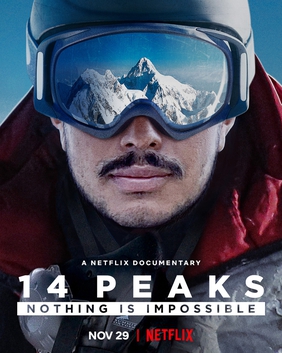 14 Peaks: Nothing is Impossible: A mountain documentary following Nimsdai Purja as he and his team attempt to summit all 14 of the world’s 8,000-meter peaks in seven months. In many ways, the backstory–Purja is a Gurka and British special forces solider–is even more interesting. It does say something that most people don’t know his name.
The Eternals on Disney: Terrible. Didn’t finish it. A diverse cast with no actual diversity. Kumail Nanjiani, Dinesh from Silicon Valley, plays his super hero like Dinesh from Silicon Valley. Karun, the Indian sidekick, is the most authentic person in the whole ensemble. Aside from being boring it’s also dark, not emotionally but visually. It doesn’t matter the scene, battle scenes, outdoor scenes, kitchen table scenes–all so dark they are literally hard to see.
Wheel of Time: It’s hard to believe they spent a reported $10 million per episode on this clunker. The special effects were weak, the editing was bad, the mood-setting and world building were poor. The actors have no chemistry. Why would anyone be interested in Egwene who shows no spunk, intelligence or charisma? For better in this genre is The Witcher on Netflix.
The French Dispatch (theatres and Amazon): I loved it. Maybe the most Wes Anderson of Wes Anderson movies, so be prepared. Every scene has something interesting going on and there’s a new scene every few minutes. A send-up and a love story to the New Yorker. Lea Seydoux is indeed, shall we say, inspiring.
Anéantir, by Michel Houellebecq
As it happens, Balzac is Houellebecq’s hero. Anéantir not only demonstrates comparable ambition to Balzac; it is also proof of Houellebecq’s tireless work. In his various books he has accumulated notes on: the stages of terminal tongue cancer; the precise topography of the Ministry of Finance; the exact operation of a guillotine (with schematics); the names, composition and texture of processed sandwiches on sale in Parisian train stations; the vernacular of Paris’s best political spin doctor; the triage of dying residents in provincial care homes, and more. When, some time around the 2100s Anéantir is re-published by Penguin Classics, the notes section will take up half the space of the novel proper. The translator will battle to properly convey the Tom Wolfe-like bleak hopelessness encompassed in ‘un sandwich Daunat maxi-moelleux au blanc de poulet-emmental dans son emballage et une Tourtel’.
Like Balzac, many of Houellebecq’s characters are drawn from real life. The book is set in the year 2026. The sitting president is transparently Emmanuel Macron, who’s been re-elected in 2022. Term limits mean he can’t run again: his cunning plan is to push a popular television talk show host to win in 2027, coached by, among others, the minister of finance, thereby keeping the seat warm for a return of ‘Macron’ himself at the 2032 election — a kind of Putin-Medvedev switcheroo.
The book just came out in France, here is more information. Is Houllebecq best at 736 pp.? I guess we’ll find out. In French, on Kindle. And in German. When in English? I have ordered it in German, though I am not sure when I will get to start much less finish it.
Tuesday assorted links
How to watch movies
Fergus asks:
Having enjoyed your posts on how to read canonical Western literature and how to get started with opera, I’d like the same thing but for film, and perhaps for architecture.
Today let’s do movies! I am hardly an expert, but here are my tips:
1. Yes there are some movies made for the television, but for first-rate movies you really do need the big screen. Do whatever you must, and no your home studio arrangement is not a good substitute. Good cities for seeing movies on a large screen are NYC, LA, Paris, London, and the DC area (Silver Spring, MD in particular, AFI).
2. Choosing with whom to go is very important. And you should see a fair share of movies alone, so you are not swayed by the views and reactions of the other parties.
3. The best prep for watching a particular movie is to have watched a lot of other movies already, and from a wide variety of sources and countries. Knowledge of the Bible can be helpful too.
3b. If you don’t “get” a classic movie with good pedigree, 3/4 of the time the fault is yours.
4. I don’t like to read reviews before seeing a movie. I might read just enough to see the evaluation, but then I stop. I don’t want the movie “explained to me,” and furthermore very few critics have an adequate mix of travel, linguistic facility, knowledge of the classics, etc. Critics can stop you from seeing what is there. That said, after I’ve seen the movie I try to read as many reviews as possible.
5. If a movie is good, you should watch it again. Then a smaller screen might be OK, or at the very least necessary. You should have seen your favorite “deep” movies at least four times.
6. You want to have good peer groups to discuss movies with. And get a movie mentor!
7. The classic movie critics — not always on-line! — are worth reading. Buy a book of Pauline Kael essays, and then keep on buying books of essays by movie critics. Don’t rely too heavily on Google. My favorite movie critic used to be David Denby of The New Yorker. Buy books on the history of movies too.
8. Now go watch more movies.
By the way, here is an interesting review of the best movies of 1931.
What else?
Most Popular MR Posts of the Year!

As measured by page views here are the most popular MR posts of 2021. Coming in at number 10 was Tyler’s post:
10. Best non-fiction books of 2021
Lots of good material there and well worth revisiting. Number 9 was by myself:
9. Revisionism on Deborah Birx, Trump, and the CDC
TDS infected many people but as the Biden administration quickly discovered the problems were much deeper than the president, leading to revisionism especially on the failures of the CDC and the FDA. Much more could be written here but this was a good start.
Number 8 was Tyler’s post:
8. The tax on unrealized capital gains
which asked some good questions about a bad plan.
7. We Will Get to Herd Immunity in 2021…One Way or Another
Sadly this post, written by me in January of 2021, had everything exactly right–we bottomed out at the end of June/early July as predicted. But then Delta hit and things went to hell. Sooner or later the virus makes fools of us all.
6. Half Doses of Moderna Produce Neutralizing Antibodies
One of my earlier pieces (written in Feb. 21) on fractional dosing. See also my later post A Half Dose of Moderna is More Effective Than a Full Dose of AstraZeneca. We have been slow, slow, slow. I hope for new results in 2022.
5. A few observations on my latest podcast with Amia Srinivasan
Listener’s took umbrage, perhaps even on Tyler’s behalf, at Srinivasan but Tyler comes away from every conversation having learned something and that makes him happy.
4. The Most Impressive AI Demo I Have Ever Seen
Still true. Still jaw-dropping.
3. Patents are Not the Problem!
I let loose on the Biden administration’s silly attacks on vaccine patents. Also still true. Note also that as my view predicts, Pfizer has made many licensing deals on Paxalovid which has a much simpler and easier to duplicate production process (albeit raw materials are still a problem.)
2. A Nobel Prize for the Credibility Revolution
A very good post, if I don’t say so myself, on this year’s Nobel prize recipients, Card, Angrist and Imbens.
1. How do you ask good questions?
Who else but Tyler?
To round out the top ten I’d point to Tyler’s post John O. Brennan on UFOs which still seems underrated in importance even if p is very low.
Erza Klein’s profile of me still makes me laugh, “He’s become a thorn in the side of public health experts…more than one groaned when I mentioned his name.” Yet, even though published in April many of these same experts are now openly criticizing the FDA and the CDC in unprecedented ways.
UFOs going mainstream or Tabarrok’s view of the FDA going mainstream. I’m not sure which of these scenarios was more unlikely ex ante. Strange world.
Let us know your favorite MR posts in the comments.
What I’ve been reading
1. Richard Hanania, Public Choice Theory and the Illusion of Grand Strategy: How Generals, Weapons Manufacturers, and Foreign Governments Shape American Foreign Policy. Could this be the best public choice treatment of U.S. foreign policy? Gordon Tullock always was wishing for a book like this, and now it exists. I see Hanania’s views as more skeptical than my own (in East Asia in particular I think the American approach has brought huge benefits, Europe too), but nonetheless I am impressed by his careful analysis. This is a book that should revolutionize a field, though I doubt if it will.
2. Claire Keegan’s Small Things Like These is one of the best written pieces of literary fiction this year. Very Irish, and it helps to have a one paragraph knowledge of Ireland’s earlier “Magdalen laundries” problem. It is not exciting for the action-oriented reader, but a perfect work within the terms of the world it creates.
3. Justin Gest, Majority Minority. The book considers racial transitions and how majorities may lose their ethnic or racial majority status. To see where America might be headed, the author considers histories from Bahrain, Hawaii, Mauritius, Singapore, trinidad and Tobago, and New York City.
4. Lloyd Llewellyn-Jones, Persians: The Age of Great Kings. The Persian empire had the best infrastructure of any of the great ancient civilizations. The Royal Road for instance stretched 2,400 kilometers. Read more about the whole thing here.
Hannah Farber’s Underwriters of the United States: How Insurance Shaped the American Founding is a good and economically literate treatment of the importance of maritime insurance during the time of America’s founding.
Gregory Zuckerman, A Shot to Save the World: The Inside Story of The Life-or-Death Race for a Covid-19 Vaccine is a good account of what it promises.
In the Douglass North tradition is Jennifer Brick Murtazashvili and Ilia Murtazashvili, Land, the State, and War: Property Institutions and Political Order in Afghanistan.