Results for “best book” 2008 found
My Conversation with Amia Srinivasan
I am pleased to have had the chance to do this, as in my view she is one of the thinkers today who has a) super smarts, b) breadth and depth of reading, and c) breadth and depth of thinking. That combination is rare! That said, I don’t quite agree with her on everything, so this exchange had more disagreements than perhaps what you are used to sampling from CWT.
Here is the transcript and audio. Here is part of the CWT summary:
Amia joined Tyler to discuss the importance of context in her vision of feminism, what social conservatives are right about, why she’s skeptical about extrapolating from the experience of women in Nordic countries, the feminist critique of the role of consent in sex, whether disabled individuals should be given sex vouchers, how to address falling fertility rates, what women learned about egalitarianism during the pandemic, why progress requires regress, her thoughts on Susan Sontag, the stroke of fate that stopped her from pursuing a law degree, the “profound dialectic” in Walt Whitman’s poetry, how Hinduism has shaped her metaphysics, how Bernard Williams and Derek Parfit influenced her, the anarchic strain in her philosophy, why she calls herself a socialist, her next book on genealogy, and more.
Here is one excerpt:
SRINIVASAN: No, it really wouldn’t. Part of why I find this whole discourse problematic is because I think we should be suspicious when we find ourselves attracted to data — very, very thin and weak data — that seem to justify beliefs that have held great currency in lots of societies throughout history, in a way that is conducive to the oppression of large segments of the population, in this particular case women.
I also think one error that is consistently made in this discourse, in this kind of conversation about what’s innate or what’s natural, is to think about what’s natural in terms of what’s necessary. This is a point that Shulamith Firestone made a very long time ago, but that very few people register, which is that — and it was actually made again to me recently by a philosopher of biology, which is, “Look what’s natural isn’t what’s necessary.”
It’s extraordinary. It’s not even like what’s natural offers a good equilibrium point. Think about how much time you and I spend sitting around. Completely unnatural for humans to sit around, yet we’re in this equilibrium point where vast majority of humans just sit around all day.
So, I think there’s a separate question about what humans — as essentially social, cultured, acculturating creatures — what our world should look like. And that’s distinct from the question of what natural predispositions we might have. It’s not unrelated, but I don’t think any of us think we should just be forming societies that simply allow us to express our most “natural orientations.”
COWEN: Should women’s chess, as a segregated activity, continue to exist? We don’t segregate chess tournaments by race or by anything — sometimes by age — but anything other than gender. Yet women’s chess is a whole separate thing. Should that be offensive to us? Or is that great?
Recommended, engaging throughout. And again, here is Amia Srinivasan’s new and (in the UK, just published yesterday in the U.S.) bestselling book The Right to Sex: Feminism in the 21st Century.
Emergent Ventures winners, sixteenth cohort
Phoebe Yao, founder and CEO of Pareto, “a human API delivering the business functions startups desperately need.” Here is the Pareto website. She was born in China, formerly of Stanford, and a former classical violist. (By my mistake I left her off of a previous cohort list, apologies!)
BeyondAging, a new group to support longevity research.
Sam Enright, for writing, blogging, and general career development, resume here. From Ireland, currently studying in Scotland.
Zena Hitz, St. John’s College, to build The Catherine Project, to revitalize the study of the classics.
Gavin Leech, lives in Bristol, he is from Scotland, getting a Ph.D in AI. General career support, he is interested in: “Personal experimentation to ameliorate any chronic illness; reinforcement learning as microscope on Goodhart’s law; weaponised philosophy for donors; noncollege routes to impact.”
Valmik Rao, 17 years old, Ontario, he is building a program to better manage defecation in Nigeria.
Rabbi Zohar Atkins, New York City, to pursue a career as a public intellectual. Here is one substack, here is another.
Basil Halperin, graduate student in economics at MIT, for his writing and for general career development.
Gytis Daujotas, lives in Dublin, studying computer science at DCU, for a project to make the Great Books on the web easy to read, and for general career development. Here is his web site.
Geoff Anders, Leverage Research, to support his work to find relevant bottlenecks in science and help overcome them. A Progress Studies fellow.
Samantha Jordan, NYU Stern School of Business, with Nathaniel Bechhofer, for a new company, “Our platform will accelerate the speed and quality of science by enabling scientists to easily manage their data and research pipelines, using best practices from software engineering.” Also a Progress Studies grant.
Nina Khera, “I’m a teenage human longevity researcher who’s interested in preventing aging-related diseases, especially those related to brain aging. In the past, I’ve worked with companies like Alio on computation and web-dev-based projects. I’ve also worked with labs like the Gladyshev lab and the Adams lab on data analysis and machine learning-based projects.” Her current project is Biotein, about developing markers for aging, based in Ontario.
Lipton Matthews, from Jamaica, here is his YouTube channel, for general career development.
My Conversation with Ed Glaeser
I did David Cutler and Ed sequentially, based on their new co-authored book, here is the joint episode but there is also a separate link concerning Cutler. Here is one excerpt from the general summary:
They joined Tyler for a special joint episode to discuss why healthcare outcomes are so correlated with education, whether the health value of Google is positive or negative, why hospital price transparency is so difficult to achieve, how insurance coding systems reimburse sickness over health improvement, why the U.S. quit smoking before Europe, the best place in America to get sick, the risks that come from over-treatment, the possible upsides of more businesses moving out of cities, whether productivity gains from remote work will remain high, why the older parts of cities always seem to be more beautiful, whether urban schools will ever improve, why we shouldn’t view Rio de Janeiro’s favelas as a failure, how 19th century fights to deal with contagious diseases became a turning point for governance, Miami’s prospects as the next tech hub, what David and Ed disagree on, and more.
And from my exchange with Ed:
COWEN: Let’s start with a simple question. All this enthusiasm about cities and agglomeration benefits — the pandemic comes along. A lot of people transition to work from a distance, and then we see big measured productivity gains. What has gone on there?
GLAESER: It reminds us that for many jobs, in a static sense, you can do this long-distance. You can make things work. I think many of us found this. We wrote this book in eight months over the pandemic year, distinctly away from each other, partially because there were no distractions, and all that was good.
However, you also need to recognize the limits of long-distance living. The most important of those limits is just it’s much less fun. It’s much less joyful, but while it seems as if it’s fine for static productivity, it seems distinctly more problematic for people learning and for onboarding new talent.
Let me just give you two types of studies, one of which is we have the call center studies. The father of that was the Nick Bloom paper, which was a randomized control trial in China. A more modern version is done by our students, Natalia Emanuel and Emma Harrington, which looks into American call centers.
Both of them find the same thing in terms of static productivity. If anything, it goes up, but the workers who go remote are much less likely to be promoted in both studies. One interpretation of this is that promotion in the call center work means that you actually are given the job of handling more difficult calls.
How would your boss know that you are good at handling difficult calls if they weren’t in the same room with you? How would you learn how to do those difficult calls if you weren’t around other people? So while the static productivity remains, you lose the dynamic benefits of being around other people.
Second piece of evidence it comes from Burning Glass Technologies and new hires. Even though Microsoft tells us that its programmers were just as productive, overall, new hires for programmers were down 42 percent between November 2019 and November 2020. Firms were clearly unwilling to take the same kind of risks of hiring new workers that they couldn’t inculcate in their corporate culture or screen them properly, or do any of those other things.
Even though measured productivity did well during the pandemic, there were still lots of disruptions. In particular, many younger workers who came of age really lost out as a result of this.
COWEN: If work from a distance goes fine in the short run, what’s the cross-sectional prediction about where it will persist in the future? Is it firms facing bankruptcy, firms with immediate projects now, possibly start-ups who will then later transition to all being together in one big happy family, but they’re afraid they’re going to fail before then? What should we expect?
GLAESER: I think we should expect young workers to be more likely to be brought together. Young firms, as well, because you’re very much at this learning, creative phase. I think the optimal work-from-home strategy is a couple of partners who are in an accounting practice and have decided they know each other perfectly well and are delighted to Zoom it in from wherever they are.
I think, unquestionably, working from home will remain a part of the economy. It may well be many workers end up spending 20 percent of their time working from home, even if they’re part of a generally full-time job. But for younger workers, for firms that are just getting started, I think being live is likely to continue being a major part of the work environment.
It also depends a lot on what your home environment is like. If you’re like us — if you are a middle-aged professor who’s likely to have a comfortable home office, and maybe even not having kids at home anymore, certainly not kids who are crying all the time at home anymore — working at home is a lot more pleasant than if you’re a 23-year-old and live in a studio apartment in Somerville or New York or London.
Recommended!
My Conversation with David Cutler
I did Cutler and Ed Glaeser sequentially, based on their new co-authored book, here is the joint episode but I will create another link concerning Glazer. Here is one excerpt from the general summary:
They joined Tyler for a special joint episode to discuss why healthcare outcomes are so correlated with education, whether the health value of Google is positive or negative, why hospital price transparency is so difficult to achieve, how insurance coding systems reimburse sickness over health improvement, why the U.S. quit smoking before Europe, the best place in America to get sick, the risks that come from over-treatment, the possible upsides of more businesses moving out of cities, whether productivity gains from remote work will remain high, why the older parts of cities always seem to be more beautiful, whether urban schools will ever improve, why we shouldn’t view Rio de Janeiro’s favelas as a failure, how 19th century fights to deal with contagious diseases became a turning point for governance, Miami’s prospects as the next tech hub, what David and Ed disagree on, and more.
And from David:
COWEN: But even if we adjust for that, education seems to matter a lot. It’s also puzzling to me — in your own work, it matters more at younger ages. You would think the returns are cumulative: it would really pay off when you’re 67 because you’ve invested in a stock portfolio for decades, but it matters most when you’re young. What’s your best micro account of that?
CUTLER: One of the things that’s super interesting is that, for example, people who live in cities — where there are more better-educated people — smoke less, even conditional on your own education. The same thing is true about age and so on.
I think it’s partly that cities and areas are run by upper-middle-class folks often. For example, the environment is set up in a way that’s more conducive to health when you have more upper-middle-income people. It’s much more difficult to smoke. There are healthier behaviors in general. There are parks and things like that. I think part of it is just that society is shaped by higher-income, higher-SES people, and that can be good for everyone who lives around those areas.
COWEN: To the extent education makes you healthier by lowering your stress and raising your relative status — which is a possible hypothesis — what are the policy implications of that? What should we do?
CUTLER: Part of what we’re learning over time is that social insurance programs are actually having a bigger and more sustained effect on health than we had thought they did. For example, we’ve always thought of Medicare and Medicaid as being the primary social insurance programs that affect health, but then there’s research that the WIC program — Women, Infants, and Children — affects health, that food stamp programs affect health, that TANF benefits affect health, that housing policies can affect health.
COWEN: And you think that’s through lowering stress as one mechanism?
Recommended!
What I’ve been reading
1. Sarah Gilbert and Catherine Green, The Vaxxers: The Inside Story of the Oxford AstraZeneca Vaccine and the Race Against the Virus. Self-recommending (they were leaders on the team), most of all it is striking how much time they spend covering and complaining about problems in the science funding network. Let’s improve that. In any case I enjoyed the book.
2. Harald Jähner, Aftermath: Life in the Fallout of the Third Reich, 1945-55. A quite interesting book which considers how German women were disappointed in German men, how eastern German women dealt with Soviet soldier rape, how the Soviets resumed classical orchestral concerts within weeks (for their own pleasure), currency conversion, and more: “But Beate Uhse fell foul of the law for the first time, not because of violation of the moral code of corrupting the young, but for breach of price regluations.”
3. Jeevan Vasagar, Lion City: Singapore and the Invention of Modern Asia. Selective rather than comprehensive, but entertaining and balanced and insightful. Those interested in Singapore should read this book, and even Singapore experts will learn some new nuggets. The author was the FT correspondent in Singapore from 2015 to 2017.
4. Mathilde Fasting and Øystein Sørensen, The Norwegian Exception: Norway’s Liberal Democracy Since 1814. “This book started as an idea to explain Norwegian society to a broader public.” I am not sure they quite succeed, but still it is the best single Norway book I know. I hadn’t known for instance that Norway has two different official written languages. In general there should be more books trying to explain highly successful countries! This is a move in the right direction, and I am happy to see that the authors do not try to deny or run away from Norway’s first-rate performance.
5. James Hawes, The Shortest History of England. One can pick nits with books such as these, but I found this one useful. It stresses the role of the French in English history, and also the ongoing clash between the South and the North over who will rule whom.
There is also Robert Wuthnow’s Why Religion is Good for American Democracy (true), and Michael Taylor’s The Interest: How the British Establishment Resisted the Abolition of Slavery, which dashed my hopes when I learnt that Alexander McDonnell, the Belfast-born 19th century chess player who famously sparred with Louis de la Bourdonnais, also was a strongly pro-slavery and pro-imperialism economist in his time.
What I’ve been reading
1. Anne Serre, The Beginners. What is it like for a woman to go from loving one man to another? This newly translated French novel was fun enough, insightful enough, and direct and short enough for me to finish.
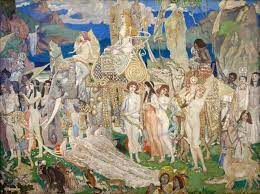
2. Lachlan Goudie, The Story of Scottish Art. Even if you don’t care about art, this is a wonderful way to learn the history of Scotland. My takeaway favorite painters were Allan Ramsey (friends with Smith and Hume), Henry Raeburn, David Wilkie, and John Duncan, more or less consistent with my earlier views but now they are better informed. A good book with a nice blue and yellow cover.
 3. Frank Herbert, Dune. For me a reread, I loved it when I was twelve, but how does it stand up? I am struck by how excellent and pathbreaking the best chapters are, including the introductory chapter. The influence on Star Wars is obvious, as is the role of Islam in the story. It strikes me as remarkably cinematic, with the right kinds of transitions to boot — how was this never put successfully on the big screen? I am about two-thirds through it right now, and maybe it 2/3 holds up? But would you want all of the slow pacing of the detail removed?
Carole Hooven, T: The Story of Testosterone, the Hormone that Dominates and Divides Us. Recommended.
Aubrey Clayton, Bernoulli’s Fallacy: Statistical Illogic and the Crisis of Modern Science. I found this most interesting as a history of probability theory, and with more coverage of Quetelet than one usually finds.
Tuesday assorted links
1. Rating the menus.
2. The Fed takes duration risk.
3. Margaritaville Times Square markets in everything.
4. Brazilian criminal group ties hostages to getaway cars. That was to deter gunfire from the police.
5. The five best Faulkner books?
What I’ve been reading
1. M.J. Ryan and Nicholas Higham, The Anglo-Saxon World. I’ve been reading more books in this area, even though data limitations make it difficult to form an accurate picture of what was happening. Here is Wikipedia on King Alfred, plenty of facts, broader context often difficult to recreate. (What exactly would they have debated on Twitter, and why?) I would put this as one of the two or three best Anglo-Saxon books I have seen, and with excellent visuals and photos.
2. John B. Thompson, Book Wars: The Digital Revolution. Thompson’s Merchants of Culture was surprisingly excellent, now the quality is no longer a surprise. This book covers the Kindle revolution (now dominated by romances), Google books, how electronic publishing rights evolved, crowdfunding books, the ascent of Amazon, and much more. In all or most of these areas he offers you more substance and more inside scoops than the other discussions you might have read, thus recommended.
3. Max Siollun, What Britain did to Nigeria: A Short History of Conquest and Rule. It is hard to find good books on Nigeria that are easy to follow and not just for specialists. This new one is maybe the best overall treatment I know? The British conquest of Nigeria took seventy-seven years to accomplish. Siollun also stresses the role of missionaries in bringing literacy to Nigeria, noting that what you might call Nigerian literacy skills, for instance in native scripts, were longstanding in many regions. Before the British arrived, the north of Nigeria was much more advanced economically than the south, though colonialism inverted this relationship. I found this sentence interesting: “Perhaps no question makes Nigerians disagree as much as why Britain created their country.”
4. Matthew Affron, et.al. Inventing Abstraction, 1910-1925: How a Radical Idea Changed Modern Art. Clustered discoveries are one of the best areas to read about, whether they be scientific or artistic. There will be many overlapping treatments, biographies, and so on. And the people who write about these areas may do so with a certain amount of passion. The rise of abstract art early in the twentieth century is one of the most remarkable of such clusters, as in so many countries top-rate artists made major breakthroughs in similar directions. This book shows you how better than any other I know, with excellent color plates as well.
5. Trevor Rowley, The Normans: A History of Conquest. As I understand the author, he presents the Normans as an essential part of what fed into the creation of modern Europe, also serving to spread those practices and norms. I hadn’t known that Tocqueville was in part originally a Scandinavian name, deriving from “Toki’s ville,” the Scand name tacked onto the Norman suffix.
*Pragmatism as Anti-Authoritarianism*
That is the new Richard Rorty book, released ten years after his death. Parts feel unfinished or underdeveloped, but mostly it is splendid. Imagine Rorty defending the Enlightenment (but not the Enlightenment epistemology of representation), and then tracing how that might lead to a defense of democracy and liberalism. Some of the themes overlap with my own Stubborn Attachments, and here is one short excerpt:
Plato’s mistake, on Dewey’s view, was having identified the ultimate object of eros with something unique, atemporal, and non-human rather than with an indefinitely expansible pantheon of transitory temporal accomplishments, both natural and cultural.
Rorty makes a much better case for Dewey being an important philosopher of liberalism than I have seen anywhere else. Imperfect as a work, but to my eye this is by far Rorty’s best stab at political philosophy.
You can buy the book here.
How good was Paul Samuelson’s macroeconomics?
Reading the new Nicholas Wapshott book and also Krugman’s review (NYT) of it, it all seemed a little too rosy to me. So I went back and took a look at Paul Samuelson the macroeconomist. I regret that I cannot report any good news, in fact Samuelson was downright poor — you might say awful — as a macroeconomist.
For instance, during the early 1970s there was a debate about President Nixon’s 1971 wage and price controls. There is some disagreement about the actual stance of Samuelson, as Wapshott (p.152) claims Samuelson opposed Nixon’s wage and price controls, but that doesn’t seem to be true. The Los Angeles Times for instance reported Samuelson opining as follows: “With the wage and price controls, he [Nixon] assured a more rapid short-term economic recovery, and made it absolutely certain he would be the overwhelming victor in the 1972 election.” Maybe that is not quite a full endorsement, but consider Samuelson’s remarks on the August 17, 1971 ABC Evening News: “I don’t think that a ninety-day freeze is going to solve the problem of inflation. But it’s a first move toward some kind of an incomes policy. Benign neglect did not work. It’s time the president used his leadership…We’re better off this Monday morning than we were last Friday. Friday was an untenable situation.”[1]
Really?
For Samuelson and many other Keynesians of his era, it was mostly about wage-push inflation. Do you know what my take would have been?: “The wage and price controls are neither good microeconomic nor good macroeconomic policy.” Samuelson did not come anywhere near to uttering such words. In October 1971, Samuelson argued that Nixon’s NEP [New Economic Policy], which included both severing the tie of the dollar to gold and wage and price controls, was “necessary,” and that the wage and price controls were working better than might have been expected.[2]
In October 1971, Samuelson also argued that the Fed should continue to let the money supply grow, to stave off the risk of a liquidity crisis occasioned by America’s lingering involvement in the Vietnam War (what??…if this is fear of a Bretton Woods collapse, print fewer dollars, besides Samuelson wanted to end Bretton Woods). He said he favored presidential “guideposts” to lower the rate of price inflation from four to three percent, but didn’t favor explicit wage and price controls because it wasn’t enough of an “emergency” situation. That is the extent of his opposition to wage and price controls – lukewarm at best, not objecting in principle, contradicting his earlier stances, and showing a poor understanding of monetary economics more broadly. You don’t have to be a hardcore monetarist to realize that continued money supply growth, in an expansionary period, combined with presidential “guideposts” to lower rates of price inflation, was simply an incorrect view.
In a 1974 piece, Samuelson continued to insist, as he had argued in the past, that the inflation of that era was cost-push inflation, and not driven by the money supply. He also asserted (without evidence) that full employment and price stability were incompatible. In one 1971 piece he made the remarkable and totally false assertion that: “…with our population and productivity growing, it takes more than a 4 per cent rate of real growth just to hold unemployment constant at a high level.”[3]
Really?
In other words, his basic model was just flat out wrong. More generally, the Samuelson Newsweek columns of that era make repeated, dogmatic, and arbitrary stabs at forecasting macroeconomic variables without much humility or soundness in the underlying model.
Milton Friedman did have an overly simplified view of the money supply, as many of his critics have alleged and as Scott Sumner would confirm. But as a macroeconomist he was far, far ahead of Paul Samuelson.
Don’t forget how bad macro was before Friedman came along.
[1] For The Los Angeles Times, see Hiltzi (1994), and also see “Questions and Answers: Paul A. Samuelson,” Newsweek, October 4, 1971. For the ABC News remarks, see Nelson (2020, volume 2, p.267).
[2] See “Questions and Answers: Paul A. Samuelson,” Newsweek, October 4, 1971.
[3] See Paul Samuelson, “Coping with Stagflation” Newsweek, August 19, 1974, and for the 1971 remarks see “How the Slump Looks to Three Experts” Newsweek, Oct.18, 1971. On the four percent claim, see Paul A. Samuelson, “Nixon Economics,” Newsweek, August 2, 1971.
What I’ve been reading
1. Richard Zenith, Pessoa: A Biography. 942 pp. of text, yet interesting throughout. Brings you into Pessoa’s mind and learning to a remarkable degree. (Have I mentioned that the world is slowly realizing that Pessoa’s The Book of Disquiet is one of the great works of the century?) His favorite book was Dickens’s Pickwick Papers, and he very much liked Carlyle’s Sartor Resartus. This biography is also interesting about non-Pessoa topics, such as Durban, South Africa in 1900 (Pessoa did live there for a while). I am pleased to see Pessoa finally receiving the attention he deserves — definitely one of the books of this year. Here is a good review of the book. For a man who never had sex, this book covers his sex life a great deal! And what a short and lovely title, no long subtitle thank goodness.
2. Nicholas Wapshott, Samuelson Friedman: The Battle over the Free Market. Quite a good book, though it is interior to my current knowledge set and thus better for others reader than myself. Contrary to what I have read elsewhere, Wapshott points out that Samuelson did not support Nixon’s wage and price controls, but this LA Times link seems to suggest Samuelson thought they were a good idea?
3. Jamie Mackay, The Invention of Sicily: A Mediterranean History. While it was less conceptual than I might have preferred, this is perhaps the single best general history of Sicily I know of. Short and to the point in a good way.
4. N.J. Higham, The Death of Anglo-Saxon England. In 1066, five different individuals were recognized as de facto King of England — how did that come to pass? Why was Aethelred the Unready not ready? (He was only 12 when he assumed the throne, though much of the actual criticism concerned the later part of his reign.) I find this one of the most intelligible and conceptual treatments of Anglo-Saxon England out there. I don’t care what the Heritage Foundation says, beware Danish involvement in your politics!
Peter Kinzler, Highway Robbery: The Two-Decade Battle to Reform America’s Automobile Insurance System is a useful look at where that debate stands and how it ended up there. Here is a good summary of the book.
It does not make sense for me to read Emily Oster’s The Family Firm: A Data-Driven Guide to Better Decision-Making in the Early School Years, but it is very likely more reliable information than you are likely to get from other sources.
*The Deep Places: A Memoir of Illness and Discovery*
That is the new forthcoming Ross Douthat book, focusing on his struggles with Lyme disease. It is very much a memoir, starting with talk of Connecticut, deer, and his family’s dream house, all leading to an unfortunate bite from a tick. Visits to many doctors ensue, motivated by chronic pain and weakness.
Overall this is a book about the medical establishment, the psychological path of coming to terms with one’s own illness (a kind of Krankheitsbildungsroman), how bureaucracy shapes science, and a plea that a lot of people really are chronically sick rather than psychosomatic or malingerers. It is Ross’s best-written book, and it has echoes of Susan Sontag and also Robert Burton.
If I understand Ross correctly, he is pro-antibiotic use under these circumstances, at least for his individual case. I do not myself have any opinion about the various medical views expressed in this work. Even prior to reading this book, my intuition was to believe that chronic Lyme disease is very much real, but that is not based upon aggregating a great deal of information. In any case, Covid and the response of the public health establishment have made the relevance of this book much clearer. The discussion here doesn’t give you much reason to trust them more.
I believe we are entering a new era where public intellectuals have an increasing degree of “medical sway.”
This is also a tale, under the surface, of how “the privileged” interact with the medical establishment in a fundamentally different way (I don’t mean that as snark or whining).
Here is an update on one potential Lyme disease vaccine. Was the previous vaccine really so bad?
How should you react if electromagnetic stimulation appears to improve your symptoms?
NB: I don’t like walking in the woods.
My excellent Conversation with Niall Ferguson
Here is the audio, video, and transcript. Here is part of the CWT summary:
Niall joined Tyler to discuss the difference between English and Scottish pessimism, his surprise encounter with Sean Connery, what James Bond and Doctor Who have in common, how religion fosters the cultural imagination to produce doomsday scenarios, which side of the Glorious Revolution he would have been on, the extraordinary historical trajectory of Scotland from the 17th century through the 18th century, why historians seem to have an excessive occupation with leadership, what he learned from R.G. Collingwood and A.J.P. Taylor, why American bands could never quite get punk music right, Tocqueville’s insights on liberalism, the unfortunate iconoclasm of John Maynard Keynes, the dystopian novel he finds most plausible, what he learned about right and left populism on his latest trip to Latin America, the importance of intellectual succession and building institutions, what he’ll do next, and more.
Here is one excerpt:
COWEN: If you had been alive at the time and the Glorious Revolution were going on, which side would you have been rooting for and why? Speaking of counterfactuals.
FERGUSON: I think everybody should ask themselves that question each morning. Whig or Tory? Are you a Jacobite?
COWEN: Do you want Dutch people coming over to run your country? That’s another part of it, right? I would have been quite worried. Nothing against Dutch people, but you might think, “Well, they don’t have a stable ruling coalition, so they’re going to be all the more tyrannical.”
FERGUSON: Yes. I wrote about the Dutch takeover in Empire. It’s bizarre that the British Isles just get taken over by a Dutch monarch at the behest of a faction mainly motivated by religious prejudice and hostility to Roman Catholicism. At the time, I would have been a Whig on religious grounds. I’m from the ardently Protestant Lowlands of Scotland. I’m like all people from that part of the world, drawn to the romanticism of the Jacobites but also repelled by what it would have been like in practice.
If you want to understand all this, by the way, you have to read Walter Scott, which I hadn’t done for years and years. I’d never really read Scott because I was told he was boring. Then during the pandemic, I started reading the Waverley novels, and it’s all there: all the fundamental dilemmas that were raised, not just by the Glorious Revolution, but prior to that by the Civil War of the 17th century, and that were raised again in the 1745 Jacobite rising.
Scott’s brilliant at explaining something that I don’t think is properly understood, and that is that Scotland had the most extraordinary historical trajectory. It went from being Afghanistan in the 17th century — it was basically Afghanistan. You had violent warring clans in the north, in the mountainous parts of the country, and a theocracy of extreme Calvinist zealots in the Lowlands. This was a deeply dysfunctional, very violent place with much higher levels of homicide than England. Really, it was a barbaric place.
And something very strange happened. That was that in the course of — beginning really from the late 17th century — in the course of the 18th century, Scotland became the most dynamic tiger economy in the world. Also, it became the cradle of the enlightenment, had really all the best ideas of Western civilization, all at once in a really short space of time with a really small number of people, all sitting around in Glasgow and Edinburgh.
I still don’t think a book has been written that properly explains that. You certainly wouldn’t have put a bet on Scotland behaving that way by the late 18th century, if all you knew about it was Scotland in the mid-17th century. If you look at it that way, then you kind of have to be a Whig. You have to recognize that the institutions that came from England, including the Dutch institutions that were imported in the Glorious Revolution, really helped Scotland get out of its Afghan predicament.
Recommended, interesting throughout. And again, here is Niall’s new book Doom: The Politics of Catastrophe.
Why has the Indian diaspora been so successful?
Dwarkesh writes to me:
Why do you think the Indian diaspora has been so successful? Just selection of the best immigrants from a large pool of candidates or something else too?
Yes, there are plenty of Indians, and surely that matters, but I see several others factors at work:
1. The Indian diaspora itself is large, estimated at 18 million and the single largest diaspora in the world.
2. A significant portion of the better-educated Indians are hooked into English-language networks early on, including through the internet. The value of this connection has been rising due to the rising value of the internet itself. That is a big reason to be bullish on the Indian diaspora.
3. India has been growing rapidly enough so that people understand the nature and value of progress, yet the country remains poor enough that further progress seems urgent.
4. Many Indian parents seem intent on expecting a great deal from their children. The value of this cannot be overemphasized. This effect seems to be stronger in India than in say Indonesia.
5. There is especially positive selection for Indians coming to America. You can’t just run across a border, instead many of the ways of getting here involve some specialization in education and also technical abilities. Virtually all migrated in legal manners, and here is some interesting data on how the various cohorts of Indians arriving in America differed by wave.
6. More speculatively, I see a kind of conceptual emphasis and also a mental flexibility resulting from India’s past as a mixing ground for many cultures. Perhaps some of this comes from the nature of Hinduism as well, even for non-Hindu Indians (just as American Jews are somewhat “Protestant”). Indians who move into leadership roles in U.S. companies seem to do quite well making a very significant cultural leap. I cannot think of any other emerging economy where the same is true to a comparable extent. In any case, the intellectual capital embedded in Indian culture is immense.
7. Those Indians who leave seem to retain strong ties to the home country, which in turn helps others with their subsequent upward mobility, whether in India or abroad. In contrast, Russians who leave Russia seem to cut their ties to a higher degree.
8. I feel one of the hypotheses should involve caste, but I don’t have a ready claim at hand.
Here is the take of Stephen Manallack. Here is Times of India. (And by the way, here is Shruti’s piece on India’s 1991 reforms, not irrelevant to the diaspora.)
What else?
*The Morning Star*, by Karl Knausgaard
Yes, it is the real Knausgaard again, writing under lockdown and delivering a nearly 700-pp. novel that does indeed sound like Knausgaard but is not (strictly) autobiographical.
Here is a Swedish review, excerpt:
I read mostly the novel as an entertaining study of non-reflective life, an exploration of how a secularized society chooses to refrain from considering what does not fit the common explanatory models provided by our various sciences….
Here is a Kirkus review:
A sui generis metaphysical yarn, engrossing in its particulars if broadly rambling.
I would say it is not as viscerally satisfying as the best parts of My Struggle, but about half of it is quite good, the pace is fairly quick, and I had no trouble wanting to finish the book. Some surprises come at the end, and KK is increasingly a “religious thinker” in my sense of that term.
Two more parts will be written, and those will clear up all of the remaining mysteries.