Results for “best book” 2011 found
More on *Fairness and Freedom*, by David Hackett Fischer
I very much liked this book, which compares the histories of New Zealand and the United States, and in particular I liked:
1. The discussion of how the New Zealand government encouraged smaller land holdings through some deliberate policy decisions in the late 19th century (p.165).
2. The discussion of how New Zealand abolished its provinces in 1875 (circa p.193), and the importance of that decision (passim).
3. The near-uniformity of the crime rate throughout New Zealand (p.198).
4. The comparison between labor movements in the two countries and the possibly differing history of labor-saving devices (circa p.328).
5. The comparison between Bills of Rights; New Zealand for instance has a right not to be subjected to medical experiments and a right to refuse medical treatment, but no right to a jury trial (circa p. 464).
It is probably the best introduction to New Zealand history for an American, even though much of the book is not about New Zealand history at all. That said, while I found this a very good book, and certainly a book to recommend and to make the year’s “best of” list, it did not for me quite live up to its full potential. I have high standards in this particular area, so I would have liked:
6. A discussion of “cutting down tall poppies” before p.487.
7. A deeper discussion of the differences in role models in the two countries. New Zealanders admire Sir Edmund Hillary more than a successful businessman, though this has changed somewhat.
8. A comparison between American social conformism, as outlined brilliantly by Tocqueville, with the more outwardly conformist New Zealand working class variety.
9. A discussion of why New Zealanders are less prone to extreme thought and explicit missionary dedication; can you imagine a Kiwi version of Whittaker Chambers?
10. More attention to the commodities dependence in the New Zealand economy, and the importance of the UK abolishing NZ trade preferences in 1972-3, and the ongoing struggles to suss out a coherent vision for a relationship with Asia and China.
11. More discussion of how it mattered for New Zealand as many centres of activity shifted over time from the South Island to the North Island, culminating in the centralization of so much activity in or near Auckland.
12. Much more discussion of religion, and of the extreme enthusiasms which are bred in the United States.
13. A greater understanding of how Americans would not necessarily regard their society as “less fair,” but rather that some benefits are to be portioned out in accordance with a peculiarly American notion of what a person deserves.
14. A discussion of Upper Hutt or Lower Hutt, ideally both.


15. Why are New Zealanders perhaps the most polite people in the Western world?
16. The importance of having so many people living so close to the water, and (in some parts of the country) being surrounded by relatively few trees, and the much lower productivity of hunting in New Zealand, as there is not so much to hunt.
17. A more explicit discussion of economies of scale, and of why New Zealand is sometimes accused of being boring. There is one quotation offered from an outside visitor: “”I suppose they are happy,” she wrote in her contemptuous way. “I couldn’t bear it.”” (p.xix).
*Fairness and Freedom*
The author is David Hackett Fischer and the subtitle is A History of Two Open Societies: New Zealand and the United States. Excerpt:
They do not all climb mountains, play rugby, raise sheep, and consume large platters of Pavlova for dessert.
So far it is the best non-fiction book of the year, by a clear mark, I will read more of it soon.
J.C. Bradbury emails me on the allocation of talent
I hope you are doing well. I have a Micro III question that I thought might interest you. I often have such Tyler questions, but keep them to myself, yet this morning I decided to share with you.
What does Jeremy Lin tell us about talent evaluation mechanisms? This article ( http://www.wired.com/wiredscience/2012/02/what-jeremy-lin-teaches-us-about-talent/?utm_source=dlvr.it&utm_medium=twitter ) argues that the standard benchmarks for evaluating basketball and football players at the draft level are flawed. The argument is that Jeremy Lin couldn’t get the opportunity to succeed because his skill wasn’t being picked up by the standard sorting procedure. This got me thinking. Baseball sorts players in a different way than basketball. In professional basketball (and football), college sports serve as minor leagues, where teams face a high variance in competition (the difference between the best and worst teams in a top conference is normally quite large), with very little room for promotion. There is some transferring as players succeed and fail at lower and higher levels, but for the most part you sink or swim at your initial college. This is compounded by the fact that the initial allocation of players to college teams is governed by a non-pecuniary rewards structure with a stringent wage ceiling, which likely hinders the allocation of talent. At the end of your college career, NBA teams make virtually all-or-nothing calls on a few players to fill vacancies at the major-league level. In baseball it’s different. Players play their way up the ladder, and even players who are undrafted can play their way onto teams at low levels of the minor league. At such low levels, the high variance in talent is high like it is in college sports; however, promotions from short-season leagues through Triple-A, allow incremental testing of talent along the way without much risk. I have looked at metrics for predicting major-league success from minor-league performance and found that it is not until you reach the High-A level (that is three steps below the majors) can performance tell you anything. Players in High-A who are on-track for the majors are about-the age of college seniors. Performance statistics from Low-A and below have no predictive power. Baseball is also much less of a team game than basketball, so this should make evaluation easier in baseball but it is still quite difficult by the time most players would be finishing college careers. Also, a baseball scout acquaintance, who is very well versed in statistics, tells me that standard baseball performance metrics in college games are virtually useless predictors of performance (this is contrary to an argument made in Moneyball). Even successful college baseball players almost always have to play their way onto the team.
Back to Lin. He played in the Ivy League and his stats weren’t all that bad or impressive in an environment that is far below the NBA. If Lin is a legitimate NBA player, he didn’t have many opportunities to play his way up like a baseball player does. In the NBA, he experienced drastic team switches, and even when making a team he received limited opportunities to play. MLB teams often keep superior talent in the minors so that they can get practice and be evaluated through in-game competition. An important sorting mechanism for labor market sorting is real-time work. Regardless of your school pedigree, most prestige professions (lawyers, financial managers, professors, etc.) have up-or-out rules after a period of probationary employment where skill is evaluated in real world action. Yes, there is a D-League and European basketball, but the D-league is not as developed as baseball’s minor-league system, and European basketball has high entry cost and may suffer from the same evaluation problems faced by the NBA. Thus, I wonder if the de facto college minor-league systems of basketball and football hinder the sorting of talent so that the Jeremy Lins and Kurt Warners of the world often don’t survive. Thus, another downside of these college sports monopsonies is an inferior allocation of talent at the next level.
J.C.’s points of course apply (with modifications) to economics, to economies, and to our understanding of meritocracy, not to mention to how books, movies, and music fare in the marketplace. Overall I would prefer to see economics devote much more attention to the topic of the allocation of talent.
Here is J.C. on Twitter, here are his books.
What good are hedge funds?
How can they beat the market consistently, especially if we take EMH seriously at all? And if they don’t beat the market, how is 2-20 to be justified? Here is a snippet from an interesting Amazon review:
…this kind of comparison misses the entire point of most hedge funds. A market-neutral fund is not designed as a stand-alone investment, but as a diversifier for an equity portfolio. It can have half the return of equities with the same volatility, and still be valuable. The question isn’t whether putting 100% of your money in hedge funds did better than putting 100% in stocks, it’s what portion of assets an investor should allocate to hedge funds. Using the author’s own numbers, an investor would have done best to have 30% of assets in hedge funds, rebalancing annually, from 1998 to 2010. That produced 4.2% annual alpha (return in excess of what you could have gotten investing in stock index funds and t-bills with the same volatility). That number is certainly overstated, hedge fund investors typically do worse than the index suggests, but it demonstrates that you can’t consider only stand-alone returns. This point is borne out by the finding that endowments and pension funds that make use of hedge funds have consistently better risk-adjusted performance than those that do not.
The review, by Aaron C. Brown, offers other points of interest. I’ve ordered the underlying asset itself (the book) and I will report back on it. It was reviewed in today’s FT, still no permalink.
*Library Journal* review of *An Economist Gets Lunch*
Part In Defense of Food: An Eater’s Manifesto and part Roadfood, this is a culinary coming-out party for Cowen (economics, George Mason Univ.), who up to now has been known for more standard economic works like The Great Stagnation. This latest book combines economic and environmental messages, all written in a highly entertaining and informative style—often with a counterintuitive twist. The real story, though, is the author and his techniques for finding and eating delicious, inexpensive food from all over the world. Thus, we get tips on how to obtain good Chinese food from local, not-so-authentic places; which strip malls are likely to have the best restaurants (who knew they were in strip malls to begin with?); using Google to turn up unexpected restaurant gems; and why places filled with fun, laughing, drinking people often don’t have good food. An entire chapter is devoted to barbecue, and another provides specific suggestions for eating well in numerous countries.
VERDICT A fun and informative book that environmentalists, economists, and (most of all) foodies will enjoy. Recommended for all. [See Prepub Alert, 10/7/11.]—Susan Hurst, Miami Univ. Libs., Oxford, OH
A possible answer to a common European question (Atomic bread baking at home)
Thus, in 1954, USDA investigators journeyed from Chicago and Washington, D.C., to the shores of the Rock River to select two test groups, each comprising three hundred families “scientifically representative” of a typical American community. Over the next two years, the market researchers would deploy all the techniques of their emerging field on these six hundred families. They tracked bread purchases, devised means of weighing every ounce of bread consumed by the test population, conducted long interviews with housewives, and distributed thousands of questionnaires. Most important, they created a double-blind experiment that asked every member of every family to assess five different white-bread formulas over six weeks. Four years and almost one hundred thousand slices of bread after the project’s conception, a clear portrait of America’s favorite loaf emerged. It was 42.9 percent fluffier than the existing industry standard and 250 percent sweeter.
…In early twentieth-century consumers’ minds, fluffier bread seemed fresher—even if it wasn’t. Squeezable softness had become consumers’ proxy for knowing when their bread had been baked. By the 1920s, market surveys revealed that consumers didn’t necessarily like eating soft bread, but they always bought the softest-feeling loaf. By the 1950s, softness had become an end in itself, and savvy bakery scientists set about engineering ever-fluffier loaves—like USDA No. 1.
That is from Aaron Bobrow-Strain, interesting throughout, I just pre-ordered his new book White Bread: A Social History of the Store-Bought Loaf. For the pointer I thank Michael Rosenwald.
Here is Alex in 2006 on bread in Paris. In the comments I wrote this:
Alex’s response is, as you would expect, right on the mark. But most of the differences in ingredients *can* be traced to underlying economic causes. For reasons of rents, commuting distances, and city design, the French are better situated to consume fresh breads right after consuming them. Cheaper bread alternatives, in the U.S., also stem from economics, although this is a long and complicated story. The best salts come from France, for complex but largely economic and geographic reasons. Non-pasteurization makes French butters better, plus French farm subsidies keep many more small farmers in business. This raises price but also improves quality and shortens supply chains. Freezing foods, including dough, is much cheaper in the United States, again for economic reasons. We have a more dispersed population and longer supply lines, both of which favor freezing, plus we have much cheaper transport.
Again, I would stress that American bread is getting better and French bread is probably getting worse. We are seeing convergence, though I would not expect this to ever be exact.
*Life in the Sick-Room*
This neglected gem of a book was written by Harriet Martineau, best known for her 19th century tracts on political economy. Now I learn she was a forerunner of behavioral economics, occupying a space somewhere between Burton’s Anatomy of Melancholy and the pain meditations of Dan Ariely, excerpt:
I have spoken of the relief afforded by visitations of severe pain. These really the vital forces, and dismiss the temptation, by substituting torture for weariness — at times a welcome change. The healthy are astonished at the good spirits of sufferers under tormenting complaints; and the most strait-laced preachers of fortitude and patience admit an occasional wonder that there is no suicide among that class of sufferers. The truth is, however, that the influence of acute pain, when only occasional, and not extremely protracted, is vivifying and cheering on the whole. The immediate anguish causes a temporary despair: but the reaction, when the pain departs, causes a relish of life such as the healthy and the gay hardly enjoy. Though a slow death by a torturing disease is a lot unspeakably awful to meet, and even to contemplate, there can be no question to the experience, that illness in which severe pain sometimes occurs is less trying than some in which a different kind of suffering is not relieved by such a stimulus and its consequent sensations.
The Wikipedia page on Martineau is especially good.
Eventually, p = 0 catches up to you
Especially if it is a product consumers wish to bring home:
In Fairfax, officials more than doubled the inventory of e-book copies from 2010 to 2011, to more than 10,000, but demand for the books tripled in that time. Now the average wait time is three weeks. Of course, there can also be lengthy waits for hardcover and paperback books, although those waits are usually for current bestsellers while older titles are generally available.
By contrast, on a typical day, about 80 to 85 percent of the system’s e-books are checked out, said Elizabeth Rhodes, the collection services coordinator for the Fairfax library system. But after the holidays, when many people received e-readers, 98 percent of the collection was spoken for.
Here is more.
Law and Literature reading list
Class started yesterday, the reading list is here (pdf):
The New English Bible, Oxford Study Edition, Billy Budd and Other Tales, by Hermann Melville. The Metamorphosis, In the Penal Colony, and Other Stories, by Franz Kafka, In the Belly of the Beast, by Jack Henry Abbott, Borges and the Eternal Orangutans, by Fernando Verrissimo, Glaspell’s Trifles, available on-line, Sherlock Holmes, The Complete Novels and Stories, Sir Arthur Conan Doyle, volume 1, I, Robot, by Isaac Asimov, Moby Dick, by Hermann Melville, excerpts, chapters 89 and 90, available on-line. Year’s Best SF 9, edited by David G. Hartwell and Kathryn Cramer, G.K. Chesterton, The Man Who Was Thursday, Edgar Allen Poe, The Gold-Bug, available on-line, Joseph Conrad, The Secret Agent, Running the Books, by Avi Steinberg, Sakhalin Island, Anton Chekhov. tr. Brian Reeve, Death and the Maiden, Ariel Dorfman, The Pledge, Friedrich Durrenmatt. tr. Joel Agee, Red Harvest, Dashiell Hammett, Red April, by Santiago Roncagliolo, The Crime of Sheila McGough, Janet Malcolm, Leslie Katz, “John Keats’s Attitudes to Lawyers,” http://papers.ssrn.com/sol3/papers.cfm?abstract_id=1307146.
Some additions to this list will be made as we proceed, mostly a few short articles. We also will view a small number of movies on legal themes. You will be responsible for obtaining these or for viewing them in the theater.
What I’ve been reading
1. Dave Prager, Delirious Delhi: Inside India’s Incredible Capital. An excellent book on India, an excellent book on a city, and an excellent book on Delhi, all rolled into one. Unlike many travel books, it tells you a lot about the city. Here is a short excerpt. I believe it does not yet have full availability in the United States; order it from the first link above, the author tells me that the current Amazon link is actually a fraud.
2. Katerina Clark, Moscow, The Fourth Rome: Stalinism, Cosmopolitanism, and the Evolution of Soviet Culture, 1931-1941. A detailed and insightful revisionist look at Soviet culture during that period, asking whether it really can all be boiled down to communism or if there was more behind it and it turns out there was.
3. David Roodman, Due Diligence: An Impertinent Inquiry into Microfinance. Puts microfinance into a broader historical perspective, balanced and insightful throughout, informationally dense, recommended. A good model for many other non-fiction books.
4. Michael Erard, Babel No More: The Search for the World’s Most Extraordinary Language Learners. A fun and useful book, you can take the subtitle literally. You need to ignore the very weak material on neurodevelopmental issues.
5. John Cowper Powys, Wolf Solent. Unlike George Steiner’s claim, this is not comparable to Tolstoy. Still, it is an excellent if uneven 1920s novel that ought to be read more widely. The best passages are frequent and striking. The bottom line is that I can imagine someday reading it again. If you are tempted, give it a try.
There is also the self-explanatory Emrys Westacott, The Virtues of Our Vices: A Modest Defense of Gossip, Rudeness, and Other Bad Habits.
Which celebrity chef-branded restaurants are better than others?
William Baude asks:
Is there any way to predict which celebrity-chef-branded restaurants will be better than others? Obviously one rarely expects such restaurants to be excellent, but there are times (airports, Las Vegas) when a celebrity-chef-branded restaurant may well be the best one around. Is the best chef likely to endorse the best restaurants? Or should one look for profligate branders like Wolfgang Puck and Emeril? Or something else?
When it is “branded” or when simply the genius chef owns and runs a few places (e.g., Thomas Keller) is a tricky distinction. That said, the Wolfgang Puck pizza outlet at O’Hare airport counts as branded, as do many of the fancy places in Las Vegas. Overall I find these restaurants to be a good bet, conditional on the fact that you are somewhere which encourages the proliferation of branded restaurants. I haven’t eaten everywhere in O’Hare but odds are if you are by the Puck outlet you should stop and eat there, relative to what you are likely to find and have time for. The branded outlets in Las Vegas may not be the very best places but again they are fairly wise choices, knowing that just about everywhere is frequented by tourists. Joel Robuchon’s restaurant in Las Vegas isn’t exactly hated.
Branded restaurants tend to be poor choices when they are offered as a protection against an ethnic food subculture, which maybe is considered inferior by many subgroups but actually is superior. Yes, Jean-Georges does have a place in Shanghai and probably it is quite good. Yet you should be out in the street looking for noodles and dumplings, waving your arms in desperation if need be.
My next book — An Economist Gets Lunch: New Rules for Everyday Foodies — is out this coming April.
*Rethinking the Good*, by Larry Temkin
The subtitle is Moral Ideals and the Nature of Practical Reasoning. Without hesitation I paid full price for this book, in this case $74 though since then the price is falling. While not an easy read, it is the most important work in choice theory and social choice in some time.
Why does the transitivity debate matter? If you believe in transitivity, you will see lots of piecemeal improvements as adding up to something desirable. If you do not believe in transitivity, useful normative inquiries have to be much more global. You will put less weight on the Pareto principle, and less weight on partial equilibrium cost-benefit analyses. You will focus on what constitutes a good society, and you will trust some very gross macro comparisons (“America is better than Albania”) more than micro comparisons (“the best system of taxation is X”).
If you are skeptical of transitivity as a postulate, you probably are less inclined to see individuals with intransitive preferences as irrational. This may affect your views on paternalism and time inconsistency.
Many economists of course view the rejection of transitivity as simply unthinkable. Perhaps without transitivity we cannot even speak of the notion of a coherent preference. Temkin is skeptical of transitivity. There are a few versions of anti-transitivity arguments:
1. A version of Arrow’s theorem will apply to plausible versions of pluralistic moral reasoning, just as it applies to decathlon scoring. Temkin does not pursue this route, though he notes in the introduction it may be possible. It is the route I would have preferred, as it makes the investigation more economical.
2. The Sorites paradox, or how many stones make a pile. Temkin insists his argument does not boil down to the Sorites paradox, though one may add this to the pile of arguments against transitivity.
3. The “roughness” relation: maybe Mozart is roughly as good as Beethoven, but this need not be transitive. Possibly Haydn is roughly as good as Mozart, but it does not follow that Haydn is necessarily “roughly as good” as Beethoven. Often judgments about the good are rough by their nature.
4. Various pairwise comparisons lead the transitivity advocate to unacceptable conclusions. For instance you can start with the view that adding a pain to the world is a bad, and (with intermediate steps), end up having to believe that adding a very very slight pain for a trillion lives is worse than brutally torturing ten people. Or perhaps you are familiar with Derek Parfit’s Mere Addition Principle. If you endorse some pairwise comparisons which increase both utility and equality, you can again be led to apparently unpalatable conclusions by some multi-stage comparisons (pdf, it would take a long time to explain here). Temkin stresses this kind of argument and works through the possible responses in great detail.
The main contribution of this book is to show you that the transitivity postulate is far less intuitively appealing than it seems at first. Twenty-two years ago I disagreed with Temkin but now I accept much of his critique. Here is one very good Temkin piece from JSTOR.
These days, I see the good is more holistic than additive-aggregative. This defuses Temkin’s arguments, though at a high cost. (You will find Temkin’s criticisms of holism and related ideas at around p.355, though I find them unusually lacking in force. One of his worries boils down to how a multiplicative view will handle negative numbers but I see the scale as sufficiently arbitrary that they need not pop up to begin with.) We can make some gross comparisons of better and worse at the macro level, with partial rankings at best, but for many individualized normative comparisons there simply isn’t a right answer. I view “ranking” as a luxury, occasionally available, rather than an axiomatic postulate which can be used to generate normative comparisons, and thus normative paradoxes, at will. I see that response as different than allowing or embracing intransitivity across multiple alternatives and in that regard my final position differs from Temkin’s. Furthermore, in a holistic approach, the “pure micro welfare numbers’ used to generate the paradoxical comparisons aren’t necessarily there in the first place but rather they have to be derived from our intuitions about the whole.
These thoughts provide one reason — though by no means the only reason — why I think so many policy comparisons are not very clear cut, not even in principle, not even if we had better empirics.
My main objection to this book is how it was written. It is too long and too branching, much like Parfit’s recent volumes. Temkin notes that Shelley Kagan, a very smart guy, gave him 117 pages of single-spaced comments on a prior manuscript draft. Temkin took that as an invitation to lengthen the presentation rather than shorten it.
Addendum: If you are interested in these issues, you also should read Leo Katz’s new and fascinating book, more applied than Temkin’s, also rejecting transitivity as a universal principle of reasoning but focused on explaining the content of the law and its apparent paradoxes.
The culture that is Norway?
The UK’s 2011 bestseller lists might have been dominated by cookery, courtesy of Jamie Oliver, and romance, courtesy of David Nicholls, but Norwegian readers were plumping for another sort of book last year: the Bible.
The first Norwegian translation of the Bible for 30 years topped the country’s book charts almost every week between its publication in October and the end of the year, selling almost 80,000 copies so far and hugely exceeding expectations. Its launch in the autumn saw Harry Potter-style overnight queues, with bookshops selling out on the first day as Norwegians rushed to get their hands on the new edition.
I’ve been wondering what the new religion of Europe (is Norway Europe?) is going to be. The article is here.
Assorted links
1. Cause and effect, by Jonah Lehrer.
2. eBook of Paul Ryan vs. David Brooks debate.
3. European Union proposes to fund largest cultural program, ever.
4. Maria Popova, infovore, and here, and some of her favorite history books here.
5. Can central banks still raise rates when they wish?, important questions in this piece.
6. The year’s most striking scientific images, and quantum levitation video, recommended.
Steven Landsburg Reviews Launching
I am a big fan of Steven Landsburg’s books such as The Armchair Economist, More Sex is Safer Sex, and The Big Questions so Landsburg’s review of Launching the Innovation Renaissance was a personal thrill:
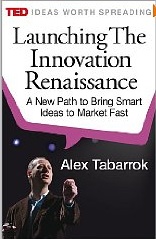
…This is a great book. It’s fast-paced, fun to read, informative as hell, and it gets everything right. At first I wished I’d written it— until I realized I could never have written it half so well.
…I wish everyone in the world would read this book. It only takes a couple of hours, and it is by far the best introduction I know of to the topic that towers above all others in its importance for the happiness of human beings everywhere, now and in the future, namely how to foster and accelerate the kinds of innovation that lead to economic growth. It will, I hope and expect, make you an enlightened advocate for enlightened policies. And it will arm you with a bundle of fun facts and anecdotes to share with your friends. This book might turn you into a proselytizer, but it will surely not turn you into a bore.
Buy Launching the Innovation Renaissance (Amzn, Nook, iTunes) and read it over the holidays!