USG assets are worth less than Arnold Kling had thought
Federal oil and gas rights are worth about $625 billion on the paper’s own method, down 75% in real terms since 1981. Federal land has gone the other way, to roughly $1.1 trillion to $1.6 trillion. Land, not minerals, is now the larger asset.
Here is the full post.
My excellent Conversation with Terence Tao
Here is the audio, video, and transcript. Here is part of the episode summary:
Tyler opens by asking Terence what it feels like to contemplate Euler’s identity, quantum mechanics, the Riemann hypothesis, and Gödel’s incompleteness theorem, before moving into why mathematical history gets stripped out of classrooms, whether abstract math is a lottery ticket or a unified whole, string theory’s beauty versus its lack of confirmation, why real analysis arrived so late, why zero took until the 7th century to be invented, game theory, the Black-Scholes model, Bostrom’s simulation argument, and Newcomb’s paradox, math education and the case for teaching more statistics, Tao’s view that AI has pushed mathematics from an era of “proof scarcity” into “proof abundance,” what that means for the research paper, why video talks may become more valuable than papers themselves, Tao’s favorite Hong Kong action movies, his unconventional path through an Australian university at age 13, his most unusual work habit, his verdict on the Collatz conjecture, and more.
Excerpt:
COWEN: When you look at mathematical economics over the last two decades, is it interesting to you as math, or is it just a bunch of people doing something different that, to you, is low level?
TAO: Oh, yes, I was always fascinated by economics. I love game theory, and actually often there are pure math problems where it’s actually good to think in game theory terms. In analysis, you have all these complicated statements, like for every ε, there exists a δ, blah, blah, blah. It looks very intimidating, but if you phrase it as a game, your opponent is giving you an ε, you need to counter that ε with a δ of your own. If you view it as a game, then actually you can talk about strategies and who’s ahead, who’s behind. It actually activates really good modes of thinking.
I’ve used economic thinking in my own work. We talk about cost functions and minimizing loss. There are lots of concepts. Ricardo’s law of comparative advantage, I use that to run my life. There are so many things I can do. What do I choose to spend my time on? It’s actually a very useful principle: comparative advantage.
Economics, I find it’s a very good arena to understand the difference between models and reality. Physics, we’re spoiled because we’ve had these great physicists who’ve created these very accurate models of the real world, classical mechanics, quantum mechanics, and they’re very well tested and very accurate. You can just go to town exploring their consequences and still predict reality. Economics is a much more mixed situation where you have models, and sometimes they predict the real world very well, but sometimes they don’t.
In addition to doing the math, you also have to do the modeling, and you have to understand the limits of when a model starts breaking down and what you need to do to adjust it. I find that fascinating. It’s somewhere between the hard sciences and the social sciences. There’s enough hard models that you can do math, but there’s also enough real-world messiness that you have to also grapple with the subjectivity. As an outsider, I find it a really fascinating subject.
COWEN: When you looked at the Black-Scholes model, were you shocked when the probability doesn’t matter? Was that beautiful to you?
TAO: Yes, yes, yes. There is a special feature of Gaussian fluctuations that you can price options just by knowing risk. There is one algebraic miracle that makes this work. Normally, predicting future costs of anything is just an intractable problem, and there just happens to be this miracle. If you have Gaussian fluctuations, then it is beautiful. This is actually a really good example of when you need to know when the models work and when they don’t work. If you don’t have Gaussian fluctuations, then actually Black-Scholes is somewhat dangerous to use, especially if you compound it into derivatives over and over again. Again, that’s an old story. You know what happened in 2009.
Self-recommending, and of interest throughout. There is some on AI, but he has spoken so much on that topic lately I decided not to emphasize it. And Terry does have a new book out, namely Six Math Essentials.
Richard Posner, RIP…
Experimentally validated digital twins
There is a new paper by Raj Chetty, Jamie Fogel, Lawrence F. Katz, Kadeem Noray, Sonya Porter, and James Reisinger:
Modern program evaluation prioritizes evidence from randomized controlled trials (RCTs) because prior research found that observational estimates of program impacts often diverge substantially from experimental benchmarks. We revisit this finding — which was based on small survey datasets — in the era of large-scale administrative data. Using anonymized income tax records covering all American adults between 1999 and 2025, we estimate the effects of workforce training programs on earnings by using machine learning models to predict counterfactuals from rich data on prior work histories, demographics, and residential locations. Rather than testing whether our observational estimates are unbiased, we use 37 RCTs to estimate the distribution of their bias. We find that our machine learning estimates closely match the RCT estimates, with root mean squared error (RMSE) comparable to that of the RCTs themselves. Our method reduces RMSE by 60% relative to parametric estimators used in prior work because our larger samples and richer covariates permit more flexible, higher-dimensional models of the counterfactual. Applying our method to a broader set of sites and enrollment years beyond the experimental sample, we find that treatment effects on earnings vary substantially across locations and over time, even within a given program. Programs that place more participants into target-sector jobs generate the largest earnings gains, with impacts that persist even after participants leave their initial jobs. These findings provide guidance for improving job training programs and, more broadly, illustrate a scalable approach to program evaluation that uses observational data to construct experimentally validated “digital twins.”
Work of this sort is going to revolutionize economic method.
Wednesday assorted links
1. “We were discussing this today in office: future paper is 5 pages (what’s question, where is lit now very briefly, what do we do, what do we find), with all details left to a long appendix, hyperlinked, with rigorous AI review. We would read many more papers in that world! Agree?” Kevin Bryan.
2. “Norway now has more than 2,000 underwater AI laser robots shooting lice off its salmon”
3. Coefficient Giving is looking to support new types of organizations.
4. The future of fermented food in Africa.
5. Shruti and Henry Oliver podcast with transcript on Gulliver’s Travels.
What should I ask Simon Sebag Montefiore?
I will be doing a Conversation with him, most of all about his new and very good book The Cauldron: The Making of the Modern Middle East. He has many other excellent books too, including on Russian history and some fiction. Here is his home page, here is his Wikipedia page.
So what should I ask him?
UK fact of the day
UK panel data, 1991-2019. Couples who support different parties separate more often. The effect is as strong as some other mismatches, like education. Disagreement over Brexit mattered even more than party preference.
Here is a longer Nikolaus Haufler thread on European fertility, with a variety of interesting observations about other countries.
Spying makes a comeback
That is the theme of my latest Free Press article, here is one excerpt:
It may look like merely the latest story of a wealthy, powerful man making an irresponsible decision. But below the surface, it is also a harbinger of the erosion of privacy today, as well as the acceleration of espionage and the increasing value of secrets. More time and resources are going to be devoted to uncovering secrets, with honeypotting only one part of a larger picture: more spying, more attempted honeypotting, more private surveillance, more attempts to record (and search, using AI) conversations, more hacks of phones and computers, and more attempts to use AI to figure out the details of people’s lives and plans. Life is going to feel much more cloak-and-dagger, especially for the wealthy and influential…
The wealthy and influential are likely to take ever-greater care to minimize public scrutiny, protect their digital privacy, prevent journalists from going through their trash, and travel incognito, and their language in (supposedly) private conversations will have to be more guarded as well. We now live in an era where NDAs for hookups and even dinner dates are a thing.
Worth a ponder, as in the pending world secrets will be more valuable than before. The super-wealthy and their companies can be decisive actors, there are more prediction markets than before, and AI is equalizing the value of high-quality but publicly available information.
Are RCTs underpowered?
Maybe so:
We study the statistical credibility of randomized controlled trials (RCTs) in development economics and the optimal allocation of resources to replication. Using 745 principal-hypothesis tests from 190 articles in leading economics journals, we find that actual t-statistics peak well below the theoretical benchmark of 2.8 expected under 80 percent power, though above values associated with p-hacking. This suggests many RCTs are underpowered. Estimating an empirical Bayes mixture model that accounts for selective publication, we find that approximately 30 percent of published rejections are false discoveries, with average directional power at only 40 percent. At conventional significance thresholds, the posterior probability of a false discovery reaches 66 percent. Doubling original sample sizes lowers the average false discovery rate by five percentage points, whereas tightening the significance threshold to 0.005 yields a larger reduction at the cost of total discoveries. Finally, we characterize a funder’s optimal replication policy under a fixed budget and an evidence standard. Under standard regularity conditions, replications concentrate in an intermediate interval of original test statistics, and the optimal replication sample size is single-peaked in the original t-statistic. Illustrative calibrations show that successful replications reduce aggregate false discovery rates to 1.8–7.8 percent, depending on the evidence standard.
That is from a new paper by
Tuesday assorted links
2. Hayek for our time, by Cass Sunstein, free download for two weeks.
3. Works in Progress is looking for business and finance writers.
4. Matthew Lilley on Harvard grad students. I believe they teach the permanent income hypothesis there?
5. Ethan Mollick on Fable 5.2.
Checking the AI audit of Saez and Zucman’s research.
We checked the anonymous AI audit of Emmanuel Saez and Gabriel Zucman’s research that Marginal Revolution featured on 28 Oct: all 147 problems it calls serious enough to change a headline number, against the papers, their sources and the authors’ own data. The audit’s facts hold up: for 131 of the 147, every fact we could check was right, and none had its core facts wrong. 21 of the 147 change a headline number; 98 depend on a disputed choice of method; 20 change no number; 8 we could not check on that question. A second pass graded the 99 flags we first counted as depending on a disputed choice of method: 11 standard, 70 defensible, 11 questionable, 6 we could not grade, and 1 contested. It found one, No. 54, that does change a headline number, which is why the counts are now 21 and 98. Saez and Zucman were sent our findings on 29 Oct and did not reply by 6 Nov.
Here is the audit of the audit, open code and data, kudos to the authors. Here was the original AI audit. Here is the October 30 revision of that audit.
Addendum: And a revised version with less jargon.
*Godzilla: Minus Zero* (no spoilers)
This is a morally serious movie (really). And Ghidorah stars! The whole thing is about twenty minutes too long, but mostly very good. And like many in the Godzilla series, it offers extended and instructive commentary on American-Japanese relations, and how the Japanese view them. Not for everyone, but I am glad I went.
*Unbeatable: The Brutally Honest Case for Free Markets*
That is the new and forthcoming book from Bryan Caplan, University of Chicago Press. Excerpt:
Real-world free markets deliver one broad benefit that flies under the radar of economic theory: They shield humanity from its own Social Desirability Bias. Markets do the good things that sounds bad. Good things like driving incompetent, unresponsive, and obsolete businesses into bankruptcy. Producing “shameful” products people secretly love. Refusing to produce “admirable” products they secretly loathe. Keeping costly products out of the hands of pe ople who barely appreciate them. Putting convenience above safety. Firing superfluous workers so they search for constructive ways to spend their lives. Charging people to drive. Charging extra during rush hour. Inducing teens to abandon their childish dreams. Persuading grown-ups to volunteer for the uninspiring dirty jobs that someone has to do.
Bryan of course is very much on target here, as he is in the broader text. Here is the Table of Contents:
Introduction: When good sounds bad and bad sounds good
1. What economists really think about markets and government
2. Why economists tragically underrate free markets
3. Why economists absurdly overrate government
4. Irrationality is the best case for and against government
5. What we ought to do but probably won’t
Conclusion: A Plea to the Free-Marketeers of the Future
I am delighted to see another book by Bryan, the title says it all.
Monday assorted links
End the State Veto on Power Lines
It’s one of the peculiarities of American regulatory history that a natural gas pipeline can cross state lines with a single federal permit, but oil and electricity must run a gauntlet of state approvals. When a power line crosses one state to reach another, for example, the intervening state often imposes exorbitant tolls or, worse, vetoes the project entirely. It’s the holdout problem played out among the states.
In a new paper, Liscow, Shapiro and Williams show that after Congress ended the states’ veto over interstate gas pipelines in 1947, miles built per year rose nearly sixfold. Oil pipelines, which still had to run the state gauntlet, held steady. Lower transaction costs let natural gas flow to where it was most valued, creating a national market.
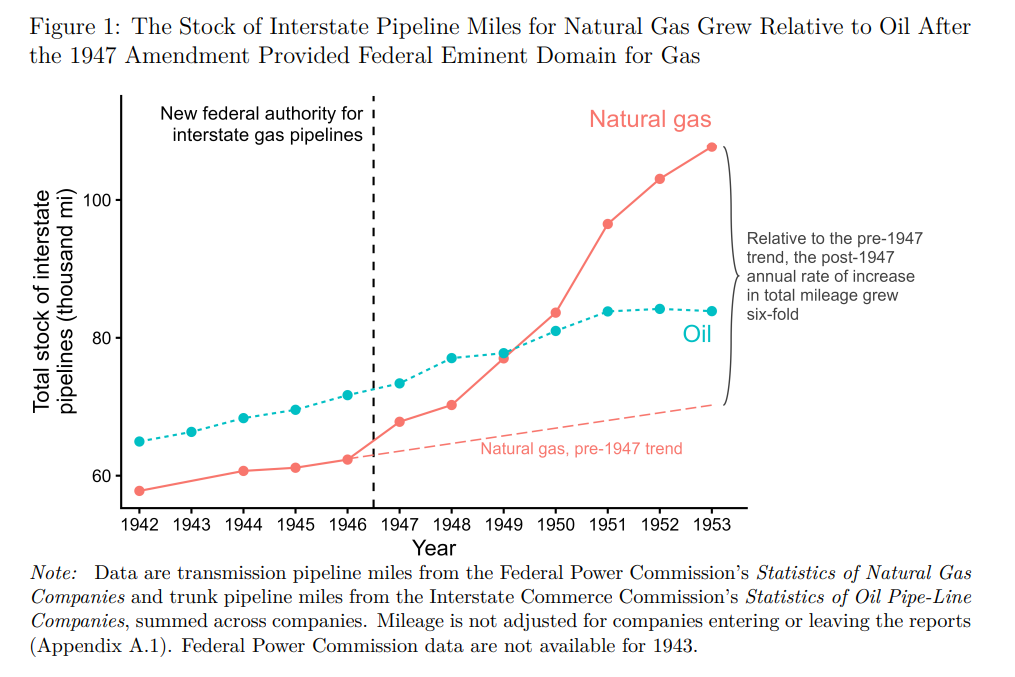
Today, as Liscow and Shapiro write in the Washington Post, the issue is electricity:
An interstate power line, however, typically needs approval from every state it crosses. That gives each state a veto over projects in which the benefits often flow mostly to its neighbors.
New England has experienced the consequences. In 2016, Massachusetts attempted to import Canadian hydropower. New Hampshire, which would have hosted the power lines without getting the same influx of cheap energy, rejected it. A second route through Maine was blocked in a referendum and didn’t deliver power until January. Meanwhile, Massachusetts households paid some of the highest electricity prices in the country.
As with natural gas, electricity is cheapest to produce far from where it is most valued, so to get the most from our national resources we need to transmit electricity across the country.
The Bipartisan American Affordability and Jobs Act, which faces a Senate cloture vote on Monday, would let FERC approve an interstate line that a state has blocked or stalled for a year, a big step toward a national market in electricity.
Let the power flow!