Year: 2016
The best argument for Brexit so far
The plummeting pound is threatening UK households’ supplies of Ben & Jerry’s ice cream and Marmite spread, as Tesco, the country’s biggest supermarket, pulled dozens of products from sale online in a row over who should bear the cost of the weakening currency.
Unilever has demanded steep price increases to offset the higher cost of imported commodities, which are priced in euros and dollars, according to executives at multiple supermarket groups.
But Tesco signalled it would fight the rises, removing Unilever products from its website and warning that some of the items could disappear from shelves if the dispute dragged on. Other supermarkets have warned that they could follow suit.
Here is the full FT story.
Wednesday assorted links
From The Adam Smith Institute
So it’s official. As of today we are no longer a libertarian think tank. We’re neoliberals. And maybe you are too.
Here is the link. Here Sam Bowman, the Executive Director, explains:
And I think to most people in Britain the word libertarian connotes a sort of unflexible extremeness – a preoccupation with hard-and-fast rules over policies that actually make people’s lives better. It was this misconception that allowed the Prime Minister get away with equating the libertarian right with the socialist left, as if the two were somehow comparable…
So in embracing the term neoliberal, we’re hoping that we’re being a little clearer about what we already believe in and do. We fight for free markets, property rights, globalisation and an open society, all based on real-world evidence. Those are what have given us the rich, peaceful, prosperous world we live in, and with more of them we can help to make things even better. It’s time for us neoliberals to start going on the offensive and fight for the world we have helped to create.
I do not have sufficient background on the situation to parse this, but perhaps it is also one way of signaling that they are anti-Brexit, and the word libertarian would not do that, and might even suggest they favored Brexit as a means for arriving at a more libertarian society (which by the way is not how things are running). A neoliberal one would think favors arrangements for free trade and migration.
Addendum: Here is their home page.
Do European banks need more capital?
Maybe so, but I have a sneaking suspicion they are not about to get much of it, not anytime soon. Corina Ruhe reports, and I say put on your Bayesian thinking cap for this bit:
Bundesbank board member Andreas Dombret…said in an interview with Boersen-Zeitung that the revised rules, due by year-end, mustn’t disproportionately affect European banks. “Not significant means an increase of zero percent or near to zero percent; that has to be the starting point for all negotiations,” he said.
I like to negotiate that way too, when I can. What might the French be saying?:
“We are in favor of Basel III, but we think it is unhelpful, even dangerous, to want to add layer upon layer of obligations on banks, in particular on European banks,” French Finance Minister Michel Sapin said on Monday.
Are you starting to see a pattern? Neither the governments nor the banks would find it very simple to cough up the extra resources to boost capital. And cross-border or other mergers would lead to higher capital requirements yet, given the way the regulations are written to penalize increases in bank size.
Did you know that the ECB gave Deutsche Bank special treatment in its recent stress tests? Still, I think it is more likely that Deutsche Bank is a slow wasteful drain rather than the next explosive Lehman Brothers, if only because the level of financial risk paranoia is so high.
The more fundamental point is that there is significant excess capacity in European banking. That makes it hard for DB to get back on its feet, and it may send other European banks to a similar fate, creating a chronic problem though probably not a dramatic crisis. The bank-dependent EU economies don’t have a simple way to make their banking sectors shrink a lot more. Whether or not this is necessary right now or rather later, either way it will feel a lot like that ill-defined concept “austerity.”
“Global banks are international in life but national in death,” former Bank of England governor Mervyn King once noted.
More fundamentally, there is excess capacity when it comes to EU governments as well, a less frequently recognized point. There is more and more governance, some of it good in fact, but it never goes away. There are whole new levels of governance, connected to the EU. Somewhere in the system, governance too needs to shrink. Losing a few countries through consolidation is not possible, but in terms of the pure logic (divorced from actual fact and possibilities), there is something to be said for the idea. And yet we are relying on governance to get the banks to shrink. And relying on the banks to boost growth so that governance can shrink. Relying on relying.
Get the picture?
*American Honey*
This sprawling, 2 hour, 42 minute movie likely will be seen as one of the important creations of the decade. Variety described it as “femme-driven corrective to…”Spring Breakers””, and “Part dreamy millennial picaresque, part distorted tapestry of Americana and part exquisitely illustrated iTunes musical,” the phrase “Midwestern America Walpurgis Night” came to my mind. “…Almost ridiculously full of life…” was another account. Most of all, it is a story of how a post-Christian America can go awry, told through the classic medium of a road trip. Instead of the blood and flesh of Christ at Holy Communion, here the serving is toxic mezcal and eating the worm inside the bottle, for cash of course. The other parallels I do not wish to give away.
In terms of cinematography and especially soundtrack, it’s as strong as any movie in recent times. Scene after scene felt special and memorable, and only about ten minutes or so dragged. I kept on thinking it couldn’t keep up its pace of quality, but it did and in fact kept surpassing itself. Sasha Lane deserves the Best Actress Oscar, and in her film debut at that. I just ordered everything I can by British director Andrea Arnold.
Recommended (re)reading for a viewing includes Genesis, most of all the story of Jacob, his family, and his wrestle with the angel. But don’t expect the reviews to mention any of that — Ross Douthat, telephone!
Remember people, the influential thinkers of the next generation will be the religious ones…whether you like it or not.
Tuesday assorted links
1. Luigi Zingales on the Laureates. And the full 49-page report on the Laureates, from Sweden. And David Warsh on Holmström on debt and banking. Cardiff Garcia on Bengt on money. Kling on the prize. Boettke on the prize. A Fine Theorem on Oliver Hart, and how he changed his mind, recommended. And where Nobel Laureates come from.
3. Tim Harford on man-machine interaction, adopted from his new book Messy.
4. College chain from India expanding into the U.S.?
5. Paul Krugman on Brexit and the pound. I don’t agree with those arguments, but I think they are more consistently Krugmanian than his earlier posts on Brexit. If an economy is in demand-side secular stagnation, and then a government taxes production and trade, and takes finance down a peg, but boosts exports through a lower currency, I am not sure the model will predict significantly negative consequences. His arguments are also consistent with a more general New Old Keynesian neglect of wealth effects.
Private Prisons and Incentive Design: Critiquing Oliver Hart
One of Nobel prize-winner Oliver Hart’s most influential papers (co-authored with Andrei Shleifer and Robert Vishny) is on incentive design and private prisons (see Tyler’s post covering Hart’s work). Yesterday was not the day for a critique but Tyler and I do critique this paper in our principles textbook, Modern Principles. I believe that our textbook is the only principles textbook to have a chapter on contract design and we make this modern material accessible to undergraduates! Here is our explanation and critique:
Should the management of prisons be contracted out to the private sector? The
owners of a private firm have a strong incentive to cut costs and improve productivity because they get to keep the resulting profits. If a public prison cuts
costs, there is more money in the public treasury but no one gets to buy a yacht so the incentive to cut costs is much weaker.
 In 1985, Kentucky became the first state to contract out a prison to a for profit firm. Private prisons today hold about 120,000 prisoners in the United
States, about 5 percent of all prisoners. Should efficient private prisons replace
inefficient public prisons? Three economists—Oliver Hart, Andrei Shleifer, and
Robert Vishny (HSV)—say no. HSV don’t question that the profit motive gives
private prisons stronger incentives than public prisons to cut costs—HSV say
that’s the problem! Suppose that we care about costs but we also care about
prisoner rehabilitation, civil rights, and low levels of inmate and guard violence.
What we pay for is cheap prisons, but what we want is cheap but high quality
prisons. If we can’t measure and pay for quality, then strong incentives could
encourage cost cutting at the expense of quality.
The principle is a general one, a strong incentive scheme that incentivizes
the wrong thing can be worse than a weak incentive scheme. One car dealer in
California advertises that its sales staff is not paid on commission. Why would
a store advertise that its sales staff do not have strong incentives to help you?
The answer is clear to anyone who has tried to buy a car. High-pressure dealers
who pounce on you the moment you enter the showroom and bombard you
with high-pressure sales tactics (“I can get you 15 percent off the sticker, but
you have to act NOW!”) may sell cars to first-time buyers, but the strategy is
too unpleasant to win many repeat customers. Car dealers who rely on repeat
business usually prefer a low-pressure, informative sales staff….In theory, a car dealer could have strong incentives and repeat business by
paying its sales staff based on their “nice” sales tactics, but in practice it’s too
expensive to monitor how salespeople interact with clients. Cheating by the
sales staff would be difficult to detect and thus would be common.
…What about prisons? Are HSV correct that weak-incentive public prisons
are better than strong incentive private prisons? Not necessarily. HSV assume
that cutting quality is the way to cut cost. But sometimes higher quality is also
a path to lower costs. Low levels of inmate and guard violence, for example, are
likely to reduce costs. And respect for prisoner’s civil rights? That can save on
legal bills. When quality and cost cutting go together, a private firm has a strong
incentive to increase quality.
HSV may also underestimate how well quality can be measured. Measuring
output pays off more when incentives are high. Unsurprisingly, therefore,
private prison companies and government purchasers have made extensive
efforts to measure the quality of private prisons.
Finally, don’t forget that weak incentives reduce the incentive to cut costs
but they don’t increase the incentive to produce high quality! Public prisons
might use their slack budget constraints to offer high-quality rehabilitation
programs, or they might instead offer prison guards above-market wages.
Which do you think is more likely?
Nevertheless, whether HSV are right or wrong about private prisons, their
argument is clever. The usual argument against government bureaucracy is that
without the profit incentive, public bureaucracies won’t have an incentive to
cut costs. HSV suggest this is exactly why public bureaucracies may sometimes
be better than private firms.
Addendum: We don’t go through the empirical literature in the text but overall it’s not supportive of HSV. As HSV predict, private prisons appear to be cheaper than public prisons but they are not significantly cheaper and the quality of private prisons is comparable to that of public prisons and maybe a little bit higher (faint praise). Basically the government gets what it pays for.
Why was there no Coasean solution to the American Revolution?
Sebastian Galiana and Gustavo Torrens have a new NBER paper on this underappreciated question:
Why did the most prosperous colonies in the British Empire mount a rebellion? Even more puzzling, why didn’t the British agree to have American representation in Parliament and quickly settle the dispute peacefully? At first glance, it would appear that a deal could have been reached to share the costs of the global public goods provided by the Empire in exchange for political power and representation for the colonies. (At least, this was the view of men of the time such as Lord Chapman, Thomas Pownall and Adam Smith.) We argue, however, that the incumbent government in Great Britain, controlled by the landed gentry, feared that allowing Americans to be represented in Parliament would undermine the position of the dominant coalition, strengthen the incipient democratic movement, and intensify social pressures for the reform of a political system based on land ownership. Since American elites could not credibly commit to refuse to form a coalition with the British opposition, the only realistic options were to maintain the original colonial status or fight a full-scale war of independence.
You may recall that Adam Smith wanted to see a continuing empire, but with North America as essentially the more powerful partner, though he did not quite use those words.
How might agency problems limit innovation?
Holmstrom’s work has provided me with a great deal of understanding of why innovation management looks the way it does. For instance, why would a risk neutral firm not work enough on high-variance moonshot-type R&D projects, a question Holmstrom asks in his 1989 JEBO Agency Costs and Innovation? Four reasons. First, in Holmstrom and Milgrom’s 1987 linear contracts paper, optimal risk sharing leads to more distortion by agents the riskier the project being incentivized, so firms may choose lower expected value projects even if they themselves are risk neutral. Second, firms build reputation in capital markets just as workers do with career concerns, and high variance output projects are more costly in terms of the future value of that reputation when the interest rate on capital is lower (e.g., when firms are large and old). Third, when R&D workers can potentially pursue many different projects, multitasking suggests that workers should be given small and very specific tasks so as to lessen the potential for bonus payments to shift worker effort across projects. Smaller firms with fewer resources may naturally have limits on the types of research a worker could pursue, which surprisingly makes it easier to provide strong incentives for research effort on the remaining possible projects. Fourth, multitasking suggests agent’s tasks should be limited, and that high variance tasks should be assigned to the same agent, which provides a role for decentralizing research into large firms providing incremental, safe research, and small firms performing high-variance research. That many aspects of firm organization depend on the swirl of conflicting incentives the firm and the market provide is a topic Holmstrom has also discussed at length, especially in his beautiful paper “The Firm as an Incentive System”; I shall reserve discussion of that paper for a subsequent post on Oliver Hart.
That is A Fine Theorem on the work of Bengt Holmstrom, do read the whole thing.
Monday assorted links
2. “Why, then, shouldn’t we have an official inquiry into abuses during the Bush years?” (NYT) Me, thee, etc. Personally, I don’t favor any of these suits and prosecutors and the like, not for either side, and I was one of the very first to warn about this with respect to Trump. But please don’t think Trump just pulled this idea out of some kind of personal fascist cookbook.
3. The Brexit plan for Ireland. And revisionist take that maybe Brexit made the UK wealthier. And Wolfgang M. ponders Irexit.
4. Are state-dependent cash transfers better yet?
5. Cheap Talk on Bengt Holmström. And here is a Nobel message for the blockchainers. And Paul Romer’s storified tweets on them. And Noah Smith on the prize.
6. Earth fact of the day: our planet has only the 7th greatest quantity of water in the solar system.
My Bloomberg column on the two new Laureates
Read it here, this is one short bit:
They’ve built a technical framework for other researchers to build on, which is much harder to do than to throw off useful insights. So don’t be underwhelmed if some of their work, when conveyed in sound bites, seems like something you heard last week at the water cooler.
Overall a simpler take than what you can read on MR below.
The Performance Pay Nobel
The Nobel Prize in economics goes to Oliver Hart and Bengt Holmstrom for contract theory, the design of incentives. See Tyler’s posts below for overviews. In our textbook, Modern Principles, Tyler and I have a chapter called Managing Incentives which covers some of this work, especially related to Holmstrom’s work on performance pay. Let’s give a simplified precis (fyi, the textbook doesn’t have the math).
Suppose that you are a principal monitoring an agent who produces output. The output depends on the agent’s effort but also on noise. It wouldn’t be a very efficient contract to just reward the agent based on output since then you would mostly be responding to noise—punishing hard-working agents when the noise factors were bad and rewarding lazy agents when the noise factors were good. Not only is that unfair–if you setup a contract like this the agents will a) demand that you pay them a lot of money in the good state because they will be taking on a lot of risk and b) the agents won’t put in much effort anyway since their effort will tend to be overwhelmed by the noise, either good or bad. Thus, rewarding output alone gets you the worst of all worlds, you have to pay a lot and you don’t get much effort.
But perhaps in addition to output, y, you have a signal of effort, call it s. Both y and s signal effort with noise but together they provide more information. First, lesson – use s! In fact, the informativeness principle says you should use any and all information that might signal the agent’s effort in developing your contract. But how should you combine the information from y and s? Suppose you write a contract where the agent is paid a wage, w=B0+By*y+Bs*s where Bo is the base wage, By is the beta on y, how much weight to put on output and Bs is the weight on the s signal–think of By as the performance bonus and Bs as a subjective evaluation bonus. Then it turns out (under some assumptions etc. Canice Prendergast has a good review paper) you should weight By and Bs according to the following formula:
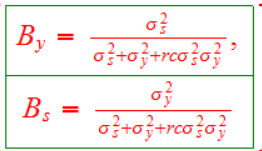
that looks imposing but it’s really not. σ^2s (sorry for the notation) is the variance of the s signal, σ^2y is the variance of the y signal. Now for the moment assume r is zero so the formula boils down to:
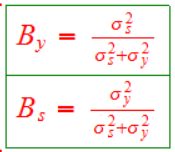
Ah, now that looks sensible because it’s an optimal information theorem. It says that you should put a high weight on y when the s signal is relatively noisy (notice that By goes to 1 as σ^2s increases) and a high weight on s when the y signal is relatively noisy. Notice also that the two betas sum to 1 which means that in this world you put all the risk on the agent. Ok, now let’s return to the first version and fill in the details. What’s r? r is a measure of risk aversion for the agent. If r is zero then the agent is risk neutral and we are in the second world where you put all the risk on the agent. If the agent is risk averse, however, then r>0 and so what happens? If r>0 then you don’t want to put all the risk on the agent because then the agent will demand too much so you take on some risk yourself and tamp down By and Bs (notice that the bigger is r the smaller are both By and Bs) and instead increase the base wage which acts as a kind of insurance against risk. So the first version combines an optimal information aggregation theorem with the economics of managing the risk-performance-pay tradeoff.
(c, by the way, is a measure of how costly effort is to the agent and so it also makes sense that the higher is c the less weight you put on performance incentives and the more on the base wage.)
Let’s also discuss some further work which is closely related to Holmstrom’s approach, tournament theory (Lazear and Rosen). When should you use absolute pay and when should you use relative pay? For example, sometimes we reward salespeople based on their sales and sometimes we reward based on which agent had the most sales, i.e. a tournament. Which is better? The great thing about relative pay is that it removes one type of noise. Suppose, for example, that sales depend on effort but also on the state of the economy. If you reward based on absolute sales then you are rewarding a lot of noise. Once again, that has two bad effects it means that you have to pay your agents a lot since you are imposing risk on them and it means that they won’t work that hard since they know they will be paid a lot when the economy is good and hardly at all when the economy is bad so in neither case do the agents have strong incentives to work hard. Suppose, however, that you have a relative pay scheme, a tournament. Now you have removed the noise coming from the state of the economy–since all the salespeople face the same economy and since there is always a first, second and third place the agent’s now have an incentive to work hard in good or bad times. Not only do they have an incentive to work hard you don’t have to pay them much of a risk premium since more of their pay is now based on their own effort rather than on noise.
But relative pay isn’t always better. If the sales agents come in different ability levels, for example, then relative pay means that neither the high ability nor the low ability agents will work hard. The high ability agents know that they don’t need to exert high effort to win and the low ability agents know that they won’t win even if they do exert high effort. Thus, if there is a lot of risk coming from agent ability then you don’t want to use tournaments. Or to put it differently, tournaments work best when agent ability is similar which is why in sports tournaments we often have divisions (over 50, under 30) or rounds.
FYI, in our textbook Tyler and I use this model to discuss when students should prefer an absolute grading scale and when they should prefer grading on a curve. Work it out!
Holmstrom’s work has lot of implications for structuring executive pay. In particular, executive pay often violates the informativeness principle. In rewarding the CEO of Ford for example, an obvious piece of information that should used in addition to the price of Ford stock is the price of GM, Toyota and Chrysler stock. If the stock of most of the automaker’s is up then you should reward the CEO of Ford less because most of the gain in Ford is probably due to the economy wide factor rather than to the efforts Ford’s CEO. For the same reasons, if GM, Toyota, and Chrysler are down but Ford is down less then you might give the Ford CEO a large bonus even though Ford’s stock price is down. Oddly, however, performance pay for executives rarely works like a tournament. As a result, CEOs are often paid based on noise.
The basic framework has since been applied in many different circumstances because principal-agent can be interpreted in many different ways employer-worker, teacher-student, regulator-banker and so forth. Thus the basic insights have been reflected in a wealth of applications each of which adds to the body of theory.
Bengt Holmström, Nobel Laureate
Again, I’ll be refreshing this post throughout the morning, keep on hitting refresh. Here is Bengt Holmström’s home page, which includes a CV, short biography, and links to research papers. Here is his Wikipedia page. He has taught for a long time at MIT, was born in Finland, and is one of the most famous and influential economists in the field of contracts and industrial organization. Here is the Swedish summary. Here is a video explanation. This is a nice short bio of how he was influenced by his private sector experience, recommended, not just the usual take on him.
One key question he has considered is when incentives should be high-powered or when they should be more blunt. It is now well known that you get what you pay for; see Alex’s excellent summary on this and related points.
His most famous paper is his 1979 “Moral Hazard and Observability.” What are the optimal sharing rules when the principal can observe outcomes but not efforts or inputs? And how might those sharing rules lead to a less than optimal result? This is probably the most elegant and most influential statement of how direct incentives and insurance value in a contract can conflict and hinder efficiency. A simple example — what about deductibles in a health insurance contract? Yes, they do encourage the customer to internalize the value of staying in better health. But they also limit the insurance value of a contract. That a first best outcome will not be created in this situation was part of what Holmstrom showed, and he showed it in a relatively tractable way.
If you are thinking about CEO compensation, you might turn to the work of Holmström, the Swedes have a good summary of this paper and point:
…an optimal contract should link payment to all outcomes that can potentially provide information about actions that have been taken. This informativeness principle does not merely say that payments should depend on outcomes that can be affected by agents. For example, suppose the agent is a manager whose actions influence her own firm’s share price, but not share prices of other firms. Does that mean that the manager’s pay should depend only on her firm’s share price? The answer is no. Since share prices reflect other factors in the economy – outside the manager’s control – simply linking compensation to the firm’s share price will reward the manager for good luck and punish her for bad luck. It is better to link the manager’s pay to her firm’s share price relative to those of other, similar firms (such as those in the same industry).
That is again a result about how incentives and insurance interact. When do you pay based on perceived effort, and when on the basis of observed outcomes, such as profits or share price? Holmström has been the number one theorist in helping to address issues of this kind.
“Moral Hazard in Teams,”1982, is a very famous and influential paper, here is the working paper version. Holmström showed that the optimal incentive scheme has to consider time consistency. Sometimes good incentive schemes impose penalties on the workers/agents to get them to work harder. But let’s say you had a worker-owned and worker-run firm. If the workers fail, will the workers/owner impose punishments on themselves? Maybe not. Thus in a fairly general class of situations you need an outside residual claimant to impose and receive the penalty. This is Holmström trying to justify one feature of the capitalist system against socialists and Marxists.
A Fine Theorem has an excellent post on his work.
“Managerial Incentive Problems: A Dynamic Perspective” is another goodie, this one from 1999. The key point is that repeated interactions, for instance with a manager, can make incentive problems worse rather than better. The more the shareholders monitor a manager, for instance, and the more that is over a longer period of time, perhaps the manager has a greater incentive to manipulate signals of value. When are career incentives beneficial or harmful? This paper is the starting point in thinking through this problem. Here is one of the possible traps: if a worker fully reveals his or her quality to the boss, the boss will use that information to capture more surplus from the worker. So many workers don’t let on just how talented they are, so they can slack more, rather than being caught up in the dragnet of a ‘super-efficient” incentives scheme. I have long found this to be a very important paper, it is probably my favorite by Holmström.
This 1994 investigation, based on personnel data from within firms, is actually way ahead of its time in terms of empirical methods. It is certainly known but he never received full credit for it.
Holmström and Hart together have a very nice piece surveying the theory of contracts and theories of the firm. With John Roberts, he has a very nice (and highly readable!) survey of economic work on theories of the boundary of the firm, recommended on the field more generally. Not his most famous piece, but if you are looking in the applied direction, here is his survey piece with Steven Kaplan on mergers.
With Jean Tirole has has a 1997 paper “Financial Intermediation, Loanable Funds, and the Real Sector.” This was an important precursor of the later point about how collateral constraints really can matter. Firms and banks should be well-capitalized! This piece was significantly influenced by the Nordic financial crises of the 1990s and it was prescient regarding later events in the United States and elsewhere.
His liquidity-based asset pricing model, with Jean Tirole, did not in its published form “take off” in the world of finance, but it is an excellent and important piece, worth revisiting as part of the puzzle of why the world has so many super-low interest rates today.
Holmström has since written much more about banking and agency problems. His very latest piece is on banks as secret keepers, and it tries to model and explain the fundamental nature of banking and its fixed value liabilities. Here is his piece on why financial panics are so likely to involve debt. With Jean Tirole, he wrote a well-known paper on why government supply of liquidity services sometimes may be justified.
Here is his 2003 survey paper, with Steven Kaplan, on what is right and wrong in U.S. corporate governance. It is a more applied side than what you often see from him. The piece claims that, even in light of the scandals of that time, American corporate governance is not broken and will probably become better yet, though it could stand some improvement, including on the regulatory side. Overall I view his co-authorships with Kaplan as suggesting that his overall stance toward corporations is more influenced by Chicago-style thinking than is oftetn the case at MIT. Read his defense of asset securitization for instance.
Congratulations to Bengt Holmström!
Oliver Hart, Nobel Laureate
Here is Hart’s most famous piece, with Sandy Grossman, 1986, “The Costs and Benefits of Ownership.” Think of it as an extension of Ronald Coase and Oliver Williamson, also two Nobel Laureates (hey, that’s a lot of prizes for one topic area…)
Why does one party ever purchase residual rights in the assets of another party? Say for instance there is a factory firm and a coal mining firm. The coal can be treated in a particular way to be more suitable for use in the factory. If the factory firm buys out the coal mining company, the incentives for coal treatment differ, that is the key insight behind this model. You can think of this as a very important modification of the Coase Theorem. It does matter who owns the asset. Why? If the coal mining company owns the coal, it has one set of incentives to make ex ante improvements in the values of those assets; if the factory firm owns the coal mine, it has another set of incentives. Part of the work in this paper is done by a bargaining axiom — if you own an asset outright, you keep a greater share of the proceeds from improving the value of that asset. Ownership should thus migrate to those parties who have the greatest ability to improve value.
And that is a very fundamental improvement on the Coase theorem, which suggests ownership won’t matter when there is ex post contractibility. This paper showed that for ownership not to matter there must also be ex ante contractibility about value-improving investments at earlier stages in the game, an unlikely assumption to hold.
This is a tricky paper to master. It has all kinds of assumptions built in about ownership, control, and residual claimancy, which do not move together in simple ways. Eventually Hart (working with others) cleaned up the assumptions and produced a more transparent model of this process. This paper is a — I should say the — starting point for thinking about mergers, vertical integration, and other questions of corporate ownership and contract and control. Bengt Holmström of all people wrote a very nice appreciation of the paper.
What about Grossman, I hear you wondering? I would have guessed he would have shared in the Prize, as he has other seminal papers about information and much of Hart’s key work is co-authored with him. On the bright side for him, he has made hundreds of millions of dollars running a hedge fund.
Hart is a true gentleman and he has a very nice British accent. He is very highly respected by his peers. Here is his Wikipedia page. Here is his home page, he is now at Harvard but spent part of his career at MIT. Here is his vita. Here is Hart on Google Scholar. Here is the Nobel survey essay from Sweden. Here is a video explanation.
His second best known piece is “Property Rights and the Nature of the Firm,” with John Moore, 1990. This is again a model and series of parables about ownership and the allocation of rights, but with some twists on the earlier Grossman and Hart piece. The key point is to not allow inessential agents to achieve blocking power of value creation. The authors tell a story about a venture with a tycoon, a boat owner, and a chef, all of whom might organize a voyage together. The tycoon and the boat owner are essential, so one of them should own the boat, and then they can split most of the surplus from the voyage and pay the chef his or her marginal product. Value creation then proceeds. Alternatively, if the chef owns the boat, he has potential blocking power and the surplus has to be split three ways. That may result in some loss of value, due to a tougher bargaining problem, higher transactions costs, and a chance there won’t be enough surplus to cover the most significant investments. Parties who create a lot of value should own things is the central message here, and this is another key paper for thinking about contracts, ownership, and what kind of business arrangements induce investment in idiosyncratic assets, yet another follow-up on the work of previous Laureates Coase and also Oliver Williamson.
In case you hadn’t figured it out by now, Oliver Hart is basically a theorist in his major lines of research.
Another famous paper by Grossman and Hart is “Takeover Bids, the Free Rider Problem, and the Theory of the Corporation.” One of Alex’s most interesting papers is an extension of this work, so I suspect he’ll be covering it in detail. In a nutshell, this model helps explain why a lot of value-maximizing takeover don’t happen, or why it is hard to buy up a whole city block and renovate it. Let’s for instance a corporation currently is valued at $80 a share, and a raider has a good plan to make the company worth $100 a share. The raider then comes along and offers you, a shareholder, $90 for each of your shares. Will you sell? Well, it depends what you think the other shareholders will do. But you might not sell, instead seeking to hold on for the ride. If others sell, you can get $100 in value instead of $90. But if everyone feels this way, then no one sells and the bid fails. Then you might sell at $90 after all, but then no one will sell after all…and so on. A tough problem, but this is a very important piece in understanding the limitations of various kinds of takeovers. Right now my security device won’t let me link to the paper but try googling the title.
Hart’s 1983 paper with Sandy Grossman was at the time a breakthrough and highly rigorous means of modeling the principal-agent problem. It is in Econometrica and quite hard for many people to read. Economists had been modeling principal-agent problems through the notion of a participation constraint. Have the contract give incentives, subject to the proviso that it is still worthwhile for the agents to be involved in the trades. But Mirrlees had pointed out this can give misleading results when there is not automatically a unique solution to the problem at hand. Grossman and Hart reconceptualized the math into a convex programming problem. Theorists love the paper, and it was highly influential when it came out.
Here is Hart and Moore on incomplete contracts and renegotiation. This paper is connected to the Nobel Prize for Jean Tirole two years ago. How can you write a contract so a) parties will make the appropriate relationship-specific investments, and b) it doesn’t have to be renegotiated all of the time? Again, Hart’s work is obsessed with this idea of value maximization within corporate endeavors and possible obstacles to such value maximization.
By the way, here is Hart, with Shleifer and Vishny, on why the private sector probably should not be allowed to own and run prisons. The incentive to cut costs is too strong! Government ownership will instead, in their view, create more value maximization because the government won’t have the same profit incentive to skimp on quality along various margins. This paper has been highly influential in recent debates over private ownership of prisons, which recently was countermanded at the federal level at least. You also probably wouldn’t want Air Force One owned by the private sector, though you do want it to be designed and produced by the private sector. This paper helped produce a framework for understanding the reasons why.
Hart’s 1979 piece on shareholder unanimity asks the important theory question of whether all shareholders will desire that firms maximize profits if markets are incomplete and some firm shares also serves secondary “insurance” purposes of helping protect against adverse states of the world. For instance, say there is no insurance market in wheat. You might use the shares of a wheat-producing firm for that purpose, and desire, for insurance purposes that the value of the firm covary with the value of wheat in ways that differ from simple firm profit-maximization. The upshot of this literature is that firm profit maximization is not as simple or as self-evident an assumption as people used to think.
By the way, here are the two Laureates together, on “A Theory of Firm Scope.” Here is their long, joint survey on theory of contracts.
Congratulations to Oliver Hart!
Oliver Hart and Bengt Holmstrom win the Nobel Prize
Hey, they announced it early this year! Good thing I got up. I’ll be revising a few (separate) posts throughout the morning, they will start out small and grow, so keep on hitting refresh.
These are theory choices in Industrial Organization, two very famous, well-deserving economists at the top of the field. They focused on “theory of the firm,” internal organization, incentives,, and principal-agent problems. More to come!
Here is the announcement. After Jean Tirole two years ago, I wasn’t expecting another IO prize so soon…