Year: 2016
Has Fed policy been favoring the Democrats as of late?
No. I have a longer Bloomberg column on that topic. Here is an excerpt:
Overall, Republican legislators are less comfortable with higher inflation than Democratic lawmakers. In other words, political constraints, to the extent they have had influence, have pushed Fed monetary policy closer to the views of many Republicans than to Democrats. That is not because the Fed is partisan, but rather because it simply cannot afford to alienate the public too much.
In other words, no.
Narrow networks in Obamacare
That’s why the results of a recent study of new plans offered in California are especially troubling. Simon Haeder, a West Virginia University political scientist, and colleagues at the University of Wisconsin-Madison and the University of California, Irvine, found that access to primary care physicians was relatively poor for a sample of plans offered through California’s Affordable Care Act Marketplace in 2015. Most Obamacare marketplace plans in California, as well as in other states, are narrow network plans.
Using a “secret shopper” approach, the study found that only about 30 percent of attempts for appointments with specific primary care doctors were successful. In this approach, an individual pretending to be a patient seeking an appointment called the offices of over 700 primary care doctors listed in marketplace plan directories.
In about 15 percent of cases, the doctor did not accept the caller’s plan, despite being listed in its directory. In nearly 20 percent of cases, the directory included the wrong phone number or the number was busy in two calls on consecutive days. Ten percent of doctors called were not accepting new patients. And about 30 percent of doctors called were not primary care physicians, despite being listed as such in the directory.
When callers were able to make an appointment, the average waiting time for a physical exam was about three weeks. In cases for which the caller pretended to have acute symptoms, the average time until an appointment was about one and a half weeks.
That is from Austin Frakt (NYT). It seems to be an example of the kind of rationing many of us predicted for Obamacare, although I would like to see the comparable numbers for the pre-ACA years. The piece has other points of interest, mostly about cost savings, which seem to be real.
Tuesday assorted links
1. Wikipedia edits are becoming more neutral and less partisan over time. Ideological polarization does not seem to be ruling in that space.
2. Is it possible that the Paris Accord accelerates climate change? Beware the phase-in!
3. I applaud the interview subject for demonstrating so clearly that macroeconomics is not a science (NYT).
4. Claims about learning styles. I don’t think this piece is the correct bottom line (what about individuals who have auditory processing disorders? isn’t all the action in variances rather than means?), but nonetheless worth a ponder.
5. Edward Banfield’s old critique of what was wrong with the nominating process in political parties. That link is slightly slow to load but it does work.
6. Spain and the Spanish empire were never that centralized.
America fact of the day a few of us like to complain a lot
A small number of people complain a lot about the airports.
As for the noise complaints about National Airport, two individuals at one residence in NW D.C. made 6,852 complaints, 78% of the total number of noise complaints.
Don’t assume ongoing democratization is the default
Authoritarian leaders are seen as far more trustworthy than politicians in more openly democratic countries across the emerging world, according to data compiled by the World Economic Forum.
Leaders in Singapore, the Gulf states and Rwanda are rated as having the highest ethical standards in the emerging markets, closely followed by their Chinese and central Asian counterparts.
In contrast, politicians in democracies such as Brazil, Paraguay, Nigeria, Mexico and Romania are seen as exhibiting the lowest ethical standards.
“It does look counterintuitive,” says Thierry Geiger, head of analytics and quantitative research at the WEF, which has polled local and expatriate business communities in 138 countries on the issue since 2007 as part of its annual Global Competitiveness Report.
One of the biggest losers in the WEF’s “trust in politicians” ranking over this period has been Tunisia, widely regarded as the sole success story of the 2011 Arab uprisings. Its politicians were ranked as the 15th most trustworthy in the world in 2010, before the overthrow of President Zein al-Abidine Ben Ali. Under democratic rule, the country has fallen to 63rd.
Other countries that saw sharp falls in the ranking include the democracies of South Africa, Barbados, South Korea, Iceland, Cyprus and Spain.
Overall, among the 20 emerging market countries rated as having the most trustworthy politicians in the 2016 survey, 13 are rated as “not free” by Freedom House, a US government-funded non-governmental organisation, with three classed as partly free and just four classed as free.
Among the 20 emerging markets whose politicians are seen as having the lowest ethical standards, not one is classed by Freedom House as not free, with six free and 14 partly free.
That is from Steve Johnson at the FT.
The wisdom of Interfluidity
It is tempting, among those of us who would be appalled by a Trump victory, to try to sway undecided voters by equating voting for Trump with racism full-stop. That’s a bad idea. If it becomes the mainstream view that Trump voters are simply racists, it leaves those who are already committed, those who are unwilling to abandon Trump or to stomach Clinton, little choice but to own what they’ve been accused of. Racist is the new queer. The same daring, transgressional psychology that, for gay people, converted an insult into a durable token of identity may persuade a mass of people who otherwise would not have challenged the social taboo surrounding racism to accept the epithet with defiant equanimity or even to embrace it. The assertion that Trump’s supporters are all racists has, I think, become partially self-fulfilling. In and of itself, that will make America’s already deeply ugly racial politics uglier. It will help justify the further pathologization of the emerging white underclass while doing nothing at all to help communities of color except, conveniently for some, to set the groups at one another’s throats so they cannot make common cause. It will become yet another excuse for beneficiaries of economic stratification to blame its victims. Things were bad before this election. They are worse now, and we should be very careful about how we carry this experience forward. These are frightening times.
Here is more, interesting throughout.
Monday assorted links
1. Arnold Kling on Cass Sunstein and books to change people’s minds.
2. “Methodological terrorism“? With a significant cameo by Andrew Gelman.
4. “A 2015 analysis published in The BMJ found 727 potential references to Dylan songs in a search of the Medline biomedical journals database; the authors ultimately concluded that 213 of the references could be “classified as unequivocally citing Dylan.”” Link here.
Robin Hanson: Futurist
A great cover and story in The Chronicle of Higher Education on our colleague, Robin Hanson. The answer, of course, is yes.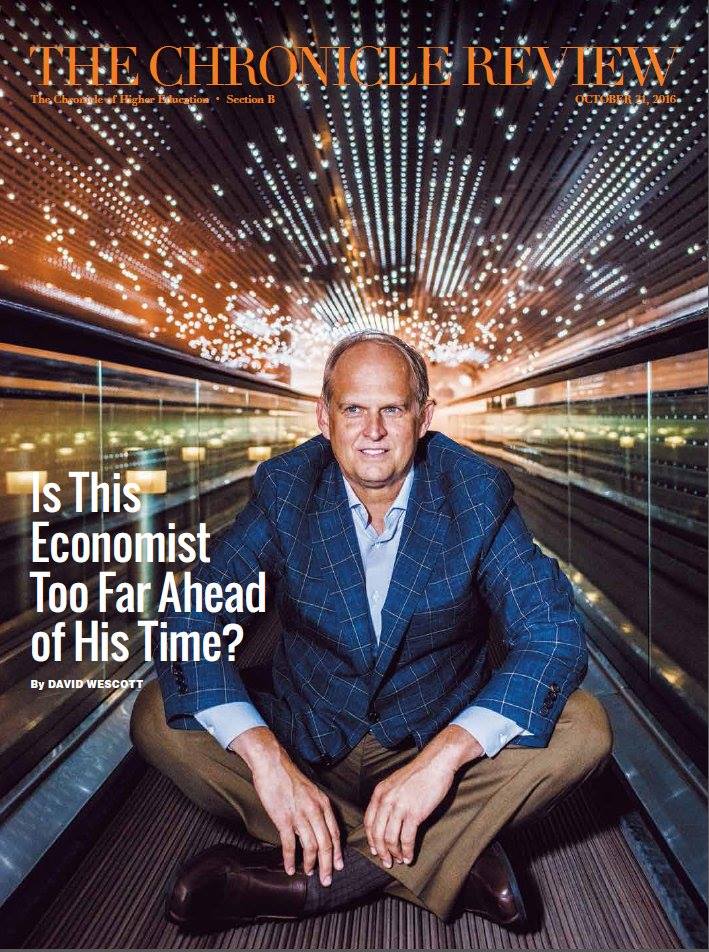
What should I ask Fuchsia Dunlop?
In case you have been living under a quiche shop, she has written the very best Chinese cookbooks ever, and her memoir is excellent too.
No, the public chat with Steven Pinker has not been held yet, but I will be recording with Fuchsia soon due to schedule constraints, so I am asking now for question suggestions. There is no public event, as it will be centered around a restaurant meal, with myself and an illustrious panel of interlocutors, including Ezra Klein and Mark Miller, founder of Santa Fe’s Coyote Cafe.
Here are my previous posts about Fuchsia Dunlop. And I can strongly recommend to you her very latest book Land of Fish and Rice, on the food in and near Shanghai, both recipes and text.
Here is her FT piece on gastro-nihilists and gastro-sexual tension. Here are her scrapbook excerpts. Here is a recent interview.

India’s biometric smartcards, a good sentence about them
Overall, our results suggest that investing in secure payments infrastructure can significantly enhance “state capacity” to implement welfare programs in developing countries.
That is from Muralidharan, Niehaus, and Sukhtankar in the latest American Economic Review. Their main result is this:
We find that, while incompletely implemented, the new system delivered a faster, more predictable, and less corrupt NREGS payments process without adversely affecting program access.
Most of all there is lower leakage of benefits, and program participants strongly prefer the biometric arrangements and the accompanying direct cash transfers. The measurements of this paper, by the way, are based on 19 million data points.
I believe the Indian biometric smartcard initiative remains under-discussed and underappreciated. It is actually one of the greatest achievements of contemporary times, based upon the innovative mobilization of the labor of millions in a manner that probably only India could do and that at first sounded quite ridiculous. Scan, record, and use the biometric information of over a billion people, and in a “backward” country at that. Well, they haven’t finished but it is well on track to succeed.
I do worry about the privacy implications of the technology and the data collection, but as it stands today so many Indians don’t have that much privacy in any case.
Here are ungated versions of the paper. Here is my earlier post on the paper and the technology. I had written:
One broader lesson here is that developing nations are not merely copying and applying the inventions of the West, but innovating on their own. But a lot of their innovations take labor-intensive rather than capital-intensive forms, and thus they do not always look like innovations to our sometimes ethnocentric eyes.
Still true.
The death of football, installment #1437
…the NFL is seeing its ratings tumble in the same way that the Olympics, awards shows and other live events have, falling more than 10 percent for the first five weeks of the season compared with the first five weeks of last season. A continued slide, executives say, could pose an even bigger danger: If football can’t survive the new age of TV, what can?
Football’s traditional TV audience “is never going to be what it was again,” said Brian Hughes, a senior vice president at Magna Global, which tracks audience and advertising trends.
The explosion of modern entertainment options, offered on more devices and at any time, has splintered American audiences and sped TV’s decline, Hughes said. “Sports seemed to be immune from it — it was live, the last bastion of broadcast television. But [the world] has caught up to it now.”
That is from Drew Harwell, and much of the decline seems to be coming from cord-cutting, audience fragmentation, and also the presence of a somewhat controversial election season, which has drawn some viewers (not me) to cable news.
Does Diversity Reduce Freedom or Growth?
The founding father of Singapore, Lee Kuan Yew, credits ‘social discipline’ for the phenomenal economic rise of his country (Sen, 1999). Countries such as Singapore apparently demonstrate that autocratic measures are probably necessary, particularly in culturally fractionalized societies for creating the social stability necessary for economic growth (Colletta et al., 2001). Such thinking informs the so-called “Asian model” (Diamond, 2008).1 Recent studies, particularly in economics, support the logic (Alesina et al., 2006 and Easterly et al., 2006). According to these scholars, the more congruent territorial borders are with nationality, the better the chances for good economic policy to appear endogenously from within these societies because social cohesion determines good institutions and policies for development (Banerjee et al., 2005 and Easterly, 2006b). This paper addresses the question of whether or not social diversity hampers the adoption of sound economic policies, including institutions that promote property rights and the rule of law. We also examine whether democracy conditions diversity’s effect on sound economic management, defined as economic freedom, because the index of economic freedom is strongly associated with higher growth and is endorsed by proponents of the ‘diversity deficit’ argument (Easterly, 2006a).2
…Using several measures of diversity, we find that higher levels of ethno-linguistic and cultural fractionalization are conditioned positively on higher economic growth by an index of economic freedom, which is often heralded as a good measure of sound economic management. High diversity in turn is associated with higher levels of economic freedom. We do not find any evidence to suggest that high diversity hampers change towards greater economic freedom and institutions supporting liberal policies.
Paper here. The data is a panel from 116 countries covering 1980–2012 so this doesn’t rule out a negative long-run effect but it is prima facie evidence that diversity need not reduce freedom or growth.
Sunday assorted links
1. Ursula Le Guin profile. And Bob Dylan as Richard Wagner.
2. Tom Sietsema on the Michelin picks for D.C.
3. Maria Konnikova reviews Tim Harford at NYT.
4. Inaction markets in everything, age of television college football edition.
5. David Warsh on the Laureates.
6. If you could get everyone to read one book, what would it be? I find most of the listed answers strange, and overly specific, and dependent on the readers already knowing plenty of other books. Surely your selection needs to be a bestseller if indeed by “everyone” you mean everyone. I find The Bible, Krishnamurti’s Think on These Things, or even Jonathan Livingston Seagull, or perhaps a book about the enjoyment of sex, to be more plausible picks. Which book would you recommend?
I guess I was traveling when Congress took the vote on this one
The Americans are providing targeting intelligence and refueling Saudi warplanes involved in bombing rebel positions. But coalition strikes have also destroyed hospitals, markets and residential neighborhoods, killing large numbers of civilians.
Last Saturday, airstrikes by the Saudi-led coalition killed more than 100 people at a funeral in Sana, shown above. More than 10,000 people have been killed in the war, according to the United Nations, and the threat to civilians has increased since the collapse of peace talks in August.
After the Houthi rebels launched two failed missile attacks at an American warship in the Red Sea, another American vessel destroyed three radar installations in Yemen.
I do not know what is correct American policy in this conflict, but is it so wrong to have wished to have seen a Congressional vote and thereby Congressional accountability? Now that the conflict has heated up, will this be happening anytime soon? Is anything stopping the President from requesting it? Didn’t my whole Twitter feed just decide they want a President who respects the Constitution and the rule of law?
Here is the full story (NYT), short but useful and informative in any case.
Saturday assorted links
4. Is the House really on the line?
5. Wallonia blocks EU-Canada trade deal.
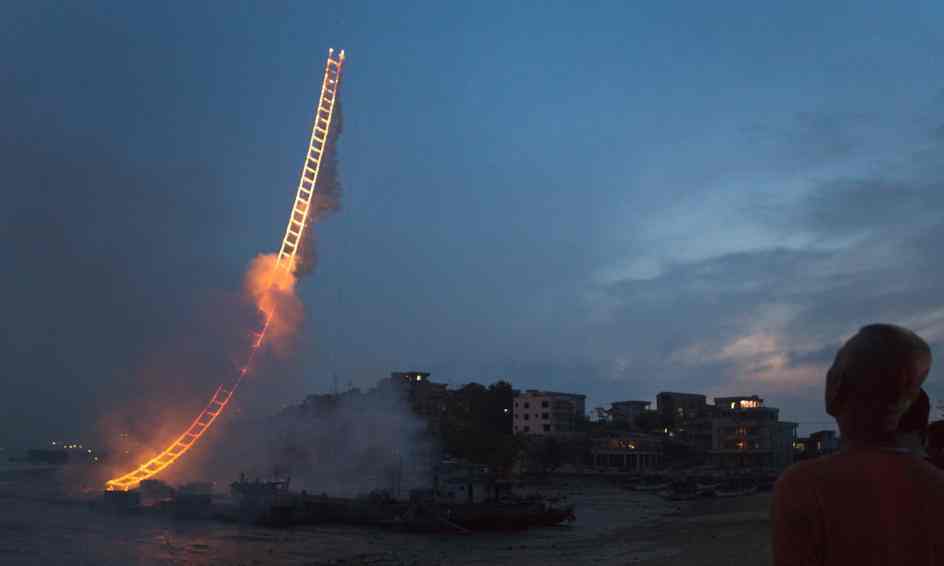
6. Sky Ladder is a splendid documentary, Netflix. It’s the story of Cai Guo-qiang, probably the world’s greatest active artist, and his quest to produce a truly amazing artistic display for his 100-year-old grandmother before she passes away. it is also one of the best movies about contemporary China, or for that matter art and politics.