Year: 2016
Is Indian fertility collapsing?
From Sanjeev Sanyal:
The TFR for rural areas stands at 2.5, but that for urban India is down at 1.8 — marginally below the readings for Britain and the US. An important implication of this is that India’s overall TFR will almost certainly fall below replacement as it rapidly urbanises over the next 20 years.
There continue to be wide variations in the fertility rates across the country. Readings for the southern states have been low for some time, but are now dropping sharply in many northern states.
Tamil Nadu has a TFR of 1.7 but so do Punjab, Himachal Pradesh and Delhi. Uttar Pradesh and Bihar continue to have the country’s highest TFR at 3.1 and 3.5 respectively, but these are also falling steadily.
Demise of the Bhadralok Interestingly, West Bengal has the lowest fertility in the country with a TFR reading of 1.6. The level for rural Bengal is 1.8 but is a shockingly low 1.2 for the cities. This is one of the lowest levels in the world and is at par with Singapore and South Korea.
Do read the whole thing. The net Indian TFR is about 2.3, which given gender imbalance and infant and child mortality is already about replacement rate.
How will talking bots affect us?
I have a short New Yorker piece on that question, here is one bit from it:
If Siri is sometimes sarcastic, could heavy users of the Siri of the future become a little more sarcastic, too?
For companies, there are risks associated with such widespread personification. For a time, consumers may be lulled by conversational products into increased intimacy and loyalty. But, later, they may feel especially betrayed by products they’ve come to think of as friends. Like politicians, who build up trust by acting like members of the family only to incur wrath when they are revealed to be careerist and self-interested, companies may find themselves on an emotional roller coaster. They’ll also have to deal with complicated subjects like politics. Recently, Tay, a chat bot from Microsoft, had to be disabled because it began issuing tweets with Nazi-like rhetoric. According to Elizabeth Dwoskin, in the Post, Cortana, another talking Microsoft bot, was carefully programmed not to express favoritism for either Hillary Clinton or Donald Trump. A product’s apparent intelligence makes it likable, but also offers more of an opportunity to offend.
Here is another:
And there are ways in which just knowing that bots exist will change us. If the bots are good enough, we won’t be able to distinguish them from actual people over e-mail or text; when you get an e-mail, you won’t necessarily be certain it’s from a human being. When your best friend writes that she’s also “looking forward to seeing you at the baseball game tonight,” you’ll smile—then wonder if she’s busy and has asked her e-mail bot to send appropriate replies. Once everyone realizes that there might not be a person on the other end, peremptory behavior online may become more common. We’ll likely learn to treat bots more like people. But, in the process, we may end up treating people more like bots.
Do read the whole thing.
What I’ve been reading
1. Tom Bissell, Apostle: Travels Among the Tombs of the Twelve. Fun, engaging, and informative, worthy of the “best of the year non-fiction” list.
2. China Miéville, Embassytown. The first of his novels that has clicked with me, perhaps because it is the one that comes closest to being a true novel of ideas, Heideggerian ideas in this case. A new prophecy is needed, and the nature of the new prophecy, like the old, will be shaped by language. Just accept that upon your first reading you won’t enjoy the first one hundred pages and you should at some point go back and read them again.
3. Yuri Herrara, Signs Preceding the End of the World. Sometimes considered Mexico’s greatest active writer, this novella draws upon the Juan Rulfo-Dante-Dia de los muertos tradition to create a convincing moral universe in 128 pages. I find this more vivid and arresting than Cormac McCarthy’s treatment of the other side of the border.
4. The Gene: An Intimate History, by Siddhartha Mukherjee. This book filled in a number of gaps in my knowledge, plus it is engaging to read. Overall it confirmed my impression of major advances in the science, but not matched by many medical products for general use.
The other books I read weren’t as good as these.
Wednesday assorted links
1. Are teaching evaluations biased against female instructors?
2. Ryan Avent has a book coming out in September.
3. Is this the worst debate I ever have read? No, but for a short while I thought it was.
4. It will receive more criticism when Trump does the same.
5. “Earlier this month, Ringling Bros. Circus retired all of their elephants.”
6. The China-Pakistan nexus and its strength.
7. Beckworth podcast with Selgin on monetary policy and the productivity norm.
Against Historic Preservation
Larry Summers asks:
How…could our society have regressed to the point where a bridge that could be built in less than a year one century ago takes five times as long to repair today?
As I wrote in Launching:
Our ancestors were bold and industrious–they built a significant portion of our energy and road infrastructure more than half a century ago. It would be almost impossible to build the system today. Unfortunately, we cannot rely on the infrastructure of our past to travel to our future.
Summers alludes to the regulatory thicket as a cause of the infrastructure slowdown but doesn’t have much to say about fixing the problem. Here’s a place to begin. Repeal all historic preservation laws. It’s one thing to require safety permits but no construction project should require a historic preservation permit. Here are three reasons:
First, it’s often the case that buildings of little historical worth are preserved by rules and regulations that are used as a pretext to slow competitors, maintain monopoly rents, and keep neighborhoods in a kind of aesthetic stasis that benefits a small number of people at the expense of many others.
Second, a confident nation builds so that future people may look back and marvel at their ancestor’s ingenuity and aesthetic vision. A nation in decline looks to the past in a vain attempt to “preserve” what was once great. Preservation is what you do to dead butterflies.
Ironically, if today’s rules for historical preservation had been in place in the past the buildings that some now want to preserve would never have been built at all. The opportunity cost of preservation is future greatness.
Third, repealing historic preservation laws does not mean ending historic preservation. There is a very simple way that truly great buildings can be preserved–they can be bought or their preservation rights paid for. The problem with historic preservation laws is not the goal but the methods. Historic preservation laws attempt to foist the cost of preservation on those who want to build (very much including builders of infrastructure such as the government). Attempting to foist costs on others, however, almost inevitably leads to a system full of lawyers, lobbying and rent seeking–and that leads to high transaction costs and delay. Richard Epstein advocated a compensation system for takings because takings violate ethics and constitutional law. But perhaps an even bigger virtue of a compensation system is that it’s quick. A building worth preserving is worth paying to preserve. A compensation system unites builders and those who want to preserve and thus allows for quick decisions about what will be preserved and what will not.
Some people will object that repealing historic preservation laws will lead to some lovely buildings being destroyed. Of course, it will. There is no point pretending otherwise. It will also lead to some lovely buildings being created. More generally, however, the logic of regulatory thickets tells us that we cannot have everything. As I argued in Launching:
There are good regulations and bad regulations and lots of debate over which is which. From an innovation perspective, however, this debate misses a key point. Let’s assume that all regulations are good. The problem is that even if each regulation is good, the net effect of all the regulations combined may be bad. A single pebble in a big stream doesn’t do much, but throw enough pebbles and the stream of innovation is dammed.
It’s time to blow the dam. Creative destruction requires some destruction.
Uruguay fact of the day
Person with a median income in Uruguay is better-off than 73% of the world population.
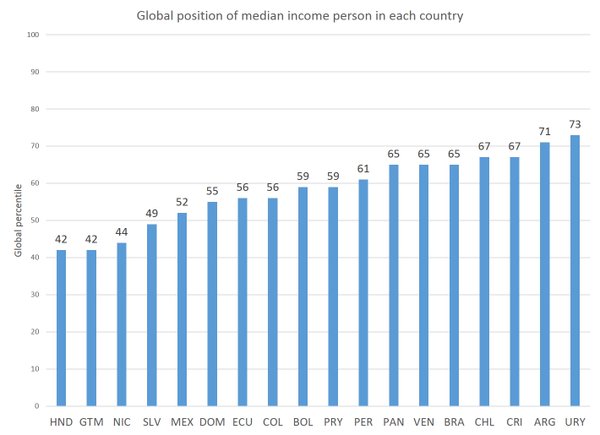
That is from Branko Milanovic.
My worries about Singapore
Singapore is a well-run place by world standards, and has perhaps the world’s highest quality bureaucracy, yet right now the country faces a somewhat menacing constellation of silent risks, none of their own making:
1. It is possible that the role of the United States in the Pacific Ocean is rewritten rather suddenly. This could come about through either a Trump presidency, or a successful Chinese attempt to grab more in the South China Sea. Can you imagine a Singapore that had to court Japan and India rather than relying on the United States for protection? In this same world Japan is probably more militarized than in the status quo, and possibly even a nuclear power.
2. Singapore sovereign wealth funds and related institutions have been pulling in high returns since the 1970s. Yet the opportunities in both China and Singapore’s own real estate just aren’t there any more. They would be very lucky to pull in four percent a year looking forward. While fiscal risk is minimal, this will crimp expansion plans, especially if Singapore ends up needing to spend more on national defense.
3. It seems increasing pressure is being brought to bear on the Chinese currency yet again. China would like to lower rates to stimulate its economy, and the Fed is likely to raise rates at least once more this year. There is surely a chance that the renminbi simply snaps due to capital outflow. During the Asian currency crisis, the Singaporean dollar fell about twenty percent as a side effect of the turmoil elsewhere. Yet now China is much bigger than South Korea + Thailand + Indonesia were in 1997. Furthermore Singapore is much more of a financial and clearinghouse center. How insulated is Singapore from this China risk? Does anybody know? To what extent might a flow of capital into Singapore mitigate some of this risk?
4. Climate change could well lead to rising water levels for island nation Singapore. Investing in sea walls and other forms of protection could take what percent of gdp? The Dutch are already putting 0.5% of gdp a year into a fund for future water defense.
From this list, #2 and #4 are more likely problems, whereas #1 and #3 are more speculative, but by no means in the realm of science fiction. There is the possibility of a perfect storm from all four.
And yet think of how things must have looked in 1965. The Vietnam War was going badly, and most of the trends in Southeast Asia were negative. Chinese Communism was at its nadir with the Cultural Revolution. Indonesia had just massacred 500,000 citizens, many of them Chinese. Singapore itself had just been kicked out of Malaysia, an outcome which its key founders mostly opposed. There was not yet evidence that what later became “the Singapore model” was going to work, and even Japan was not yet an evident success. It was commonly believed that Singapore, Malaysia, or both might collapse into a kind of ethnic civil war. British military expenditures were about 20% of Singapore’s gdp, and it was widely understood that source of income would be going away. Somehow they managed, most of all with the aid of human capital and being in the right place at the right time.
Here is the Singapore Complaints Choir, one of my favorite music videos.
In any case, I am happy to be here once again. For dining, I recommend Sinar Pagi Nasi Padang, at Geylang Serai hawker centre, get the beef rendang. National Kitchen, in the new National Gallery is also very good for a more traditional kind of dining.
Do witchcraft beliefs hurt economic progress?
Maybe so, here is the latest:
Where witchcraft beliefs are widespread, American University Economics Professor Boris Gershman found high levels of mistrust exist among people. Gershman also found a negative relationship between witchcraft beliefs and other metrics of social capital relied upon for a functioning society, including religious participation and charitable giving.
It’s long been argued that witchcraft beliefs impede economic progress and disrupt social relations, and Gershman’s statistical analysis supports that theory. From a policy perspective, Gershman’s results emphasize the importance of accounting for local culture when undertaking development projects, especially those that require communal effort and cooperation. Gershman and other social scientists believe that education can help foster improved trust and decrease the prevalence of witchcraft beliefs.
Furthermore:
Parents in witchcraft-believing societies inculcate antisocial traits in children.
Second-generation immigrants from witchcraft-believing nations are less trusting.
Here is the summary statement, here is the full article. Here are related papers by Gershman. For the pointer I thank the excellent Samir Varma.
Tuesday assorted links
1. Xenoglossy.
3. How to lose thirty calories a meal in Thailand just by changing your plate (speculative).
4. “Their primary difficulty is not necessarily one of healing emotional wounds; they thrived in combat. It is rather a matter of unlearning the very skills that have kept them alive: unceasing vigilance; snap decision making; intolerance for carelessness; the urge to act fast and decisively. “I don’t even leave my house much,” said Jeff Ewert, who served with the Marines in Iraq and now lives in Utah. “I’m scared not because I’m an über-killer or anything. I just minimize my exposure because I know how easy it is to cross that line, to act without thinking.”” Story here, NYT.
Ride sharing, vehicle accidents, and crime
That is a new paper from Sean E. Mulholland and Angela K. Dills. Here is the abstract:
The advent of smart-phone based, ride-sharing applications has revolutionized the vehicle for hire market. Advocates point to the ease of use and lower wait times compared to hailing a taxi or pre-arranging limousine service. Others argue that proper government oversight is necessary to protect ride-share passengers from driver error or vehicle part failure and violence from unlicensed strangers. Using a unique panel of over 150 cities and counties from 2010 through 2013, we investigate whether the introduction of the ride-sharing service, Uber, is associated with changes in vehicle accidents and crime. We find that Uber’s entry lowers the rate of DUIs and fatal accidents. For most specifications, we also find declines in arrests for assault and disorderly conduct. Conversely, we observe an increase in vehicle thefts.
For the pointer I thank the excellent Kevin Lewis.
How well does the post-recession world scale?
The bumps we’ve seen over the past 12-18 months stem from a reality that the post-recession world we’ve built doesn’t scale beyond its current size. Consider the following:
-Chipotle wanted to be this era’s McDonald’s. Turns out scaling organic, freshly-prepared food isn’t as cheap or easy as they thought.
-Fintech lenders promised to disrupt big banks. Turns out the lending business requires a lot of capital, and that in jittery markets that capital doesn’t like funding a growing lending business. Maybe the big bank model isn’t so bad.
-The San Francisco Bay Area is the economic center of the early 21st century. But it’s finding that scaling housing and infrastructure for workers is a lot harder than scaling servers and storage. So jobs and people have to move to cheaper metros.
-On demand startups were the solution to mass unemployment and megacity renters who demand services immediately. But they’re finding that as the labor market tightens those workers are getting harder to find, and maybe the unit economics never worked to begin with.
-Tesla wants to disrupt the auto industry. But it’s never produced more than 50,000 cars in a year, and suddenly has to meet demand for as many as 500,000 cars a year. That won’t be cheap or easy, and it’s unclear how much shareholders and lenders will be willing to finance that growth. It’s not as cheap to scale atoms as it is to scale bits.
-Uber and Facebook are the 800-pound gorillas in their respective industries. But as they grow, they’re running into problems of scale. For Uber, it’s finding drivers and fighting regulation. For Facebook, it’s eating too much of the revenue pie for content, and maybe as it grows it’s going to come under greater and greater scrutiny given its media clout. Both will argue they’re not utilities, but the vision and scale they aspire to would make them exactly that.
-Conservatism is finding that the demographic groups that believe in conservatism no longer scale to form a viable national party. Trump will soon find the same to be true for his white working class coalition. The Republican Party needs a new ideology or constituency that can scale to compete with Democrats.
It’s time to let Steve Jobs and Ronald Reagan rest in peace, and find new leaders who can build the world of the 2020′s.
Coloring book markets in everything
There are coloring books for every imaginable interest group, including “Game of Thrones” and “Harry Potter” ones, Hillary Clinton and Donald J. Trump versions, and, in a new and surprisingly durable trend, “sweary” coloring books. Because how better to demonstrate that your coloring book is not for kids than by incorporating lots of four-letter words?
Here is the Alexandra Alter NYT piece, I have yet to see a good essay on the broader implications or causes of the coloring book trend.
New issue of Econ Journal Watch
In this issue (.pdf):
Symposium:
My Understanding of Adam Smith’s Impartial Spectator
The mysterious impartial spectator is addressed by leading Smith scholars: What is the impartial spectator, in Smith’s highest sense of that expression? Does the impartial spectator have knowledge that is super-human? Is it universal? How does the impartial spectator relate to “the man within the breast”? To the being whose hand is invisible? To God?
Contributions:
- The symposium Prologue
- Vivienne Brown
- María Alejandra Carrasco and Christel Fricke
- Douglas Den Uyl
- Samuel Fleischacker
- Michael Frazer
- Jimena Hurtado
- John McHugh
- Paul Mueller
- Maria Pia Paganelli
- Craig Smith
- Vernon Smith
- Robert Urquhart
- Jack Weinstein
Other articles:
CIA Interventions, Tariff Changes, and Trade During the Cold War: Bruno Ćorić tests the robustness of results of an American Economic Review article, using a different data set, and finds that increases in imports from the United States can be explained by changes in tariffs that are unrelated to CIA interventions.
Follow-up on the left orientation of industrial relations:Bruce Kaufman reflects on Mitchell Langbert’s January 2016 article, and Langbert replies.
On the perfect ploy against free enterprise: Friedrich Hayek’s classic essay The Meaning of Competition.
EJW Audio
Samuel Fleischacker on Adam Smith’s Impartial Spectator
Pavel Kuchař on Liberalism in Mexico
Again, here is the general link to the issue.
Monday assorted links
1. Yang Jiang has passed away at 104 (NYT).
2. Is there a mini-literary boom in Singapore?
3. Sewer robots, some are named Luigi.
4. Ten most cited law faculty in the United States, 2010-2014. Number one is Cass Sunstein, number four is Eric Posner, who seems to be pulling a Stephen Curry on us.
5. A controversy about overlooked citations which I cannot get excited about. And good interview with a DC used book store owner.
Mexico body ratio fact of the day
In many forms of combat between armed groups, about four people are injured for each person killed, according to an assessment of wars since the late 1970s by the International Committee of the Red Cross. Sometimes, the number of wounded is even higher.
But the body count in Mexico is reversed. The Mexican Army kills eight enemies for every one it wounds.
For the nation’s elite marine forces, the discrepancy is even more pronounced: The data they provide says they kill roughly 30 combatants for each one they injure.
The government stopped reporting such figures in 2014 — model this!